

Product Search API vs. Product Data API: What's the Difference?
The terminology around ecommerce APIs creates unnecessary confusion. A product search API retrieves real-time results from a single query, while a product data API provides access to structured, aggregated datasets for analysis at scale.
- Search APIs work like a storefront lookup: you ask a question, you get an immediate answer.
- Data APIs function like a warehouse: you access comprehensive records for deeper analysis.
- The right choice depends on whether you need instant answers or analytical depth.
- Choosing incorrectly leads to overspending, integration headaches, and workflows that break under pressure.
If your use case involves competitive intelligence, pricing analysis, or catalog enrichment across thousands of SKUs, a data-first approach will serve you better than cobbling together search queries.
Anyone who has evaluated ecommerce APIs knows the naming problem. Vendors use "search" and "data" interchangeably, product pages blur the lines between features, and documentation assumes you already know what you need. The result is wasted time testing solutions that were never designed for your actual workflow.
The architecture behind these two API types differs. Pick the wrong one, and you pay for capabilities you don't need or discover the limitations only after you have built the integration. Global ecommerce sales are projected to reach $6.88 trillion in 2026, and the teams capitalizing on that growth have reliable access to product intelligence. Understanding the distinction between a product search API and a product data API is the first step toward building systems that scale with your ambitions.
What Defines a Product Search API in Ecommerce?
A product search API is designed for real-time, query-based retrieval. You send a request with specific parameters, and the API returns matching results from a live index or external source. You ask a question and get an immediate, narrowly scoped answer.
How Search APIs Operate
These APIs typically connect to a single data source or scrape information on demand. When you query for "wireless headphones under $100," the API searches its index or fetches current listings from a target site, then returns whatever matches your criteria at that moment.
The strength here is immediacy. You get current pricing, availability, and product details as they exist right now. The limitation is scope. Each request returns a finite result set, and building comprehensive datasets means executing hundreds or thousands of individual queries.
Many search APIs also run on an indexed layer, so results can lag the underlying source by minutes or hours. That tradeoff is fine for discovery, but it makes search a poor fit for anything that depends on a complete, point-in-time picture of a category.
Common Applications for Search-Based APIs
Search APIs excel where you need specific, time-sensitive information. A customer-facing app that shows competitor prices next to your own listings benefits from real-time search. So does a tool that checks whether a particular SKU is in stock at a specific retailer.
Developers building comparison widgets, price alert systems, or availability checkers often start with a search API because the use case demands fresh data per query. The tradeoff is that scaling beyond a handful of products gets expensive and technically complex.
What Defines a Product Data API for Ecommerce?
A product data API provides access to structured, pre-aggregated datasets rather than running searches on demand. Instead of asking questions one at a time, you query against a comprehensive database of millions of product records already normalized and ready for analysis.
How Data APIs Operate
These APIs connect you to a maintained repository of product information collected from thousands of sources. The data has already been crawled, deduplicated, and organized into consistent schemas. When you request records matching your criteria, you receive structured data that includes history, pricing trends, and attributes across many merchants.
The architecture prioritizes depth and breadth over real-time freshness. A data API might refresh its records daily or weekly rather than instantly, but it compensates with coverage that no single-source search tool can match.
Common Applications for Data-Centric APIs
Analysts running competitive pricing research across entire categories rely on aggregated data. So do teams building catalog-enrichment pipelines that fill gaps in descriptions, images, and specifications. Market researchers tracking pricing over time need historical depth, and a pricing feeds API delivers it without forcing them to collect and store snapshots themselves.
An ecommerce product API built around aggregated data also supports use cases like assortment planning, where buyers need to understand what exists in a category before deciding what to stock. The emphasis is analytical, not transactional.
What Are the Key Differences Between Search and Data Approaches?
The distinction goes deeper than how you phrase a query. Architecture, pricing, and integration complexity all differ.
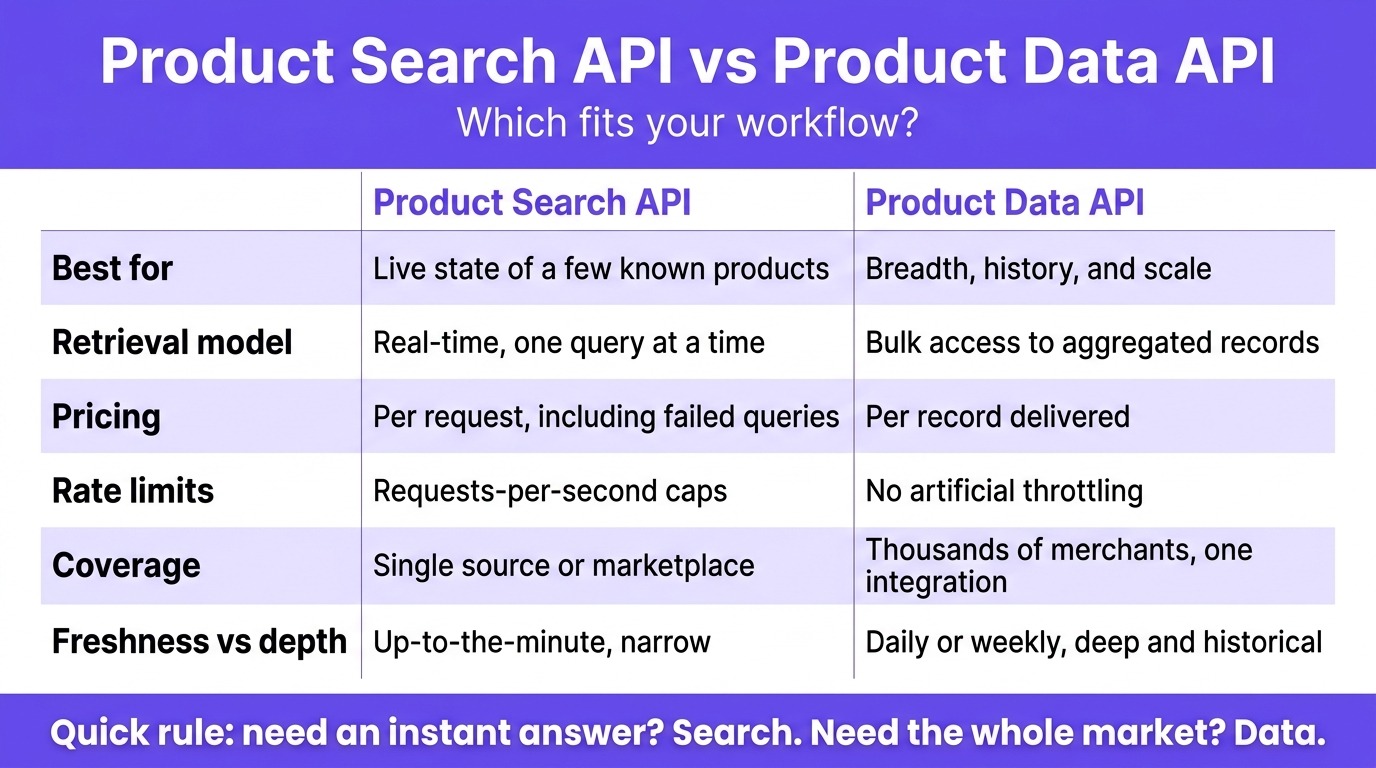
Search APIs use a request-response model where each query consumes resources and returns a limited result set. You pay for the act of searching, whether or not the results contain what you need. Data APIs use a record-delivery model where you pay for the data you actually receive. That difference compounds at scale.
Rate limiting is another divergence. Search APIs frequently impose requests-per-second caps to manage server load, which forces developers to build throttling logic and retry handling into their applications. APIs designed for bulk access typically skip these artificial constraints, so you can pull large datasets without engineering around limits.
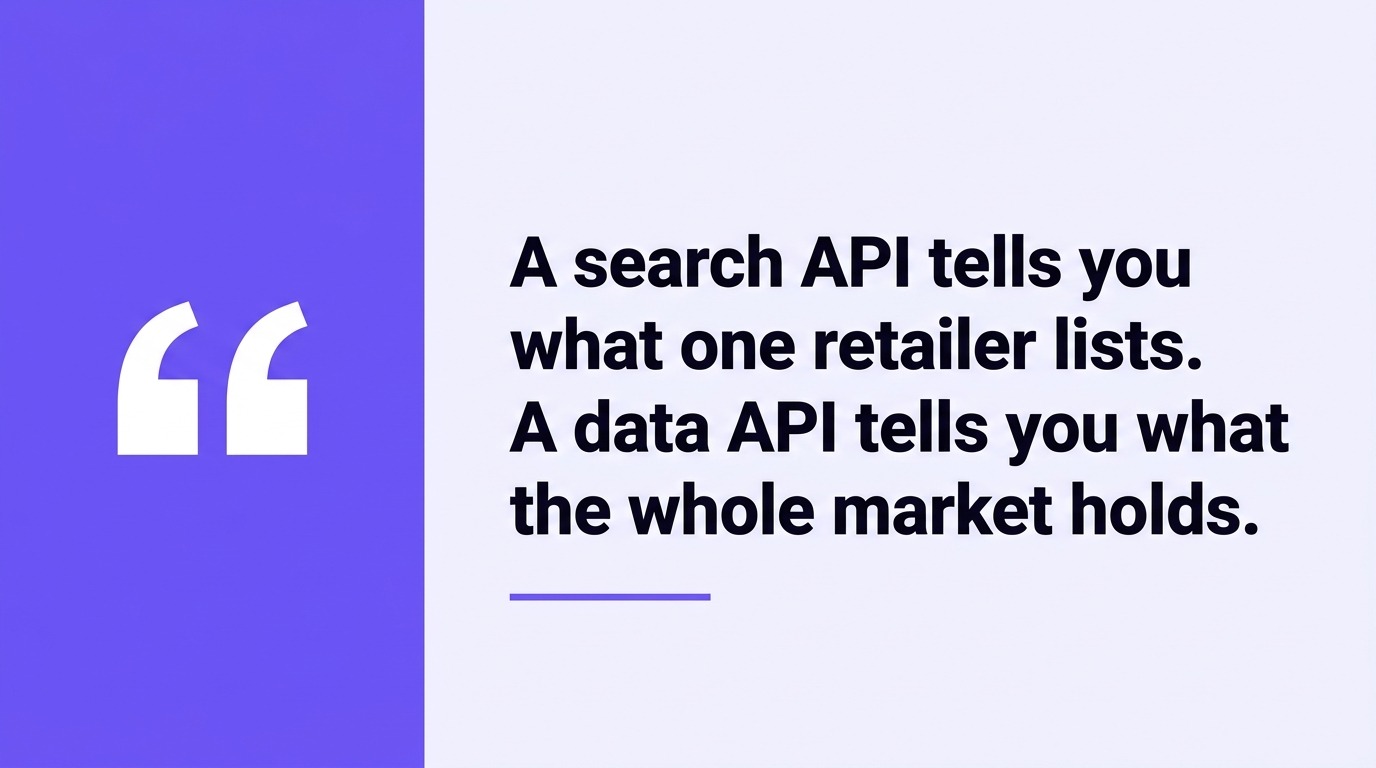
Coverage separates the two as well. A product search API connected to a single marketplace gives you depth within that ecosystem but nothing beyond it. A data API aggregating thousands of merchants gives you breadth that supports cross-market analysis. The first answers, "What does this one marketplace have?" The second answers, "What exists across the entire market?"
Five Questions to Determine Which API Type You Need
- Do you need real-time pricing accurate to the minute, or is a daily refresh sufficient?
- Are you querying for specific products you already know about or exploring categories to discover what exists?
- Will your application run occasional lookups or process thousands of records in batch?
- Do you need data from one marketplace or competitive intelligence across many retailers?
- Is your primary output a customer-facing feature or an internal analytical report?
If your answers lean toward the second option in each pair, the data approach fits your needs better than a search-based solution.
A Simple Decision Framework
If you still aren't sure, the logic comes down to a few clear conditions. Choose a search API when your application needs the live state of a small, known set of products: a checkout price match, a stock check on a specific SKU, or a customer-facing widget where minute-by-minute accuracy is the whole point.
Choose the data approach when you need breadth, history, or scale: pricing analysis across a full category, catalog enrichment for tens of thousands of listings, or any pipeline that processes records in bulk. If your project starts in the first camp but you can see it drifting toward the second, build on the data model now before re-architecting becomes expensive.
How Does AI Commerce Change the Product Search API Decision?
Shoppers increasingly research through AI assistants, augmented reality try-ons, and marketplace comparisons before they buy, and the path to purchase has grown far less linear. Among shoppers who use AI tools for buying decisions, most lean on them for product research, which puts new pressure on the breadth and quality of the data behind every answer.

When you weigh search against a data-first approach, AI systems are only as good as the structured records feeding them.
An AI shopping assistant can't reason over a handful of live results from a single source. It needs normalized records with consistent identifiers, complete attributes, and pricing across many merchants so it can match products, compare options, and explain tradeoffs. Aggregated, structured records power product search and catalog automation in a way that on-demand search cannot. The matching logic needs the whole picture in a stable format rather than assembled query by query.
When your output is an AI answer or a market-wide analysis, coverage stops being optional. A single-source tool can tell you what one retailer lists, but not whether that price is competitive or what the category looks like as a whole. Full national coverage across thousands of merchants closes that gap with one integration instead of a patchwork of single-source connections.
Real-World Ecommerce Scenarios
Abstract definitions only go so far. Here is how these API types perform in practice.
Scenario: Competitive Price Monitoring
A consumer electronics retailer wants to track competitor pricing across 5,000 SKUs. With a search-based approach, that means 5,000 individual queries per cycle. At four cycles a day, you are running 20,000 daily requests. Most search APIs charge per request, and rate limits force the system to spread those queries across hours rather than minutes.
A data API handles this scenario differently. The retailer pulls a filtered dataset of all relevant SKUs in a single operation, with pricing history already included, so trend analysis needs no extra queries. Cost scales with records retrieved, not queries attempted, so failed or empty searches never burn budget.
Scenario: Catalog Enrichment
A marketplace operator needs to fill missing attributes across 50,000 listings. Descriptions, specs, and images are incomplete, and manual research is not feasible. A search approach means querying each product individually, parsing unstructured results, and hoping the sources carry the needed fields.
A product data API built for enrichment workflows returns normalized records with consistent schemas instead. The operator queries for products matching the catalog, receives structured data with all available fields included, and maps attributes directly to the listings. No per-field upcharges, and no inconsistent formatting between sources.
Scenario: Market Trend Analysis
An analyst needs to understand pricing dynamics in the outdoor furniture category over the past 12 months. Search tools return the current state only. Historical analysis would require running daily queries for the entire period and storing the results independently.
A pricing feeds API with historical data solves this problem immediately. The analyst requests records by date range, receives pricing snapshots over time, and builds trend models without standing up a collection pipeline. For recurring work, a pricing feeds API turns what used to be a months-long data-gathering effort into a single query.
What to Evaluate When Choosing an Ecommerce Product API
Technical fit matters more than marketing language. These criteria separate a useful ecommerce product API from a frustrating one, and they make a good lens when you compare product data providers side by side.
Pricing transparency should be your first filter. Per-request pricing charges you for failed queries. You pay whether or not the search returns anything useful. Per-record pricing aligns cost with value, so you only pay for data you actually receive, which keeps budgets predictable. Be wary of vendors who make per-request models sound reasonable by citing low unit costs. At scale, those costs compound into a runaway bill.
Throughput constraints decide whether your integration survives production. Strict rate limiting forces you to build queues, implement exponential backoff, and accept that time-sensitive workflows will bottleneck. APIs without artificial throttling let you pull data at the speed your application requires. If a vendor highlights their "generous" rate limits, ask why limits exist at all.
Field access policies reveal hidden costs. Some vendors advertise low base prices, then charge premiums for attributes like historical pricing, reviews, or merchant data. Others include every available field at no extra cost, which lets your team design against a stable schema. Clear, public documentation helps too, since you can confirm what a record contains before writing integration code.
Coverage and freshness should match your use case. For a customer-facing price comparison tool, freshness beats historical depth. For strategic planning, coverage and history beat minute-by-minute updates. Be skeptical of vendors who claim both without explaining the tradeoff, and use a visual portal to explore the available data before you commit to an integration.
Frequently Asked Questions
Can I use a search API for bulk data collection? Technically yes, but it means thousands of individual queries, managing rate limits, and a higher cost per record. A data API is purpose-built for bulk access and removes those friction points.
How often is aggregated product data updated? It varies by provider. Some refresh daily, others weekly. For most analytical use cases, daily updates are accurate enough. Real-time applications like checkout price matching may still call for a search-based supplement.
What fields are typically included in an aggregated product dataset? Comprehensive providers include names, descriptions, brands, categories, current and historical pricing, merchant information, availability, images, specifications, and reviews. Confirm your provider includes all fields without premium tiers or add-on charges.
Is a search API ever the better choice? Yes, for applications that need real-time accuracy on a limited product set. Price alert tools, availability checkers, and customer-facing comparison features all benefit from that immediacy. The key is matching the tool to the use case rather than forcing one approach to serve every need.
How do AI shopping tools change which API I should use? AI assistants and recommendation engines need broad, structured, multi-merchant records to compare products and explain options, which favors a data-first approach. A search API can still feed live details for a known item, but the underlying intelligence almost always depends on aggregated data.
Why Data-First Approaches Scale Better
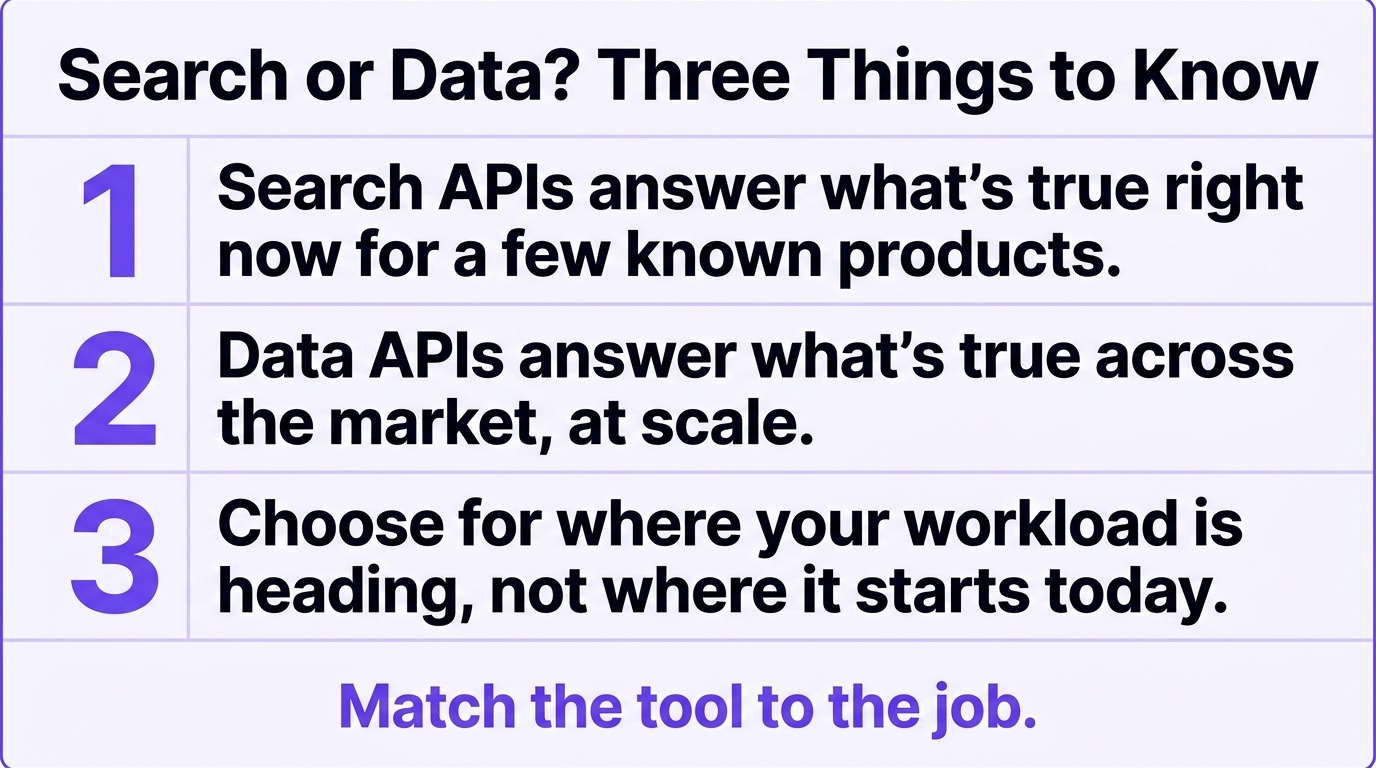
Most ecommerce data projects move from simple to complex. Monitoring a few competitors becomes category-wide analysis. Enriching one product line becomes maintaining a full catalog. Teams that start with search APIs often end up re-architecting once query volumes and costs become unsustainable.
Building on a data API from the start avoids that rework. Bulk access, historical records, and consistent schemas support workflows that grow with your business instead of constraining it. As AI-driven discovery becomes the norm, the teams with the broadest, cleanest data are the ones whose tools can actually answer the questions buyers are asking.
Datafiniti offers a product data API with over 560 million records, credit-based pricing tied to records delivered, and no rate limiting or per-field upcharges. If your use case demands analytical depth and predictable scaling, request a demo to see whether it fits your requirements.
Read the latest articles

Read more

Build vs Buy: Business Data Enrichment for Growing Teams

Company Data API Pricing: Bulk & Enterprise-Scale Access

Best Business Data APIs for Sales Teams & Prospecting

Business Data API: Company Data at Enterprise Scale

How to Build a Product Database With a Product Data API

Property Data API Coverage: What U.S. Datasets Include

Product Data API for Ecommerce Price Monitoring and Repricing

Real-Time Product Data API for Product-Led Growth Teams

Property Ownership Data API for Skip Tracing and Lead Gen

How APIs Make Building a Product Database Easy
Learn how to build a product database with APIs for cleaner imports, updates, search, and scalable product data.

How to Leverage Competitor Pricing Data with an API
Use competitor pricing data to build API-driven monitoring, analysis, and smarter pricing decisions.

Price Monitoring API: The Key to E-Commerce Pricing Strategy
Use a price monitoring API to track market changes, improve pricing decisions, and protect ecommerce margins.

How do Product Data APIs Work for E-Commerce Companies?
Learn how a product data API works, from collection and queries to ecommerce integration and use cases.

GTIN Lookup API: Search Products by Barcode & UPC at Scale

Best Real Estate API 2026: Coverage, Pricing, Data Quality

Best Product Data API 2026: A State-of-the-Market Guide

Product Data API Integration Patterns for Ecommerce Platforms

Build a PropTech MVP With a Property Ownership Data API

3 Benefits of Web Scraping for Real Estate
Boost your research by using web scraping for real estate to gain market insights, automate lead lists, and minimize property risk.

How Real Estate Agents Can Leverage Proptech Data
Leverage proptech data to source leads, speed up valuations, and manage risk with accurate, real-time property insights.

What Is a UPC Lookup API?
Learn about the UPC lookup API, how it works, and its benefits for businesses. Get product data easily.

What Is a GTIN Lookup API?
Learn about the GTIN lookup API and how it can help your business grow. Get product data insights.

How Does a Property Data API Work?
Learn how a property data API works, its features, and how you can use it for real estate and business insights.

What The Best Real Estate APIs Should Have
Discover what makes the best real estate APIs stand out. Learn about essential features for your property data needs.
How to Access MLS Listing Data
Learn how to access MLS listing data using an MLS data API. Discover Datafiniti's solutions and integration tips.
.png)
How to Enrich Your Product Catalog With a Real-Time API
.jpeg)
Product Data API Buyer's Guide for Ecommerce Teams

Do I Need a Real Estate Listing API?
Explore the benefits and technicalities of a real estate listing API. Learn how to choose the right provider and integrate data for business growth.

Why Real Estate Tech Startups Need Property APIs with Ownership Details
Discover how property APIs with ownership details empower real estate tech startups. Learn about data integration, risk mitigation, and driving business value.
The Value of a Product Catalog Sync for Product Managers
Unlock the value of product catalog sync for product managers. Streamline data, improve decisions, and reduce costs with real-time insights.

What is a Product Data Webhook?
Learn about product data webhooks, their components, and how they enable real-time updates for business intelligence and workflow automation.

Why Is a Product Data API Integration Essential for Analysts & Product Managers?
Unlock insights with product data API integration. Essential for analysts & product managers to streamline data access & enhance product strategy.

What Is a Product Data API and Its Benefits
Learn about product data APIs, their benefits, and how they drive business growth. Explore integration and advanced use cases.

What Do eCommerce Data Vendors Do?
Learn what ecommerce data vendors do, their services, and how to choose the right one for your business growth.

How to Compare Product Data Providers: What to Look For
Compare product data providers. Learn what to look for in data quality, structure, and integration features.

How to Get Your Product Data in Real-Time Using APIs
Learn how to leverage real-time product data APIs for e-commerce, competitive analysis, and AI. Get instant access to clean, structured product data.

Best Product Data API: Features to Look for
Find the best product data API with real-time updates, comprehensive coverage, and a user-friendly portal. Explore features to look for.

Unlocking Property Data with an API
Access property data with a powerful property database API. Explore listings, market analysis, investment opportunities, and more. Get started today!

Unlocking CRE with APIs
Unlock commercial real estate insights with a powerful API. Access property data, streamline workflows, and enhance investment strategies.

How to Get a Real-Time Product Feed Using an API
Learn how to get a real-time product feed using an API. Access, leverage, and ensure accuracy of product data for your business needs.

Spying on Competitor Prices: What You Need to Know
Learn how to gather and analyze competitor pricing data to inform your business strategy. Understand key components and ethical considerations.

Product Data Enrichment: What Are You Missing?
Enhance your product data with comprehensive enrichment. Discover insights, drive growth, and choose the right approach for your business.
.png)
IDX vs MLS API: A Developer's Guide to Real Estate Listing Data
.png)
Real Estate API Pricing Models Explained: Subscription vs. Usage-Based

Real Estate API vs Web Scraping: The Buy-vs-Build Decision
.png)
Product Data APIs Explained: Powering Product Search and Catalog Automation

How to Get the Most out of a Product Catalog API
Learn how to leverage a product catalog API for business growth. Discover data quality, access methods, and strategy for your product catalog API.

Taming Your Ecommerce Product Data Feed
Optimize your ecommerce product data feed for growth. Learn strategies, leverage technology, and ensure data quality for better customer experience and AI initiatives.

Streamlining Your Product Search with an API
Explore the benefits and integration of a product search API. Streamline your product discovery and leverage data for business growth.
.png)
What Is a Real Estate Transaction Database? A Complete Guide

How Real Estate Platforms Access MLS Database APIs
.png)
Commercial Real Estate API vs. Residential Property API
.png)
How to Choose a Real Estate Database API for Your MVP
MLS API vs. IDX: What's the Diff?
MLS API vs IDX: Explore the differences in real estate data access, retrieval, and integration. Understand which solution fits your needs.

Scraping vs. APIs: Getting Real Estate Data
Compare web scraping vs real estate API for data acquisition. Learn the pros, cons, and best use cases for each method.

Property Valuation API: Your Go-To Real Estate Tool
Leverage the property valuation API for real estate insights. Access comprehensive property data for diverse applications with Datafiniti.

Product Data APIs Explained
Learn about product data APIs explained. Discover how to access, integrate, and utilize product data for e-commerce, analytics, and more.

Unlocking Your Ecommerce Data with APIs
Unlock ecommerce data with APIs for business insights, product catalog enrichment, and competitive analysis. Explore data via portal or API.

Real Estate Ownership Data: How to Access, Analyze and Use at Scale
Access, analyze, and use real estate ownership data at scale. Learn how to find, process, and leverage this crucial information for business insights.
IDX vs MLS API: What Every Real Estate Professional Should Know
Understand IDX vs MLS API differences. Learn about data access, integration, and how Datafiniti's solutions empower real estate professionals.

How a Property Database API Can Help Real Estate Pros
Learn how a property database API can help real estate pros analyze trends, monitor listings, and optimize strategies. Get data insights.

What Is a Residential Property API?
Explore what a residential property API is, its features, benefits, and real-world applications for real estate professionals and investors.

What Is a Commercial Real Estate API?
Explore commercial real estate API functionality, data integration, and use cases. Learn how to leverage property, business, and people data for insights.

Understanding MVP Data Integration
Learn about MVP data integration, its components, benefits, and strategies for accessing and utilizing data resources effectively.

How to Choose the Best Property Data API
Learn how to choose the best property data API. Explore features, providers, pricing, and integration for real estate insights.

Real Estate Database API: What to Look for
Explore real estate database API options. Learn about data quality, features, and how to choose the right provider for your needs.

How Do Product Data APIs Work?
Understand how a product data API works, its key features, integration methods, and applications for e-commerce and business intelligence.

How Do Data Aggregation Platforms Work?
Explore how data aggregation platforms work, their capabilities, and applications. Learn to choose and implement the right platform for your business intelligence needs.

Why Do Companies Need Property Data Aggregation?
Discover why property data aggregation is crucial for businesses. Streamline access, empower functions, enhance risk management, and drive strategic decisions with authoritative insights.

MLS Database API: How to Choose a Provider and Get Access
Product Search API vs. Product Data API: What's the Difference?

What Is a Product Data API?
Explore the functionality and benefits of a product data API. Learn how to integrate, leverage, and choose the right provider for your business insights.
What Is the Difference Between Product Search API and Product Data API?
Understand the difference between Product Search API and Product Data API. Learn how to leverage product data for business intelligence and analytics.

What Is a Property Data API?
Explore the capabilities of a property data API. Understand its core functionality, key features for developers, and how to access property information at scale for business insights.
.png)
Real Estate API Pricing: What You Need to Know Before You Build
.jpeg)
How to Choose a Property Market API for Investment Platforms
Choosing the right property market API is critical for investment platforms. Learn how to evaluate data depth, coverage, freshness, and integration quality before you commit.
Data you can trust, delivered in a format your systems can use, at the scale your product requires.