
.png)
Real Estate API Pricing: What You Need to Know Before You Build
Key Takeaways
Real estate API pricing is the structure a data provider uses to bill for programmatic access to property records, and choosing the wrong model can quietly inflate your engineering budget well beyond the sticker price.
- Pricing models split into four shapes: pay-per-request, subscription tiers, usage-based per-record billing, and enterprise contracts.
- Per-record billing charges only for data actually delivered, while per-request models bill every query, including the ones that return nothing useful.
- Hidden costs like field-level upcharges, regional add-ons, overage penalties, and integration time often exceed the headline price.
- Run total cost of ownership across multiple usage scenarios before you sign anything.
Evaluate any real estate API pricing model against your projected three-year usage curve, not your launch-week query count.
Real estate API pricing is the structure a data provider uses to bill for programmatic access to property records, and it varies far more than the rates on a pricing page suggest. With the global PropTech market sized at USD 53.24 billion in 2026 and projected to nearly double by 2031, teams building investment platforms, fraud detection systems, lender tooling, and property analytics dashboards all need reliable, programmatic access to property records, and each is making pricing decisions that lock in costs for years.
The challenge is that the cheapest real estate API on paper often becomes the most expensive in practice. Understanding how structured property data providers actually structure their billing helps you avoid costly surprises mid-project. This guide breaks down every common pricing model, the hidden costs that erode budgets, the 2026 benchmarks you should expect, and a clear framework for evaluating providers before committing development resources.
How Does Real Estate API Pricing Actually Work?
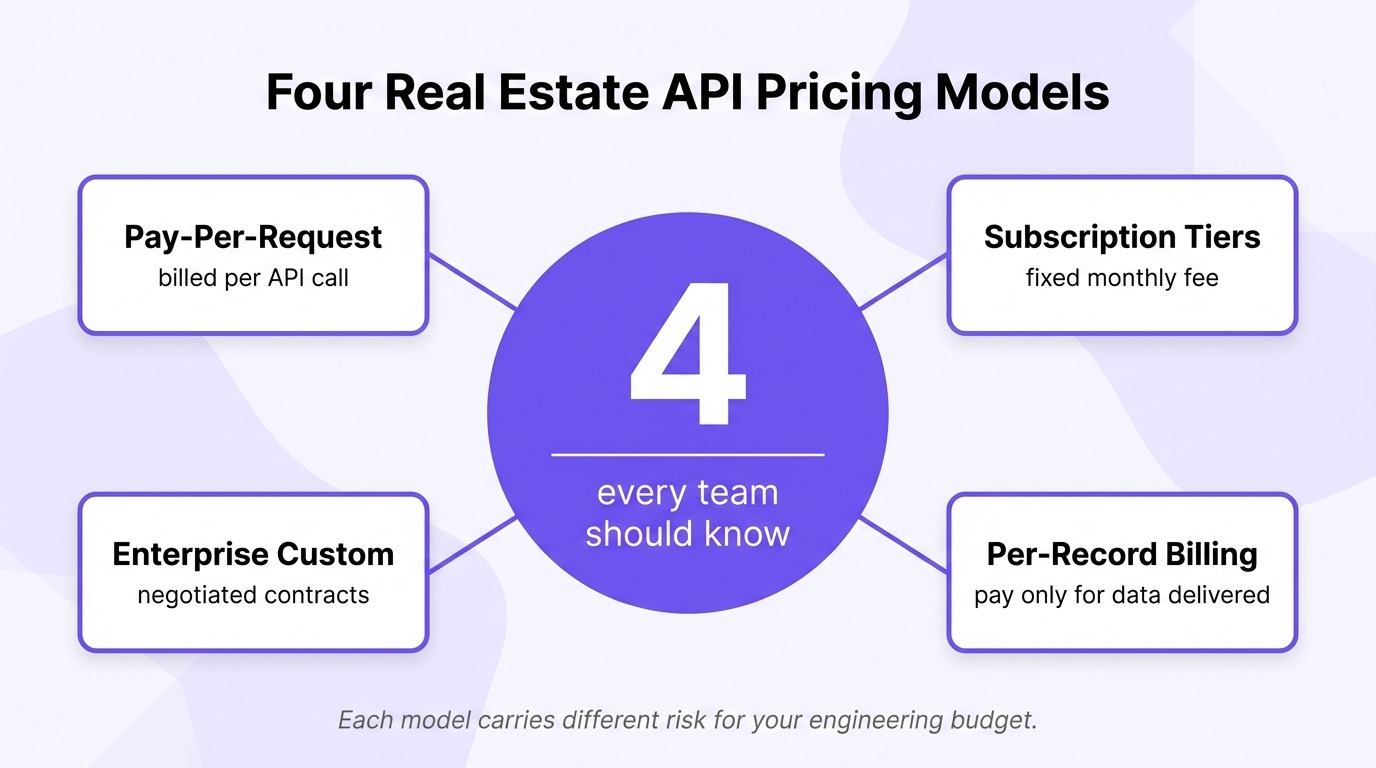
Before comparing specific price points, you need to understand the structures in the market. Each model suits different use cases, and choosing the wrong one can mean either overpaying for unused capacity or facing unexpected overage charges during traffic spikes. The four shapes you will encounter are pay-per-request, subscription tiers, usage-based per-record, and enterprise custom contracts.
Pay-Per-Request Pricing
Pay-per-request pricing charges you for each API call, typically measured per thousand requests. It works well for early-stage proof-of-concept work with unpredictable volume. The downside is that pay-per-request models bill every query you send, whether the response contains useful data or not. A search returning zero results still costs the same as one returning a full property record.
Subscription and Tiered Plans
Subscription models offer a fixed monthly or annual fee that includes a predetermined number of requests or records. Tiered plans typically range from starter packages with capped monthly volume up through professional production tiers with significantly higher allocations. This provides budget predictability and volume discounts, but you pay for allocated capacity whether you use it or not, and exceeding tier limits triggers overage rates that often run well above the in-plan cost.
Usage-Based and Per-Record Pricing
Usage-based pricing has become the dominant model for serious real estate data work in 2026, and the most important variant is per-record billing. Instead of paying for every API call you send, you pay only for the property records actually delivered to your application. A query that returns nothing costs nothing. For a deeper breakdown, see our companion guide on subscription versus usage-based pricing models.
Per-record billing aligns cost with value in a way per-request pricing cannot. Bulk operations become predictable, since pulling property data for an entire ZIP code costs exactly the records returned. Failed queries, empty responses, and exploratory searches do not pad the invoice. Credit-based per-record models put the financial risk of poor query design back on the developer's optimization choices rather than on a billing meter that runs regardless of outcome.
Enterprise and Custom Pricing
Enterprise pricing involves negotiated contracts tailored to high-volume requirements, often including dedicated support, custom SLAs, and flexible terms. The biggest watch-out is contract length, since a three-year enterprise commitment locks you in even if a better provider emerges in year two.
What Factors Influence the Cost of an API for Real Estate Data?
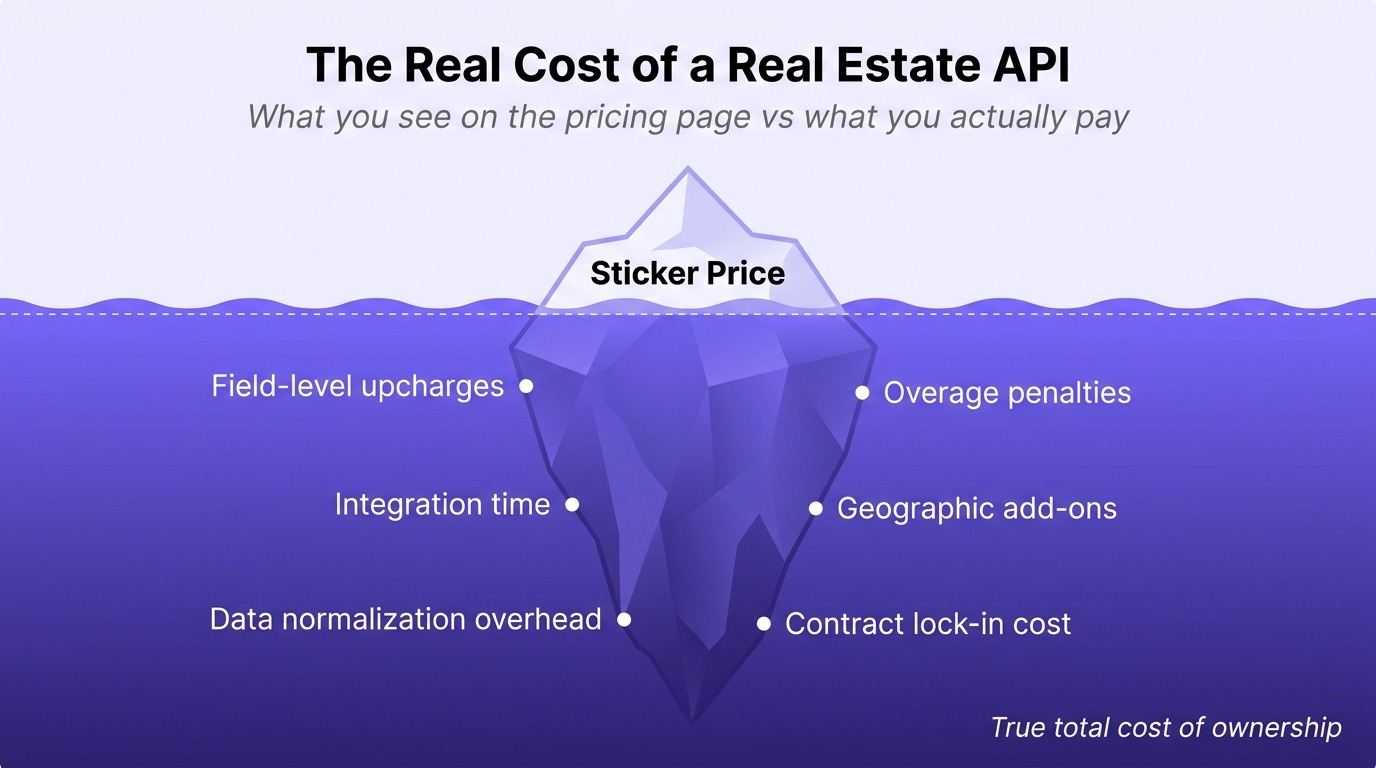
The sticker price on a provider's pricing page rarely tells the whole story. Several factors shape what you actually pay for an api for real estate data. The three that move the budget needle most are the fields and data depth you need, the geographic coverage and update frequency you require, and the level of support and reliability your application demands.
Field Access and Data Depth
Beyond the pricing model itself, the specific fields you need have a major impact on cost. Basic APIs cover address, square footage, and bedroom count. More comprehensive APIs add ownership history, tax assessments, transaction records, and mortgage details. Some providers charge separately for premium fields, which can make initial pricing look attractive while actual costs climb as you add necessary attributes. Providers offering comprehensive property data in a single request, without per-field upcharges, offer more predictable budgeting as your data requirements evolve.
Geographic Coverage and Update Frequency
National coverage typically costs more than regional access. Some providers sell access on a per-region or per-metro basis, which creates complications as you scale. Expanding to new markets means purchasing additional packages, often with little or no volume discount, and each new geography may require a separate contract.
Update frequency also influences pricing. An api for real estate data with daily refreshes commands premium pricing compared to weekly or monthly updates. For applications like fraud detection or investment analysis, stale data creates business risk that may exceed the cost savings of less frequent updates.
Support Levels and SLAs
Technical support quality varies widely, from community forums with multi-day response times to dedicated account managers with guaranteed response windows. For a production application, the difference between hours and days of response time is the difference between a manageable incident and a public outage. Service level agreements define uptime guarantees, and even small percentage gaps translate into hours of annual downtime. The highest uptime tiers typically require enterprise commitments.
What Hidden Costs Should You Watch For?
Beyond the obvious factors, several less visible costs affect your total investment. Recent research on API economics consistently shows that poor documentation and integration friction translate directly into budget overruns, often more than the API subscription itself. Accounting for these hidden costs during evaluation prevents surprises after you have already committed to a provider.

- Field-based upcharges: Some providers advertise low base prices but charge premium rates for specific data attributes like owner contact details, historical transactions, or tax assessments. Review the complete field list and associated costs before assuming the base price covers your requirements.
- Integration and development time: Complex authentication, inconsistent response formats, or sparse documentation increases development hours. A well-documented API with intuitive data structures can reduce integration time from weeks to days.
- Data normalization overhead: Poorly structured data requires additional processing before it is usable. If property addresses arrive in inconsistent formats or nested JSON structures require extensive parsing, you are paying engineering time to clean data that should arrive ready to use.
- Overage penalties: Exceeding your plan limits can trigger steep overage rates that run well above the standard per-request cost. Understand how providers handle overages and whether they offer soft caps or automatic tier upgrades.
- Contract lock-in terms: Annual commitments often come with discounts but limit flexibility. If your usage projections prove incorrect or a better option emerges, you may be stuck paying for a suboptimal solution.
These hidden costs are often the difference between an API choice that ages well and one you regret six months in.
How Do You Evaluate a Real Estate API Before You Commit?
A structured evaluation process helps you identify the right provider without committing significant resources to dead ends. The five steps below cover the essential checkpoints every team should run before signing anything.
- Map your actual usage patterns. Project query volume across three scenarios: initial development, launch-phase traffic, and scaled production. A provider that fits your budget today may become prohibitively expensive once production traffic ramps. Forecast well beyond your current expected scale before committing.
- Test data quality and structure with real records. Request sample data or use a free trial that exposes production records, not synthetic sandbox data. Evaluate completeness, accuracy, and schema consistency across property types and geographies before paying for anything.
- Review documentation and developer experience. Comprehensive documentation accelerates integration and reduces support dependency. Look for complete endpoint references, code samples, clear authentication explanations, and active version updates.
- Verify coverage of every property type you may need. Confirm the provider covers residential, commercial, and industrial property records under a single integration. Splitting these across separate contracts adds engineering overhead you do not want to discover in year two.
- Calculate true total cost of ownership. Build a comprehensive cost model that includes projected API charges, integration development at your team's loaded labor rate, ongoing maintenance, and support costs. The lowest sticker price rarely produces the lowest total cost.
Choosing the Right Real Estate API for Your Project
Different applications require different property types. Some platforms focus exclusively on residential data, while others need commercial, industrial, or mixed-use coverage. Before committing to a provider, consider whether your application might expand beyond its initial scope, because rebuilding integrations later costs far more than choosing a broader provider up front.
A commercial real estate API typically includes lease information, tenant details, zoning classifications, and building specifications that residential databases omit. If your application serves brokers, investors, or property managers, verify that prospective providers maintain robust commercial real estate API coverage from day one. Knowing what to look for in a property data API before any sales conversation gives you a sharper read on what is actually available than a pricing page ever will.
Building separate integrations for residential and commercial real estate API coverage creates technical debt that compounds with every release. A single provider offering comprehensive coverage across all property types streamlines initial development and long-term maintenance. A free trial with production data is the fastest way to validate coverage and quality before any contract commitment.
Frequently Asked Questions
What Is the Average Cost of a Real Estate API in 2026?
Costs vary widely by provider and use case. Most providers offer free or trial tiers with capped record volume for testing. Paid plans generally fall into starter tiers for moderate-volume applications, professional tiers for production workloads, and enterprise arrangements for high-volume or custom requirements. Actual costs depend on the data types included, geographic coverage, update frequency, and support level you need.
Is Per-Record or Per-Request Pricing Better?
Per-record pricing is better for almost every production use case. Per-record models bill only for property data actually delivered, while per-request models charge for every query sent, including ones that return empty results or fail. For bulk operations and any application where query design is still being optimized, per-record pricing produces lower and more predictable total costs.
How Do I Know if I Need a Subscription or Usage-Based Plan?
Subscription models suit applications with predictable, steady usage where budget consistency matters. Usage-based plans work better for variable usage patterns, early-stage testing, or applications where traffic fluctuates significantly. Calculate your expected monthly volume and compare total costs under each model at your projected scale.
What Data Fields Should I Expect From an API for Real Estate Data?
A comprehensive api for real estate data typically includes property address and location, physical characteristics like square footage and room counts, ownership history, tax assessments, transaction records with sale prices and dates, and listing status. More advanced APIs add mortgage details, lien information, and commercial fields like zoning and tenant data.
How Can I Test a Real Estate API Before Buying?
Look for providers offering free trials with access to production data rather than limited sandboxes. A meaningful trial lets you validate data coverage for your target geography, assess record completeness, test query performance, and evaluate documentation quality. Trials that expose the full platform with only volume restrictions provide the most realistic preview of what you will receive as a paying customer.
Making a Confident Decision on Real Estate API Pricing
The providers delivering the best long-term value share certain characteristics: transparent billing without hidden field-based charges, complete data access within each tier, documentation that respects developers' time, and trial options that expose the full platform rather than a limited preview.
The right choice depends on your specific requirements, usage patterns, and growth trajectory. For teams seeking a real estate API with per-record pricing, full national coverage, and complete property data across residential, commercial, and industrial records under one integration, Datafiniti offers a free trial with full production access Request a demo to see how predictable billing changes what your team can build.
Read the latest articles

Read more

Best Property Data API Platforms for U.S. Real Estate: A Buyer's Comparison

Best Product Catalog API for Online Retailers: Aggregating Multi-Retailer Catalogs

Build vs Buy: Business Data Enrichment for Growing Teams

Company Data API Pricing: Bulk & Enterprise-Scale Access

Best Business Data APIs for Sales Teams & Prospecting

Business Data API: Company Data at Enterprise Scale

How to Build a Product Database With a Product Data API

Property Data API Coverage: What U.S. Datasets Include

Product Data API for Ecommerce Price Monitoring and Repricing

Real-Time Product Data API for Product-Led Growth Teams

Property Ownership Data API for Skip Tracing and Lead Gen

How APIs Make Building a Product Database Easy
Learn how to build a product database with APIs for cleaner imports, updates, search, and scalable product data.

How to Leverage Competitor Pricing Data with an API
Use competitor pricing data to build API-driven monitoring, analysis, and smarter pricing decisions.

Price Monitoring API: The Key to E-Commerce Pricing Strategy
Use a price monitoring API to track market changes, improve pricing decisions, and protect ecommerce margins.

How do Product Data APIs Work for E-Commerce Companies?
Learn how a product data API works, from collection and queries to ecommerce integration and use cases.

GTIN Lookup API: Search Products by Barcode & UPC at Scale

Best Real Estate API 2026: Coverage, Pricing, Data Quality

Best Product Data API 2026: A State-of-the-Market Guide

Product Data API Integration Patterns for Ecommerce Platforms

Build a PropTech MVP With a Property Ownership Data API
How Real Estate Agents Can Leverage Proptech Data
Leverage proptech data to source leads, speed up valuations, and manage risk with accurate, real-time property insights.

What Is a UPC Lookup API?
Learn about the UPC lookup API, how it works, and its benefits for businesses. Get product data easily.

What Is a GTIN Lookup API?
Learn about the GTIN lookup API and how it can help your business grow. Get product data insights.

How Does a Property Data API Work?
Learn how a property data API works, its features, and how you can use it for real estate and business insights.

What The Best Real Estate APIs Should Have
Discover what makes the best real estate APIs stand out. Learn about essential features for your property data needs.

MLS Listings API: How to Access MLS Listing Data
.png)
How to Enrich Your Product Catalog With a Real-Time API
.jpeg)
Product Data API Buyer's Guide for Ecommerce Teams

Why Real Estate Tech Startups Need Property APIs with Ownership Details
Discover how property APIs with ownership details empower real estate tech startups. Learn about data integration, risk mitigation, and driving business value.
The Value of a Product Catalog Sync for Product Managers
Unlock the value of product catalog sync for product managers. Streamline data, improve decisions, and reduce costs with real-time insights.

What is a Product Data Webhook?
Learn about product data webhooks, their components, and how they enable real-time updates for business intelligence and workflow automation.

Why Is a Product Data API Integration Essential for Analysts & Product Managers?
Unlock insights with product data API integration. Essential for analysts & product managers to streamline data access & enhance product strategy.

What Is a Product Data API and Its Benefits
Learn about product data APIs, their benefits, and how they drive business growth. Explore integration and advanced use cases.

What Do eCommerce Data Vendors Do?
Learn what ecommerce data vendors do, their services, and how to choose the right one for your business growth.

How to Compare Product Data Providers: What to Look For
Compare product data providers. Learn what to look for in data quality, structure, and integration features.

How to Get Your Product Data in Real-Time Using APIs
Learn how to leverage real-time product data APIs for e-commerce, competitive analysis, and AI. Get instant access to clean, structured product data.

Best Product Data API: Features to Look for
Find the best product data API with real-time updates, comprehensive coverage, and a user-friendly portal. Explore features to look for.

Unlocking Property Data with an API
Access property data with a powerful property database API. Explore listings, market analysis, investment opportunities, and more. Get started today!

Unlocking CRE with APIs
Unlock commercial real estate insights with a powerful API. Access property data, streamline workflows, and enhance investment strategies.

How to Get a Real-Time Product Feed Using an API
Learn how to get a real-time product feed using an API. Access, leverage, and ensure accuracy of product data for your business needs.

Spying on Competitor Prices: What You Need to Know
Learn how to gather and analyze competitor pricing data to inform your business strategy. Understand key components and ethical considerations.

Product Data Enrichment: What Are You Missing?
Enhance your product data with comprehensive enrichment. Discover insights, drive growth, and choose the right approach for your business.
.png)
Real Estate API Pricing Models Explained: Subscription vs. Usage-Based

Real Estate API vs Web Scraping: The Buy-vs-Build Decision
.png)
Product Data APIs Explained: Powering Product Search and Catalog Automation

How to Get the Most out of a Product Catalog API
Learn how to leverage a product catalog API for business growth. Discover data quality, access methods, and strategy for your product catalog API.

Taming Your Ecommerce Product Data Feed
Optimize your ecommerce product data feed for growth. Learn strategies, leverage technology, and ensure data quality for better customer experience and AI initiatives.

Streamlining Your Product Search with an API
Explore the benefits and integration of a product search API. Streamline your product discovery and leverage data for business growth.

What Is a Real Estate Transaction Database? A Complete Guide
.png)
Commercial Real Estate API vs. Residential Property API
.png)
How to Choose a Real Estate Database API for Your MVP

Property Valuation API: Your Go-To Real Estate Tool
Leverage the property valuation API for real estate insights. Access comprehensive property data for diverse applications with Datafiniti.

Product Data APIs Explained
Learn about product data APIs explained. Discover how to access, integrate, and utilize product data for e-commerce, analytics, and more.

Unlocking Your Ecommerce Data with APIs
Unlock ecommerce data with APIs for business insights, product catalog enrichment, and competitive analysis. Explore data via portal or API.

Real Estate Ownership Data: How to Access, Analyze and Use at Scale
Access, analyze, and use real estate ownership data at scale. Learn how to find, process, and leverage this crucial information for business insights.

IDX vs MLS API: What Every Real Estate Professional Should Know

How a Property Database API Can Help Real Estate Pros
Learn how a property database API can help real estate pros analyze trends, monitor listings, and optimize strategies. Get data insights.

What Is a Residential Property API?
Explore what a residential property API is, its features, benefits, and real-world applications for real estate professionals and investors.

What Is a Commercial Real Estate API?
Explore commercial real estate API functionality, data integration, and use cases. Learn how to leverage property, business, and people data for insights.

Understanding MVP Data Integration
Learn about MVP data integration, its components, benefits, and strategies for accessing and utilizing data resources effectively.

How to Choose the Best Property Data API
Learn how to choose the best property data API. Explore features, providers, pricing, and integration for real estate insights.

How Do Product Data APIs Work?
Understand how a product data API works, its key features, integration methods, and applications for e-commerce and business intelligence.

How Do Data Aggregation Platforms Work?
Explore how data aggregation platforms work, their capabilities, and applications. Learn to choose and implement the right platform for your business intelligence needs.

Why Do Companies Need Property Data Aggregation?
Discover why property data aggregation is crucial for businesses. Streamline access, empower functions, enhance risk management, and drive strategic decisions with authoritative insights.

MLS Database API: How to Choose a Provider and Get Access

Product Search API vs. Product Data API: What's the Difference?

What Is a Product Data API?
Explore the functionality and benefits of a product data API. Learn how to integrate, leverage, and choose the right provider for your business insights.
What Is the Difference Between Product Search API and Product Data API?
Understand the difference between Product Search API and Product Data API. Learn how to leverage product data for business intelligence and analytics.

What Is a Property Data API?
Explore the capabilities of a property data API. Understand its core functionality, key features for developers, and how to access property information at scale for business insights.
Real Estate API Pricing: What You Need to Know Before You Build
.jpeg)
How to Choose a Property Market API for Investment Platforms
Choosing the right property market API is critical for investment platforms. Learn how to evaluate data depth, coverage, freshness, and integration quality before you commit.
Data you can trust, delivered in a format your systems can use, at the scale your product requires.