
.png)
Real Estate Transaction Database: An API Access Guide

A real estate transaction database has become essential infrastructure for data-driven property decisions, yet most teams struggle to find APIs that deliver comprehensive records without unpredictable costs or technical friction.
- The global PropTech market is projected to grow from $40 billion in 2025 to over $88 billion by 2032, with data access at the center of this expansion.
- Per-request pricing models create budget uncertainty, while per-record billing ensures you only pay for data you actually receive.
- Rate limiting and geographic restrictions force developers to build workarounds that add complexity and slow time-to-value.
If your team needs reliable access to housing transaction data, prioritize providers that offer transparent pricing, unrestricted throughput, and nationwide coverage under a single integration.
Accessing accurate property records has shifted from competitive advantage to operational necessity. Investment firms, lenders, insurers, and PropTech platforms all depend on structured property data to power everything from underwriting models to fraud detection systems. A well-designed real estate transaction database can reduce research time from days to seconds while ensuring consistency across analytical workflows.
The challenge is that these databases vary dramatically in coverage, pricing structure, and ease of integration. Some providers charge per API request regardless of whether that request returns useful data. Others restrict access by metro area or property type, forcing teams to manage multiple contracts as they scale. This guide walks through what a real estate transaction database actually contains, how to evaluate providers, and what to look for when integrating property data into your workflows.
What Is a Real Estate Transaction Database?
A real estate transaction database aggregates records of property sales, ownership transfers, and related financial events into a queryable system. These databases pull from public records, county assessors, deed filings, and other authoritative sources to create a consolidated view of property history.
The core value lies in historical depth. While listing feeds show what properties are currently on the market, transaction databases reveal what has already happened: previous sale prices, ownership chains, tax assessment changes, and mortgage activity. This historical context is essential for valuation models, risk assessment, and market trend analysis.
Transaction databases typically include deed records documenting ownership transfers, sale prices and dates, tax assessment histories, mortgage and lien information, and property characteristics tied to each transaction. The combination of these fields allows analysts to track how property values have changed over time, identify patterns in ownership turnover, and flag anomalies that might indicate fraud or data quality issues.
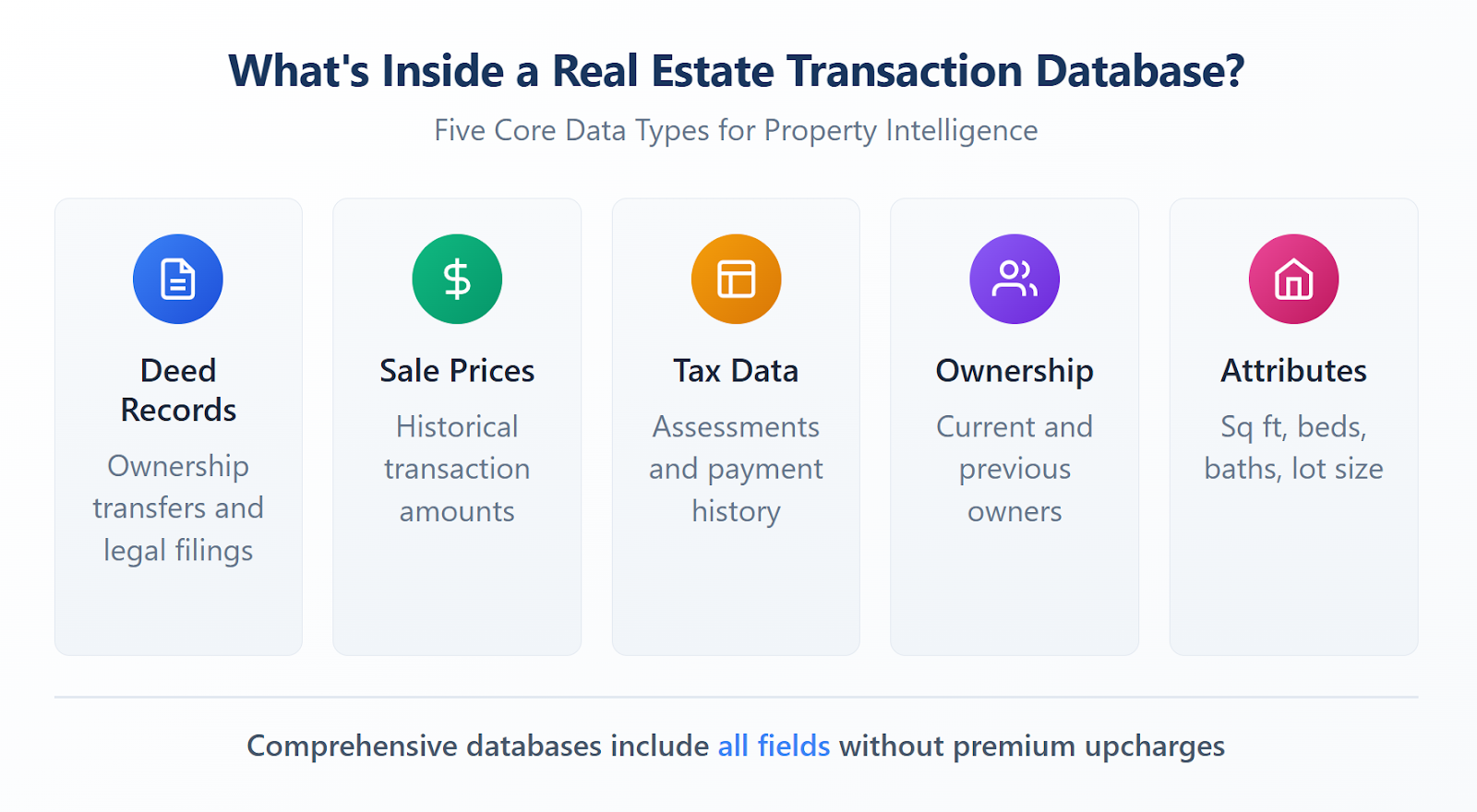
How Transaction Data Differs from Listing Data
Listing data captures properties actively marketed for sale or rent. It reflects asking prices, agent information, and marketing descriptions. Transaction data, by contrast, documents completed events. It shows what buyers actually paid, when ownership changed hands, and how assessors valued the property at various points in time.
For investment analysis, transaction data provides the ground truth that listing data cannot. A property might be listed at $500,000, but transaction records reveal that comparable homes in the same neighborhood have consistently sold for $420,000 over the past three years. This distinction matters for anyone building pricing models, conducting due diligence, or validating automated valuations.
Why Access Housing Transaction Data Through an API?
Manual data collection does not scale. Pulling transaction records county by county, reformatting spreadsheets, and reconciling inconsistent schemas consumes hours that technical teams cannot afford. APIs eliminate this friction by delivering standardized records on demand.
Speed is the most obvious benefit. A well-designed property data API returns results in seconds rather than days. Teams can query millions of records, filter by geography or property type, and receive structured responses ready for analysis. This acceleration compresses project timelines and allows for iterative testing that manual processes cannot support. According to recent industry research, two-thirds of real estate professionals cite time savings as their primary motivation for adopting new technology, underscoring how critical efficient data access has become.
Integration matters just as much. When transaction data flows directly into existing systems through an API, it eliminates the copy-paste errors and version control problems that plague spreadsheet-based workflows. Analysts can build dashboards that refresh automatically, data scientists can train models on current information, and operations teams can trigger alerts based on real-time changes.
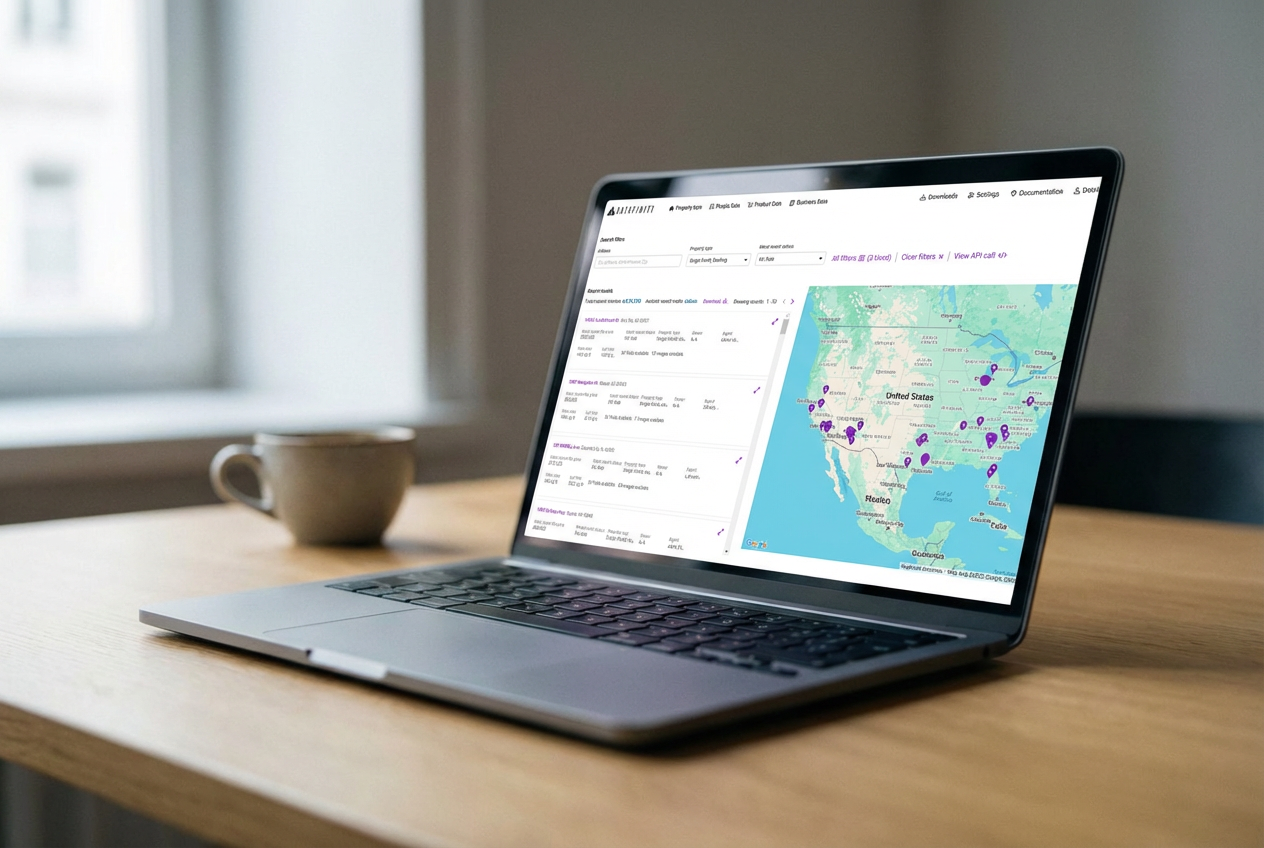
Common Use Cases for Property Data APIs
The applications for a real estate database API extend across multiple industries. Investment firms use transaction histories to identify undervalued properties and validate acquisition targets. Lenders pull ownership records and tax assessments during underwriting to verify borrower information and assess collateral risk.
Insurance companies cross-reference transaction data to detect fraudulent claims and ensure accurate property valuations for coverage calculations. Fraud prevention teams at financial institutions flag shipping addresses that match vacant or recently sold properties, reducing losses from stolen goods delivered to empty homes.
PropTech startups build consumer-facing tools on top of transaction data, powering everything from home value estimators to neighborhood trend reports. Each of these use cases demands reliable, comprehensive data delivered through an interface that integrates cleanly with production systems.
Evaluating Real Estate Database API Providers
Choosing a real estate database API requires more than comparing feature lists. The differences that matter most often hide in pricing structures, access restrictions, and operational constraints that only surface during implementation or scale. The sections below break down the three areas where providers diverge most significantly.
Pricing Model Considerations
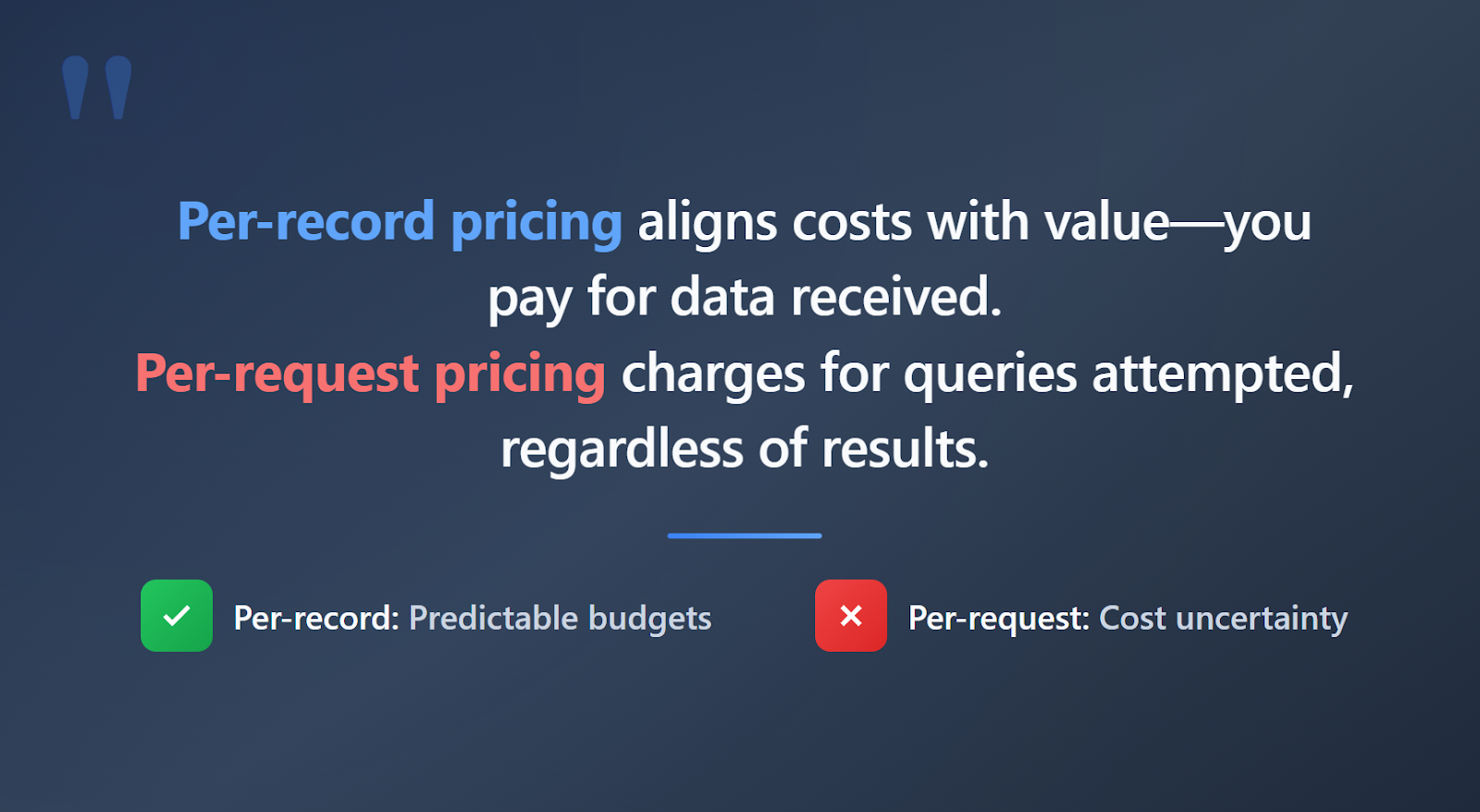
Pricing structures vary significantly, and the wrong model can turn a promising integration into a budget headache. Per-request pricing charges for every API call regardless of outcome. If a query returns no results or incomplete data, you still pay. This model creates uncertainty, especially for exploratory analysis or applications with variable query volumes.
Per-record pricing aligns costs with value. You pay for the data you actually receive, not for the queries you attempt. This approach makes budgeting predictable and eliminates the penalty for thorough searches. When evaluating providers, ask specifically how they handle queries that return no results and whether pricing scales linearly with data volume.
Hidden costs also deserve scrutiny. Some providers charge premium rates for specific fields like tax histories or ownership records. Others require separate contracts for different data types. Look for providers that include comprehensive field access without per-attribute upcharges.
Rate Limiting and Throughput
Rate limiting restricts how many requests you can send within a given time window. Providers impose these limits to manage server load, but they create real problems for developers. When your application hits a rate limit, you must build retry logic, implement request queuing, and handle failures gracefully. This adds engineering complexity that has nothing to do with your actual product.
For high-volume applications, rate limiting becomes a scaling bottleneck. Teams end up throttling their own systems to stay within provider constraints rather than optimizing for user experience or analytical throughput. Providers that operate without artificial request caps remove this friction entirely, allowing your infrastructure to scale without external constraints.
Geographic Access and Property Type Coverage
Some providers package data by metropolitan area or region, requiring separate contracts for each geography. This creates friction as your business expands. A company that starts with coverage in three metros might need data from twelve within a year. Regional packaging turns scaling into a procurement exercise rather than a technical one.
Property type restrictions cause similar problems. A provider focused exclusively on residential single-family homes leaves gaps for teams that need commercial, industrial, or multi-family data. Maintaining separate integrations for different property types increases maintenance burden and introduces inconsistencies in data schemas.
Full national access with all property types under a single integration eliminates these constraints. Your queries can span any geography and any property category without renegotiating contracts or managing multiple vendor relationships.

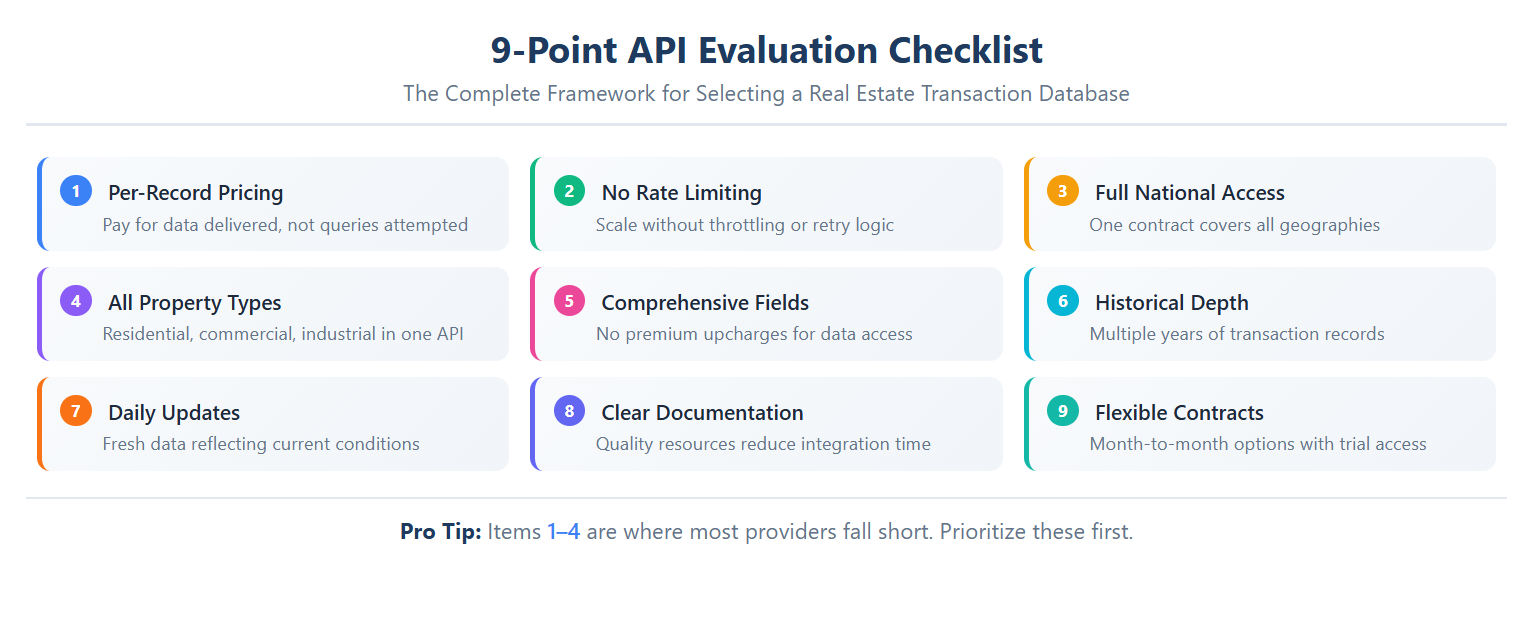
9-Point Checklist for Evaluating a Real Estate Transaction Database
The sections above cover pricing, throughput, and coverage in depth. This checklist pulls those criteria together with additional practical factors to give you a complete evaluation framework:
- Per-record pricing: You pay for data delivered, not queries attempted. Budgets stay predictable.
- No rate limiting: Your infrastructure scales without artificial throttling or retry logic.
- Full national access: One contract covers all geographies. No regional packages or scaling friction.
- All property types included: Residential, commercial, and industrial under a single integration.
- Comprehensive field coverage: Ownership, tax, deed, and transaction data without premium upcharges.
- Historical depth: Multiple years of records, not just recent activity.
- Daily updates: Data freshness that reflects current market conditions.
- Clear documentation: Well-maintained API documentation reduces integration time.
- Flexible contracts: Month-to-month options with trial access before long-term commitments.
How to Integrate a Property Data API Into Your Workflow
Integration complexity varies based on your existing infrastructure and use case requirements. However, the general process follows a consistent pattern that most technical teams can execute without specialized expertise.
Authentication typically involves API keys or tokens that identify your account and authorize requests. Most providers issue these credentials through a web portal after account creation. Store these tokens securely and implement rotation procedures if your security requirements demand it.
Query construction depends on the specific API design, but most property data APIs accept geographic filters, property type specifications, and date ranges. Start with narrow queries that return small result sets to verify that responses match your expectations. Expand scope gradually as you confirm data quality and schema compatibility.
Sample Query Walkthrough
A typical workflow begins with defining your search criteria. Suppose you need transaction records for single-family homes in Texas from the past two years. You would construct a query specifying the state, property type, and date range, then submit it to the API endpoint.
The response returns structured data, usually in JSON or CSV format, containing all matching records with their associated fields. Your application parses this response, extracts the relevant information, and stores or processes it according to your business logic.
For bulk operations, many providers support download endpoints that queue large result sets for asynchronous retrieval. This approach handles datasets too large for synchronous responses without timing out or overwhelming your application.

Frequently Asked Questions
What types of records are included in a real estate transaction database? Transaction databases typically include deed records, sale prices, ownership histories, tax assessments, mortgage information, and property characteristics. The specific fields vary by provider, so verify that coverage matches your requirements before integrating.
How is per-record pricing different from per-request pricing? Per-request pricing charges for every API call regardless of whether it returns useful data. Per-record pricing charges only for the actual data delivered. This distinction significantly impacts budget predictability, especially for applications with variable query patterns.
Can I access both residential and commercial property data through a single API? Some providers require separate integrations or contracts for different property types. Others offer unified access to residential, commercial, and industrial records under one integration. Consolidated access reduces maintenance complexity and ensures consistent data schemas across property categories.
How frequently is transaction data updated? Update frequency varies by provider. Some refresh data weekly or monthly, while others provide daily updates. For time-sensitive applications like underwriting or fraud detection, prioritize providers with more frequent update cycles.
Getting Started with Real Estate Transaction Data
The demand for reliable housing transaction data continues to grow as more industries recognize its value for decision-making, risk management, and product development. Industry analysts project the PropTech sector will expand at an 11.9% compound annual growth rate through 2032, driven largely by demand for programmatic data access. As data and technology become top spending priorities for real estate leaders, the gap between organizations with reliable data infrastructure and those without will continue to widen.
Selecting the right provider determines whether your team captures that advantage or struggles with workarounds and limitations. The evaluation criteria outlined here, from pricing transparency to geographic coverage, should guide your assessment of any potential partner.
Datafiniti offers a property data API built around the principles that matter most: per-record pricing that aligns costs with value, no rate limiting to constrain your throughput, nationwide coverage across residential, commercial, and industrial properties, and comprehensive field access without hidden fees. To explore how structured property data can support your specific use case, reach out to the Datafiniti team and request a demo.
Read the latest articles

Read more

Product Data API for Ecommerce Price Monitoring and Repricing

Real-Time Product Data API for Product-Led Growth Teams

Property Ownership Data API for Skip Tracing and Lead Gen

How APIs Make Building a Product Database Easy
Learn how to build a product database with APIs for cleaner imports, updates, search, and scalable product data.

What Is Property Transaction Data and How Does an API Help Get It?
Learn how property transaction data works and how APIs provide structured access for analysis and workflows.

How to Use Real Estate Transaction Data
Learn how to use real estate transaction data for analysis, valuation, underwriting, and market decisions.

How to Leverage Competitor Pricing Data with an API
Use competitor pricing data to build API-driven monitoring, analysis, and smarter pricing decisions.

Price Monitoring API: The Key to E-Commerce Pricing Strategy
Use a price monitoring API to track market changes, improve pricing decisions, and protect ecommerce margins.

How do Product Data APIs Work for E-Commerce Companies?
Learn how a product data API works, from collection and queries to ecommerce integration and use cases.

Bulk Real Estate Data Licensing: Access Datasets at Scale

How to Integrate MLS Listings Using an MLS Data API

GTIN Lookup API: Search Products by Barcode & UPC at Scale

Best Real Estate API 2026: Coverage, Pricing, Data Quality

Best Product Data API 2026: A State-of-the-Market Guide

Product Data API Integration Patterns for Ecommerce Platforms

Build a PropTech MVP With a Property Ownership Data API

3 Benefits of Web Scraping for Real Estate
Boost your research by using web scraping for real estate to gain market insights, automate lead lists, and minimize property risk.
How Real Estate Agents Can Leverage Proptech Data
Leverage proptech data to source leads, speed up valuations, and manage risk with accurate, real-time property insights.

What Is a UPC Lookup API?
Learn about the UPC lookup API, how it works, and its benefits for businesses. Get product data easily.

What Is a GTIN Lookup API?
Learn about the GTIN lookup API and how it can help your business grow. Get product data insights.

How Does a Property Data API Work?
Learn how a property data API works, its features, and how you can use it for real estate and business insights.

What The Best Real Estate APIs Should Have
Discover what makes the best real estate APIs stand out. Learn about essential features for your property data needs.
The Benefits of a Real Estate MLS API
Learn about the benefits of a real estate MLS API for streamlining data access and driving business growth.

Why Every Real Estate Pro Needs an MLS Database API
Learn why a MLS database API is vital for real estate pros. Get data, insights, and competitive edge.
How to Access MLS Listing Data
Learn how to access MLS listing data using an MLS data API. Discover Datafiniti's solutions and integration tips.
.png)
How to Enrich Your Product Catalog With a Real-Time API
.jpeg)
Product Data API Buyer's Guide for Ecommerce Teams

Do I Need a Real Estate Listing API?
Explore the benefits and technicalities of a real estate listing API. Learn how to choose the right provider and integrate data for business growth.

Unlocking the MLS Database with APIs
Unlock the MLS database with APIs. Learn how to access property data, gain real estate insights, and integrate MLS data for your business needs.

Why Real Estate Tech Startups Need Property APIs with Ownership Details
Discover how property APIs with ownership details empower real estate tech startups. Learn about data integration, risk mitigation, and driving business value.
The Value of a Product Catalog Sync for Product Managers
Unlock the value of product catalog sync for product managers. Streamline data, improve decisions, and reduce costs with real-time insights.

What is a Product Data Webhook?
Learn about product data webhooks, their components, and how they enable real-time updates for business intelligence and workflow automation.

Why Is a Product Data API Integration Essential for Analysts & Product Managers?
Unlock insights with product data API integration. Essential for analysts & product managers to streamline data access & enhance product strategy.

What Is a Product Data API and Its Benefits
Learn about product data APIs, their benefits, and how they drive business growth. Explore integration and advanced use cases.

What Do eCommerce Data Vendors Do?
Learn what ecommerce data vendors do, their services, and how to choose the right one for your business growth.

How to Compare Product Data Providers: What to Look For
Compare product data providers. Learn what to look for in data quality, structure, and integration features.

How to Get Your Product Data in Real-Time Using APIs
Learn how to leverage real-time product data APIs for e-commerce, competitive analysis, and AI. Get instant access to clean, structured product data.

Best Product Data API: Features to Look for
Find the best product data API with real-time updates, comprehensive coverage, and a user-friendly portal. Explore features to look for.

Unlocking Property Data with an API
Access property data with a powerful property database API. Explore listings, market analysis, investment opportunities, and more. Get started today!

Unlocking CRE with APIs
Unlock commercial real estate insights with a powerful API. Access property data, streamline workflows, and enhance investment strategies.

How to Get a Real-Time Product Feed Using an API
Learn how to get a real-time product feed using an API. Access, leverage, and ensure accuracy of product data for your business needs.

Spying on Competitor Prices: What You Need to Know
Learn how to gather and analyze competitor pricing data to inform your business strategy. Understand key components and ethical considerations.

Product Data Enrichment: What Are You Missing?
Enhance your product data with comprehensive enrichment. Discover insights, drive growth, and choose the right approach for your business.
.png)
IDX vs MLS API: A Developer's Guide to Real Estate Listing Data
.png)
Real Estate API Pricing Models Explained: Subscription vs. Usage-Based

Real Estate API vs Web Scraping: Which Wins in 2026?
.png)
Product Data APIs Explained: Powering Product Search and Catalog Automation

Best Sources for Bulk Real Estate Transaction Data

How to Get the Most out of a Product Catalog API
Learn how to leverage a product catalog API for business growth. Discover data quality, access methods, and strategy for your product catalog API.

Taming Your Ecommerce Product Data Feed
Optimize your ecommerce product data feed for growth. Learn strategies, leverage technology, and ensure data quality for better customer experience and AI initiatives.

Streamlining Your Product Search with an API
Explore the benefits and integration of a product search API. Streamline your product discovery and leverage data for business growth.
.png)
Real Estate Transaction Databases: What You Need to Know
.png)
Best MLS API for Real Estate Software: What Developers Need

How Real Estate Platforms Access MLS Database APIs
.png)
Commercial Real Estate API vs. Residential Property API
.png)
How to Choose a Real Estate Database API for Your MVP
MLS API vs. IDX: What's the Diff?
MLS API vs IDX: Explore the differences in real estate data access, retrieval, and integration. Understand which solution fits your needs.

Scraping vs. APIs: Getting Real Estate Data
Compare web scraping vs real estate API for data acquisition. Learn the pros, cons, and best use cases for each method.

Cracking the Code: Housing Sales Insights
Unlock housing sales analytics insights with Datafiniti. Explore property data, market trends, and advanced techniques for strategic decisions.

Property Valuation API: Your Go-To Real Estate Tool
Leverage the property valuation API for real estate insights. Access comprehensive property data for diverse applications with Datafiniti.

Product Data APIs Explained
Learn about product data APIs explained. Discover how to access, integrate, and utilize product data for e-commerce, analytics, and more.

Unlocking Your Ecommerce Data with APIs
Unlock ecommerce data with APIs for business insights, product catalog enrichment, and competitive analysis. Explore data via portal or API.

Your Guide to Housing Sales APIs
Explore housing sales API data for insights. Access property data, integrate into applications, and gain business intelligence. Get started today!

Real Estate Ownership Data: How to Access, Analyze and Use at Scale
Access, analyze, and use real estate ownership data at scale. Learn how to find, process, and leverage this crucial information for business insights.

Unlocking Opportunities: Navigating Bulk Real Estate Transaction Data
Unlock opportunities with bulk real estate transaction data. Learn how to access, analyze, and leverage property data for investing, marketing, and more.
What Is a Property Sales Database?
Explore what a property sales database is, its core components, how to access data, and key use cases for real estate analysis and more.

Benefits of Obtaining Housing Transaction Data
Unlock insights with housing transaction data. Analyze markets, investments, sales, and risk. Get comprehensive property data for informed decisions.

Understanding Real Estate Transaction Databases
IDX vs MLS API: What Every Real Estate Professional Should Know
Understand IDX vs MLS API differences. Learn about data access, integration, and how Datafiniti's solutions empower real estate professionals.

What Is an MLS Database API?
Explore the MLS database API: understand its components, benefits, and how to access real estate data for various applications. Learn about its core functionality and technical aspects.

How a Property Database API Can Help Real Estate Pros
Learn how a property database API can help real estate pros analyze trends, monitor listings, and optimize strategies. Get data insights.

What Is a Residential Property API?
Explore what a residential property API is, its features, benefits, and real-world applications for real estate professionals and investors.

What Is a Commercial Real Estate API?
Explore commercial real estate API functionality, data integration, and use cases. Learn how to leverage property, business, and people data for insights.

Understanding MVP Data Integration
Learn about MVP data integration, its components, benefits, and strategies for accessing and utilizing data resources effectively.

How to Choose the Best Property Data API
Learn how to choose the best property data API. Explore features, providers, pricing, and integration for real estate insights.

Real Estate Database API: What to Look for
Explore real estate database API options. Learn about data quality, features, and how to choose the right provider for your needs.
Real Estate Transaction Database: An API Access Guide

How Do Product Data APIs Work?
Understand how a product data API works, its key features, integration methods, and applications for e-commerce and business intelligence.

How Do Data Aggregation Platforms Work?
Explore how data aggregation platforms work, their capabilities, and applications. Learn to choose and implement the right platform for your business intelligence needs.

Why Do Companies Need Property Data Aggregation?
Discover why property data aggregation is crucial for businesses. Streamline access, empower functions, enhance risk management, and drive strategic decisions with authoritative insights.

MLS API: The Complete Guide to Accessing MLS Listing Data

Product Search API vs. Product Data API: What's the Difference?

What Are the Best MLS Data API Features to Look For?
Discover the best MLS data API features, including real-time updates, bulk downloads, and flexible filtering for property data.

What Is a Product Data API?
Explore the functionality and benefits of a product data API. Learn how to integrate, leverage, and choose the right provider for your business insights.
What Is the Difference Between Product Search API and Product Data API?
Understand the difference between Product Search API and Product Data API. Learn how to leverage product data for business intelligence and analytics.

Guide to Accessing Real Estate Transaction Database Via API
Access real estate transaction data via API. Explore property insights, sales, underwriting, and advanced applications with our authoritative guide.

Is a Real Estate MLS API Beneficial?
Explore the benefits of a real estate MLS API for enhanced data access, streamlined workflows, and market responsiveness. Learn about key features and use cases.

What is an MLS Database API?
Explore the MLS database API for comprehensive property data access. Learn about its core functionality, key features, and integration into real estate technology.

What Is a Property Data API?
Explore the capabilities of a property data API. Understand its core functionality, key features for developers, and how to access property information at scale for business insights.
.png)
Real Estate API Pricing: What You Need to Know Before You Build
.jpeg)
How to Choose a Property Market API for Investment Platforms
Choosing the right property market API is critical for investment platforms. Learn how to evaluate data depth, coverage, freshness, and integration quality before you commit.
Data you can trust, delivered in a format your systems can use, at the scale your product requires.