

Understanding Real Estate Transaction Databases
Key Takeaways
Valuation models are only as good as the transfer records feeding them, and coverage gaps hurt accuracy more than model architecture does.
- Recorded deeds, sale prices, and ownership history are the raw inputs behind automated valuation models, comps, and portfolio risk scoring.
- Coverage varies sharply by geography, and thin comp density in rural counties and non-disclosure markets degrades confidence where valuation is hardest.
- API access, bulk delivery, and scheduled sync each solve a different workload, and most teams need more than one of them.
- Recorded deeds and listing feeds each miss part of the market, so property transaction data drawn from a single source leaves a blind spot in your model.
Evaluate a provider on where its records are thinnest before you evaluate anything else.
Every automated valuation model, comparable sales report, and portfolio risk score rests on the same foundation of real estate transaction data. The models attract the engineering attention, but the records underneath them decide whether the output holds up. Teams usually learn this after a pilot performs beautifully across three metros and falls apart in the fourth.
That gap between demo and production is a sourcing problem rather than a modeling problem. How easily a team can access structured property records at scale tends to determine both how fast a valuation product ships and how well it performs once real users start submitting addresses nobody tested.
The stakes have risen. Automated valuation models used by mortgage originators and secondary market issuers now fall under federal quality control standards that took effect on October 1, 2025. Covered institutions must maintain policies designed to ensure a high level of confidence in estimates and to protect against the manipulation of data. Model governance now depends on input governance.
This guide covers what transfer records contain, where they originate, why coverage varies so sharply across the country, and how teams move the data into production.
What Is Real Estate Transaction Data?
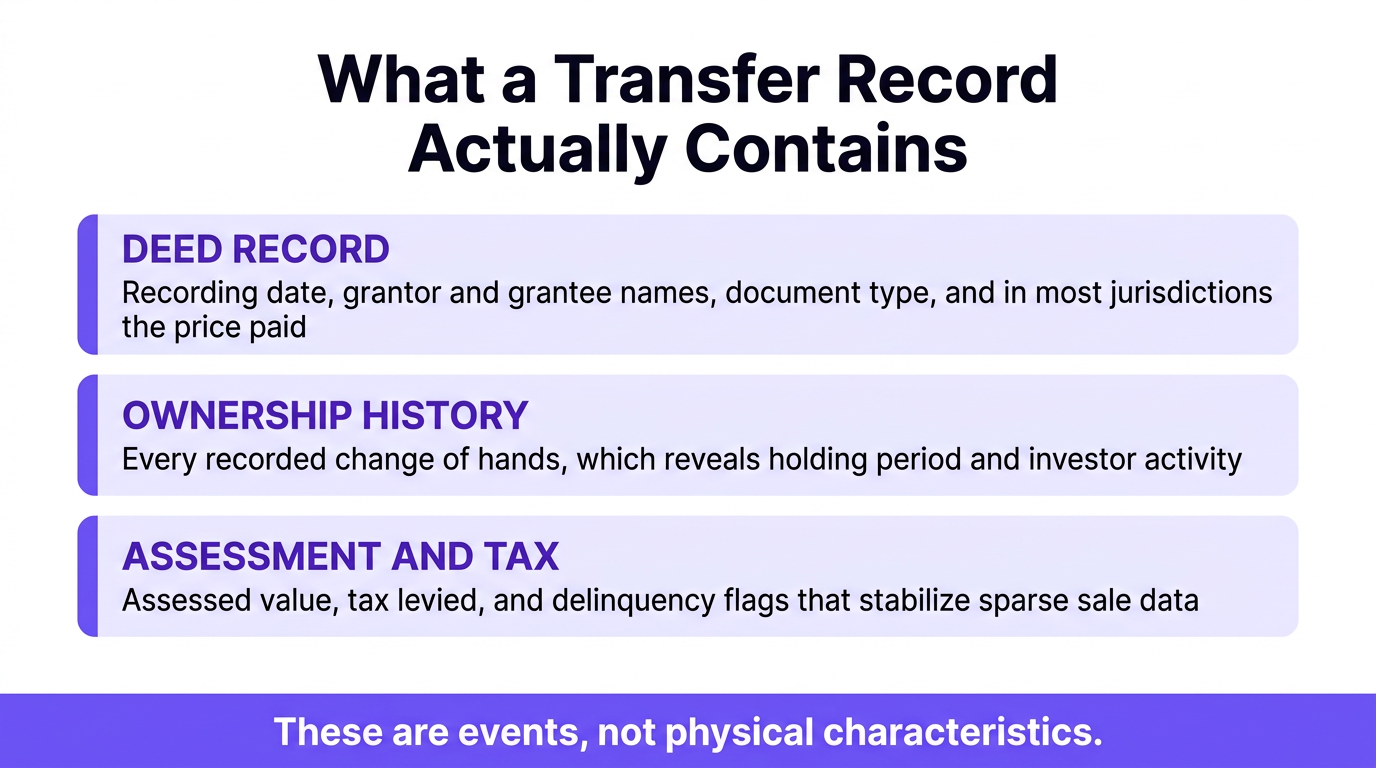
Real estate transaction data is the structured record of property transfers: who sold, who bought, when the transfer closed, what was paid, and how the purchase was financed. It captures events rather than physical characteristics, which is what separates it from the attribute data most property APIs lead with.
The distinction matters for modeling. Square footage tells you what a property is. Transfer history tells you what the market has been willing to pay, and how that willingness has moved over time.
Deed and Sale Records
A deed record documents the legal transfer of title. It carries the recording date, grantor and grantee names, document type, and in most jurisdictions the consideration paid. Deed type matters more than newcomers expect, because a warranty deed between unrelated parties signals a very different event than a quitclaim deed between family members.
Sale records add the commercial layer: sale price, sale date, and often the financing attached. Together these fields separate arm's-length transactions from transfers that should never enter a comparable set. Foreclosure deeds, intrafamily transfers, and corporate reorganizations all appear in raw feeds, and models that fail to filter them produce values that drift low without any obvious cause.
A well-built property sales database exposes these fields as discrete, queryable attributes rather than burying them in document text you have to parse.
Ownership and Title History
Ownership records answer who holds a property and for how long. Chained across successive transfers, they produce a title history covering every recorded change of hands, which is the backbone of both valuation and risk work.
Holding period is one of the most useful derived signals available. A property that changes hands three times in eighteen months behaves differently from one held for two decades, and the gap shows up in pricing behavior and fraud risk alike.
Teams working with real estate ownership data at scale usually find entity resolution is the hard part. The same owner appears under slightly different name spellings across county lines, and reconciling those variants is what turns a pile of records into a portfolio view. Entity ownership in a single-family neighborhood is often the signal that flags investor activity.
Assessment and Tax Records
Assessment records carry the value a taxing authority assigns to a property, along with the tax levied and the assessment year. They are not market values and should never be modeled as such, since assessment ratios and reassessment cycles vary widely by jurisdiction.
They earn their place as a stabilizing signal. Assessed values move slowly and predictably, which makes them useful for flagging outliers in sale price data and for filling gaps where a recorded price is unavailable. Tax delinquency flags carry separate value for distress modeling.
Where Does Real Estate Transaction Data Come From?
Transfer records originate in two very different systems, and understanding the split explains most of the coverage variation you will encounter during vendor evaluation. One system is governmental, nearly universal, slow, and inconsistently formatted. The other is commercial, fast, standardized, and incomplete by design.
County Recorders and Assessors
Deeds are recorded at the county level, which means the authoritative source for property transfers sits across thousands of separate recording offices, each with its own formats, fee structures, and publication cadence. Some counties publish searchable digital indexes within days. Others release scanned images monthly.
That fragmentation is the biggest single reason national coverage is hard to assemble, and a provider covering one state thoroughly may cover its neighbor poorly. Assessor offices run on a separate track with annual or biennial cycles, so joining recorder data to assessor data at the parcel level is a real matching problem that decides whether you receive one coherent property record or two loosely related fragments.
Listing Systems and Closed Sales
Listing systems capture the market side of a transaction: asking price, days on market, closing price, and condition at the time of sale. That context is often richer than anything in the recorded deed.
The limitation is coverage. The National Association of Realtors builds its monthly existing-home sales series on closings reported through listing services, and its methodology notes state plainly that sales trends outside of those systems are not captured. Off-market sales, new construction sold directly by builders, and investor-to-investor transfers frequently never appear.
A complete guide to MLS listing data covers the listing side in depth. The short version: listings describe the market while recordings document the transfer, and a model that sees only one carries a blind spot it cannot measure.
Why Does Coverage Decide Whether Your Valuation Model Works?
Model architecture gets the engineering hours. Coverage decides the outcome. A straightforward model trained on dense, clean records beats a sophisticated one trained on sparse records every time, and no amount of feature engineering closes a gap that starts in the data.
Coverage problems also have a specific shape. They concentrate in exactly the places where valuation is already hardest.
Comp Density in Thin Markets
Comparable sales selection needs volume. In a dense suburban market with steady turnover, finding a dozen recent sales of similar properties within half a mile is trivial. In a rural county with sparse turnover, the same query returns a handful of results, some of them agricultural parcels.
This is where confidence scores collapse and where the business consequences land. Lenders, insurers, and investors need coverage across their entire operating footprint, and a provider that is excellent across the top fifty metros and thin everywhere else leaves the hardest cases unsolved.
Testing against properties in Dallas and Phoenix tells you almost nothing about performance in Vermont or the Nebraska panhandle. Build your evaluation set around the markets where you expect the data to be worst.

Non-Disclosure Markets and Proxy Signals
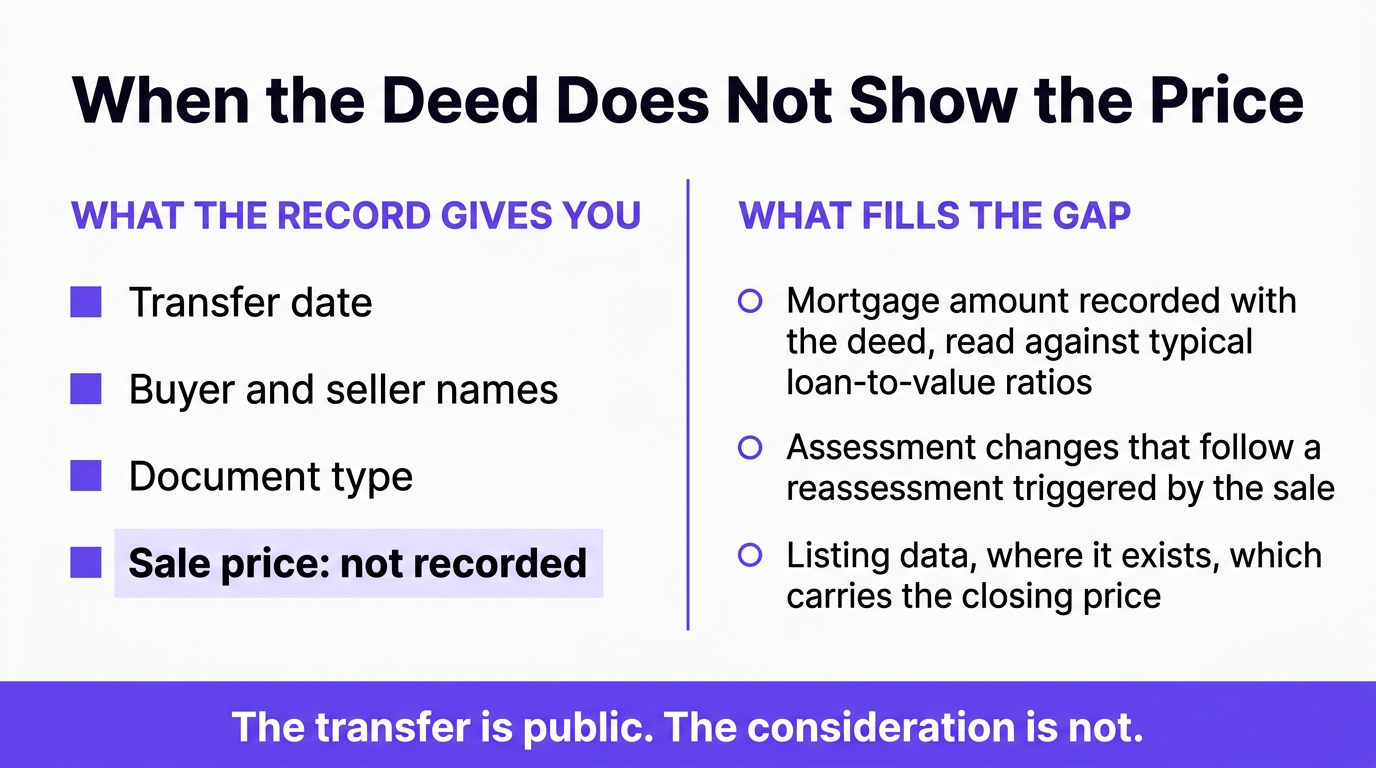
In a number of states, recorded deeds document that a transfer occurred without stating the price paid. The transfer is public. The consideration is not. Standard comparable analysis stops working, and models that assume a price is always present degrade silently rather than failing loudly.
Working these markets means leaning on proxy signals rather than a recorded price:
- Mortgage amounts recorded alongside the deed, which imply a price range when combined with typical loan-to-value ratios
- Assessment changes following a transfer, which often reflect a reassessment triggered by the sale
- Listing data, where it exists, which supplies the closing price the recorder does not
None of that works without breadth. A real estate transaction database built only on recorded deeds leaves you guessing in these states, and one built only on listing data leaves you guessing everywhere listing participation is thin. The value comes from holding several independent signals for the same parcel.
What Regional Licensing Actually Costs You
Many providers sell coverage by region or metro package. That structure creates a predictable set of problems as a product grows, and they compound rather than stay flat.
Each new market becomes a procurement event rather than a configuration change. Expanding from six metros to twenty means fresh contracts, negotiations, and legal review, and roadmaps end up shaped by which agreements closed rather than by where demand is. Schema differences between regional feeds make it worse, since normalizing three vendors into one internal model is permanent engineering work that never earns a line item.
Full national access under a single integration removes that entire category of friction. Adding a market becomes a query parameter change instead of a quarter of contract work, with no per-region packages or volume tiers to renegotiate as usage grows. Residential, commercial, and industrial records arrive through the same interface, so a product that starts with single-family valuation extends into other asset classes without a second integration. Ask providers whether national coverage is included or assembled from regional add-ons, because that answer shapes the second year more than anything on the feature list.
How Does a Transaction Data API Work?
Access pattern matters as much as coverage. The same dataset delivered three ways supports three genuinely different workloads, and most valuation teams use more than one. A transaction data API handles targeted lookups and moderate-volume enrichment. Bulk delivery handles model training and historical backfill. Scheduled queries handle the ongoing job of staying current.
Query Patterns That Fit Valuation Workloads
Most valuation queries take a few recognizable shapes. Address and parcel lookups retrieve the full record for one property, which powers a single valuation request. Geographic radius queries retrieve every recorded transfer within a distance of a point, which builds a comparable set.
Filtered searches combine geography with attributes and date ranges: single-family transfers in a zip code, closed within eighteen months, above a square footage threshold. This is the workhorse query for comp selection, and how expressively a provider supports it decides how much filtering you write yourself.
Two things are worth confirming before you commit. Whether the provider imposes requests-per-second caps that force you to build throttling and retry handling, and whether you are billed for the records you actually receive or for every request you send, including the ones that come back empty.
Keeping a Real Estate Transaction Database Current
Recorded transfers arrive continuously, and a product built on a stale snapshot degrades quietly. The practical pattern is a scheduled delta query: poll the search endpoint on a fixed cadence, filtered to records with a dateUpdated value later than your last successful sync, then upsert the results into your own store.
Two operational details prevent most common failure modes. Store the sync timestamp reported by the provider rather than the one from your own clock, so drift between systems does not open gaps you never notice. And alert on unexpectedly small result sets, because a sync that silently returns zero records looks exactly like a quiet week in the market until someone thinks to check.
Bulk Delivery for Model Training
Training a valuation model means loading years of history at once, and pulling that volume through per-record calls is the wrong tool. Bulk files and scheduled exports move large volumes into a warehouse without iterating requests. Bulk handles the historical load and periodic refreshes, while the API handles targeted lookups and incremental updates in production.
Teams comparing sources for bulk transaction records should confirm both delivery modes draw from the same underlying dataset. If the bulk file and the API response use different field names or date formats, your training pipeline and your production pipeline quietly diverge, and the model you validated stops being the model you shipped.
What Can You Build With Property Transaction Data?
The applications share a common core. Every one depends on knowing what similar properties sold for, when, and under what circumstances. What differs is how much precision each demands and how much tolerance it has for gaps. A marketing segmentation tool works fine with approximate values. A lending decision does not.
Three broad categories account for most production usage:
- Valuation and pricing products, where transfer history supplies the comparable evidence behind every estimate
- Risk and underwriting workflows, where transfer patterns surface collateral concerns before a decision is made
- Market analytics, where aggregated transfers reveal absorption, turnover, and price movement at the neighborhood level
Automated Valuation Models
An automated valuation model estimates a property's value from its characteristics and the recorded behavior of similar properties nearby. Transfer records supply both the dependent variable the model learns from and the comparable evidence it reasons over, which makes them the most consequential input in the system.
Automated valuation keeps expanding into more of the mortgage process. The Federal Housing Finance Agency expanded eligibility for appraisal waivers on purchase loans, raising the maximum loan-to-value ratio for standard waivers from 80 percent to 90 percent and for inspection-based waivers to 97 percent. More decisions resting on model output means more scrutiny on what feeds the model.
Teams building a property valuation tool should plan for confidence scoring from the start. Returning an estimate without a measure of how much comparable evidence supported it invites users to trust a thin result exactly as much as a well-supported one.
Comparable Sales Selection
Comp selection is where data quality becomes visible to end users. The algorithm picks candidate sales by proximity, recency, and similarity, then adjusts for differences between each comparable and the subject property.
Filtering separates usable systems from frustrating ones. Non-arm's-length transfers, portfolio sales where dozens of properties moved under one document, and transactions with obviously anomalous prices all need to come out before adjustment begins. Deed type and document type fields do most of that work, which is why their presence matters considerably more than the raw record count a provider advertises.
Recency thresholds deserve deliberate handling rather than a fixed global window. In a fast-moving market, sales older than six months actively mislead. In a slow rural market, a two-year-old sale may be the best evidence available, and a hard cutoff returns nothing at all.
Underwriting and Portfolio Risk
Lenders use transfer history to confirm a property is what an application claims and that its value has behaved plausibly. Rapid resale at a sharply higher price, a chain of transfers between related entities, or a recorded transfer the borrower failed to disclose all justify a closer look.
Portfolio monitoring extends the same logic across time. Tracking recorded transfers against a book of collateral surfaces ownership changes, new liens, and neighborhood price movement that feeds into loss assumptions. Insurance underwriting and tax appeal work draw on the same records, which argues for sourcing property transaction data from a provider whose coverage already spans property types rather than assembling a feed per use case.
Seven Questions to Ask Before Licensing a Real Estate Transaction Database
Provider evaluations tend to center on record counts, close to the least informative number available. These questions surface what actually determines whether a dataset works for you.
- Where is your coverage thinnest? Every provider has weak markets. The ones worth working with will tell you which.
- How do you distinguish a missing sale price from a zero-dollar transfer? In non-disclosure markets the two look identical in a null field, and a provider that cannot tell them apart will quietly corrupt your comp set.
- Which fields are consistently populated versus occasionally present? A field that exists in the schema but sits null in most records is a fundamentally different product from one that is reliably filled.
- How current is the data, broken out by source type? Recorder lag varies enormously by county. Ask for typical latency ranges by region rather than a single headline number.
- Are residential, commercial, and industrial records available through one interface? Products that start narrow tend to broaden, and discovering you need a second integration two years in is expensive.
- Can I explore the data before writing integration code? A visual portal for running real queries and inspecting real responses answers schema questions in an afternoon that documentation alone leaves open for weeks.
- Is your documentation publicly accessible? Sparse docs that require a sales call just to understand basic query structure preview what support will feel like after you sign.
Frequently Asked Questions
A few questions come up repeatedly from teams scoping this work for the first time.
What Is the Difference Between Real Estate Transaction Data and Property Records?
Property records is the broader term, covering physical attributes, ownership, assessment, and transfers together. Transaction data refers specifically to the event layer: deeds, sales, and the details of each transfer. Most providers deliver both, though the depth of the transaction layer varies far more between vendors than the attribute layer does.
How Far Back Does Transfer History Typically Go?
Depth varies by county rather than by provider. Many jurisdictions have digitized records reaching back decades, while others have reliable digital coverage only for recent years. Ask about depth in your specific target markets rather than accepting a national average, since the average conceals exactly the variation that will affect your model.
Do I Need Listing Data If I Already Have Recorded Transfer Records?
For most valuation work, yes. Recorded data confirms that a transfer happened and usually what was paid. Listing data explains the property's condition, how long it took to sell, and how far the closing price moved from the asking price. Adjustment logic performs considerably better with that context.
How Often Should a Transaction Data API Sync Run?
Daily suits most valuation and analytics workloads, because county recording lag usually exceeds any delay a once-a-day poll introduces. Push the cadence higher only if your product surfaces brand-new transfers as a headline feature, and keep in mind that faster polling cannot overcome slow publication at the source.
Can Transfer Records Be Used for Commercial Property Valuation?
Yes, though the comparable logic differs. Commercial valuation leans more on income characteristics and less on nearby sales, and comp sets get drawn from a wider radius because similar assets are sparser. The recorded transfer data behaves the same way across asset classes, which is why single-interface access across property types is worth confirming early.
Building Valuation Products on Real Estate Transaction Data
The distance between a valuation prototype and a production system is almost entirely a data problem. Coverage determines whether your model performs in the markets you actually serve. Field completeness determines how much cleanup precedes the first usable estimate. Delivery flexibility determines whether training and production run on the same foundation or slowly drift apart.
Whichever provider you choose, instrument the gaps you inherit. Log the valuation requests that return fewer comparables than your confidence threshold requires, break those failures out by state and county, and revisit your sourcing when a market you care about keeps appearing. Coverage problems surface in production long before they show up in a vendor comparison.
Datafiniti delivers transaction records across residential, commercial, and industrial property types through a single API with full national coverage, alongside structured property data that brings attributes, ownership, and transfer history together in one record. Request a demo to get started and see how the data fits your valuation workflow.
Read the latest articles

Read more

Product Data API for Ecommerce Price Monitoring and Repricing

Real-Time Product Data API for Product-Led Growth Teams

Property Ownership Data API for Skip Tracing and Lead Gen

How APIs Make Building a Product Database Easy
Learn how to build a product database with APIs for cleaner imports, updates, search, and scalable product data.

What Is Property Transaction Data and How Does an API Help Get It?
Learn how property transaction data works and how APIs provide structured access for analysis and workflows.

How to Use Real Estate Transaction Data
Learn how to use real estate transaction data for analysis, valuation, underwriting, and market decisions.

How to Leverage Competitor Pricing Data with an API
Use competitor pricing data to build API-driven monitoring, analysis, and smarter pricing decisions.

Price Monitoring API: The Key to E-Commerce Pricing Strategy
Use a price monitoring API to track market changes, improve pricing decisions, and protect ecommerce margins.

How do Product Data APIs Work for E-Commerce Companies?
Learn how a product data API works, from collection and queries to ecommerce integration and use cases.

Bulk Real Estate Data Licensing: Access Datasets at Scale

How to Integrate MLS Listings Using an MLS Data API

GTIN Lookup API: Search Products by Barcode & UPC at Scale

Best Real Estate API 2026: Coverage, Pricing, Data Quality

Best Product Data API 2026: A State-of-the-Market Guide

Product Data API Integration Patterns for Ecommerce Platforms

Build a PropTech MVP With a Property Ownership Data API

3 Benefits of Web Scraping for Real Estate
Boost your research by using web scraping for real estate to gain market insights, automate lead lists, and minimize property risk.
How Real Estate Agents Can Leverage Proptech Data
Leverage proptech data to source leads, speed up valuations, and manage risk with accurate, real-time property insights.

What Is a UPC Lookup API?
Learn about the UPC lookup API, how it works, and its benefits for businesses. Get product data easily.

What Is a GTIN Lookup API?
Learn about the GTIN lookup API and how it can help your business grow. Get product data insights.

How Does a Property Data API Work?
Learn how a property data API works, its features, and how you can use it for real estate and business insights.

What The Best Real Estate APIs Should Have
Discover what makes the best real estate APIs stand out. Learn about essential features for your property data needs.
The Benefits of a Real Estate MLS API
Learn about the benefits of a real estate MLS API for streamlining data access and driving business growth.

Why Every Real Estate Pro Needs an MLS Database API
Learn why a MLS database API is vital for real estate pros. Get data, insights, and competitive edge.
How to Access MLS Listing Data
Learn how to access MLS listing data using an MLS data API. Discover Datafiniti's solutions and integration tips.
.png)
How to Enrich Your Product Catalog With a Real-Time API
.jpeg)
Product Data API Buyer's Guide for Ecommerce Teams

Do I Need a Real Estate Listing API?
Explore the benefits and technicalities of a real estate listing API. Learn how to choose the right provider and integrate data for business growth.

Unlocking the MLS Database with APIs
Unlock the MLS database with APIs. Learn how to access property data, gain real estate insights, and integrate MLS data for your business needs.

Why Real Estate Tech Startups Need Property APIs with Ownership Details
Discover how property APIs with ownership details empower real estate tech startups. Learn about data integration, risk mitigation, and driving business value.
The Value of a Product Catalog Sync for Product Managers
Unlock the value of product catalog sync for product managers. Streamline data, improve decisions, and reduce costs with real-time insights.

What is a Product Data Webhook?
Learn about product data webhooks, their components, and how they enable real-time updates for business intelligence and workflow automation.

Why Is a Product Data API Integration Essential for Analysts & Product Managers?
Unlock insights with product data API integration. Essential for analysts & product managers to streamline data access & enhance product strategy.

What Is a Product Data API and Its Benefits
Learn about product data APIs, their benefits, and how they drive business growth. Explore integration and advanced use cases.

What Do eCommerce Data Vendors Do?
Learn what ecommerce data vendors do, their services, and how to choose the right one for your business growth.

How to Compare Product Data Providers: What to Look For
Compare product data providers. Learn what to look for in data quality, structure, and integration features.

How to Get Your Product Data in Real-Time Using APIs
Learn how to leverage real-time product data APIs for e-commerce, competitive analysis, and AI. Get instant access to clean, structured product data.

Best Product Data API: Features to Look for
Find the best product data API with real-time updates, comprehensive coverage, and a user-friendly portal. Explore features to look for.

Unlocking Property Data with an API
Access property data with a powerful property database API. Explore listings, market analysis, investment opportunities, and more. Get started today!

Unlocking CRE with APIs
Unlock commercial real estate insights with a powerful API. Access property data, streamline workflows, and enhance investment strategies.

How to Get a Real-Time Product Feed Using an API
Learn how to get a real-time product feed using an API. Access, leverage, and ensure accuracy of product data for your business needs.

Spying on Competitor Prices: What You Need to Know
Learn how to gather and analyze competitor pricing data to inform your business strategy. Understand key components and ethical considerations.

Product Data Enrichment: What Are You Missing?
Enhance your product data with comprehensive enrichment. Discover insights, drive growth, and choose the right approach for your business.
.png)
IDX vs MLS API: A Developer's Guide to Real Estate Listing Data
.png)
Real Estate API Pricing Models Explained: Subscription vs. Usage-Based

Real Estate API vs Web Scraping: Which Wins in 2026?
.png)
Product Data APIs Explained: Powering Product Search and Catalog Automation

Best Sources for Bulk Real Estate Transaction Data

How to Get the Most out of a Product Catalog API
Learn how to leverage a product catalog API for business growth. Discover data quality, access methods, and strategy for your product catalog API.

Taming Your Ecommerce Product Data Feed
Optimize your ecommerce product data feed for growth. Learn strategies, leverage technology, and ensure data quality for better customer experience and AI initiatives.

Streamlining Your Product Search with an API
Explore the benefits and integration of a product search API. Streamline your product discovery and leverage data for business growth.
.png)
Real Estate Transaction Databases: What You Need to Know
.png)
Best MLS API for Real Estate Software: What Developers Need

How Real Estate Platforms Access MLS Database APIs
.png)
Commercial Real Estate API vs. Residential Property API
.png)
How to Choose a Real Estate Database API for Your MVP
MLS API vs. IDX: What's the Diff?
MLS API vs IDX: Explore the differences in real estate data access, retrieval, and integration. Understand which solution fits your needs.

Scraping vs. APIs: Getting Real Estate Data
Compare web scraping vs real estate API for data acquisition. Learn the pros, cons, and best use cases for each method.

Cracking the Code: Housing Sales Insights
Unlock housing sales analytics insights with Datafiniti. Explore property data, market trends, and advanced techniques for strategic decisions.

Property Valuation API: Your Go-To Real Estate Tool
Leverage the property valuation API for real estate insights. Access comprehensive property data for diverse applications with Datafiniti.

Product Data APIs Explained
Learn about product data APIs explained. Discover how to access, integrate, and utilize product data for e-commerce, analytics, and more.

Unlocking Your Ecommerce Data with APIs
Unlock ecommerce data with APIs for business insights, product catalog enrichment, and competitive analysis. Explore data via portal or API.

Your Guide to Housing Sales APIs
Explore housing sales API data for insights. Access property data, integrate into applications, and gain business intelligence. Get started today!

Real Estate Ownership Data: How to Access, Analyze and Use at Scale
Access, analyze, and use real estate ownership data at scale. Learn how to find, process, and leverage this crucial information for business insights.

Unlocking Opportunities: Navigating Bulk Real Estate Transaction Data
Unlock opportunities with bulk real estate transaction data. Learn how to access, analyze, and leverage property data for investing, marketing, and more.
What Is a Property Sales Database?
Explore what a property sales database is, its core components, how to access data, and key use cases for real estate analysis and more.

Benefits of Obtaining Housing Transaction Data
Unlock insights with housing transaction data. Analyze markets, investments, sales, and risk. Get comprehensive property data for informed decisions.
Understanding Real Estate Transaction Databases
IDX vs MLS API: What Every Real Estate Professional Should Know
Understand IDX vs MLS API differences. Learn about data access, integration, and how Datafiniti's solutions empower real estate professionals.

What Is an MLS Database API?
Explore the MLS database API: understand its components, benefits, and how to access real estate data for various applications. Learn about its core functionality and technical aspects.

How a Property Database API Can Help Real Estate Pros
Learn how a property database API can help real estate pros analyze trends, monitor listings, and optimize strategies. Get data insights.

What Is a Residential Property API?
Explore what a residential property API is, its features, benefits, and real-world applications for real estate professionals and investors.

What Is a Commercial Real Estate API?
Explore commercial real estate API functionality, data integration, and use cases. Learn how to leverage property, business, and people data for insights.

Understanding MVP Data Integration
Learn about MVP data integration, its components, benefits, and strategies for accessing and utilizing data resources effectively.

How to Choose the Best Property Data API
Learn how to choose the best property data API. Explore features, providers, pricing, and integration for real estate insights.

Real Estate Database API: What to Look for
Explore real estate database API options. Learn about data quality, features, and how to choose the right provider for your needs.
.png)
Real Estate Transaction Database: An API Access Guide

How Do Product Data APIs Work?
Understand how a product data API works, its key features, integration methods, and applications for e-commerce and business intelligence.

How Do Data Aggregation Platforms Work?
Explore how data aggregation platforms work, their capabilities, and applications. Learn to choose and implement the right platform for your business intelligence needs.

Why Do Companies Need Property Data Aggregation?
Discover why property data aggregation is crucial for businesses. Streamline access, empower functions, enhance risk management, and drive strategic decisions with authoritative insights.

MLS API: The Complete Guide to Accessing MLS Listing Data

Product Search API vs. Product Data API: What's the Difference?
What Are the Best MLS Data API Features to Look For?
Discover the best MLS data API features, including real-time updates, bulk downloads, and flexible filtering for property data.

What Is a Product Data API?
Explore the functionality and benefits of a product data API. Learn how to integrate, leverage, and choose the right provider for your business insights.
What Is the Difference Between Product Search API and Product Data API?
Understand the difference between Product Search API and Product Data API. Learn how to leverage product data for business intelligence and analytics.

Guide to Accessing Real Estate Transaction Database Via API
Access real estate transaction data via API. Explore property insights, sales, underwriting, and advanced applications with our authoritative guide.
Is a Real Estate MLS API Beneficial?
Explore the benefits of a real estate MLS API for enhanced data access, streamlined workflows, and market responsiveness. Learn about key features and use cases.

What is an MLS Database API?
Explore the MLS database API for comprehensive property data access. Learn about its core functionality, key features, and integration into real estate technology.

What Is a Property Data API?
Explore the capabilities of a property data API. Understand its core functionality, key features for developers, and how to access property information at scale for business insights.
.png)
Real Estate API Pricing: What You Need to Know Before You Build
.jpeg)
How to Choose a Property Market API for Investment Platforms
Choosing the right property market API is critical for investment platforms. Learn how to evaluate data depth, coverage, freshness, and integration quality before you commit.
Data you can trust, delivered in a format your systems can use, at the scale your product requires.