

Best Sources for Bulk Real Estate Transaction Data
Key Takeaways
Every source of bulk real estate transaction data traces back to the same county records, so what separates providers is not what they have but how much of it you can verify before you integrate.
- County recorders and tax assessors are the authoritative layer, but collecting them yourself means solving a separate data problem in every county you enter.
- The main source types fail in different places: freshness, schema consistency, and how fast a field-level problem gets resolved.
- Record counts predict almost nothing about whether your specific markets and property types are actually covered.
- Grantee and grantor names, recording dates, deed types, and parcel identifiers decide what you can build. Sale price alone does not.
Run your real query against real records before you sign anything. A provider that cannot show you that is asking you to buy on trust.
Capital is moving again, and every dollar of it leaves a record. U.S. commercial real estate investment volume climbed 21% year to date through the first half of 2026, reaching $250.3 billion. Layer residential activity on top of that and the annual trail of real estate transaction data runs into millions of recorded transfers.
For teams building underwriting engines, valuation models, and investment platforms on that trail, the question is rarely whether the data exists. It is how to get bulk real estate transaction data at national scale without stitching together regional feeds, signing four contracts to cover twelve states, or paying for records that never arrive. Getting to structured property data at scale is a sourcing decision before it is an engineering one.
This guide covers where the records originate, how the main transaction data sources compare in 2026, which fields determine what you can build, and the verification step that separates a source that works from one that looked good in a sales deck.
What Is Bulk Real Estate Transaction Data?
Real estate transaction data is the record of property transfers across a market: what sold, when it was recorded, for how much, and between which parties. The bulk version means those records arrive in volume through an API or a file export rather than one property at a time.
The term gets stretched. A provider can describe a product as a complete transaction database while shipping records that carry little beyond sale price and address. Before comparing sources, it helps to be specific about what a usable record contains.
The Core Transaction Fields
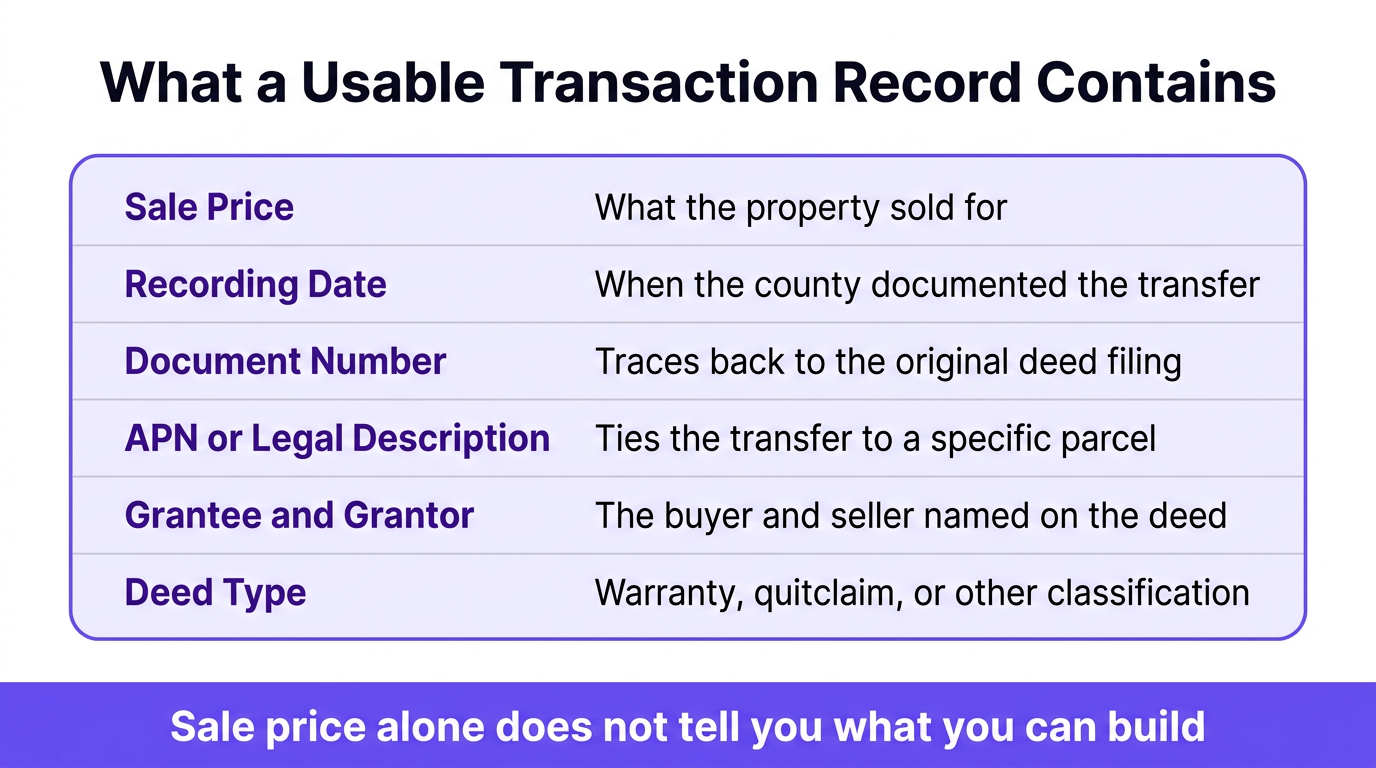
At minimum, a usable record includes sale price, recording date, document number, and the legal description or APN that ties the transfer to a specific parcel. Recording date usually matters more than sale date for historical work, because it marks when the transfer was officially documented and stays consistent across jurisdictions.
Document numbers let you trace a record back to the original deed filing. When a model produces an outlier, that traceability is the difference between fixing a data issue in an hour and arguing about it for a week.
Many workflows also need buyer and seller names, which appear in deed language as grantee and grantor. These drive ownership chain analysis, portfolio tracking, and any application identifying the entity behind a transfer rather than the address alone. Deeper records add mortgage and lien detail, deed type classifications, and prior sale history for the same parcel. The field list available through any property sales database determines which analyses are possible without buying a second source to fill gaps.
How Ownership Records Extend the Picture
Transaction records capture events. Ownership records capture state: who holds the deed now, how long they have held it, and whether encumbrances affect the title.
Hold duration is one of the most useful signals in the dataset. Properties held ten years or longer by individual owners draw investor attention because long holds can indicate motivation or price flexibility. Working with ownership data at scale means reconstructing chain of title, which requires coverage complete enough to rebuild the full sequence of transfers.
Completeness also varies by property type. Residential parcels tend toward standardized documentation because the mortgage process demands clean title. Commercial and industrial properties more often sit behind entities and trusts that need parsing before a beneficial owner is identifiable.

Where Does Bulk Real Estate Transaction Data Come From?
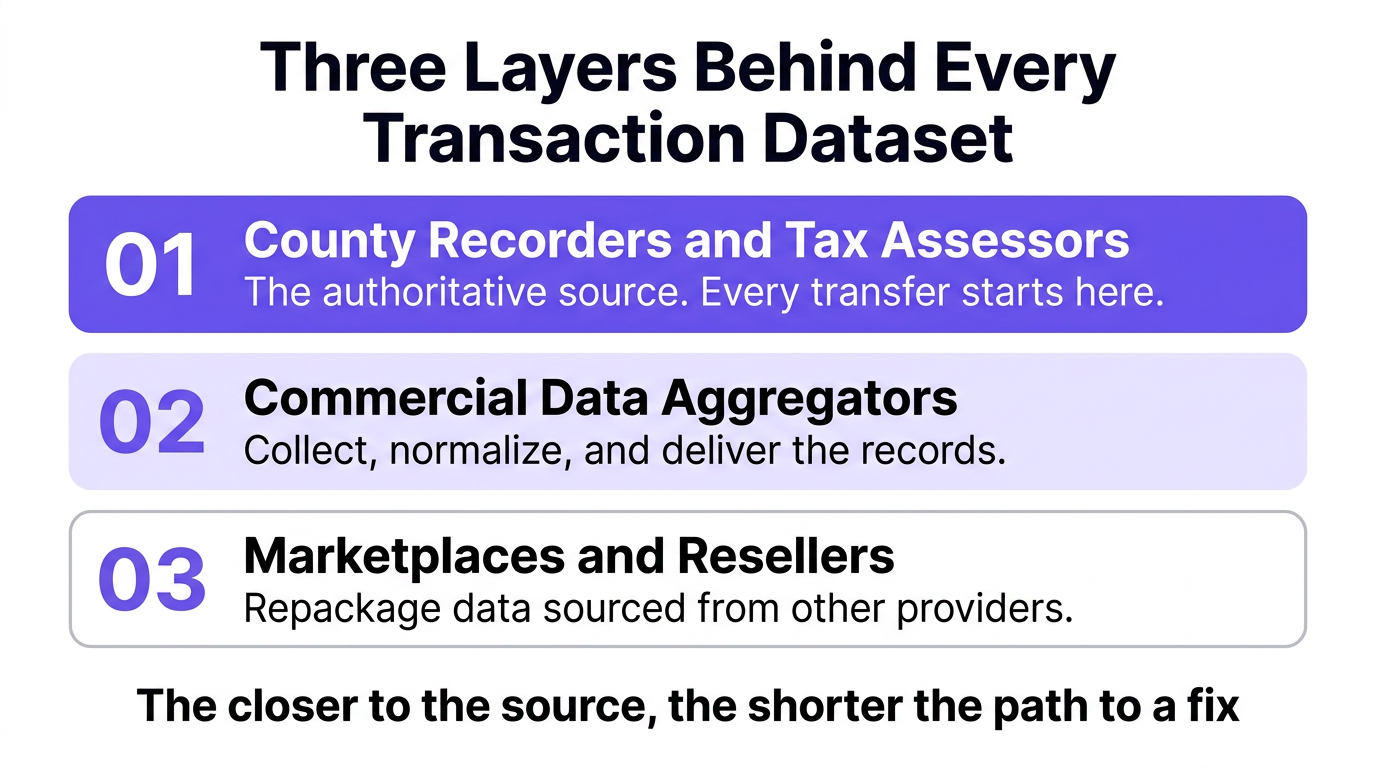
Source layer determines freshness, completeness, and which gaps surface in production. Providers drawing from the same upstream channels share the same blind spots. What differentiates them is how much of the country they reached, how often they refresh, and how much normalization happened before delivery.
County Recorders and Tax Assessors
Every property transfer in the United States generates a public record. A recorded deed becomes permanent public record, and tax assessors maintain a parallel set tying ownership to assessment values and tax history. Together these form the authoritative foundation beneath every commercial product on the market. The obstacle is arithmetic: the country has 3,069 counties, parishes, and boroughs, each with its own system, digitization timeline, and format.
Some publish daily electronic feeds. Others still require retrieving physical documents. Any provider claiming national coverage solved that problem in every one of those jurisdictions, including the rural counties where digitization moved slowest. This fragmentation is the main reason building an in-house feed is prohibitively expensive for most teams.
Commercial Data Aggregators
Aggregators sit between public records and end users. They handle county-by-county collection, normalize field names, resolve entity names, and deliver through APIs or scheduled file exports. What you buy is not access to otherwise unavailable data. It is access to data already collected, cleaned, and shaped for programmatic use.
Quality varies on two axes: how complete county coverage actually is, and how consistent the schema stays across property types. A provider covering nearly all U.S. counties sounds close to complete, but the remainder is never randomly scattered. It clusters in rural markets and secondary metros, which is exactly where expanding platforms tend to go next.
Marketplaces and Resellers
A third tier packages and redistributes data from primary providers. Marketplaces genuinely help with discovery and side-by-side shopping, and they lower the effort of building a shortlist. They also add a layer between you and the source.
That escalation distance is the real cost. When a field starts returning nulls across a region, a reseller often cannot diagnose or fix it upstream. They file a ticket on your behalf and wait, which turns a data question into a scheduling question.
How Do the Main Transaction Data Sources Compare in 2026?
Most published comparisons rank vendors by record count. That number means little alone, because two providers reporting similar totals can differ enormously in which counties, property types, and fields those totals represent. A more useful comparison looks at structural trade-offs, since those are what your engineering team lives with.
Across the four common approaches, the trade-offs sort cleanly:
- Direct county access gives you the freshest, most authoritative records, at the cost of building collection logic for every jurisdiction you enter. Practical for a handful of counties, unworkable nationally.
- Aggregator APIs give you normalized national records through one integration, and you inherit whatever coverage and refresh cadence the provider achieved. Verification before commitment is what makes this option safe.
- Bulk file licensing suits model training and warehouse seeding where you need the full historical set. Refresh happens on a negotiated schedule rather than on request.
- Marketplaces shorten discovery but lengthen the path to resolution when something breaks.
Pricing structure cuts across all four. Per-record models, where you pay only for records actually delivered, behave predictably at volume. Per-request models charge for every query regardless of whether it returned anything, so broad exploratory queries and empty result sets both cost money. At bulk volumes that difference compounds.
Residential activity shows the scale involved. Existing-home sales ran at a seasonally adjusted annual rate of 4.09 million in June 2026, up 2.8% year over year, and each closing generates a deed record and an ownership transfer. Commercial and industrial activity sits on top of that. A platform operating nationally needs a data layer built for that throughput rather than one that caps requests per second and forces you to write retry logic around it.
Downstream requirements should drive the choice. Teams consuming real estate transaction data for AVMs and comparable-sales analysis tolerate different refresh lags than a lead-generation workflow does, and that tolerance decides whether bulk files, scheduled API pulls, or both belong in your architecture.
Why Should You Explore the Data Before You Integrate?
Here is the pattern that costs teams the most money. Coverage looks fine during evaluation, because evaluation happens against markets you already serve. Gaps surface in production, after query logic, pipelines, and dashboards were built on the assumption that records are complete. By then remediation is expensive and public. The fix is unglamorous: look at real records before you write integration code.
What a Portal Shows You That Documentation Cannot
A visual portal for browsing available records and building queries changes the shape of an evaluation. Instead of reading a coverage claim, you filter to your actual target counties and see what returns. Instead of trusting a field list, you pull sample records and check which fields are populated versus present but empty. Those are different things, and only one of them is visible from documentation.
This is also where documentation quality reveals itself. Providers with fragmented backends tend to have fragmented docs, because each regional dataset carries edge cases a unified document cannot cleanly describe. When basic query structure requires a sales call to understand, that opacity is usually protecting something. A provider confident in its coverage has no reason to hide the query surface, which is a useful filter when evaluating any real estate API against a shortlist.
How Do You Keep Bulk Property Data Current After the First Load?
Bulk delivery solves the initial load. It does not solve month two. Property records change continuously as new deeds record, assessments update, and ownership transfers post, so a static snapshot decays from the day it lands.
The supported pattern is a scheduled delta query. On whatever cadence your use case requires, query the API filtered to records changed since your last successful sync, then merge the returns into your store. Daily suits underwriting and lead workflows. Weekly is usually enough for market analytics and model retraining.
Two details separate a sync that works from one that quietly rots. Store the timestamp of the last successful run rather than assuming your schedule executed, so a failed job does not silently skip a day. And instrument the record count per run, because a drop to zero looks identical to a quiet week unless you are watching for it.
7 Questions to Ask Any Bulk Real Estate Transaction Data Provider
These questions surface the real shape of a source faster than any spec sheet. Vague answers are themselves the answer.
- What is your county-level coverage, and how do you handle gaps? Ask for a number, not the word nationwide. A provider with genuine coverage can tell you what happens when a county goes dark.
- Are commercial and industrial records on the same integration? Residential-only coverage fails most institutional and mixed-use applications, and separate products mean separate schemas and contracts.
- Am I billed for queries or for records? Paying per record delivered means you are charged for data you actually receive. Paying per request means empty results cost the same as full ones.
- What are your throughput limits? Requests-per-second caps push throttling and retry logic into your codebase, work that adds no business value and never stops needing maintenance.
- How does update frequency vary by data type and region? Recorder data and assessor data move on different cycles. If some regions lag others, that lag is usually a coverage gap wearing a different label.
- Can I see the actual field list? The gap between buyer and seller information and named grantee and grantor fields with document numbers decides whether chain-of-title work is possible at all.
- Can I run my query against real records before signing? If seeing the data requires completing an integration first, you are committing engineering time before you know whether the data clears your bar.
Frequently Asked Questions
A few questions come up in nearly every evaluation of transaction data sources.
What Is Bulk Real Estate Transaction Data Used For?
It powers investment models, automated valuation systems, underwriting workflows, fraud detection, and market intelligence dashboards. What unites those applications is that they need large volumes of historical and current records rather than single-property lookups.
Is Public Record Data Free If I Collect It Myself?
The records are public, but access is not uniformly free or available. Some counties charge retrieval or subscription fees, some publish bulk files at no cost, and some still require in-person requests. The larger expense is engineering: separate collection logic for every jurisdiction, each able to change format without notice.
How Do I Know Whether a Provider Actually Covers My Markets?
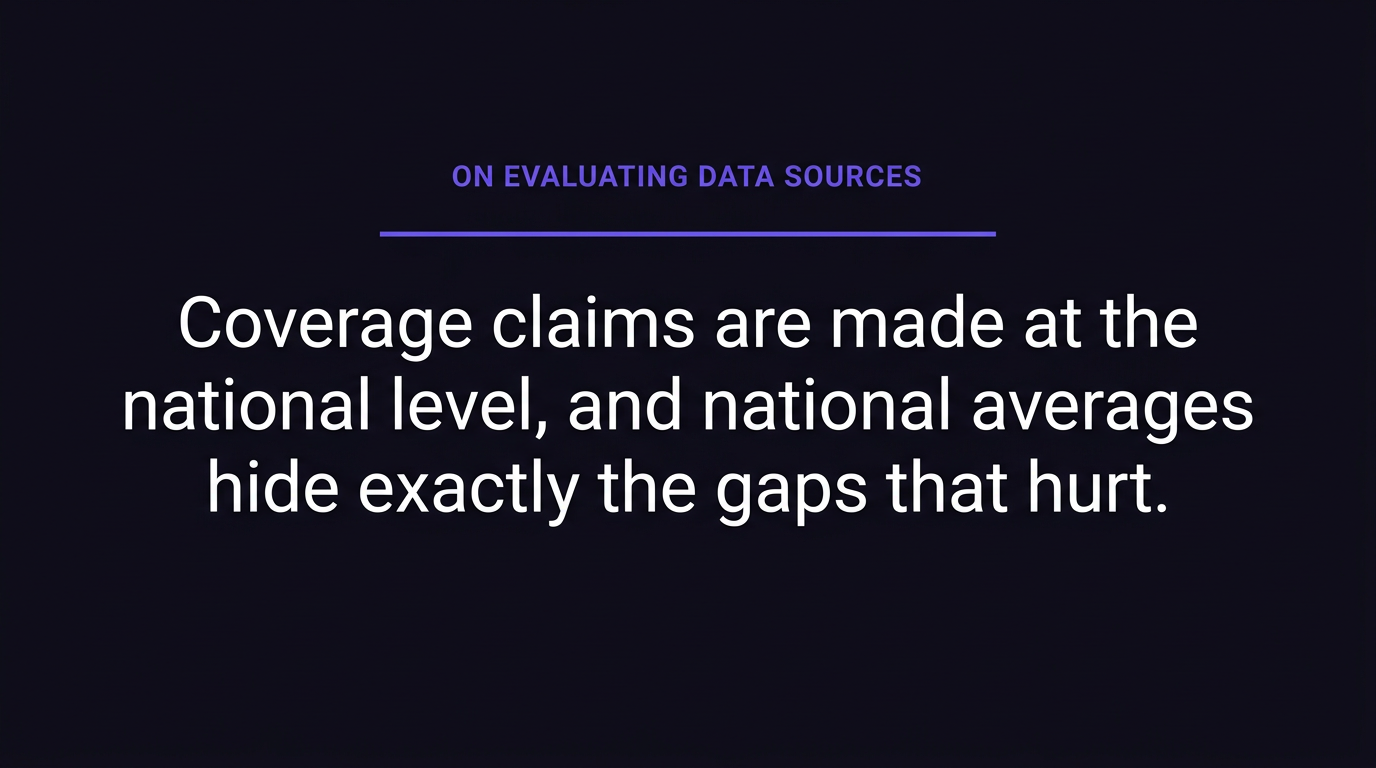
Test it rather than asking. Pick five counties that matter to your business, including at least one rural county and one secondary metro, and query for recent transfers in each. Then check field population rates on the returned records rather than only whether records came back. Coverage claims are made at the national level, and national averages hide exactly the gaps that hurt.
Does Bulk Property Data Include Commercial and Industrial Properties?
It depends on the provider, and it is worth confirming explicitly. Many transaction data sources built coverage residential-first, then added other property types later as separate products with different fields and contracts. If your roadmap includes mixed-use, multifamily at scale, or industrial, verify those records return through the same integration and schema before building around a residential-only assumption.
Choosing Your Bulk Real Estate Transaction Data Source
The quality of a source is not determined by the fields on a spec sheet. It is determined by whether coverage holds across every geography you serve, every property type your application touches, and every query volume your system generates. Regional packaging, residential-only records, and opaque refresh cycles are engineering problems that compound as you scale.
Teams that verify before they integrate avoid the expensive version of this decision. Everything else, including pricing structure and documentation depth, is a signal that confirms or contradicts what the records themselves already showed you. That holds whether you are licensing bulk property data for model training or querying it on demand.
Datafiniti provides structured property data covering residential, commercial, and industrial records through one API, with per-record pricing, no rate limiting, and a visual portal for exploring what is available before you write a line of integration code. See what returns for your markets and your fields, then decide. Request a demo to get started.
Read the latest articles

Read more

How to Build a Product Database With a Product Data API

Property Data API Coverage: What U.S. Datasets Include

Product Data API for Ecommerce Price Monitoring and Repricing

Real-Time Product Data API for Product-Led Growth Teams

Property Ownership Data API for Skip Tracing and Lead Gen

How APIs Make Building a Product Database Easy
Learn how to build a product database with APIs for cleaner imports, updates, search, and scalable product data.

What Is Property Transaction Data and How Does an API Help Get It?
Learn how property transaction data works and how APIs provide structured access for analysis and workflows.

How to Use Real Estate Transaction Data
Learn how to use real estate transaction data for analysis, valuation, underwriting, and market decisions.

How to Leverage Competitor Pricing Data with an API
Use competitor pricing data to build API-driven monitoring, analysis, and smarter pricing decisions.

Price Monitoring API: The Key to E-Commerce Pricing Strategy
Use a price monitoring API to track market changes, improve pricing decisions, and protect ecommerce margins.

How do Product Data APIs Work for E-Commerce Companies?
Learn how a product data API works, from collection and queries to ecommerce integration and use cases.

Bulk Real Estate Data Licensing: Access Datasets at Scale

How to Integrate MLS Listings Using an MLS Data API

GTIN Lookup API: Search Products by Barcode & UPC at Scale

Best Real Estate API 2026: Coverage, Pricing, Data Quality

Best Product Data API 2026: A State-of-the-Market Guide

Product Data API Integration Patterns for Ecommerce Platforms

Build a PropTech MVP With a Property Ownership Data API

3 Benefits of Web Scraping for Real Estate
Boost your research by using web scraping for real estate to gain market insights, automate lead lists, and minimize property risk.
How Real Estate Agents Can Leverage Proptech Data
Leverage proptech data to source leads, speed up valuations, and manage risk with accurate, real-time property insights.

What Is a UPC Lookup API?
Learn about the UPC lookup API, how it works, and its benefits for businesses. Get product data easily.

What Is a GTIN Lookup API?
Learn about the GTIN lookup API and how it can help your business grow. Get product data insights.

How Does a Property Data API Work?
Learn how a property data API works, its features, and how you can use it for real estate and business insights.

What The Best Real Estate APIs Should Have
Discover what makes the best real estate APIs stand out. Learn about essential features for your property data needs.
The Benefits of a Real Estate MLS API
Learn about the benefits of a real estate MLS API for streamlining data access and driving business growth.

Why Every Real Estate Pro Needs an MLS Database API
Learn why a MLS database API is vital for real estate pros. Get data, insights, and competitive edge.
How to Access MLS Listing Data
Learn how to access MLS listing data using an MLS data API. Discover Datafiniti's solutions and integration tips.
.png)
How to Enrich Your Product Catalog With a Real-Time API
.jpeg)
Product Data API Buyer's Guide for Ecommerce Teams

Do I Need a Real Estate Listing API?
Explore the benefits and technicalities of a real estate listing API. Learn how to choose the right provider and integrate data for business growth.

Unlocking the MLS Database with APIs
Unlock the MLS database with APIs. Learn how to access property data, gain real estate insights, and integrate MLS data for your business needs.

Why Real Estate Tech Startups Need Property APIs with Ownership Details
Discover how property APIs with ownership details empower real estate tech startups. Learn about data integration, risk mitigation, and driving business value.
The Value of a Product Catalog Sync for Product Managers
Unlock the value of product catalog sync for product managers. Streamline data, improve decisions, and reduce costs with real-time insights.

What is a Product Data Webhook?
Learn about product data webhooks, their components, and how they enable real-time updates for business intelligence and workflow automation.

Why Is a Product Data API Integration Essential for Analysts & Product Managers?
Unlock insights with product data API integration. Essential for analysts & product managers to streamline data access & enhance product strategy.

What Is a Product Data API and Its Benefits
Learn about product data APIs, their benefits, and how they drive business growth. Explore integration and advanced use cases.

What Do eCommerce Data Vendors Do?
Learn what ecommerce data vendors do, their services, and how to choose the right one for your business growth.

How to Compare Product Data Providers: What to Look For
Compare product data providers. Learn what to look for in data quality, structure, and integration features.

How to Get Your Product Data in Real-Time Using APIs
Learn how to leverage real-time product data APIs for e-commerce, competitive analysis, and AI. Get instant access to clean, structured product data.

Best Product Data API: Features to Look for
Find the best product data API with real-time updates, comprehensive coverage, and a user-friendly portal. Explore features to look for.

Unlocking Property Data with an API
Access property data with a powerful property database API. Explore listings, market analysis, investment opportunities, and more. Get started today!

Unlocking CRE with APIs
Unlock commercial real estate insights with a powerful API. Access property data, streamline workflows, and enhance investment strategies.

How to Get a Real-Time Product Feed Using an API
Learn how to get a real-time product feed using an API. Access, leverage, and ensure accuracy of product data for your business needs.

Spying on Competitor Prices: What You Need to Know
Learn how to gather and analyze competitor pricing data to inform your business strategy. Understand key components and ethical considerations.

Product Data Enrichment: What Are You Missing?
Enhance your product data with comprehensive enrichment. Discover insights, drive growth, and choose the right approach for your business.
.png)
IDX vs MLS API: A Developer's Guide to Real Estate Listing Data
.png)
Real Estate API Pricing Models Explained: Subscription vs. Usage-Based

Real Estate API vs Web Scraping: Which Wins in 2026?
.png)
Product Data APIs Explained: Powering Product Search and Catalog Automation
Best Sources for Bulk Real Estate Transaction Data

How to Get the Most out of a Product Catalog API
Learn how to leverage a product catalog API for business growth. Discover data quality, access methods, and strategy for your product catalog API.

Taming Your Ecommerce Product Data Feed
Optimize your ecommerce product data feed for growth. Learn strategies, leverage technology, and ensure data quality for better customer experience and AI initiatives.

Streamlining Your Product Search with an API
Explore the benefits and integration of a product search API. Streamline your product discovery and leverage data for business growth.
.png)
Real Estate Transaction Databases: What You Need to Know
.png)
Best MLS API for Real Estate Software: What Developers Need

How Real Estate Platforms Access MLS Database APIs
.png)
Commercial Real Estate API vs. Residential Property API
.png)
How to Choose a Real Estate Database API for Your MVP
MLS API vs. IDX: What's the Diff?
MLS API vs IDX: Explore the differences in real estate data access, retrieval, and integration. Understand which solution fits your needs.

Scraping vs. APIs: Getting Real Estate Data
Compare web scraping vs real estate API for data acquisition. Learn the pros, cons, and best use cases for each method.

Cracking the Code: Housing Sales Insights
Unlock housing sales analytics insights with Datafiniti. Explore property data, market trends, and advanced techniques for strategic decisions.

Property Valuation API: Your Go-To Real Estate Tool
Leverage the property valuation API for real estate insights. Access comprehensive property data for diverse applications with Datafiniti.

Product Data APIs Explained
Learn about product data APIs explained. Discover how to access, integrate, and utilize product data for e-commerce, analytics, and more.

Unlocking Your Ecommerce Data with APIs
Unlock ecommerce data with APIs for business insights, product catalog enrichment, and competitive analysis. Explore data via portal or API.

Your Guide to Housing Sales APIs
Explore housing sales API data for insights. Access property data, integrate into applications, and gain business intelligence. Get started today!

Real Estate Ownership Data: How to Access, Analyze and Use at Scale
Access, analyze, and use real estate ownership data at scale. Learn how to find, process, and leverage this crucial information for business insights.

Unlocking Opportunities: Navigating Bulk Real Estate Transaction Data
Unlock opportunities with bulk real estate transaction data. Learn how to access, analyze, and leverage property data for investing, marketing, and more.
What Is a Property Sales Database?
Explore what a property sales database is, its core components, how to access data, and key use cases for real estate analysis and more.

Benefits of Obtaining Housing Transaction Data
Unlock insights with housing transaction data. Analyze markets, investments, sales, and risk. Get comprehensive property data for informed decisions.

Understanding Real Estate Transaction Databases
IDX vs MLS API: What Every Real Estate Professional Should Know
Understand IDX vs MLS API differences. Learn about data access, integration, and how Datafiniti's solutions empower real estate professionals.

What Is an MLS Database API?
Explore the MLS database API: understand its components, benefits, and how to access real estate data for various applications. Learn about its core functionality and technical aspects.

How a Property Database API Can Help Real Estate Pros
Learn how a property database API can help real estate pros analyze trends, monitor listings, and optimize strategies. Get data insights.

What Is a Residential Property API?
Explore what a residential property API is, its features, benefits, and real-world applications for real estate professionals and investors.

What Is a Commercial Real Estate API?
Explore commercial real estate API functionality, data integration, and use cases. Learn how to leverage property, business, and people data for insights.

Understanding MVP Data Integration
Learn about MVP data integration, its components, benefits, and strategies for accessing and utilizing data resources effectively.

How to Choose the Best Property Data API
Learn how to choose the best property data API. Explore features, providers, pricing, and integration for real estate insights.

Real Estate Database API: What to Look for
Explore real estate database API options. Learn about data quality, features, and how to choose the right provider for your needs.
.png)
Real Estate Transaction Database: An API Access Guide

How Do Product Data APIs Work?
Understand how a product data API works, its key features, integration methods, and applications for e-commerce and business intelligence.

How Do Data Aggregation Platforms Work?
Explore how data aggregation platforms work, their capabilities, and applications. Learn to choose and implement the right platform for your business intelligence needs.

Why Do Companies Need Property Data Aggregation?
Discover why property data aggregation is crucial for businesses. Streamline access, empower functions, enhance risk management, and drive strategic decisions with authoritative insights.

MLS API: The Complete Guide to Accessing MLS Listing Data

Product Search API vs. Product Data API: What's the Difference?

What Are the Best MLS Data API Features to Look For?
Discover the best MLS data API features, including real-time updates, bulk downloads, and flexible filtering for property data.

What Is a Product Data API?
Explore the functionality and benefits of a product data API. Learn how to integrate, leverage, and choose the right provider for your business insights.
What Is the Difference Between Product Search API and Product Data API?
Understand the difference between Product Search API and Product Data API. Learn how to leverage product data for business intelligence and analytics.

Guide to Accessing Real Estate Transaction Database Via API
Access real estate transaction data via API. Explore property insights, sales, underwriting, and advanced applications with our authoritative guide.

Is a Real Estate MLS API Beneficial?
Explore the benefits of a real estate MLS API for enhanced data access, streamlined workflows, and market responsiveness. Learn about key features and use cases.

What is an MLS Database API?
Explore the MLS database API for comprehensive property data access. Learn about its core functionality, key features, and integration into real estate technology.

What Is a Property Data API?
Explore the capabilities of a property data API. Understand its core functionality, key features for developers, and how to access property information at scale for business insights.
.png)
Real Estate API Pricing: What You Need to Know Before You Build
.jpeg)
How to Choose a Property Market API for Investment Platforms
Choosing the right property market API is critical for investment platforms. Learn how to evaluate data depth, coverage, freshness, and integration quality before you commit.
Data you can trust, delivered in a format your systems can use, at the scale your product requires.