
.png)
How to Choose a Real Estate Database API for Your MVP
Key Takeaways
The API decision you make at the MVP stage can save or cost your startup months of rework.
- The U.S. PropTech market is expected to reach $76.84 billion by 2034, and the startups that scale fastest get their data infrastructure right early.
- Per-request pricing models charge for failed queries, making costs unpredictable when you can least afford surprises.
- Rate limiting forces developers to build throttling logic that adds engineering debt from day one.
- Geographic data packages create scaling friction that multiplies contract overhead as your product grows.
Evaluate your real estate database API against pricing structure, coverage, rate limits, and property type access before writing a line of integration code.
Startups building on real estate data face an early, high-stakes decision: which property data API will power the product. Get it right and your MVP ships cleanly, scales without surprises, and supports the features users actually want. Get it wrong and you spend months wrestling with throttling logic, renegotiating regional contracts, or refactoring around a pricing model that never made sense for how you actually use data.
The U.S. PropTech market is projected to reach $76.84 billion by 2034, growing at an 18.5% CAGR. At the same time, the sector attracted roughly $4.3 billion in growth equity and financing in 2024 alone, signaling that competition among PropTech startups is only intensifying. In that environment, the startups that move fastest are the ones who nail their data infrastructure decisions early. A real estate database API is not a commodity purchase. It is a foundational architectural decision, and it deserves the same scrutiny you would give any core dependency.
This guide walks through exactly what to evaluate, what questions to ask, and which pricing and access models will slow you down rather than accelerate you. Whether you are building a property search app, an investment analytics platform, an underwriting tool, or anything in between, the criteria here apply.
What Does a Real Estate Database API Actually Do for Your MVP?
A real estate database API connects your application to structured property data: records covering addresses, property characteristics, ownership history, tax assessments, transaction history, listing activity, and more. Rather than building your own data pipeline from public records and web sources, you query an API and receive clean, normalized records ready for your product's logic.
For an MVP, that distinction matters enormously. Your job at this stage is to validate a product hypothesis as quickly as possible. Every week spent cleaning raw data, reconciling conflicting records, or debugging a fragile scraping pipeline is a week not spent on your actual product. A well-chosen property data API compresses that timeline significantly, getting your team from idea to testable build in days rather than months.
The Core Data Types That Power PropTech Products
Depending on what you are building, you will need different slices of the property record. Search-first apps need address data, property characteristics, and current listing status. Analytics platforms need transaction history, tax assessments, and pricing trends over time. Underwriting and risk tools need ownership records, lien data, and off-market property status. Fraud detection workflows need address validation, occupancy status, and ownership verification.
The strongest property data providers cover all of these field categories within a single, consistent schema. When your data provider structures records this way, you build against one integration rather than stitching together multiple sources as the product grows. That consolidation matters even more at the MVP stage, when engineering bandwidth is limited and context-switching is expensive.
Real estate data has historically been fragmented and non-standardized — a challenge Deloitte's 2025 commercial real estate research identifies as one of the primary barriers to AI adoption and data-driven decision-making across the industry. A well-structured API that normalizes and standardizes records at ingestion removes that friction before it ever reaches your product.
Why Your API Choice Is an Architectural Decision, Not a Simple Vendor Swap
Developers sometimes treat the data API as a swappable dependency, something you can replace later if it does not work out. In practice, switching property data providers mid-product is painful. Field names change, schema structures differ, queries need to be rewritten, and historical records do not always migrate cleanly. What looks like a vendor swap in the planning doc is often a multi-week refactor in reality.
Choosing the right real estate database API at the outset means fewer breaking changes, a stable schema your team can build against with confidence, and pricing behavior that does not surprise you after you have already integrated. The cost of a poor early decision compounds quickly as your codebase, team, and user base grow around it.
The Real Estate Database API Evaluation Checklist
The fastest way to evaluate a property data API for your MVP is to work through a consistent set of criteria before you talk to any vendor. The table below covers the ten factors that matter most at the startup stage. Run any prospective provider through it before you evaluate anything else — these are structural decisions that shape your build from the ground up, not features you can patch in later.

Pricing Models: Where Most Startups Get Burned
Pricing is where most startup teams underestimate the damage until they have already signed on. There are two dominant models in the property data API market, and they produce very different outcomes for a startup workflow.
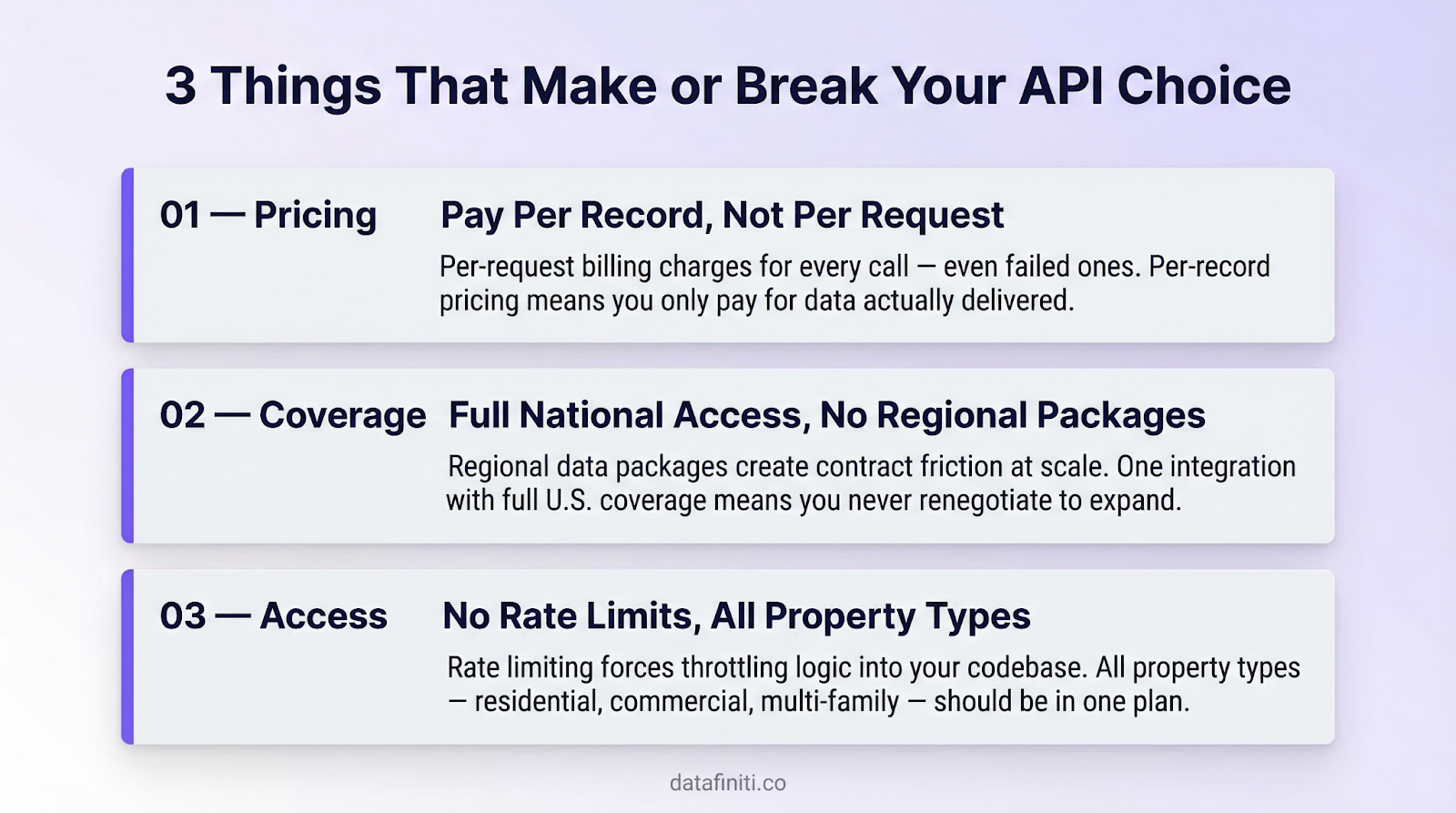
Per-request pricing charges a fee every time your application makes an API call, regardless of whether that call returns useful data. Search a specific address and get zero results: you still pay for the request. Run a broad filter query across a metro area with 50,000 properties, get back 12 that match your criteria, and you pay for the full request volume. Over a development cycle of testing, iterating on queries, and building features that require multiple lookups, the costs accumulate fast and in ways that are genuinely difficult to forecast.

Per-record pricing works differently. Often delivered through a credit-based system, you are charged only for the records actually delivered. If your query returns one property, you are charged for one record. If it returns zero, you pay nothing. For a startup working through an MVP build with frequent query iteration and exploratory data work, this is the difference between a cost model that reflects the value you receive and one that penalizes you for the learning process.
Here is what per-request pricing looks like in practice for a startup team:
- A developer runs 200 exploratory queries over a week of feature development, each returning 0 to 5 records. Per-request billing charges for all 200 calls regardless of results.
- An integration test suite fires hundreds of API calls during CI/CD runs. The test data is throwaway, but the cost is real.
- A search feature with open-ended user input generates frequent no-result queries. Every failed search is a billable event.
Per-record pricing eliminates all three of these scenarios. You pay for data received. For a startup still calibrating how users will interact with the product, that predictability is foundational to keeping your burn rate under control.
Coverage, Rate Limits, and Building for Scale
Data coverage and access policy are the two factors that look fine during early testing but create serious problems at scale. Most startups do not discover them until they are already in growth mode and the friction becomes unavoidable.
Geographic Coverage and Regional Packaging
Some property data providers sell access by region or metro area: a package for the Northeast, a separate one for the Southwest, tiered coverage based on which markets you want to serve. For a local MVP targeting one city, this structure appears workable. For anything with national ambitions, it becomes a structural problem that compounds over time.
Expanding geographic coverage with regional packages means renegotiating contracts. Each region is a separate procurement conversation, often without the volume discounts that come with unified national access. If your product grows into markets you did not initially anticipate, which is exactly what product-market fit tends to look like, you are back at the negotiating table with different rate structures and potentially different integration requirements for each region. A real estate database API that provides full national access from day one sidesteps this entirely. You build once, and expand your product's reach without revisiting the data layer.
Rate Limiting and the Hidden Engineering Cost
Rate limiting enforces a cap on how many API requests your application can make per second or per minute. It is usually framed as a minor technical detail, but for a production application under real user load, it generates real, ongoing engineering work.
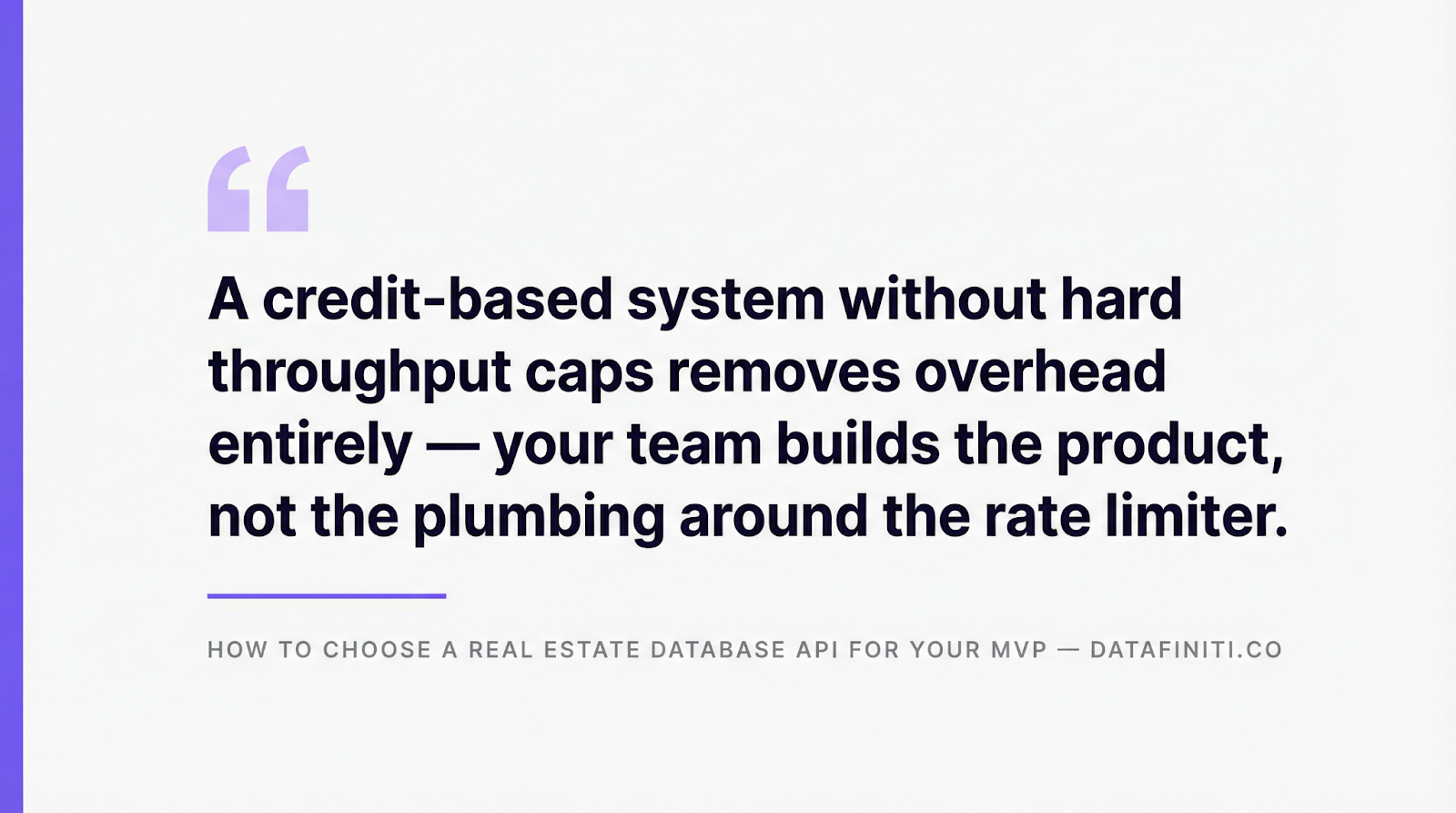
When your application hits a rate limit, requests fail unless you have built retry logic, implemented exponential backoff, added request queuing, and tested failure behavior under load. None of that work has anything to do with your product's value proposition. It is infrastructure overhead that exists entirely because the data provider restricts throughput. A credit-based system without hard throughput caps removes this overhead entirely. Your team builds the product, not the plumbing around the rate limiter, and that is a meaningful difference in where your engineering hours go during a critical build phase.
Property Types and Future-Proofing Your Integration
Many developers start an MVP focused on residential properties and assume they can add commercial or multi-family data later through an upgrade or a separate integration. This assumption is often wrong. Some providers segment property types into separate products or pricing tiers, which means expanding your property scope requires a second integration, a second contract, and a second schema to maintain in parallel.
Building on an API that covers residential, commercial, multi-family, land, and specialty property types under a single integration protects you from that rework. As your product evolves, whether that means adding commercial search to a residential platform, building landlord tools that span asset types, or supporting investment analysis across property classes, the data layer is already in place. You extend the product without rebuilding its foundation.

Developer Experience and Integration Speed
At the MVP stage, time to production is a genuine competitive advantage. A startup real estate API with strong developer experience compresses your build timeline in ways that accumulate meaningfully across a full development cycle. There are three dimensions worth evaluating before you commit to any provider.
The signal for documentation quality is specificity, not length. Good API documentation includes a complete field dictionary so you understand what every attribute means, example queries built around real use cases, schema references with field-level data types, and clear guidance on query construction.
Many property data providers ship documentation that is sparse, inconsistently maintained, or locked behind a sales conversation — leaving developers to reverse-engineer behavior through trial and error. That hidden cost compounds across a full development cycle. Look for providers whose API documentation is publicly accessible from day one, with enough detail that your team can evaluate fit and begin building without waiting on a sales rep to explain how the product works.
Schema Stability as a Long-Term Dependency
A stable schema means your integration does not break when the data provider updates their product. Many providers change field names, restructure nested objects, or deprecate endpoints without clear versioning or migration paths. For a startup running a lean engineering team, surprise breaking changes are disproportionately disruptive because there is no dedicated team to absorb and respond to them quickly.
Look for providers who document schema changes clearly, maintain versioned API endpoints, and give advance notice of deprecations. A stable, well-documented schema is a signal that the provider was built with production teams in mind and understands what developer trust actually requires.
A Visual Portal for Exploring Data Before You Commit
Most property data APIs offer only a query interface — you write a call, submit it, and parse the response. That works fine once you know exactly what you are looking for, but it creates a slow, iterative process when you are still figuring out what data fields exist, how records are structured, and whether coverage matches your use case. A web-based explorer that lets you browse available data visually, filter records interactively, and test query logic through a simple interface compresses that discovery phase significantly. For an MVP team deciding whether a data provider is the right fit, being able to explore real records without writing a single line of code is a meaningful advantage — and a differentiator that most competitors do not offer.
Free Trials That Use Real Data
Sandboxed demo data is not useful for evaluating a property data API. A sandbox environment with synthetic records or artificially limited field visibility cannot tell you whether actual coverage matches your use case, whether the data structure fits your product's logic, or whether query performance holds up under realistic conditions. A free trial that exposes real data with full field visibility, bounded only by record volume, gives you what you need to make a confident MVP data integration decision before committing a budget.
Five Questions to Ask Before You Commit
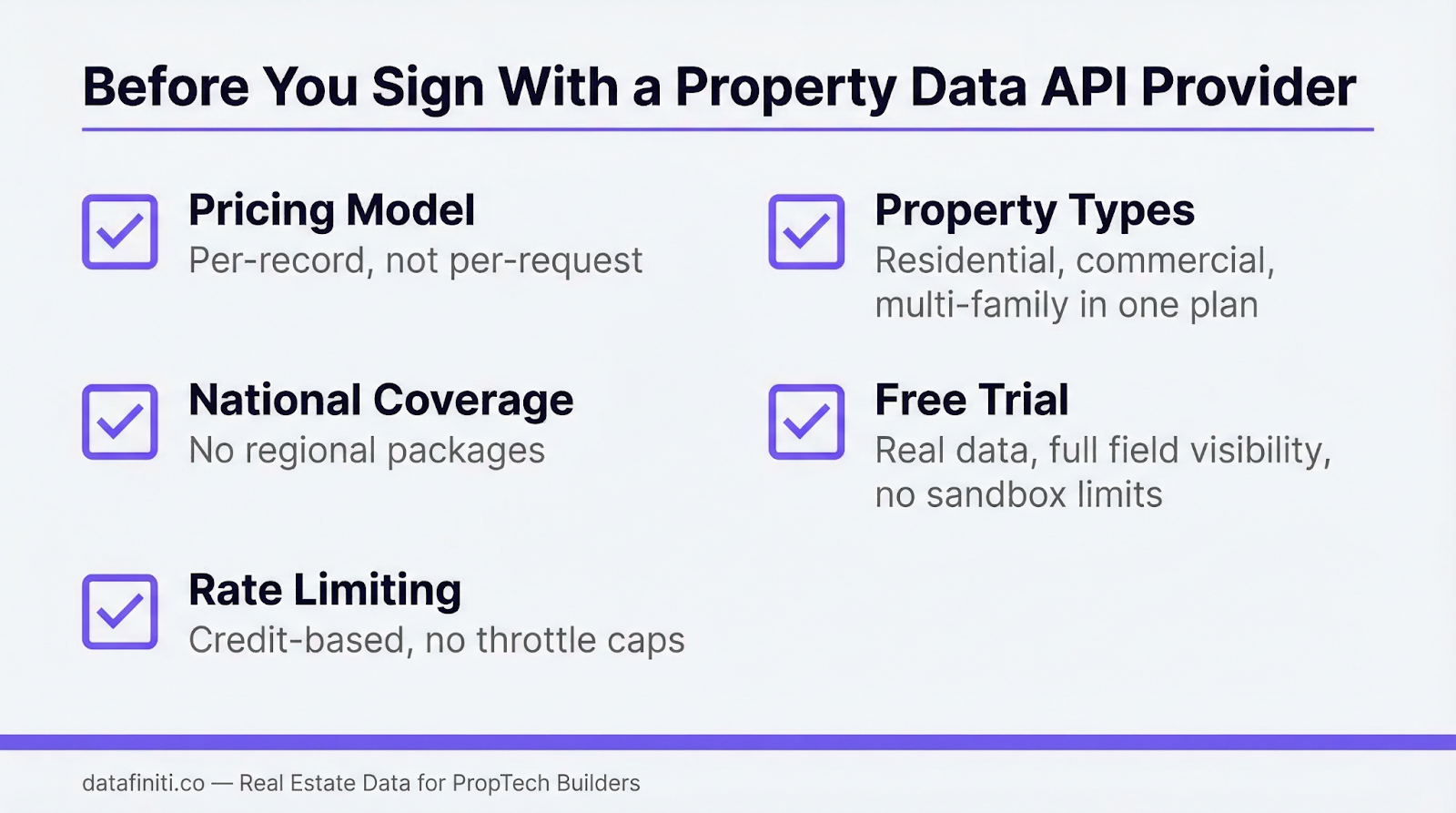
Before selecting a property data API provider, get direct answers to these five questions. They surface the structural issues that do not appear in a feature comparison or a demo.
- Do you charge per request or per record delivered? The answer tells you whether costs are tied to data value or to API activity volume. Per-request billing is the wrong pricing model for a startup in active development.
- Is national coverage included, or packaged by region? If the answer involves regional packages, ask directly how expansion is handled and what pricing looks like as you enter new markets.
- Do you enforce rate limits, and what happens when we hit them? If limits exist, ask what engineering accommodations are required and whether limits scale with plan tier or remain fixed.
- What property types are included in our plan? Confirm that residential and commercial are accessible under the same integration and the same pricing tier, not separated into siloed products.
- What does the free trial actually include? A trial with real data and full field visibility lets you validate actual coverage before you commit budget. A restricted sandbox does not.
Per-Request vs. Per-Record: What the Difference Looks Like in Practice
The pricing model comparison below illustrates how the two dominant structures play out across the criteria that matter most to a startup team. The practical implications compound quickly once you factor in test runs, query iteration, and production traffic.

The distinction between these models is sharpest during the MVP build phase, when query volumes are unpredictable, development requires iteration, and every dollar of runway matters. Per-record pricing is built for exactly that environment.
Frequently Asked Questions
What is a real estate database API and why does a startup need one?
A property data API gives your application programmatic access to structured property records: addresses, ownership history, transaction data, tax assessments, listing activity, and more. Startups use them to skip the expensive, time-consuming work of building their own data pipeline from raw public records. For an MVP, a reliable property data API compresses time-to-launch and lets your team focus on product logic rather than data infrastructure.
What pricing and access factors matter most when evaluating a property data API?
Pricing model and rate limit policy are the two factors that create the most friction during an MVP build. A per-record billing model means you only pay for data actually delivered — failed queries and empty results cost nothing, which keeps burn rate predictable during active development. Rate limiting is equally important: when a provider enforces hard request-per-second caps, your team has to build throttling logic and retry handling just to work around a data infrastructure constraint. Look for a provider whose access model removes both of these friction points from the start.
What property types should a startup's real estate database API cover?
At minimum, look for an API that covers residential and commercial property types under a single integration. Access to multi-family, land, and specialty types within the same plan future-proofs your integration as the product evolves. Providers that silo property types into separate products or pricing tiers create costly rework when your product needs to cross those boundaries.
Choose the Right Foundation Before You Build
Choosing a real estate database API at the MVP stage is one of the highest-leverage decisions you will make in early product development. Pricing model, geographic coverage, rate limit policy, and property type access all compound over time. Getting them right from the start saves significant engineering time, budget, and renegotiation overhead as your product and team grow.
Datafiniti's property data API is built for exactly this kind of technical evaluation. With per-record credit-based pricing, no artificial rate limiting, full national U.S. coverage, and residential, commercial, multi-family, land, and specialty property types under a single integration, it removes the structural friction that slows down early-stage PropTech builds. A free trial gives your team access to real property records with full field visibility so you can validate coverage and query behavior before committing. When you are ready to build on reliable property data, get in touch with the Datafiniti team to start your evaluation.
Read the latest articles

Read more

Build vs Buy: Business Data Enrichment for Growing Teams

Company Data API Pricing: Bulk & Enterprise-Scale Access

Best Business Data APIs for Sales Teams & Prospecting

Business Data API: Company Data at Enterprise Scale

How to Build a Product Database With a Product Data API

Property Data API Coverage: What U.S. Datasets Include

Product Data API for Ecommerce Price Monitoring and Repricing

Real-Time Product Data API for Product-Led Growth Teams

Property Ownership Data API for Skip Tracing and Lead Gen

How APIs Make Building a Product Database Easy
Learn how to build a product database with APIs for cleaner imports, updates, search, and scalable product data.

How to Leverage Competitor Pricing Data with an API
Use competitor pricing data to build API-driven monitoring, analysis, and smarter pricing decisions.

Price Monitoring API: The Key to E-Commerce Pricing Strategy
Use a price monitoring API to track market changes, improve pricing decisions, and protect ecommerce margins.

How do Product Data APIs Work for E-Commerce Companies?
Learn how a product data API works, from collection and queries to ecommerce integration and use cases.

GTIN Lookup API: Search Products by Barcode & UPC at Scale

Best Real Estate API 2026: Coverage, Pricing, Data Quality

Best Product Data API 2026: A State-of-the-Market Guide

Product Data API Integration Patterns for Ecommerce Platforms

Build a PropTech MVP With a Property Ownership Data API

3 Benefits of Web Scraping for Real Estate
Boost your research by using web scraping for real estate to gain market insights, automate lead lists, and minimize property risk.

How Real Estate Agents Can Leverage Proptech Data
Leverage proptech data to source leads, speed up valuations, and manage risk with accurate, real-time property insights.

What Is a UPC Lookup API?
Learn about the UPC lookup API, how it works, and its benefits for businesses. Get product data easily.

What Is a GTIN Lookup API?
Learn about the GTIN lookup API and how it can help your business grow. Get product data insights.

How Does a Property Data API Work?
Learn how a property data API works, its features, and how you can use it for real estate and business insights.

What The Best Real Estate APIs Should Have
Discover what makes the best real estate APIs stand out. Learn about essential features for your property data needs.
How to Access MLS Listing Data
Learn how to access MLS listing data using an MLS data API. Discover Datafiniti's solutions and integration tips.
.png)
How to Enrich Your Product Catalog With a Real-Time API
.jpeg)
Product Data API Buyer's Guide for Ecommerce Teams

Do I Need a Real Estate Listing API?
Explore the benefits and technicalities of a real estate listing API. Learn how to choose the right provider and integrate data for business growth.

Why Real Estate Tech Startups Need Property APIs with Ownership Details
Discover how property APIs with ownership details empower real estate tech startups. Learn about data integration, risk mitigation, and driving business value.
The Value of a Product Catalog Sync for Product Managers
Unlock the value of product catalog sync for product managers. Streamline data, improve decisions, and reduce costs with real-time insights.

What is a Product Data Webhook?
Learn about product data webhooks, their components, and how they enable real-time updates for business intelligence and workflow automation.

Why Is a Product Data API Integration Essential for Analysts & Product Managers?
Unlock insights with product data API integration. Essential for analysts & product managers to streamline data access & enhance product strategy.

What Is a Product Data API and Its Benefits
Learn about product data APIs, their benefits, and how they drive business growth. Explore integration and advanced use cases.

What Do eCommerce Data Vendors Do?
Learn what ecommerce data vendors do, their services, and how to choose the right one for your business growth.

How to Compare Product Data Providers: What to Look For
Compare product data providers. Learn what to look for in data quality, structure, and integration features.

How to Get Your Product Data in Real-Time Using APIs
Learn how to leverage real-time product data APIs for e-commerce, competitive analysis, and AI. Get instant access to clean, structured product data.

Best Product Data API: Features to Look for
Find the best product data API with real-time updates, comprehensive coverage, and a user-friendly portal. Explore features to look for.

Unlocking Property Data with an API
Access property data with a powerful property database API. Explore listings, market analysis, investment opportunities, and more. Get started today!

Unlocking CRE with APIs
Unlock commercial real estate insights with a powerful API. Access property data, streamline workflows, and enhance investment strategies.

How to Get a Real-Time Product Feed Using an API
Learn how to get a real-time product feed using an API. Access, leverage, and ensure accuracy of product data for your business needs.

Spying on Competitor Prices: What You Need to Know
Learn how to gather and analyze competitor pricing data to inform your business strategy. Understand key components and ethical considerations.

Product Data Enrichment: What Are You Missing?
Enhance your product data with comprehensive enrichment. Discover insights, drive growth, and choose the right approach for your business.
.png)
IDX vs MLS API: A Developer's Guide to Real Estate Listing Data
.png)
Real Estate API Pricing Models Explained: Subscription vs. Usage-Based

Real Estate API vs Web Scraping: The Buy-vs-Build Decision
.png)
Product Data APIs Explained: Powering Product Search and Catalog Automation

How to Get the Most out of a Product Catalog API
Learn how to leverage a product catalog API for business growth. Discover data quality, access methods, and strategy for your product catalog API.

Taming Your Ecommerce Product Data Feed
Optimize your ecommerce product data feed for growth. Learn strategies, leverage technology, and ensure data quality for better customer experience and AI initiatives.

Streamlining Your Product Search with an API
Explore the benefits and integration of a product search API. Streamline your product discovery and leverage data for business growth.
.png)
What Is a Real Estate Transaction Database? A Complete Guide

How Real Estate Platforms Access MLS Database APIs
.png)
Commercial Real Estate API vs. Residential Property API
How to Choose a Real Estate Database API for Your MVP
MLS API vs. IDX: What's the Diff?
MLS API vs IDX: Explore the differences in real estate data access, retrieval, and integration. Understand which solution fits your needs.

Scraping vs. APIs: Getting Real Estate Data
Compare web scraping vs real estate API for data acquisition. Learn the pros, cons, and best use cases for each method.

Property Valuation API: Your Go-To Real Estate Tool
Leverage the property valuation API for real estate insights. Access comprehensive property data for diverse applications with Datafiniti.

Product Data APIs Explained
Learn about product data APIs explained. Discover how to access, integrate, and utilize product data for e-commerce, analytics, and more.

Unlocking Your Ecommerce Data with APIs
Unlock ecommerce data with APIs for business insights, product catalog enrichment, and competitive analysis. Explore data via portal or API.

Real Estate Ownership Data: How to Access, Analyze and Use at Scale
Access, analyze, and use real estate ownership data at scale. Learn how to find, process, and leverage this crucial information for business insights.

IDX vs MLS API: What Every Real Estate Professional Should Know

How a Property Database API Can Help Real Estate Pros
Learn how a property database API can help real estate pros analyze trends, monitor listings, and optimize strategies. Get data insights.

What Is a Residential Property API?
Explore what a residential property API is, its features, benefits, and real-world applications for real estate professionals and investors.

What Is a Commercial Real Estate API?
Explore commercial real estate API functionality, data integration, and use cases. Learn how to leverage property, business, and people data for insights.

Understanding MVP Data Integration
Learn about MVP data integration, its components, benefits, and strategies for accessing and utilizing data resources effectively.

How to Choose the Best Property Data API
Learn how to choose the best property data API. Explore features, providers, pricing, and integration for real estate insights.

Real Estate Database API: What to Look for
Explore real estate database API options. Learn about data quality, features, and how to choose the right provider for your needs.

How Do Product Data APIs Work?
Understand how a product data API works, its key features, integration methods, and applications for e-commerce and business intelligence.

How Do Data Aggregation Platforms Work?
Explore how data aggregation platforms work, their capabilities, and applications. Learn to choose and implement the right platform for your business intelligence needs.

Why Do Companies Need Property Data Aggregation?
Discover why property data aggregation is crucial for businesses. Streamline access, empower functions, enhance risk management, and drive strategic decisions with authoritative insights.

MLS Database API: How to Choose a Provider and Get Access

Product Search API vs. Product Data API: What's the Difference?

What Is a Product Data API?
Explore the functionality and benefits of a product data API. Learn how to integrate, leverage, and choose the right provider for your business insights.
What Is the Difference Between Product Search API and Product Data API?
Understand the difference between Product Search API and Product Data API. Learn how to leverage product data for business intelligence and analytics.

What Is a Property Data API?
Explore the capabilities of a property data API. Understand its core functionality, key features for developers, and how to access property information at scale for business insights.
.png)
Real Estate API Pricing: What You Need to Know Before You Build
.jpeg)
How to Choose a Property Market API for Investment Platforms
Choosing the right property market API is critical for investment platforms. Learn how to evaluate data depth, coverage, freshness, and integration quality before you commit.
Data you can trust, delivered in a format your systems can use, at the scale your product requires.