
.png)
Commercial Real Estate API vs. Residential Property API
Key Takeaways
A commercial real estate API and a residential property API serve different schemas and use cases. Choosing one without accounting for future property-type needs creates expensive rebuild cycles.
- Commercial records include zoning, gross leasable area, building class, and entity ownership fields that residential schemas typically omit.
- Residential-only APIs force a costly rebuild when your roadmap expands to commercial or industrial data, and most product roadmaps eventually do.
- Per-request pricing penalizes mixed-type queries because you pay whether records come back or not. Rate-limited APIs add throttling and retry logic that compounds maintenance cost.
- The most defensible integration covers residential, commercial, and industrial properties under one API, one schema, and one contract.
Evaluate multi-property-type coverage before you build. Schema gaps caught during integration cost far more to fix than to avoid.
A commercial real estate API delivers structured access to property data for non-residential assets such as office, retail, industrial, warehouse, and mixed-use properties. A residential property API focuses on single-family homes, condos, townhomes, and small multi-family records. The two are not interchangeable: schemas differ, the fields each surfaces serve different analytical purposes, and the pricing structures can punish teams that build around residential volume and try to extend later. For developers building PropTech platforms that access reliable structured data, understanding these differences before integration is the difference between scaling smoothly and rebuilding mid-roadmap.
The scale of the commercial market makes this worth getting right. According to CBRE's 2026 U.S. Real Estate Market Outlook, commercial leasing activity is expected to surpass 2019 levels in 2026 as capital markets stabilize across industrial, multifamily, and retail sectors. The supporting data infrastructure is growing in step: the global PropTech market is forecast to reach $53.24 billion in 2026 and $120.74 billion by 2031, with commercial assets accounting for roughly 55 percent of that share.
This guide breaks down the key differences between commercial and residential schemas, clarifies which use cases each serves, and identifies the evaluation criteria that matter most when choosing a property database API that will not limit your product's growth.
What Makes Commercial Property Data Different From Residential?
The differences run deeper than property type labels. The underlying schema, the fields that matter, and the way data is sourced all diverge in ways that shape what you can build and how your integration has to work.
The Schema Fields That Define Commercial Records
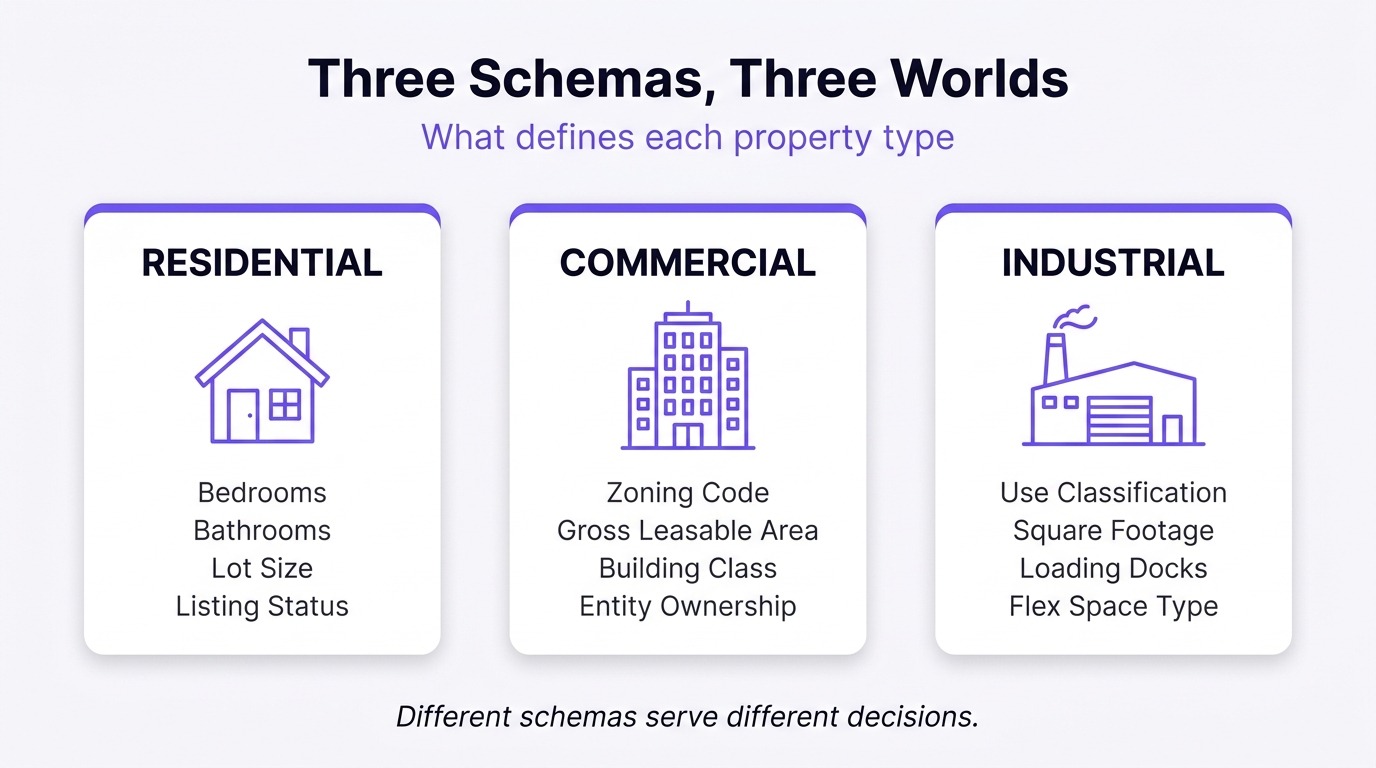
Residential property records are built around attributes that matter to buyers and consumer-facing tools: bedrooms, bathrooms, lot size, school district, sale price, listing status. A commercial schema operates on a different axis. It surfaces use classification (retail, office, industrial, multi-family), zoning code, gross leasable area, building square footage, number of units, building class, year built, and entity ownership structures.
The Real Estate Standards Organization maintains a Data Dictionary that defines standard field names and structures across the industry, and the commercial fields are categorically distinct from the residential ones. These are core fields, not supplemental, and they define what makes a record useful for investment analytics, leasing platforms, and site selection. Full coverage property data that omits these is structurally wrong for commercial use cases, not merely incomplete.
Field completeness matters more than field presence. Many providers advertise commercial coverage but return sparse data for the specific fields that drive commercial decisions. A zoning field empty for most properties in your target geography is not commercial coverage. It is a placeholder. Any serious real estate data API comparison should test field population rates rather than only confirming fields exist.
Why Tax Assessment Methodology Diverges
Commercial properties are often assessed using income-based approaches that account for net operating income, capitalization rates, and lease structures. Residential properties are typically assessed using comparable sales methods. If your application depends on tax-assessed values, verify your API source handles commercial assessment methodology correctly. Many residential-first providers either omit those fields or populate them inconsistently across markets, which produces unreliable outputs when downstream models rely on them.
How Does a Commercial Real Estate API Fit Different Use Cases?
The way teams use commercial property data varies by product type and audience. Understanding which use cases require commercial-specific data clarifies what your integration actually needs to deliver before you commit to a provider.
PropTech and Property Search Platforms
Search platforms that serve mixed-use markets need commercial records normalized to the same schema as residential records. Inconsistent field coverage forces developers to build conditional logic, apply different display templates for different record types, and patch edge cases as new gaps appear. Teams that understand what a residential property API actually delivers before adding commercial coverage can verify whether specific commercial fields are populated rather than learning about gaps in production.
Investment Analytics and Portfolio Tools
Investment-focused applications need deeper records than search platforms: ownership history, transaction history, tax assessment trends, and consistent coverage across portfolios that span residential, commercial, and industrial assets. These use cases also involve bulk data ingestion. That makes throughput and pricing model critical. An API that charges per request rather than per record delivered will cost significantly more for the high-volume queries that analytics pipelines run routinely.
Market Intelligence and Enrichment Pipelines
Data teams building enrichment pipelines often match property records against internal datasets: linking addresses to ownership entities, joining business location and category data to property records, or identifying recent transactions across a target geography. These workflows frequently span property types. A provider that cannot return consistent commercial records alongside residential ones forces teams to maintain separate data sources and reconcile them manually.
Why Multi-Property-Type Coverage Is the Future-Proof Choice
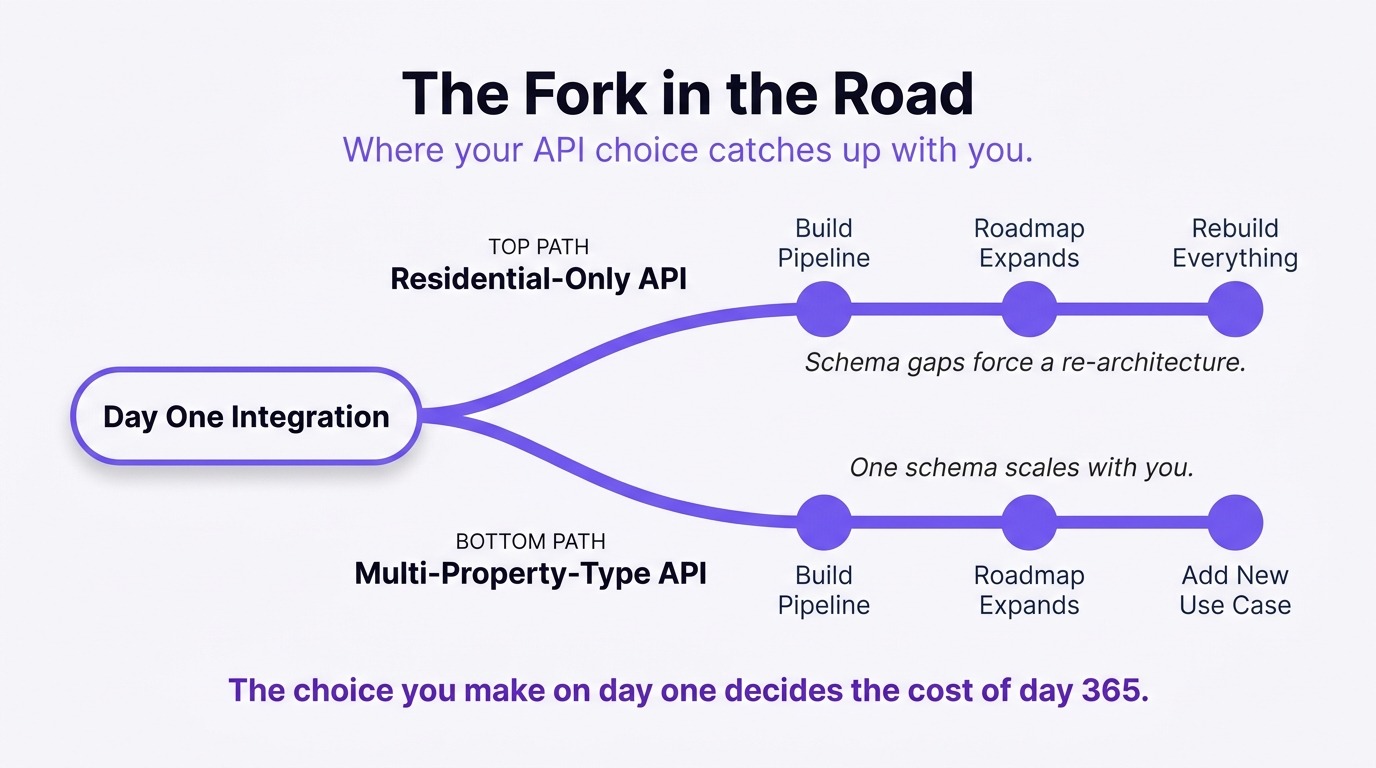
Most property data builds start with residential because the use cases are familiar and the records abundant. But many PropTech platforms and data pipelines eventually expand into commercial territory. When that happens, the API your team chose at the start determines whether the next phase is a feature release or a rebuild.

The Hidden Cost of Residential-Only Architecture
A team that builds their pipeline around a residential schema and then tries to extend coverage to commercial properties typically finds one of two situations: either the commercial records returned by their current provider are sparse and inconsistent, or the provider does not support the property types they need.
Either outcome means rebuilding the ingestion layer, renegotiating contracts, and re-architecting parts of the product that depend on consistent field coverage. A pre-build real estate data API comparison consistently identifies this as the most avoidable integration mistake developers make.
What Unified Coverage Actually Means
The smarter path is to evaluate multi-property-type coverage from the start: one integration that handles residential, commercial, and industrial property types under a single schema, one contract, and one pricing model. Even if your initial use case is entirely residential, you avoid the rebuild if commercial needs emerge later.
Unified coverage is rarer than vendor marketing suggests. Many providers ship residential data with thin commercial bolt-ons. The functional test is simple: pull sample records across all three property types in your target geographies and check field completeness.
If commercial records return empty zoning fields or industrial records lack building square footage, what you have is a residential API with commercial labels. Industrial coverage is often the weakest segment, and demand for that data has been one of the strongest in the recent CRE recovery, so verify it specifically if your use case touches logistics, manufacturing, or warehouse data.
5 Questions to Ask Before Choosing a Property Database API
Before committing to a provider, these questions will surface the integration risks that marketing materials tend to skip. A thorough real estate data API comparison covers pricing structure, geographic coverage, documentation quality, and throughput before any contract is signed.
- Does the API cover all the property types your product will ever need? Model the full roadmap, not only the current use case. If your product has any path toward commercial, industrial, or mixed-use data, evaluate that coverage now rather than after you have built.
- Are commercial-specific fields consistently populated? Ask for sample records from the geographies and property types you need. Sparse field coverage in commercial records is common and easy to miss in a demo limited to well-populated metros.
- How does the pricing model behave on failed or partial queries? Per-request pricing charges for every API call, including ones that return nothing. Model expected query volume and coverage rate to calculate real cost, not the advertised per-request rate.
- Are there rate limits, and what do they require your team to build? Throttling logic, retry handlers, and queue management all have to be built and maintained. Ask what happens when you exceed limits and whether they apply to bulk jobs.
- Is geographic coverage truly national, or structured as regional packages? Confirm whether national coverage comes with a single contract or requires additional agreements for specific regions. Per-region packaging creates renegotiation points that slow your roadmap.
Frequently Asked Questions
What Is a Commercial Real Estate API?
It is a structured data service that provides access to property data for non-residential property types: office buildings, retail spaces, industrial facilities, warehouses, and mixed-use developments. Commercial records include fields like zoning use classification, gross leasable area, entity ownership structures, and income-based tax assessment data. These differ fundamentally from the consumer-relevant attributes (bedrooms, school districts, listing status) that define residential schemas.
Can One API Cover Both Commercial and Residential Property Data?
Yes, but not all providers do it well. A unified property database API should return consistent records across property types using a shared schema, with commercial-specific fields populated reliably rather than present but empty. The practical test is whether commercial records meet the same data quality bar as residential records in the geographies you need. Many providers have strong residential coverage and thin commercial coverage, and the difference shows up in field completeness.
Why Does Rate Limiting Matter More With Commercial Data?
Commercial workflows involve higher query volumes than residential lookups. Enrichment pipelines and portfolio screening tools run bulk queries that quickly exhaust per-second caps. When limits are hit, throttling and retry logic creates partial-update states that produce inconsistent data downstream. APIs without rate limits remove that entire maintenance burden.
What Property Types Should a Commercial Real Estate API Cover?
At minimum, a strong implementation covers office, retail, industrial, warehouse, multi-family, and mixed-use properties. The best implementations extend coverage to residential property types as well, so a single integration supports the full range of property data needs as your product evolves. Industrial and flex space coverage is often the weakest segment across providers.
Choose the API That Covers Where Your Product Is Going
The right time to evaluate property data coverage is before your integration is built, not when a user requests a property type your schema cannot handle. Schema gaps, regional coverage holes, per-request pricing on failed queries, and rate-limited throughput all compound as your product scales. Each one is avoidable if you evaluate the right criteria upfront.
Datafiniti's property data API covers residential, commercial, and industrial property types in a single integration, with per-record pricing that charges only for data delivered, no rate limiting, and full national access without regional packages. Request a demo to see multi-property-type coverage in practice, or get in touch with the team to talk through your use case.
Read the latest articles

Read more

Build vs Buy: Business Data Enrichment for Growing Teams

Company Data API Pricing: Bulk & Enterprise-Scale Access

Best Business Data APIs for Sales Teams & Prospecting

Business Data API: Company Data at Enterprise Scale

How to Build a Product Database With a Product Data API

Property Data API Coverage: What U.S. Datasets Include

Product Data API for Ecommerce Price Monitoring and Repricing

Real-Time Product Data API for Product-Led Growth Teams

Property Ownership Data API for Skip Tracing and Lead Gen

How APIs Make Building a Product Database Easy
Learn how to build a product database with APIs for cleaner imports, updates, search, and scalable product data.

How to Leverage Competitor Pricing Data with an API
Use competitor pricing data to build API-driven monitoring, analysis, and smarter pricing decisions.

Price Monitoring API: The Key to E-Commerce Pricing Strategy
Use a price monitoring API to track market changes, improve pricing decisions, and protect ecommerce margins.

How do Product Data APIs Work for E-Commerce Companies?
Learn how a product data API works, from collection and queries to ecommerce integration and use cases.

GTIN Lookup API: Search Products by Barcode & UPC at Scale

Best Real Estate API 2026: Coverage, Pricing, Data Quality

Best Product Data API 2026: A State-of-the-Market Guide

Product Data API Integration Patterns for Ecommerce Platforms

Build a PropTech MVP With a Property Ownership Data API

3 Benefits of Web Scraping for Real Estate
Boost your research by using web scraping for real estate to gain market insights, automate lead lists, and minimize property risk.
How Real Estate Agents Can Leverage Proptech Data
Leverage proptech data to source leads, speed up valuations, and manage risk with accurate, real-time property insights.

What Is a UPC Lookup API?
Learn about the UPC lookup API, how it works, and its benefits for businesses. Get product data easily.

What Is a GTIN Lookup API?
Learn about the GTIN lookup API and how it can help your business grow. Get product data insights.

How Does a Property Data API Work?
Learn how a property data API works, its features, and how you can use it for real estate and business insights.

What The Best Real Estate APIs Should Have
Discover what makes the best real estate APIs stand out. Learn about essential features for your property data needs.
How to Access MLS Listing Data
Learn how to access MLS listing data using an MLS data API. Discover Datafiniti's solutions and integration tips.
.png)
How to Enrich Your Product Catalog With a Real-Time API
.jpeg)
Product Data API Buyer's Guide for Ecommerce Teams

Do I Need a Real Estate Listing API?
Explore the benefits and technicalities of a real estate listing API. Learn how to choose the right provider and integrate data for business growth.

Why Real Estate Tech Startups Need Property APIs with Ownership Details
Discover how property APIs with ownership details empower real estate tech startups. Learn about data integration, risk mitigation, and driving business value.
The Value of a Product Catalog Sync for Product Managers
Unlock the value of product catalog sync for product managers. Streamline data, improve decisions, and reduce costs with real-time insights.

What is a Product Data Webhook?
Learn about product data webhooks, their components, and how they enable real-time updates for business intelligence and workflow automation.

Why Is a Product Data API Integration Essential for Analysts & Product Managers?
Unlock insights with product data API integration. Essential for analysts & product managers to streamline data access & enhance product strategy.

What Is a Product Data API and Its Benefits
Learn about product data APIs, their benefits, and how they drive business growth. Explore integration and advanced use cases.

What Do eCommerce Data Vendors Do?
Learn what ecommerce data vendors do, their services, and how to choose the right one for your business growth.

How to Compare Product Data Providers: What to Look For
Compare product data providers. Learn what to look for in data quality, structure, and integration features.

How to Get Your Product Data in Real-Time Using APIs
Learn how to leverage real-time product data APIs for e-commerce, competitive analysis, and AI. Get instant access to clean, structured product data.

Best Product Data API: Features to Look for
Find the best product data API with real-time updates, comprehensive coverage, and a user-friendly portal. Explore features to look for.

Unlocking Property Data with an API
Access property data with a powerful property database API. Explore listings, market analysis, investment opportunities, and more. Get started today!

Unlocking CRE with APIs
Unlock commercial real estate insights with a powerful API. Access property data, streamline workflows, and enhance investment strategies.

How to Get a Real-Time Product Feed Using an API
Learn how to get a real-time product feed using an API. Access, leverage, and ensure accuracy of product data for your business needs.

Spying on Competitor Prices: What You Need to Know
Learn how to gather and analyze competitor pricing data to inform your business strategy. Understand key components and ethical considerations.

Product Data Enrichment: What Are You Missing?
Enhance your product data with comprehensive enrichment. Discover insights, drive growth, and choose the right approach for your business.
.png)
IDX vs MLS API: A Developer's Guide to Real Estate Listing Data
.png)
Real Estate API Pricing Models Explained: Subscription vs. Usage-Based

Real Estate API vs Web Scraping: The Buy-vs-Build Decision
.png)
Product Data APIs Explained: Powering Product Search and Catalog Automation

How to Get the Most out of a Product Catalog API
Learn how to leverage a product catalog API for business growth. Discover data quality, access methods, and strategy for your product catalog API.

Taming Your Ecommerce Product Data Feed
Optimize your ecommerce product data feed for growth. Learn strategies, leverage technology, and ensure data quality for better customer experience and AI initiatives.

Streamlining Your Product Search with an API
Explore the benefits and integration of a product search API. Streamline your product discovery and leverage data for business growth.
.png)
What Is a Real Estate Transaction Database? A Complete Guide

How Real Estate Platforms Access MLS Database APIs
Commercial Real Estate API vs. Residential Property API
.png)
How to Choose a Real Estate Database API for Your MVP
MLS API vs. IDX: What's the Diff?
MLS API vs IDX: Explore the differences in real estate data access, retrieval, and integration. Understand which solution fits your needs.

Scraping vs. APIs: Getting Real Estate Data
Compare web scraping vs real estate API for data acquisition. Learn the pros, cons, and best use cases for each method.

Property Valuation API: Your Go-To Real Estate Tool
Leverage the property valuation API for real estate insights. Access comprehensive property data for diverse applications with Datafiniti.

Product Data APIs Explained
Learn about product data APIs explained. Discover how to access, integrate, and utilize product data for e-commerce, analytics, and more.

Unlocking Your Ecommerce Data with APIs
Unlock ecommerce data with APIs for business insights, product catalog enrichment, and competitive analysis. Explore data via portal or API.

Real Estate Ownership Data: How to Access, Analyze and Use at Scale
Access, analyze, and use real estate ownership data at scale. Learn how to find, process, and leverage this crucial information for business insights.
IDX vs MLS API: What Every Real Estate Professional Should Know
Understand IDX vs MLS API differences. Learn about data access, integration, and how Datafiniti's solutions empower real estate professionals.

How a Property Database API Can Help Real Estate Pros
Learn how a property database API can help real estate pros analyze trends, monitor listings, and optimize strategies. Get data insights.

What Is a Residential Property API?
Explore what a residential property API is, its features, benefits, and real-world applications for real estate professionals and investors.

What Is a Commercial Real Estate API?
Explore commercial real estate API functionality, data integration, and use cases. Learn how to leverage property, business, and people data for insights.

Understanding MVP Data Integration
Learn about MVP data integration, its components, benefits, and strategies for accessing and utilizing data resources effectively.

How to Choose the Best Property Data API
Learn how to choose the best property data API. Explore features, providers, pricing, and integration for real estate insights.

Real Estate Database API: What to Look for
Explore real estate database API options. Learn about data quality, features, and how to choose the right provider for your needs.

How Do Product Data APIs Work?
Understand how a product data API works, its key features, integration methods, and applications for e-commerce and business intelligence.

How Do Data Aggregation Platforms Work?
Explore how data aggregation platforms work, their capabilities, and applications. Learn to choose and implement the right platform for your business intelligence needs.

Why Do Companies Need Property Data Aggregation?
Discover why property data aggregation is crucial for businesses. Streamline access, empower functions, enhance risk management, and drive strategic decisions with authoritative insights.

MLS Database API: How to Choose a Provider and Get Access

Product Search API vs. Product Data API: What's the Difference?

What Is a Product Data API?
Explore the functionality and benefits of a product data API. Learn how to integrate, leverage, and choose the right provider for your business insights.
What Is the Difference Between Product Search API and Product Data API?
Understand the difference between Product Search API and Product Data API. Learn how to leverage product data for business intelligence and analytics.

What Is a Property Data API?
Explore the capabilities of a property data API. Understand its core functionality, key features for developers, and how to access property information at scale for business insights.
.png)
Real Estate API Pricing: What You Need to Know Before You Build
.jpeg)
How to Choose a Property Market API for Investment Platforms
Choosing the right property market API is critical for investment platforms. Learn how to evaluate data depth, coverage, freshness, and integration quality before you commit.
Data you can trust, delivered in a format your systems can use, at the scale your product requires.