
.png)
Best MLS API for Real Estate Software: What Developers Need
Key Takeaways
The best MLS API for software development is determined by whether the pricing model, coverage, and throughput can support your platform as it scales, not simply whether the data exists.
- Per-request pricing forces developers to pay for failed queries; per-record models charge only for data actually delivered.
- MLS coverage is inherently fragmented. Most providers require separate regional contracts to achieve full national access.
- Rate limiting is a real engineering cost: throttling logic and retry handlers add weeks of overhead to any integration.
- An MLS data API that covers residential, commercial, and industrial properties under a single integration eliminates the need to stitch together multiple sources.
Before you commit to an MLS API, pressure-test it against the real costs: pricing model, geographic scope, rate limiting, and property type coverage.
The proptech sector is growing fast. According to Precedence Research, the global proptech market is on track to reach $185 billion by 2034, and the data infrastructure powering those platforms has to keep pace. For developers building property search tools, CRM integrations, or analytics dashboards, finding the best MLS API is one of the most consequential technical decisions in the entire project. The wrong choice creates compounding problems: unpredictable costs, geographic gaps, and throttling that forces engineering workarounds rather than product development.
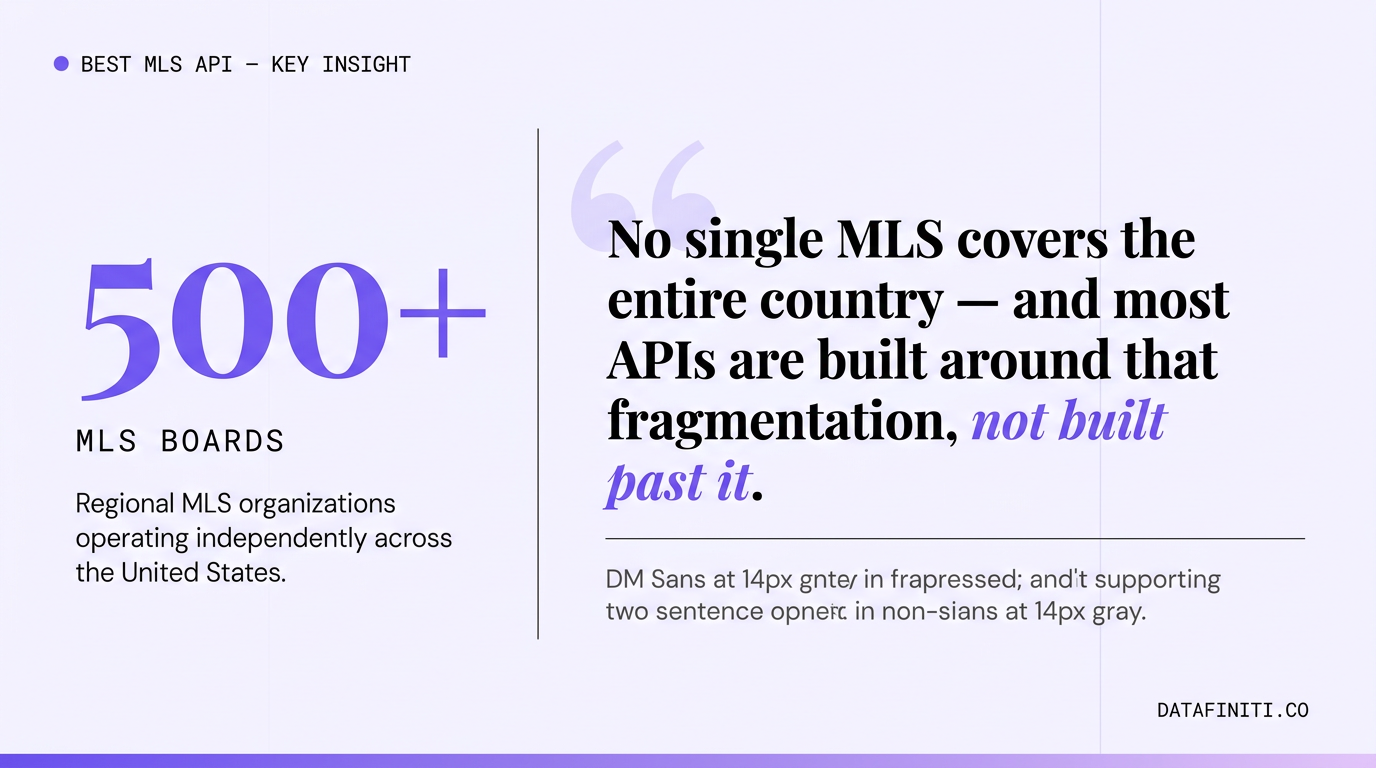
What makes real estate listing API integration so complicated is that MLS data itself is fragmented by design. There are hundreds of regional MLS organizations across the United States, and no single system covers the entire country. That means most MLS API providers serve limited geographies, require separate agreements for different regions, and vary widely on what property types and data fields they expose. Before evaluating any specific provider, developers need to understand what the MLS data API landscape actually looks like under the hood, and what clean, structured property data looks like when it comes from a national, unified source.
What Makes a Best MLS API Worth Building On?
MLS data APIs vary more than their marketing suggests. Coverage gaps, access restrictions, inconsistent data schemas, and rate limits can all surface after integration starts, and they're expensive to discover late. Understanding the structural differences between providers before you build saves significant rework down the line.
The Coverage Problem Developers Keep Running Into
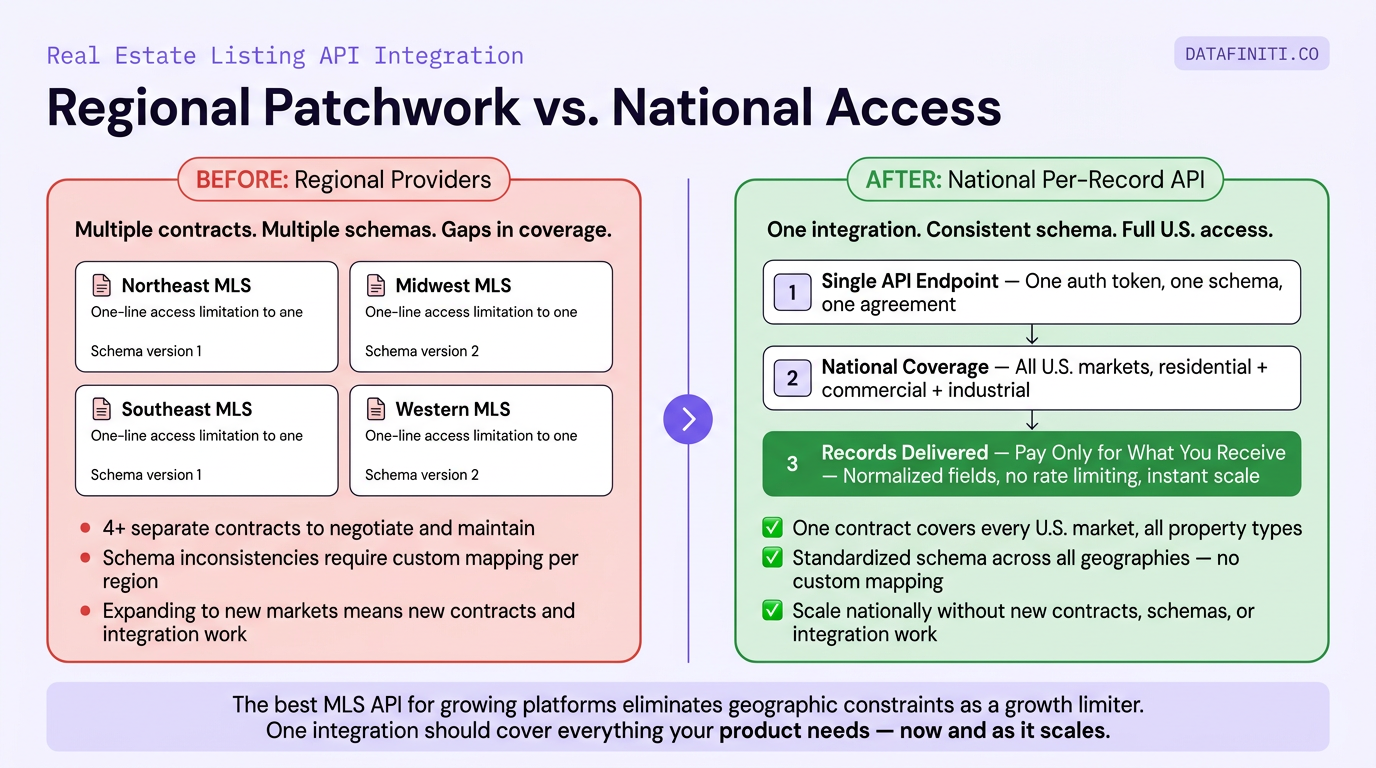
The fundamental challenge with MLS data is that no single MLS has national reach. The U.S. real estate system is organized around hundreds of regional boards, each controlling its own listings database. When a developer needs property data across multiple markets, they typically have to negotiate separate data agreements with each MLS, manage different credentials, handle different schemas, and keep track of which endpoints serve which regions. Most MLS API providers reflect this fragmentation: they serve a defined set of geographies, and expanding coverage means adding contracts.
For a CRM tool serving agents in five states, that might mean five separate integrations. For a national PropTech platform, it means either building a complex aggregation layer or accepting that your coverage has holes. Per-region packaging creates direct scaling friction, and it gets worse as the platform grows. Volume discounts rarely span across regional agreements, so a company pulling significant data nationally often pays more per record than they would with a unified source.
The cleaner alternative is a property data API that aggregates national records into a single endpoint, with consistent schema, single authentication, and no regional gaps. That type of architecture eliminates the multi-contract management problem entirely and lets developers focus on building features rather than data logistics.
Why Data Standards Matter for Long-Term Integrations
The Real Estate Standards Organization (RESO) has worked to standardize how MLS data is structured and shared, establishing a data dictionary and Web API specification that many providers now claim to support. With more than 500 MLS organizations now certified on RESO standards, the data dictionary has become the closest thing the industry has to a universal schema. RESO compliance matters because it determines how predictable your data schema will be — a provider with strong RESO alignment returns fields in a consistent format across all markets, which means less transformation logic in your pipeline. Providers that partially support RESO, or support it differently across regions, introduce schema inconsistencies that your integration has to handle.
When evaluating any best MLS API candidate, ask specifically which RESO data dictionary version they support and whether that support is consistent across all their covered geographies. Non-standardized field names, inconsistent status codes, and variable data types all become your engineering problem. They also make it harder to validate data quality programmatically, which increases QA overhead. For platforms that need accurate business and property records at scale, schema predictability is a non-negotiable.
Data freshness is a related concern that often goes under-discussed in MLS API comparisons. Active listing data changes constantly: price reductions, status changes, new listings, and expired ones. An API that batches updates daily is going to show stale data in time-sensitive contexts. For a property search portal where users are making buying decisions, stale listings create real credibility problems. Always verify refresh cadence before committing to an integration.
What Should You Evaluate Before Committing to a Best MLS API?
Most developers evaluate best MLS API options on surface-level features: does it have the fields I need, is documentation clear, does the sandbox work? Those are necessary checks, but they miss the factors that determine total cost of ownership and scalability. MLS API pricing model, geographic scope, and throughput are where options most sharply diverge.
MLS API Pricing: Per-Record vs. Per-Request
MLS API pricing splits into two fundamentally different models: per-request and per-record. In a per-request model, you're billed each time your application calls the API endpoint, regardless of whether the response contains useful data. A query that returns zero results because of a bad filter, a timeout, or a data gap still consumes credits. At low volumes, this is manageable. At scale, it means a meaningful portion of your API spend is going toward calls that returned nothing.
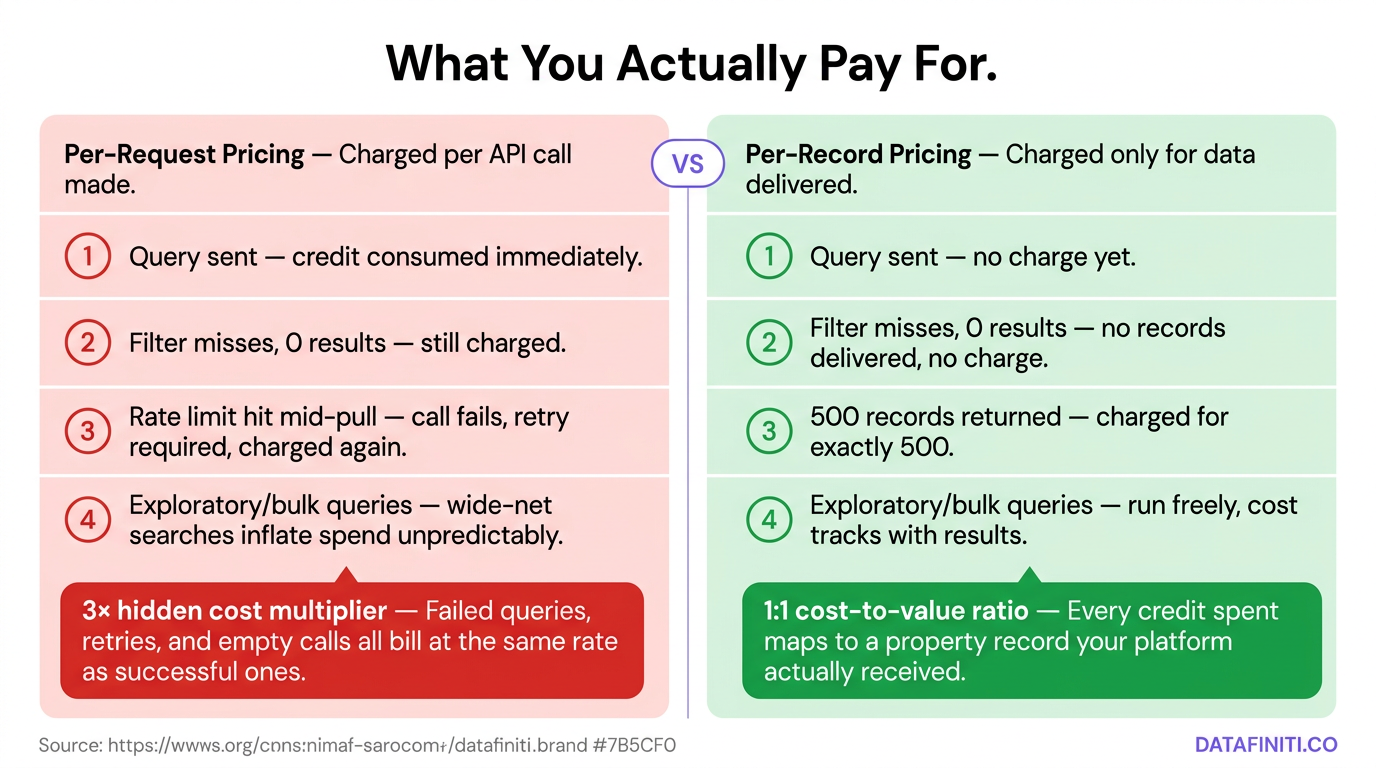
Per-record pricing works differently: you pay only for records actually delivered. If a query returns 500 results, you're charged for 500 records. If it returns zero, you're charged nothing. This model aligns costs directly with value received, which makes spend predictable and eliminates the financial penalty for failed queries. For any application that runs exploratory searches, bulk pulls, or queries across variable-density geographies, per-record pricing produces significantly lower actual costs than the per-request alternative for equivalent data volume.
MLS API pricing is also where geographic packaging creates hidden costs. Providers that sell regional access separately force buyers to estimate how much data they'll pull from each region and pre-purchase accordingly. Under-buy and you hit limits. Over-buy and the excess doesn't roll over. A national real estate data API with flat per-record pricing eliminates that calculus entirely.

The table above captures the practical difference in how these models behave under real-world usage patterns. Per-request billing looks cheaper on paper when usage is light, but the math shifts quickly once query volumes increase or queries regularly return partial results.
Rate Limiting and Throughput
Rate limiting is one of the most underestimated integration costs in any API evaluation. When a provider caps requests per second or per minute, developers must build throttling logic to stay within those bounds. That means queuing systems, retry handlers, backoff strategies, and monitoring to detect when limits are being hit. On a simple integration, that might be a few days of engineering work. On a platform with multiple concurrent data flows, it becomes a persistent maintenance burden.
Providers that impose aggressive rate limits also create data pipeline instability. A bulk enrichment job that hits a rate cap midway through stops delivering data and has to restart or queue the remainder. Downstream systems that depend on that data receive incomplete updates. The engineering complexity scales with both the volume of data and the number of distinct data flows the application manages.
A credit-based API system without artificial throughput restrictions removes this problem entirely. Developers can run large queries, execute bulk pulls, and push high volumes through the API without needing to build throttle handling. The API simply returns records until the query is satisfied, and the developer is charged per record delivered. That model respects engineering time and eliminates an entire category of operational risk.

Property Type and Geographic Scope
Many MLS API options are designed primarily around residential listings. That works fine for a homebuyer search portal, but it creates real limitations for platforms that need to serve commercial real estate clients, industrial property investors, or mixed-use portfolio managers. A developer building a CRE analytics tool who commits to a residential-focused API will eventually need to either switch providers or stitch in a second source for non-residential data.
The better architecture is a single structured national property dataset that covers residential, commercial, and industrial properties under one integration. This is particularly important for platforms that might start with residential use cases but plan to expand. Committing to a residential-only provider early locks in a future migration cost. A provider that covers all property types from the start future-proofs the integration without any additional engineering work.
Geographic scope follows the same logic. If your platform currently serves three metros, a regional provider may cover your immediate needs. But if the product roadmap includes national expansion, you'll pay for that expansion later through new contracts, new schemas, and integration testing in every new market. A provider with full national access under a single integration removes geographic constraints as a growth limiter.
Real Estate Listing API Integration in Practice
Understanding evaluation criteria is the starting point, but the decision ultimately comes down to how a real estate listing API integration actually performs inside your specific product architecture. Here's how the key factors above play out across common integration patterns.
Building a Property Search Portal
A property search portal is the most common MLS API use case, and also the one where rate limiting causes the most friction. Users expect real-time search results as they type, adjust filters, and explore the map. Each interaction triggers API calls, and if those calls are constrained by per-second request limits, the user experience degrades. Searches that should resolve in milliseconds start showing loading states, and aggressive filter changes can exhaust rate limits during peak usage.
For a search portal, the best MLS API is one that can handle concurrent, high-frequency queries without throttling, returns consistent schema across all geographic markets so that display templates work everywhere, and updates listing data frequently enough that status changes appear before users encounter discrepancies. Per-record pricing also matters here: exploratory searches, map-pan queries, and filtered searches that return few or zero results will always be part of the traffic pattern, and a per-request model charges for all of them.
Powering CRM and Lead-Gen Tools
Real estate CRMs and lead-generation platforms need property data for context-enrichment: when a lead is associated with a specific property, the CRM should be able to pull current listing status, price history, property attributes, and ownership information. This enrichment often runs as a background job, querying the API for batches of properties rather than single lookups. Rate-limited APIs slow these batch jobs down and require queuing logic that adds latency to enrichment pipelines.
Lead-gen tools also frequently need to cross-reference property data against people data and business records to build complete profiles. A provider that covers only residential MLS listings forces developers to layer in additional sources for commercial properties and ownership information. A unified property data API with broad coverage reduces the number of external dependencies and simplifies the enrichment pipeline considerably.
PropTech Platforms and Analytics Dashboards
Analytics dashboards and PropTech platforms often need to pull large volumes of data on a scheduled basis: daily market snapshots, weekly trend reports, or on-demand portfolio analyses. These bulk pulls are where per-request pricing becomes most expensive. An analytics platform that queries 50,000 property records per day will generate a predictable number of API calls, but if a portion of those calls return incomplete data or hit rate caps, the actual cost per useful record rises substantially.
For analytics use cases, schema consistency is also critical. Dashboard queries often join property data with other datasets, and any inconsistency in field names, value formats, or status codes creates transformation logic that has to be written, tested, and maintained. A best MLS API for analytics use cases returns clean, normalized data at any query volume, without throughput restrictions, and with MLS API pricing that scales linearly with records actually delivered.
6 Questions to Ask Any MLS API Provider Before You Sign
Before committing to a real estate listing API integration, run every provider through these questions. The answers reveal the true cost and complexity of building on their platform.
- Do you charge per request or per record? This is the single most important pricing question. A per-request model means you pay for every API call, including ones that return no data. A per-record model means you pay only for what you receive. At scale, the difference is substantial.
- What are your rate limits, and what happens when I hit them? Per-second or per-minute caps require you to build throttling logic and retry handlers. Ask whether there's a way to avoid rate limits entirely, and what happens to in-flight requests when a cap is reached.
- Is your coverage truly national, or is it packaged by region? Regional providers require separate contracts for each market. Ask which geographies are covered under a single agreement and whether national access is available without a multi-contract arrangement.
- Which property types are included in your base plan? Many providers default to residential MLS listings and charge separately for commercial or industrial data. If your platform needs to serve all property types, confirm that they're all accessible under one integration before committing.
- How frequently is listing data refreshed? Data freshness matters for any user-facing product. Ask whether updates are pushed in real time, batched daily, or refreshed on a longer cycle. Stale listing data creates credibility problems with end users.
- What does your documentation and sandbox environment look like? Most property data providers ship sparse documentation that requires a sales conversation just to understand basic query structure. Clear, publicly accessible docs and a functional sandbox are strong signals of a mature API product — and a meaningful differentiator that most MLS-connected providers don't meet. Ask whether the sandbox reflects production data volumes and behavior, and how responsive their developer support is to integration questions. It's also worth asking whether the provider offers a visual portal for exploring available data before writing integration code — most don't, and it's a meaningful time-saver during evaluation.
How MLS API Options Compare Across Key Integration Factors
The table below maps out how typical MLS data API options compare across the criteria that matter most to developers building at scale. These are structural characteristics, not feature lists, and they determine actual integration complexity and total cost more than any individual endpoint.

The regional provider model is often the first choice for developers with simple, localized use cases. The friction becomes apparent as soon as the product needs to expand geographically or add property types. Per-request national aggregators solve the coverage problem but introduce pricing unpredictability. A per-record national aggregator resolves both issues simultaneously.
Frequently Asked Questions
What Is the Difference Between a Best MLS API and an IDX Feed?
An MLS API is a programmatic interface that lets software applications query listing data directly, returning structured JSON or XML responses that developers can use however their application requires.
An IDX (Internet Data Exchange) feed is a standardized data-sharing arrangement that allows brokers and agents to display MLS listings on their own websites, typically through a pre-built widget or plugin. IDX feeds are designed for display compliance, not flexible development. An MLS data API gives developers direct access to the underlying data, making real estate listing API integration far more suitable for building custom applications, analytics tools, and CRM systems.
How Does MLS API Pricing Typically Work, and What Should I Watch Out For?
MLS API pricing comes in two main structures: per-request and per-record. Per-request models charge for every API call made, including calls that return no data — which creates unpredictable spend at scale. Per-record models charge only for records successfully returned, aligning cost directly with value received. Also watch for geographic packaging: providers that sell regional access separately will require multiple contracts for national coverage, adding both cost and management complexity.
Can I Use a Single MLS API to Get Both Residential and Commercial Property Listings?
Most traditional MLS APIs are built around residential listing data because that's what regional Multiple Listing Services primarily contain. Commercial and industrial property data is typically managed through separate systems and often requires a different data source or an add-on to the base API plan. If your application needs to cover all property types, look for a national property data API that consolidates residential, commercial, and industrial records under a single integration. This eliminates the need to build and maintain multiple data pipelines for different property categories.
What Causes Real Estate Listing API Integration to Slow Down or Break at Scale?
The most common cause of integration problems at scale is rate limiting. When an API enforces per-second or per-minute request caps, high-volume applications hit those limits and have to implement throttling logic, retry queues, and backoff strategies.
These systems add engineering complexity and introduce latency into data pipelines. A secondary cause is geographic coverage gaps: regional providers may not cover all markets, so expanding a platform to new geographies surfaces missing data. Schema inconsistencies across markets, data freshness issues, and per-request pricing that inflates costs during bulk operations are also frequent pain points for teams that discover them late in the build.
How Do I Know if an MLS Data API Has Full National Coverage?
Ask the provider directly which states and markets are covered under a single agreement and which require additional contracts. Many providers advertise national coverage but deliver it through regional partnerships that require separate negotiations. True national access means one contract, one integration, one schema, and consistent data quality across all geographies. Also ask whether coverage gaps exist in rural markets or smaller metros, since some providers prioritize high-density markets and leave smaller cities underserved. Request a sample of the data across multiple geographies before committing to verify that coverage matches what is advertised.
Choosing the Right Real Estate Listing API for Your Build
The evaluation framework here reduces to a few practical questions: Does the pricing model charge you only for data you actually receive? Can you access the entire country under a single contract? Does the API handle your query volume without throttling? Does it cover every property type your platform needs now and in the future? Most MLS API options answer yes to some of these and no to others. The ones that answer no create engineering debt: throttling logic, geographic workarounds, multiple data sources, and unpredictable cost models that compound as the product scales.
Developers building search portals, analytics dashboards, CRM tools, or PropTech platforms all benefit from the same architecture: a national property data API with per-record pricing, no rate limiting, and full property type coverage. That combination removes the most common sources of integration friction and lets teams focus on the product rather than the infrastructure.
Datafiniti's structured property data API gives developers access to 280M+ property records across the entire U.S., covering residential, commercial, and industrial properties under one integration, with per-record pricing and no rate limiting. If you're evaluating real estate listing API options for your next build, reach out to the Datafiniti team to see how the data fits your use case.
Read the latest articles

Read more

Property Data API Coverage: What U.S. Datasets Include

Product Data API for Ecommerce Price Monitoring and Repricing

Real-Time Product Data API for Product-Led Growth Teams

Property Ownership Data API for Skip Tracing and Lead Gen

How APIs Make Building a Product Database Easy
Learn how to build a product database with APIs for cleaner imports, updates, search, and scalable product data.

What Is Property Transaction Data and How Does an API Help Get It?
Learn how property transaction data works and how APIs provide structured access for analysis and workflows.

How to Use Real Estate Transaction Data
Learn how to use real estate transaction data for analysis, valuation, underwriting, and market decisions.

How to Leverage Competitor Pricing Data with an API
Use competitor pricing data to build API-driven monitoring, analysis, and smarter pricing decisions.

Price Monitoring API: The Key to E-Commerce Pricing Strategy
Use a price monitoring API to track market changes, improve pricing decisions, and protect ecommerce margins.

How do Product Data APIs Work for E-Commerce Companies?
Learn how a product data API works, from collection and queries to ecommerce integration and use cases.

Bulk Real Estate Data Licensing: Access Datasets at Scale

How to Integrate MLS Listings Using an MLS Data API

GTIN Lookup API: Search Products by Barcode & UPC at Scale

Best Real Estate API 2026: Coverage, Pricing, Data Quality

Best Product Data API 2026: A State-of-the-Market Guide

Product Data API Integration Patterns for Ecommerce Platforms

Build a PropTech MVP With a Property Ownership Data API

3 Benefits of Web Scraping for Real Estate
Boost your research by using web scraping for real estate to gain market insights, automate lead lists, and minimize property risk.

How Real Estate Agents Can Leverage Proptech Data
Leverage proptech data to source leads, speed up valuations, and manage risk with accurate, real-time property insights.

What Is a UPC Lookup API?
Learn about the UPC lookup API, how it works, and its benefits for businesses. Get product data easily.

What Is a GTIN Lookup API?
Learn about the GTIN lookup API and how it can help your business grow. Get product data insights.

How Does a Property Data API Work?
Learn how a property data API works, its features, and how you can use it for real estate and business insights.

What The Best Real Estate APIs Should Have
Discover what makes the best real estate APIs stand out. Learn about essential features for your property data needs.

The Benefits of a Real Estate MLS API
Learn about the benefits of a real estate MLS API for streamlining data access and driving business growth.

Why Every Real Estate Pro Needs an MLS Database API
Learn why a MLS database API is vital for real estate pros. Get data, insights, and competitive edge.
How to Access MLS Listing Data
Learn how to access MLS listing data using an MLS data API. Discover Datafiniti's solutions and integration tips.
.png)
How to Enrich Your Product Catalog With a Real-Time API
.jpeg)
Product Data API Buyer's Guide for Ecommerce Teams

Do I Need a Real Estate Listing API?
Explore the benefits and technicalities of a real estate listing API. Learn how to choose the right provider and integrate data for business growth.

Unlocking the MLS Database with APIs
Unlock the MLS database with APIs. Learn how to access property data, gain real estate insights, and integrate MLS data for your business needs.

Why Real Estate Tech Startups Need Property APIs with Ownership Details
Discover how property APIs with ownership details empower real estate tech startups. Learn about data integration, risk mitigation, and driving business value.
The Value of a Product Catalog Sync for Product Managers
Unlock the value of product catalog sync for product managers. Streamline data, improve decisions, and reduce costs with real-time insights.

What is a Product Data Webhook?
Learn about product data webhooks, their components, and how they enable real-time updates for business intelligence and workflow automation.

Why Is a Product Data API Integration Essential for Analysts & Product Managers?
Unlock insights with product data API integration. Essential for analysts & product managers to streamline data access & enhance product strategy.

What Is a Product Data API and Its Benefits
Learn about product data APIs, their benefits, and how they drive business growth. Explore integration and advanced use cases.

What Do eCommerce Data Vendors Do?
Learn what ecommerce data vendors do, their services, and how to choose the right one for your business growth.

How to Compare Product Data Providers: What to Look For
Compare product data providers. Learn what to look for in data quality, structure, and integration features.

How to Get Your Product Data in Real-Time Using APIs
Learn how to leverage real-time product data APIs for e-commerce, competitive analysis, and AI. Get instant access to clean, structured product data.

Best Product Data API: Features to Look for
Find the best product data API with real-time updates, comprehensive coverage, and a user-friendly portal. Explore features to look for.

Unlocking Property Data with an API
Access property data with a powerful property database API. Explore listings, market analysis, investment opportunities, and more. Get started today!

Unlocking CRE with APIs
Unlock commercial real estate insights with a powerful API. Access property data, streamline workflows, and enhance investment strategies.

How to Get a Real-Time Product Feed Using an API
Learn how to get a real-time product feed using an API. Access, leverage, and ensure accuracy of product data for your business needs.

Spying on Competitor Prices: What You Need to Know
Learn how to gather and analyze competitor pricing data to inform your business strategy. Understand key components and ethical considerations.

Product Data Enrichment: What Are You Missing?
Enhance your product data with comprehensive enrichment. Discover insights, drive growth, and choose the right approach for your business.
.png)
IDX vs MLS API: A Developer's Guide to Real Estate Listing Data
.png)
Real Estate API Pricing Models Explained: Subscription vs. Usage-Based

Real Estate API vs Web Scraping: Which Wins in 2026?
.png)
Product Data APIs Explained: Powering Product Search and Catalog Automation

Best Sources for Bulk Real Estate Transaction Data

How to Get the Most out of a Product Catalog API
Learn how to leverage a product catalog API for business growth. Discover data quality, access methods, and strategy for your product catalog API.

Taming Your Ecommerce Product Data Feed
Optimize your ecommerce product data feed for growth. Learn strategies, leverage technology, and ensure data quality for better customer experience and AI initiatives.

Streamlining Your Product Search with an API
Explore the benefits and integration of a product search API. Streamline your product discovery and leverage data for business growth.
.png)
Real Estate Transaction Databases: What You Need to Know
Best MLS API for Real Estate Software: What Developers Need

How Real Estate Platforms Access MLS Database APIs
.png)
Commercial Real Estate API vs. Residential Property API
.png)
How to Choose a Real Estate Database API for Your MVP
MLS API vs. IDX: What's the Diff?
MLS API vs IDX: Explore the differences in real estate data access, retrieval, and integration. Understand which solution fits your needs.

Scraping vs. APIs: Getting Real Estate Data
Compare web scraping vs real estate API for data acquisition. Learn the pros, cons, and best use cases for each method.

Cracking the Code: Housing Sales Insights
Unlock housing sales analytics insights with Datafiniti. Explore property data, market trends, and advanced techniques for strategic decisions.

Property Valuation API: Your Go-To Real Estate Tool
Leverage the property valuation API for real estate insights. Access comprehensive property data for diverse applications with Datafiniti.

Product Data APIs Explained
Learn about product data APIs explained. Discover how to access, integrate, and utilize product data for e-commerce, analytics, and more.

Unlocking Your Ecommerce Data with APIs
Unlock ecommerce data with APIs for business insights, product catalog enrichment, and competitive analysis. Explore data via portal or API.

Your Guide to Housing Sales APIs
Explore housing sales API data for insights. Access property data, integrate into applications, and gain business intelligence. Get started today!

Real Estate Ownership Data: How to Access, Analyze and Use at Scale
Access, analyze, and use real estate ownership data at scale. Learn how to find, process, and leverage this crucial information for business insights.

Unlocking Opportunities: Navigating Bulk Real Estate Transaction Data
Unlock opportunities with bulk real estate transaction data. Learn how to access, analyze, and leverage property data for investing, marketing, and more.
What Is a Property Sales Database?
Explore what a property sales database is, its core components, how to access data, and key use cases for real estate analysis and more.

Benefits of Obtaining Housing Transaction Data
Unlock insights with housing transaction data. Analyze markets, investments, sales, and risk. Get comprehensive property data for informed decisions.

Understanding Real Estate Transaction Databases

IDX vs MLS API: What Every Real Estate Professional Should Know
Understand IDX vs MLS API differences. Learn about data access, integration, and how Datafiniti's solutions empower real estate professionals.

What Is an MLS Database API?
Explore the MLS database API: understand its components, benefits, and how to access real estate data for various applications. Learn about its core functionality and technical aspects.

How a Property Database API Can Help Real Estate Pros
Learn how a property database API can help real estate pros analyze trends, monitor listings, and optimize strategies. Get data insights.

What Is a Residential Property API?
Explore what a residential property API is, its features, benefits, and real-world applications for real estate professionals and investors.

What Is a Commercial Real Estate API?
Explore commercial real estate API functionality, data integration, and use cases. Learn how to leverage property, business, and people data for insights.

Understanding MVP Data Integration
Learn about MVP data integration, its components, benefits, and strategies for accessing and utilizing data resources effectively.

How to Choose the Best Property Data API
Learn how to choose the best property data API. Explore features, providers, pricing, and integration for real estate insights.

Real Estate Database API: What to Look for
Explore real estate database API options. Learn about data quality, features, and how to choose the right provider for your needs.
.png)
Real Estate Transaction Database: An API Access Guide

How Do Product Data APIs Work?
Understand how a product data API works, its key features, integration methods, and applications for e-commerce and business intelligence.

How Do Data Aggregation Platforms Work?
Explore how data aggregation platforms work, their capabilities, and applications. Learn to choose and implement the right platform for your business intelligence needs.

Why Do Companies Need Property Data Aggregation?
Discover why property data aggregation is crucial for businesses. Streamline access, empower functions, enhance risk management, and drive strategic decisions with authoritative insights.

MLS API: The Complete Guide to Accessing MLS Listing Data

Product Search API vs. Product Data API: What's the Difference?

What Are the Best MLS Data API Features to Look For?
Discover the best MLS data API features, including real-time updates, bulk downloads, and flexible filtering for property data.

What Is a Product Data API?
Explore the functionality and benefits of a product data API. Learn how to integrate, leverage, and choose the right provider for your business insights.
What Is the Difference Between Product Search API and Product Data API?
Understand the difference between Product Search API and Product Data API. Learn how to leverage product data for business intelligence and analytics.

Guide to Accessing Real Estate Transaction Database Via API
Access real estate transaction data via API. Explore property insights, sales, underwriting, and advanced applications with our authoritative guide.

Is a Real Estate MLS API Beneficial?
Explore the benefits of a real estate MLS API for enhanced data access, streamlined workflows, and market responsiveness. Learn about key features and use cases.

What is an MLS Database API?
Explore the MLS database API for comprehensive property data access. Learn about its core functionality, key features, and integration into real estate technology.

What Is a Property Data API?
Explore the capabilities of a property data API. Understand its core functionality, key features for developers, and how to access property information at scale for business insights.
.png)
Real Estate API Pricing: What You Need to Know Before You Build
.jpeg)
How to Choose a Property Market API for Investment Platforms
Choosing the right property market API is critical for investment platforms. Learn how to evaluate data depth, coverage, freshness, and integration quality before you commit.
Data you can trust, delivered in a format your systems can use, at the scale your product requires.