

How Real Estate Platforms Access MLS Database APIs
An MLS database API connects platforms to listing data, but the fragmented, licensing-heavy structure of the MLS system creates real obstacles for developers building at national scale.
- MLS and IDX are different things, and conflating them leads to wrong architectural decisions from the start.
- The U.S. MLS count fell below 500 for the first time in 2025, yet each organization still sets its own schema, access rules, and licensing terms.
- The RESO Web API has replaced RETS as the industry standard, but uneven adoption across local MLSs still pushes most developers toward third-party aggregators.
- Reaching national coverage through the MLS system means stacking separate contracts market by market, which a single structured property data API removes.
If you need property data at national scale without the MLS compliance maze, the access model you choose matters as much as the data itself.
Real estate platforms run on listing data. Whether you're building a property search portal, a market analytics tool, or an investment dashboard, the quality and accessibility of your data determine how fast you can ship and how well your product performs. The question developers and product teams hit almost immediately is how you actually get access to that data.
The answer runs through the MLS system, a network of regional listing databases that underpins most residential real estate in the United States. Understanding how a real estate MLS database API fits into that network, and where it falls short, is essential before you commit to an architecture. The ground is also shifting, as consolidation steadily reshapes the MLS landscape. Even as the number of organizations shrinks, that fragmentation shapes every decision you make downstream.
This guide breaks down how MLS database APIs work, clears up the often-confused IDX vs MLS API distinction, explains what the RESO Web API standard means in 2026, and covers what the data licensing landscape actually means for teams building at scale.
What Is an MLS Database API, and How Does It Work?
An MLS database API is a programmatic interface that lets your software query and retrieve property listing data held in a Multiple Listing Service. The complexity isn't in the API mechanics. It's in how MLS data is governed.
The MLS System: A Cooperative, Not a Utility
An MLS is a cooperative database operated by a regional association of real estate brokers. When a licensed agent lists a property, that listing goes into their local MLS. Other member brokers can then see and share it, which is the mechanism that makes the buyer's agent and seller's agent model work. Each MLS is independently governed, so it sets its own membership requirements, data schemas, display rules, and technology access policies.
There's no national MLS in the United States. Instead, there are several hundred separate organizations, each managing its own database. That count has been falling through consolidation, but the fragmentation it creates hasn't gone away.
Unlike a utility that offers uniform access, each MLS is a private entity whose data is the proprietary information of the brokers who contributed it. Accessing that data requires a relationship with each individual organization. The Real Estate Standards Organization (RESO) has done significant work to standardize data transport and field naming across MLSs, but standardizing the technology hasn't eliminated the fragmentation of access.
If your platform needs listing data from five metro areas, you may be looking at five separate licensing agreements, five credentialing processes, and five distinct sets of display compliance rules to implement.
How Do APIs Connect to MLS Data?
When people say real estate MLS API, they usually mean one of two things. The first is a direct connection to a specific MLS through the RESO Web API, the RESTful, JSON-based standard that has replaced the older RETS protocol. This path requires MLS membership or approved vendor status, a signed data use agreement, and adherence to display rules that govern how listings can be shown publicly.
The second is access through a third-party aggregator that has already built relationships with multiple MLSs and exposes a single normalized API endpoint. Aggregators absorb the credentialing overhead and normalize field naming across markets, but they come with their own pricing structures and data-freshness tradeoffs.
Both paths deliver MLS listing data, but through very different mechanisms and compliance burdens. You'll want to know which category you're working with before you sign anything.
IDX vs. MLS API: Why the Distinction Matters for Developers
IDX and a direct MLS API aren't interchangeable, though they're often treated as if they are. The difference is architectural, and getting it wrong early means rebuilding later.
IDX Is a Policy Framework, Not a Database
IDX, or Internet Data Exchange, isn't a technology or a data source. It's a policy framework that governs how MLS participants are allowed to publicly display approved listing data on websites and apps. When a brokerage participates in IDX, it agrees to share its listings with other participating brokers for public display, under rules about attribution, freshness, required fields, and removal timelines. IDX powers the search-all-listings feature on an agent's website.
Technically, IDX data is delivered through a feed, often via a vendor who built the integration with the local MLS on the broker's behalf. The feed provides a curated subset of listing fields approved for public display. What it doesn't provide is the full richness of MLS data, including member-only fields, sold transaction history, and agent-to-agent remarks. IDX is designed for consumer-facing display, with meaningful restrictions on how the data can be used.
Developers building analytics platforms, investment tools, or data products that need deeper access quickly run into IDX's limits. The available fields, permitted uses, and display requirements make IDX unsuitable for anything beyond a consumer search interface. Understanding this boundary is the first step in correctly scoping a direct MLS integration.
When to Use a Real Estate MLS API Instead
A true real estate MLS API gives you programmatic access to the underlying database, with the ability to query specific data types, filter across complex criteria, and integrate listing data directly into your own application or workflow. APIs enable custom valuation models, market trend analysis, lead generation tools, and investment screening platforms.
The tradeoff is access. MLS APIs require authorization, licensing, and, in most cases, either MLS membership or an approved vendor agreement. For developers, that usually means working through an aggregator or establishing direct credentialing with each MLS in your coverage area.
IDX is built for public display with a restricted field set, while a direct MLS API integration is built for data products and internal applications with a broader field set. Choose the wrong access pattern, and you'll either over-engineer a consumer display feature or build a product that violates data use policies. If you want a deeper breakdown, a developer's guide to IDX vs MLS API walks through the decision in more detail.
Neither approach is better. They serve different use cases. The problem shows up when developers pick IDX because it's easier to access, then try to build data products on top of a policy framework that was never designed to support them.
Why Is MLS Fragmentation the Real Engineering Problem?
Most introductions to MLS APIs focus on the protocol. For teams building serious PropTech products, the harder problem is the fragmentation of access across hundreds of independently governed organizations, and that map is being redrawn right now.
The 2026 MLS Landscape: Below 500 and Consolidating
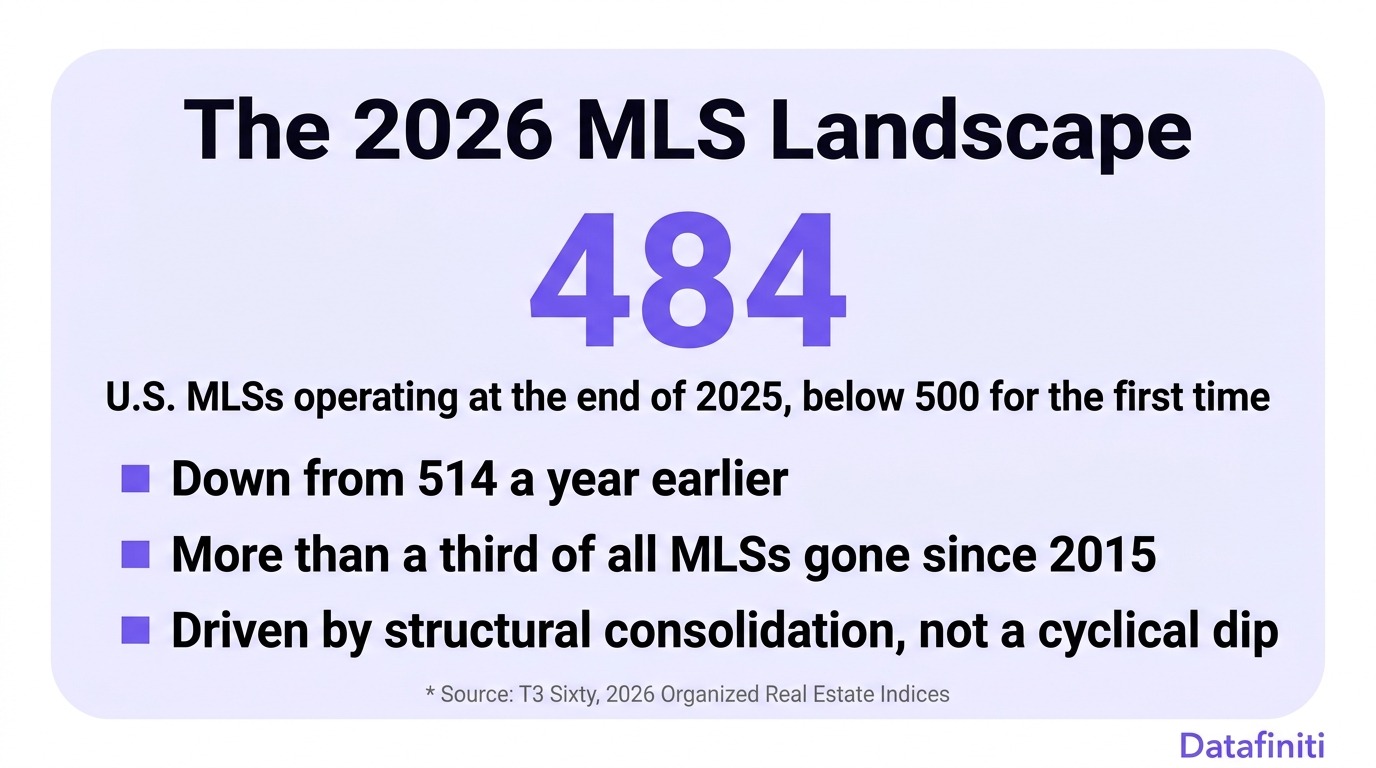
For years, the convenient round number was “over 500 MLSs.” That era just ended. The U.S. MLS count dropped below 500 for the first time in 2025, falling to 484 from 514 a year earlier, and the industry has shed more than a third of its MLSs since 2015. Analysts describe this as structural consolidation rather than a cyclical dip, driven by rising legal and compliance pressures that make scale essential. The contraction isn't evenly distributed either, since a handful of states drove most of 2025's closures, so the markets you operate in may consolidate on very different timelines.
For developers, consolidation cuts both ways. Fewer organizations can mean fewer integrations to maintain over time. But each merger also brings schema migrations, changed endpoints, and new compliance terms landing on your roadmap. If you're scoping a real estate database API for an MVP, it's worth designing for a moving target rather than a fixed list of systems.
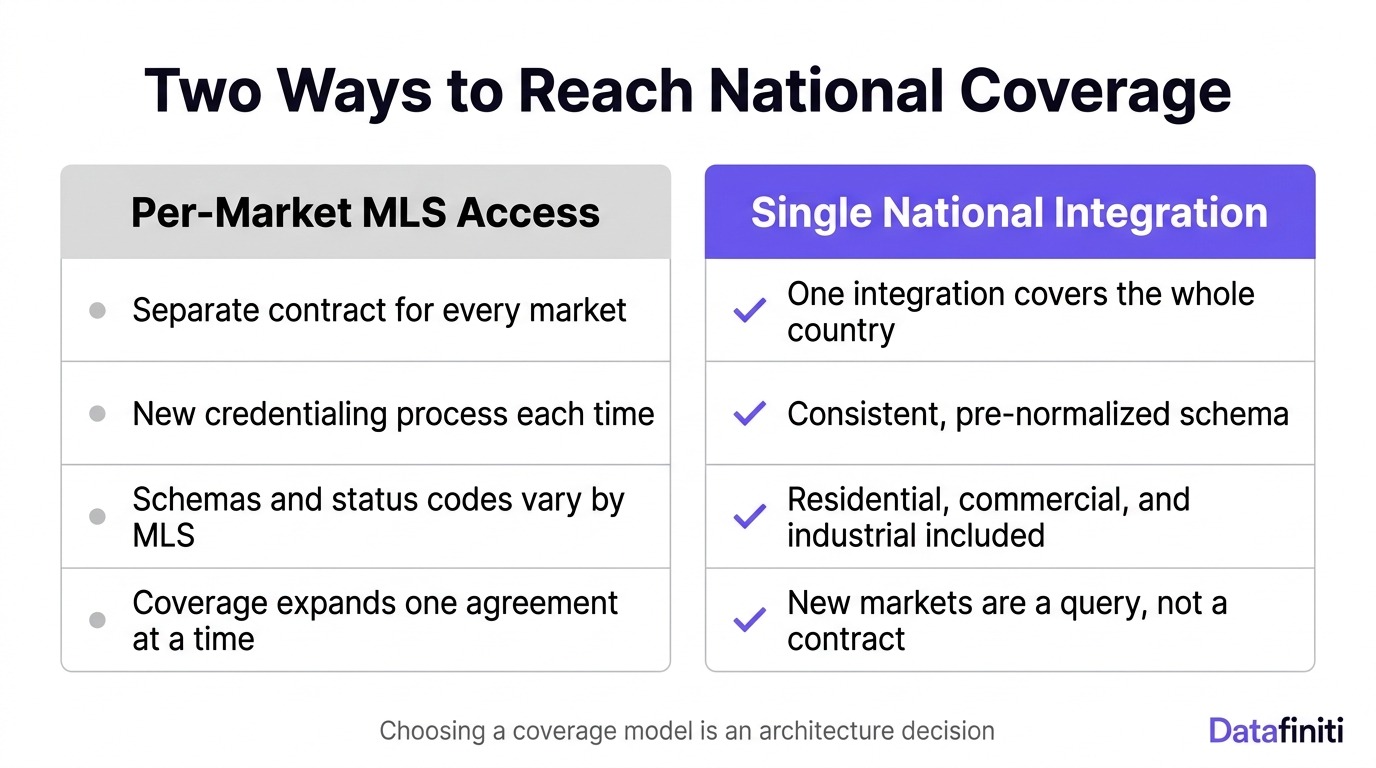
Each MLS is still independently governed, which means each one sets its own membership fees, credentialing requirements, data use policies, display rules, and technology preferences. A platform that needs coverage across 10 major metros may still need 10 separate contracts, each with its own compliance requirements baked into your application logic.
Field naming is a concrete example of the daily cost. One MLS may represent bathroom count as a decimal, another as an integer plus a separate partial-bath field. Status codes for active, pending, and sold listings vary. Timestamps arrive in different formats depending on the system.
- MLS data schemas vary widely: field names, types, and status codes differ across organizations.
- Each MLS governs its own membership criteria, vendor approval process, and display compliance rules.
- Duplicate listings are common when a property is listed in more than one MLS, so you'll need deduplication logic in your pipeline.
Every inconsistency needs normalization code, and every normalization decision is a potential point of failure when an MLS updates its schema. Most serious PropTech platforms either invest heavily in a data engineering team or route through an aggregator that absorbs the work.
What Is the RESO Web API, and Why Did It Replace RETS?
If fragmentation is the access problem, standardization is the industry's answer to it. For two decades, that standard was RETS. Today, it's the RESO Web API, and the difference matters for how you build.
The RESO Web API is a RESTful, OData-based standard for accessing MLS data, using JSON delivery and a shared Data Dictionary that normalizes field names across compliant MLSs. It replaced RETS, the older XML-based protocol.
From RETS to a Modern Web Standard
For much of the past two decades, the Real Estate Transaction Standard (RETS) was the dominant protocol for accessing MLS data. RETS was XML-based, required specialized client libraries, leaned on local database replication that could grow unwieldy, and delivered inconsistent data structures across systems.
RESO stopped supporting RETS and shifted certification to the RESO Web API, and the industry has been completing the migration ever since. The National Association of Realtors now requires affiliated MLSs to make production-level Web API access available to their data. The Web API uses a RESTful, OData query model with JSON delivery, so you can write to a consistent field structure instead of learning an MLS-specific dialect.
The RESO Data Dictionary is the other half of the story. It defines common names and types for hundreds of listing fields, which reduces the normalization burden for platforms operating in compliant markets. When two MLSs both certify against the Dictionary, the values for active, pending, and closed listings mean the same thing in both.

What RESO Standardization Doesn't Solve
The RESO Web API is a real improvement, but it isn't a national data feed. Adoption fidelity still varies: some MLSs are fully compliant, others have partial implementations, and the last mile tends to be the smaller regional and rural systems. RESO also doesn't distribute the data itself. It publishes the standard, and you still negotiate access with each MLS.
So standardization narrows the schema problem without touching the access problem. You can write cleaner integration code, and a RESO-compliant endpoint means predictable OData queries and OAuth-based auth, but you're still assembling coverage one credentialed MLS at a time, and each new market resets the contracting clock. That gap is where aggregated, pre-normalized property data providers fit.
What Does National Coverage Actually Require?
Put fragmentation and standardization together, and you arrive at the question that decides your architecture: how do you get national coverage without managing the national maze?
Through the MLS system directly, national coverage is an exercise in stacking relationships. Each market you add is another contract, another credentialing process, another set of display rules, and often another invoice. Providers that sell access by metro or region turn your expansion roadmap into a procurement project, and the friction compounds with every new market.
A pre-normalized, aggregated property data API inverts that model. Instead of negotiating coverage market by market, you integrate once and query the whole country through a single, consistent schema. Full national access under one integration means you can launch in a new metro without a new contract, and your data pipeline scales with your product.
Picture a team that launches in three metros, validates the product, and wins funding to expand to 30. Under the MLS model, that growth triggers 27 new credentialing processes, each on its own timeline, plus the legal review and display-compliance work that comes with every agreement. Under a single national integration, the same expansion is a query-parameter change. The data is already there; you're just asking for more of it.
Coverage breadth is the headline, but a few supporting traits make national-scale work practical. The absence of rate limiting matters when you're ingesting in bulk, since requests-per-second caps force you to build throttling logic and retry handling you'd rather not own. Coverage across residential, commercial, and industrial property types future-proofs you as your use cases expand. Pricing structured per record delivered, rather than per request attempted, keeps costs predictable at volume. And clear, public documentation with a visual portal for exploring the data before you write integration code shortens evaluation, which is rarely true of MLS-connected providers whose docs often require a sales call to decode.
5 Questions to Ask Before Committing to a Real Estate Listing API
Evaluating real estate listing API options is more than a technical exercise. The access model, pricing structure, and compliance requirements all have downstream effects on your architecture and budget. These are the questions worth answering before you sign anything.
- Geographic coverage and how it's priced. Some providers sell access by metro or region, so national coverage can mean multiple contracts and unpredictable costs as you expand. A single integration for national access is meaningfully easier to scale with.
- Per request or per record? Per-request pricing bills you for every query, including ones that return nothing. Per-record pricing charges only for data actually delivered. At high volume, that difference adds up.
- Rate limits and the overhead they create. Rate-limited APIs force you to build throttling logic and retry handlers into your pipeline, which adds complexity and slows bulk ingestion. APIs without rate limits remove that whole class of problems.
- Property types under the agreement. Many MLS-based providers are residential-first. If you need commercial or industrial coverage, that can mean a separate integration or a different data source entirely. Knowing whether one agreement covers all property types saves work later.
- Data display and use restrictions. MLS data carries compliance obligations. Refresh rates, attribution, field visibility, and removal timelines all have to be implemented correctly. Confirm what those requirements are before you write integration code, and check whether the provider offers a visual portal to explore the data first. Most don't.
Frequently Asked Questions
What's the Difference Between an MLS Database API and an IDX Feed?
A direct MLS API provides programmatic access to the full or near-full listing dataset held by an MLS, for use in data products, analytics tools, and internal applications. An IDX feed is a curated, policy-governed stream that lets real estate professionals display approved listing fields publicly on their sites. IDX restricts which fields you get and how you can use the data. A real estate MLS API offers far more flexibility and depth, but requires more rigorous access controls and compliance work.
Do I Need a Real Estate License to Access MLS Data via API?
Not necessarily, but you do need a formal relationship with each MLS you want to access. Developers and technology companies typically get in through an approved vendor agreement rather than a real estate license, which means demonstrating a legitimate use case, signing a data use agreement, and passing the MLS's vendor approval process. Requirements vary by organization, so working through a third-party aggregator is often the more practical path when you need coverage across multiple markets.
What Is the RESO Web API, and Why Did RETS Get Replaced?
The RESO Web API is a RESTful, OData-based standard built by the Real Estate Standards Organization to give developers consistent access to MLS data across organizations. It replaced RETS, an older XML-based protocol that required local database replication and specialized client libraries and delivered inconsistent structures across systems. RESO stopped supporting RETS in 2018, and the migration to the Web API, with its JSON delivery and shared Data Dictionary, has been underway ever since.
Can I Access MLS Listing Data Nationwide Through a Single Real Estate Listing API?
Through the MLS system directly, no. Each of the several hundred MLS organizations in the United States has to be accessed separately, each with its own credentialing and licensing. Aggregators provide a single endpoint that normalizes data from multiple MLSs, which reduces integration complexity, though they bring their own coverage and freshness tradeoffs. For teams that need genuinely national property data without per-MLS contracting, a pre-normalized structured property data API offers a different architecture worth evaluating: one integration, a consistent schema, and full national coverage.
How Often Does MLS Data Change, and Does Consolidation Affect Access?
MLS listing data constantly changes as listings go active, pending, and sold, which is why freshness and update cadence are core evaluation criteria. Consolidation adds a second kind of change: as MLSs merge, endpoints, schemas, and contract terms shift underneath integrations built against the old systems. Building against a normalized, aggregated source insulates you from much of that churn, since the provider absorbs the migrations instead of passing them to your roadmap.
Choosing the Right Foundation for Your Real Estate Data Stack
The MLS system is the primary source of listing data in the United States, and choosing the right access pattern is a foundational decision for any real estate platform. IDX feeds work for consumer-facing display. Direct MLS API access works for data products that need richer fields. Aggregators reduce integration complexity but bring their own tradeoffs. None of these is free of compromise, and the fragmentation of several hundred independently governed organizations, now consolidating fast, remains the defining constraint for anyone building at national scale.
Coverage strategy is architecture. Stacking per-market contracts builds friction directly into your roadmap, while a single national integration lets your data layer scale with your product. That's the decision worth getting right before you write the first line of integration code.
For developers and product teams who need comprehensive property data at national scale without the MLS licensing maze, Datafiniti's structured property data API delivers full national coverage across residential, commercial, and industrial property types, no rate limiting, and clear public documentation, so your pipeline runs at the speed your product demands. Request a demo to see how clean, accessible property data changes what you can build.
Read the latest articles

Read more

Build vs Buy: Business Data Enrichment for Growing Teams

Company Data API Pricing: Bulk & Enterprise-Scale Access

Best Business Data APIs for Sales Teams & Prospecting

Business Data API: Company Data at Enterprise Scale

How to Build a Product Database With a Product Data API

Property Data API Coverage: What U.S. Datasets Include

Product Data API for Ecommerce Price Monitoring and Repricing

Real-Time Product Data API for Product-Led Growth Teams

Property Ownership Data API for Skip Tracing and Lead Gen

How APIs Make Building a Product Database Easy
Learn how to build a product database with APIs for cleaner imports, updates, search, and scalable product data.

How to Leverage Competitor Pricing Data with an API
Use competitor pricing data to build API-driven monitoring, analysis, and smarter pricing decisions.

Price Monitoring API: The Key to E-Commerce Pricing Strategy
Use a price monitoring API to track market changes, improve pricing decisions, and protect ecommerce margins.

How do Product Data APIs Work for E-Commerce Companies?
Learn how a product data API works, from collection and queries to ecommerce integration and use cases.

GTIN Lookup API: Search Products by Barcode & UPC at Scale

Best Real Estate API 2026: Coverage, Pricing, Data Quality

Best Product Data API 2026: A State-of-the-Market Guide

Product Data API Integration Patterns for Ecommerce Platforms

Build a PropTech MVP With a Property Ownership Data API

3 Benefits of Web Scraping for Real Estate
Boost your research by using web scraping for real estate to gain market insights, automate lead lists, and minimize property risk.

How Real Estate Agents Can Leverage Proptech Data
Leverage proptech data to source leads, speed up valuations, and manage risk with accurate, real-time property insights.

What Is a UPC Lookup API?
Learn about the UPC lookup API, how it works, and its benefits for businesses. Get product data easily.

What Is a GTIN Lookup API?
Learn about the GTIN lookup API and how it can help your business grow. Get product data insights.

How Does a Property Data API Work?
Learn how a property data API works, its features, and how you can use it for real estate and business insights.

What The Best Real Estate APIs Should Have
Discover what makes the best real estate APIs stand out. Learn about essential features for your property data needs.
How to Access MLS Listing Data
Learn how to access MLS listing data using an MLS data API. Discover Datafiniti's solutions and integration tips.
.png)
How to Enrich Your Product Catalog With a Real-Time API
.jpeg)
Product Data API Buyer's Guide for Ecommerce Teams

Do I Need a Real Estate Listing API?
Explore the benefits and technicalities of a real estate listing API. Learn how to choose the right provider and integrate data for business growth.

Why Real Estate Tech Startups Need Property APIs with Ownership Details
Discover how property APIs with ownership details empower real estate tech startups. Learn about data integration, risk mitigation, and driving business value.
The Value of a Product Catalog Sync for Product Managers
Unlock the value of product catalog sync for product managers. Streamline data, improve decisions, and reduce costs with real-time insights.

What is a Product Data Webhook?
Learn about product data webhooks, their components, and how they enable real-time updates for business intelligence and workflow automation.

Why Is a Product Data API Integration Essential for Analysts & Product Managers?
Unlock insights with product data API integration. Essential for analysts & product managers to streamline data access & enhance product strategy.

What Is a Product Data API and Its Benefits
Learn about product data APIs, their benefits, and how they drive business growth. Explore integration and advanced use cases.

What Do eCommerce Data Vendors Do?
Learn what ecommerce data vendors do, their services, and how to choose the right one for your business growth.

How to Compare Product Data Providers: What to Look For
Compare product data providers. Learn what to look for in data quality, structure, and integration features.

How to Get Your Product Data in Real-Time Using APIs
Learn how to leverage real-time product data APIs for e-commerce, competitive analysis, and AI. Get instant access to clean, structured product data.

Best Product Data API: Features to Look for
Find the best product data API with real-time updates, comprehensive coverage, and a user-friendly portal. Explore features to look for.

Unlocking Property Data with an API
Access property data with a powerful property database API. Explore listings, market analysis, investment opportunities, and more. Get started today!

Unlocking CRE with APIs
Unlock commercial real estate insights with a powerful API. Access property data, streamline workflows, and enhance investment strategies.

How to Get a Real-Time Product Feed Using an API
Learn how to get a real-time product feed using an API. Access, leverage, and ensure accuracy of product data for your business needs.

Spying on Competitor Prices: What You Need to Know
Learn how to gather and analyze competitor pricing data to inform your business strategy. Understand key components and ethical considerations.

Product Data Enrichment: What Are You Missing?
Enhance your product data with comprehensive enrichment. Discover insights, drive growth, and choose the right approach for your business.
.png)
IDX vs MLS API: A Developer's Guide to Real Estate Listing Data
.png)
Real Estate API Pricing Models Explained: Subscription vs. Usage-Based

Real Estate API vs Web Scraping: The Buy-vs-Build Decision
.png)
Product Data APIs Explained: Powering Product Search and Catalog Automation

How to Get the Most out of a Product Catalog API
Learn how to leverage a product catalog API for business growth. Discover data quality, access methods, and strategy for your product catalog API.

Taming Your Ecommerce Product Data Feed
Optimize your ecommerce product data feed for growth. Learn strategies, leverage technology, and ensure data quality for better customer experience and AI initiatives.

Streamlining Your Product Search with an API
Explore the benefits and integration of a product search API. Streamline your product discovery and leverage data for business growth.
.png)
What Is a Real Estate Transaction Database? A Complete Guide
How Real Estate Platforms Access MLS Database APIs
.png)
Commercial Real Estate API vs. Residential Property API
.png)
How to Choose a Real Estate Database API for Your MVP
MLS API vs. IDX: What's the Diff?
MLS API vs IDX: Explore the differences in real estate data access, retrieval, and integration. Understand which solution fits your needs.

Scraping vs. APIs: Getting Real Estate Data
Compare web scraping vs real estate API for data acquisition. Learn the pros, cons, and best use cases for each method.

Property Valuation API: Your Go-To Real Estate Tool
Leverage the property valuation API for real estate insights. Access comprehensive property data for diverse applications with Datafiniti.

Product Data APIs Explained
Learn about product data APIs explained. Discover how to access, integrate, and utilize product data for e-commerce, analytics, and more.

Unlocking Your Ecommerce Data with APIs
Unlock ecommerce data with APIs for business insights, product catalog enrichment, and competitive analysis. Explore data via portal or API.

Real Estate Ownership Data: How to Access, Analyze and Use at Scale
Access, analyze, and use real estate ownership data at scale. Learn how to find, process, and leverage this crucial information for business insights.
IDX vs MLS API: What Every Real Estate Professional Should Know
Understand IDX vs MLS API differences. Learn about data access, integration, and how Datafiniti's solutions empower real estate professionals.

How a Property Database API Can Help Real Estate Pros
Learn how a property database API can help real estate pros analyze trends, monitor listings, and optimize strategies. Get data insights.

What Is a Residential Property API?
Explore what a residential property API is, its features, benefits, and real-world applications for real estate professionals and investors.

What Is a Commercial Real Estate API?
Explore commercial real estate API functionality, data integration, and use cases. Learn how to leverage property, business, and people data for insights.

Understanding MVP Data Integration
Learn about MVP data integration, its components, benefits, and strategies for accessing and utilizing data resources effectively.

How to Choose the Best Property Data API
Learn how to choose the best property data API. Explore features, providers, pricing, and integration for real estate insights.

Real Estate Database API: What to Look for
Explore real estate database API options. Learn about data quality, features, and how to choose the right provider for your needs.

How Do Product Data APIs Work?
Understand how a product data API works, its key features, integration methods, and applications for e-commerce and business intelligence.

How Do Data Aggregation Platforms Work?
Explore how data aggregation platforms work, their capabilities, and applications. Learn to choose and implement the right platform for your business intelligence needs.

Why Do Companies Need Property Data Aggregation?
Discover why property data aggregation is crucial for businesses. Streamline access, empower functions, enhance risk management, and drive strategic decisions with authoritative insights.

MLS Database API: How to Choose a Provider and Get Access

Product Search API vs. Product Data API: What's the Difference?

What Is a Product Data API?
Explore the functionality and benefits of a product data API. Learn how to integrate, leverage, and choose the right provider for your business insights.
What Is the Difference Between Product Search API and Product Data API?
Understand the difference between Product Search API and Product Data API. Learn how to leverage product data for business intelligence and analytics.

What Is a Property Data API?
Explore the capabilities of a property data API. Understand its core functionality, key features for developers, and how to access property information at scale for business insights.
.png)
Real Estate API Pricing: What You Need to Know Before You Build
.jpeg)
How to Choose a Property Market API for Investment Platforms
Choosing the right property market API is critical for investment platforms. Learn how to evaluate data depth, coverage, freshness, and integration quality before you commit.
Data you can trust, delivered in a format your systems can use, at the scale your product requires.