
.png)
Product Data APIs Explained: Powering Product Search and Catalog Automation

Key Takeaways
A product data API provides programmatic access to structured product records from a large external dataset, including pricing, availability, descriptions, specs, and identifiers across millions of SKUs.
What that means in practice:
- Product data APIs power three core use cases: competitive pricing intelligence, catalog enrichment, and product search infrastructure.
- The best providers let teams explore live product records before writing a single line of integration code, shortening evaluation from weeks to hours.
- Evaluation should focus on data coverage, schema consistency, documentation quality, and how the provider prices access to records.
- Global ecommerce is projected to reach $6.88 trillion in 2026 (Shopify/eMarketer), making clean, scalable product data a foundational infrastructure requirement for any team competing in digital commerce.
Teams that evaluate product data before committing to an integration ship better products faster. The portal is the shortcut.
A product data API is a programmatic interface that gives applications access to structured product records at scale: pricing, availability, descriptions, identifiers, and specifications across millions of SKUs from many brands and retailers. The phrase "product data API explained" covers more ground than it might seem, though.
Depending on context, it could mean a supplier catalog feed, a search layer on top of a product database, or a third-party data source built for market intelligence. These are meaningfully different tools, and choosing the wrong one creates technical debt that compounds quickly. This post covers what a product data API actually is, the use cases it enables, and what to look for when evaluating providers. Teams exploring structured ecommerce data access will find this a useful starting point.
The stakes are high enough to get this right. Global ecommerce is projected to hit $6.88 trillion by the end of 2026, according to Shopify and eMarketer, with online sales now accounting for more than 21% of all retail worldwide. Any application competing in that environment, whether it is a pricing intelligence tool, a catalog management system, or an AI-powered product recommendation engine, runs on structured product data. The quality of that data, and the reliability of the API serving it, shapes everything downstream.
What Is a Product Data API?
At its core, a product data API is a programmatic interface that delivers structured product information from a database to an application. When a developer calls the API, the response comes back as organized, machine-readable data rather than raw HTML or unstructured text. That structure is what makes the data useful for building software.
The most important distinction to understand is between APIs that manage your own product catalog and APIs that provide access to external product data at scale. Both are technically product data APIs, but they solve different problems.
Catalog Management APIs vs. External Product Data APIs
Catalog management APIs, like those built into major ecommerce platforms, are designed to let developers interact with a store's own product inventory. They handle creating, updating, and deleting product listings. They are excellent tools for building storefronts, syncing inventory across channels, and managing product operations inside a single merchant's ecosystem.
External product data APIs take a different approach. Instead of giving access to one merchant's catalog, they provide access to a large, normalized dataset spanning millions of products across many brands, retailers, and categories. These APIs are built for use cases like market intelligence, competitive research, and catalog enrichment, where the goal is not to manage internal inventory but to understand the broader product landscape.
The focus of this post is primarily the second type: third-party data infrastructure that gives teams access to structured product records they did not create themselves. The best of these platforms deliver programmatic access to millions of normalized product records covering pricing, availability, descriptions, specifications, and review signals. Well-maintained API documentation that is publicly accessible before any sales conversation is one of the clearest signals that the underlying data product is mature and production-ready.
What Data Does a Product Data API Deliver?
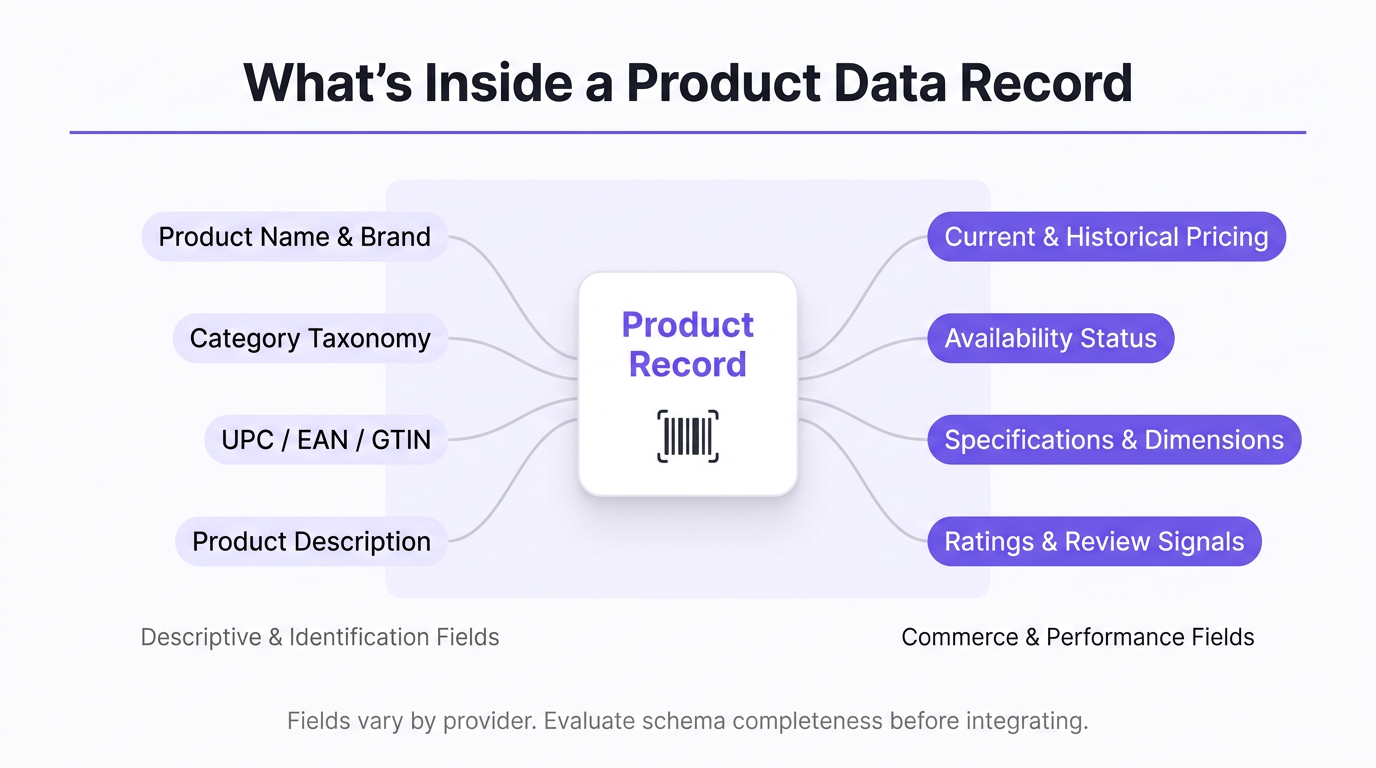
Understanding the data model is essential before committing to an integration. A well-designed product data API will always reveal more about itself through its schema than through any marketing description. The fields that matter most vary by use case, but most structured product datasets include several common attribute groups.
Core Product Attributes
Every product record should include reliable identifiers and descriptive fields: product name, brand, manufacturer, category taxonomy, and product description. These are the fields that power search functionality and catalog organization. Without clean, consistent values here, downstream features break.
Identifiers like UPC, EAN, GTIN, and SKU are particularly important for teams that need to match records across data sources. A pricing intelligence tool, for example, needs to reliably identify when two different retailers are selling the same product. If identifiers are missing or inconsistent, that matching logic fails.
Pricing and Availability Data
Pricing data is often the highest-value element in a product data API, particularly for ecommerce teams building dynamic pricing tools, competitive monitoring dashboards, or shopping comparison features. A product search API built on quality data should expose both current price and historical pricing so that teams can detect trends, identify promotional patterns, and understand price volatility across retailers.
Availability signals, including in-stock status and inventory indicators, are equally important for applications that help users find products they can actually purchase. These fields update frequently, so data freshness and refresh cadence are critical evaluation criteria.
Specifications and review data round out the record. Specs cover dimensions, materials, technical attributes, and category-specific fields. Review data, including aggregate ratings and review text, supports sentiment analysis and quality benchmarking. The best providers organize all of these fields into a consistent schema, and make that schema visible through a product data portal that teams can explore before committing to an integration.
What Can You Actually Build with a Product Data API?
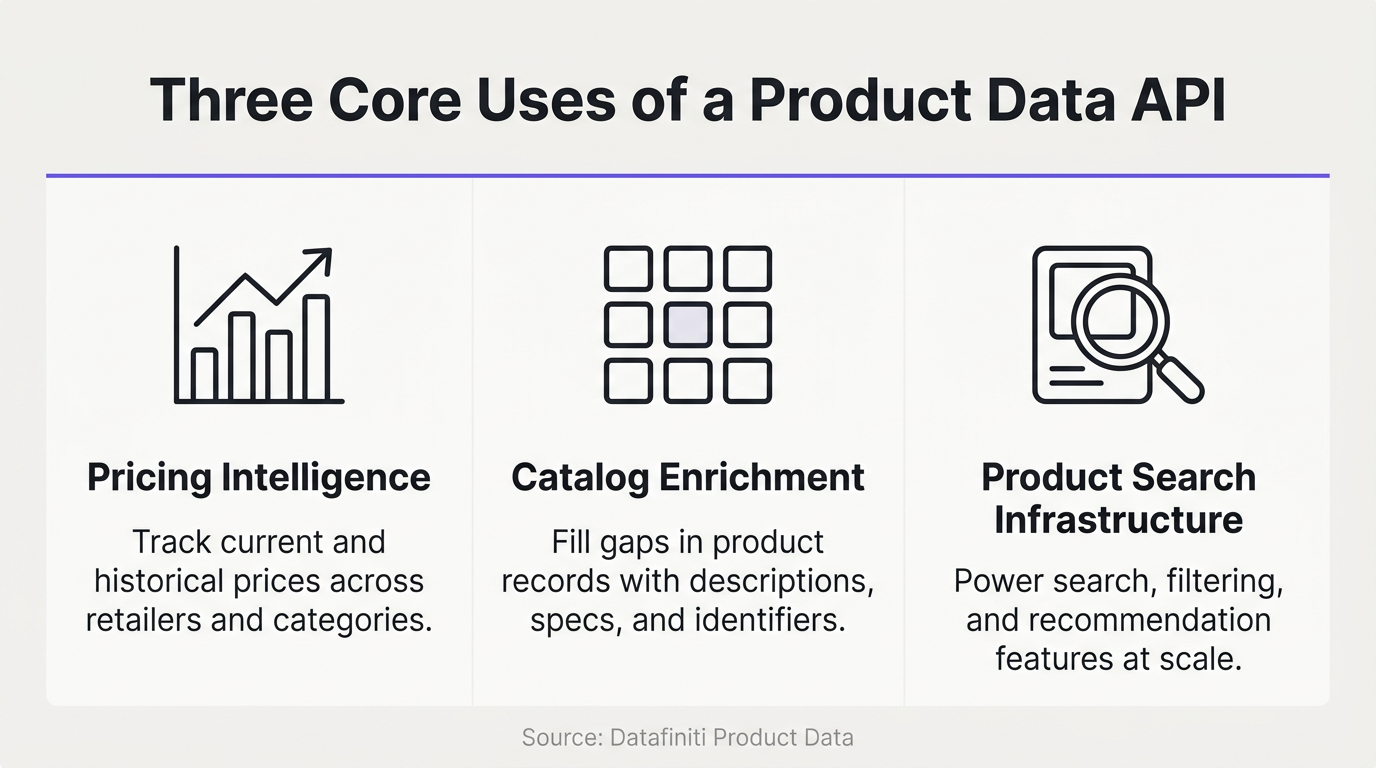
The practical value of a product data API comes from the specific workflows it enables. Three use cases appear consistently across ecommerce, SaaS, and analytics applications.
Competitive Pricing Intelligence
Pricing is one of the most dynamic variables in digital commerce. In Jungle Scout's 2024 Amazon Product Pricing Report, researchers tracked daily pricing data for 100 best-selling products across eight major categories and found that most experienced measurable price fluctuations year over year, with some categories like electronics seeing drops as steep as 50% over a two-year period. For teams building repricing tools or competitive monitoring features, that level of volatility makes a current and historical pricing feed essential rather than optional.
The practical implementation usually looks like this: a team queries the API for a list of target products, pulls pricing data across multiple merchants, compares that data against their own pricing, and flags items where their price is out of range. The catalog API handles the data retrieval; the team's application handles the business logic. Clean, structured data from the API is the prerequisite for everything else working.
Catalog Enrichment
Many ecommerce teams have a product catalog that is incomplete. SKUs without descriptions. Products missing categories. Items with inconsistent attribute fields. In the context of catalog enrichment, a product data API functions as a lookup service: the team provides an identifier, the API returns a full product record, and the application uses that data to fill gaps in the existing catalog.
This is a high-value use case for retailers who have acquired inventory from multiple suppliers, each with different data standards. Instead of manually writing product descriptions and categorizing thousands of SKUs, a team can use the catalog API to pull structured records and populate their catalog programmatically. The quality of the enrichment is entirely dependent on the quality of the source data.
Product Search Infrastructure
A product search API built on top of a large external dataset enables features that individual merchants cannot build with their own inventory alone. Price comparison tools, gift recommendation engines, market research dashboards, and category trend analysis all require access to product data at a scale that exceeds what any single merchant can provide.
Building a product search feature on top of a well-structured dataset also allows for faceted filtering, attribute-based search, and category-level aggregation. A user searching for running shoes under $80 in a specific size is running a structured query against structured data. The better the underlying schema, the more powerful and reliable the search experience.
How to Evaluate a Product Data API
Not all product data APIs are built the same way. The differences between providers become apparent when teams move from demos to real integrations. These are the factors that matter most.
- Data coverage and breadth. How many products does the dataset include? What categories, brands, and retailers are represented? Coverage gaps create blind spots in any downstream application.
- Schema consistency. Fields should be normalized across records. Inconsistent attribute names, missing values, or variable data types create significant data wrangling overhead before any meaningful analysis can happen.
- Data freshness and update frequency. For pricing and availability use cases especially, stale data produces incorrect outputs. Confirm refresh cadence and how the provider handles products that change frequently.
- Documentation quality. Most product data providers ship sparse documentation that requires a sales conversation to answer basic questions about query structure, field definitions, or error handling. Clear, publicly accessible API docs are a strong signal of a mature provider and a meaningful time-saver during integration.
- How the provider prices access. Pay attention to whether you are charged per record delivered or per request made. Per-request pricing means failed queries still cost money. Per-record pricing aligns cost directly with value received.
There is one additional factor worth highlighting separately, because it is rarely discussed but has an outsized impact on evaluation time: whether the provider offers a visual interface to explore the data before writing integration code.
Why a Visual Portal Changes the Evaluation Timeline
Most teams spend a significant amount of time in the evaluation phase of any data provider relationship. They need to understand whether the data actually covers their use case before committing engineering time to an integration. With most providers, that evaluation requires writing code, making API calls, and parsing responses just to answer basic questions about coverage and field structure.
A visual web portal inverts that process. Instead of querying blind, teams can search the dataset directly in a browser, browse actual product records, inspect field values, and verify coverage for their specific categories, brands, or retailers. The portal functions as a pre-integration sandbox, allowing analysts, category managers, and product teams to validate fit without waiting for a developer to write an API wrapper.
What This Means for Product and Data Teams
The practical implication is significant. A team evaluating a product data API can run searches in the portal, inspect pricing fields across representative SKUs, and confirm schema consistency, all before any engineering time is invested. If the data fits, the team moves to integration with confidence. If it does not, they find out early rather than after several weeks of development.
Teams can request a demo to explore the platform to see how the portal gives immediate access to live product records for validating coverage, reviewing schema structure, and building queries before writing integration code. For teams that need to move quickly without long sales cycles, that accessibility is a concrete competitive advantage.
No rate limiting means teams can run queries during evaluation and integration at whatever pace their work requires, without having to build throttling logic or manage API call budgets before they even understand what the data looks like.
Six Questions to Ask Before Committing to a Product Data API
Choosing the wrong data provider is an expensive mistake. These questions help identify fit before engineering resources are committed.
- What is the total product record count and how is it segmented? Large headline numbers can hide gaps. Ask how many records cover your specific categories, price ranges, or retailer set.
- How often is the data refreshed? For pricing and availability applications, daily refresh is often the minimum viable frequency. Understand whether updates are batch-processed or rolling.
- Can I explore the actual data before committing? A portal or sandbox with live product records answers questions about field completeness and schema consistency far faster than any documentation or demo.
- Is the schema consistent across records and categories? Inconsistent field naming or missing attributes across product types signals raw data that requires significant normalization before it is useful.
- How does pricing work when I scale? An ecommerce data API that charges per request penalizes exploratory queries and failed calls. Per-record pricing aligns cost with the value actually received.
- What does the documentation actually cover? Ask to see the API documentation before a sales conversation. If basic query structure, field definitions, and error codes are not publicly accessible, expect friction during integration.
Frequently Asked Questions
What Is a Product Data API, and How Is It Different from a Storefront Platform API?
A product data API explained in brief: it provides programmatic access to structured product information, typically from a large external dataset covering many brands, retailers, and categories. A storefront platform API is designed to manage one merchant's own product catalog. The use cases are entirely different. Platform APIs handle creating, updating, and syncing product listings for a single store. An external product data API is built for market intelligence, catalog enrichment, and product research at a scale no single merchant can provide.
What Fields Are Typically Included in a Product Data API Response?
Most structured product records include product identifiers (UPC, EAN, GTIN), name, brand, category, description, current pricing, historical pricing, availability status, specifications, images, and review signals like ratings and review counts. The completeness of these fields varies significantly across providers. Evaluating actual records in a portal or sandbox before integration is the best way to verify what is genuinely available.
How Does a Catalog API Differ from a Product Search API?
The terms are often used interchangeably, but they describe slightly different things. A catalog API typically refers to the data layer: structured product records that an application can query, ingest, or enrich from. A product search API usually refers to the query interface built on top of that data, allowing applications to retrieve relevant products based on keyword, attribute, or category filters. In practice, most ecommerce data API products provide both: a searchable interface and access to the underlying structured records.
Is a Product Data API Useful If I Only Need Pricing Data?
Yes, and often more so than a dedicated price API. Pricing data in isolation can be difficult to act on without the surrounding product context. Knowing that a product is priced at a certain amount is more useful when you also know the brand, category, specifications, and competitive set. A full product record gives applications the context to build features like dynamic pricing rules, competitive benchmarks, and market positioning analysis that a price-only feed cannot support.
How Do I Know If a Product Data API Has Enough Coverage for My Use Case?
The fastest way to evaluate coverage is to query the dataset directly for the categories, brands, or retailers that matter to your application. Providers that offer a visual portal let you do this without writing code, which compresses the evaluation from days to hours. If a provider cannot show you actual records in your target category before a sales conversation, that is a sign the evaluation process will be slow and the data may not be ready for production use.
Choosing the Right Product Data API for Your Use Case
A product data API explained at the technical level is straightforward: it is a programmatic interface to structured product records. What makes providers meaningfully different is not the interface itself but the data behind it, the schema quality, the coverage depth, the update frequency, and how accessible the data is before an integration commitment is made.
Teams that can explore actual product records in a visual portal before committing to an integration make faster, better-informed decisions. Teams that have to rely on demos and documentation alone take longer to evaluate and take on more risk. For any ecommerce data API purchase, the ability to see the data is not a luxury. It is the clearest signal of whether the provider is worth building on.
Datafiniti's product data API gives developers and data teams access to millions of structured product records, with a visual portal to explore coverage and validate schema before writing integration code, per-record pricing so you only pay for data you actually receive, and documentation designed for technical teams rather than sales conversations. Get in touch to get started and see what your team can build with clean, structured product data.
Read the latest articles

Read more

Business Data API: Company Data at Enterprise Scale

How to Build a Product Database With a Product Data API

Property Data API Coverage: What U.S. Datasets Include

Product Data API for Ecommerce Price Monitoring and Repricing

Real-Time Product Data API for Product-Led Growth Teams

Property Ownership Data API for Skip Tracing and Lead Gen

How APIs Make Building a Product Database Easy
Learn how to build a product database with APIs for cleaner imports, updates, search, and scalable product data.

What Is Property Transaction Data and How Does an API Help Get It?
Learn how property transaction data works and how APIs provide structured access for analysis and workflows.

How to Use Real Estate Transaction Data
Learn how to use real estate transaction data for analysis, valuation, underwriting, and market decisions.

How to Leverage Competitor Pricing Data with an API
Use competitor pricing data to build API-driven monitoring, analysis, and smarter pricing decisions.

Price Monitoring API: The Key to E-Commerce Pricing Strategy
Use a price monitoring API to track market changes, improve pricing decisions, and protect ecommerce margins.

How do Product Data APIs Work for E-Commerce Companies?
Learn how a product data API works, from collection and queries to ecommerce integration and use cases.

Bulk Real Estate Data Licensing: Access Datasets at Scale

How to Integrate MLS Listings Using an MLS Data API

GTIN Lookup API: Search Products by Barcode & UPC at Scale

Best Real Estate API 2026: Coverage, Pricing, Data Quality

Best Product Data API 2026: A State-of-the-Market Guide

Product Data API Integration Patterns for Ecommerce Platforms

Build a PropTech MVP With a Property Ownership Data API

3 Benefits of Web Scraping for Real Estate
Boost your research by using web scraping for real estate to gain market insights, automate lead lists, and minimize property risk.

How Real Estate Agents Can Leverage Proptech Data
Leverage proptech data to source leads, speed up valuations, and manage risk with accurate, real-time property insights.
What Is a UPC Lookup API?
Learn about the UPC lookup API, how it works, and its benefits for businesses. Get product data easily.

What Is a GTIN Lookup API?
Learn about the GTIN lookup API and how it can help your business grow. Get product data insights.

How Does a Property Data API Work?
Learn how a property data API works, its features, and how you can use it for real estate and business insights.

What The Best Real Estate APIs Should Have
Discover what makes the best real estate APIs stand out. Learn about essential features for your property data needs.

The Benefits of a Real Estate MLS API
Learn about the benefits of a real estate MLS API for streamlining data access and driving business growth.

Why Every Real Estate Pro Needs an MLS Database API
Learn why a MLS database API is vital for real estate pros. Get data, insights, and competitive edge.
How to Access MLS Listing Data
Learn how to access MLS listing data using an MLS data API. Discover Datafiniti's solutions and integration tips.
.png)
How to Enrich Your Product Catalog With a Real-Time API
.jpeg)
Product Data API Buyer's Guide for Ecommerce Teams

Do I Need a Real Estate Listing API?
Explore the benefits and technicalities of a real estate listing API. Learn how to choose the right provider and integrate data for business growth.

Unlocking the MLS Database with APIs
Unlock the MLS database with APIs. Learn how to access property data, gain real estate insights, and integrate MLS data for your business needs.

Why Real Estate Tech Startups Need Property APIs with Ownership Details
Discover how property APIs with ownership details empower real estate tech startups. Learn about data integration, risk mitigation, and driving business value.
The Value of a Product Catalog Sync for Product Managers
Unlock the value of product catalog sync for product managers. Streamline data, improve decisions, and reduce costs with real-time insights.

What is a Product Data Webhook?
Learn about product data webhooks, their components, and how they enable real-time updates for business intelligence and workflow automation.

Why Is a Product Data API Integration Essential for Analysts & Product Managers?
Unlock insights with product data API integration. Essential for analysts & product managers to streamline data access & enhance product strategy.

What Is a Product Data API and Its Benefits
Learn about product data APIs, their benefits, and how they drive business growth. Explore integration and advanced use cases.

What Do eCommerce Data Vendors Do?
Learn what ecommerce data vendors do, their services, and how to choose the right one for your business growth.

How to Compare Product Data Providers: What to Look For
Compare product data providers. Learn what to look for in data quality, structure, and integration features.

How to Get Your Product Data in Real-Time Using APIs
Learn how to leverage real-time product data APIs for e-commerce, competitive analysis, and AI. Get instant access to clean, structured product data.

Best Product Data API: Features to Look for
Find the best product data API with real-time updates, comprehensive coverage, and a user-friendly portal. Explore features to look for.

Unlocking Property Data with an API
Access property data with a powerful property database API. Explore listings, market analysis, investment opportunities, and more. Get started today!

Unlocking CRE with APIs
Unlock commercial real estate insights with a powerful API. Access property data, streamline workflows, and enhance investment strategies.

How to Get a Real-Time Product Feed Using an API
Learn how to get a real-time product feed using an API. Access, leverage, and ensure accuracy of product data for your business needs.

Spying on Competitor Prices: What You Need to Know
Learn how to gather and analyze competitor pricing data to inform your business strategy. Understand key components and ethical considerations.

Product Data Enrichment: What Are You Missing?
Enhance your product data with comprehensive enrichment. Discover insights, drive growth, and choose the right approach for your business.
.png)
IDX vs MLS API: A Developer's Guide to Real Estate Listing Data
.png)
Real Estate API Pricing Models Explained: Subscription vs. Usage-Based

Real Estate API vs Web Scraping: Which Wins in 2026?
Product Data APIs Explained: Powering Product Search and Catalog Automation

Best Sources for Bulk Real Estate Transaction Data

How to Get the Most out of a Product Catalog API
Learn how to leverage a product catalog API for business growth. Discover data quality, access methods, and strategy for your product catalog API.

Taming Your Ecommerce Product Data Feed
Optimize your ecommerce product data feed for growth. Learn strategies, leverage technology, and ensure data quality for better customer experience and AI initiatives.

Streamlining Your Product Search with an API
Explore the benefits and integration of a product search API. Streamline your product discovery and leverage data for business growth.
.png)
Real Estate Transaction Databases: What You Need to Know
.png)
Best MLS API for Real Estate Software: What Developers Need

How Real Estate Platforms Access MLS Database APIs
.png)
Commercial Real Estate API vs. Residential Property API
.png)
How to Choose a Real Estate Database API for Your MVP
MLS API vs. IDX: What's the Diff?
MLS API vs IDX: Explore the differences in real estate data access, retrieval, and integration. Understand which solution fits your needs.

Scraping vs. APIs: Getting Real Estate Data
Compare web scraping vs real estate API for data acquisition. Learn the pros, cons, and best use cases for each method.

Cracking the Code: Housing Sales Insights
Unlock housing sales analytics insights with Datafiniti. Explore property data, market trends, and advanced techniques for strategic decisions.

Property Valuation API: Your Go-To Real Estate Tool
Leverage the property valuation API for real estate insights. Access comprehensive property data for diverse applications with Datafiniti.

Product Data APIs Explained
Learn about product data APIs explained. Discover how to access, integrate, and utilize product data for e-commerce, analytics, and more.

Unlocking Your Ecommerce Data with APIs
Unlock ecommerce data with APIs for business insights, product catalog enrichment, and competitive analysis. Explore data via portal or API.

Your Guide to Housing Sales APIs
Explore housing sales API data for insights. Access property data, integrate into applications, and gain business intelligence. Get started today!

Real Estate Ownership Data: How to Access, Analyze and Use at Scale
Access, analyze, and use real estate ownership data at scale. Learn how to find, process, and leverage this crucial information for business insights.

Unlocking Opportunities: Navigating Bulk Real Estate Transaction Data
Unlock opportunities with bulk real estate transaction data. Learn how to access, analyze, and leverage property data for investing, marketing, and more.
What Is a Property Sales Database?
Explore what a property sales database is, its core components, how to access data, and key use cases for real estate analysis and more.

Benefits of Obtaining Housing Transaction Data
Unlock insights with housing transaction data. Analyze markets, investments, sales, and risk. Get comprehensive property data for informed decisions.

Understanding Real Estate Transaction Databases
IDX vs MLS API: What Every Real Estate Professional Should Know
Understand IDX vs MLS API differences. Learn about data access, integration, and how Datafiniti's solutions empower real estate professionals.

What Is an MLS Database API?
Explore the MLS database API: understand its components, benefits, and how to access real estate data for various applications. Learn about its core functionality and technical aspects.

How a Property Database API Can Help Real Estate Pros
Learn how a property database API can help real estate pros analyze trends, monitor listings, and optimize strategies. Get data insights.

What Is a Residential Property API?
Explore what a residential property API is, its features, benefits, and real-world applications for real estate professionals and investors.

What Is a Commercial Real Estate API?
Explore commercial real estate API functionality, data integration, and use cases. Learn how to leverage property, business, and people data for insights.

Understanding MVP Data Integration
Learn about MVP data integration, its components, benefits, and strategies for accessing and utilizing data resources effectively.

How to Choose the Best Property Data API
Learn how to choose the best property data API. Explore features, providers, pricing, and integration for real estate insights.

Real Estate Database API: What to Look for
Explore real estate database API options. Learn about data quality, features, and how to choose the right provider for your needs.
.png)
Real Estate Transaction Database: An API Access Guide

How Do Product Data APIs Work?
Understand how a product data API works, its key features, integration methods, and applications for e-commerce and business intelligence.

How Do Data Aggregation Platforms Work?
Explore how data aggregation platforms work, their capabilities, and applications. Learn to choose and implement the right platform for your business intelligence needs.

Why Do Companies Need Property Data Aggregation?
Discover why property data aggregation is crucial for businesses. Streamline access, empower functions, enhance risk management, and drive strategic decisions with authoritative insights.

MLS API: The Complete Guide to Accessing MLS Listing Data

Product Search API vs. Product Data API: What's the Difference?

What Are the Best MLS Data API Features to Look For?
Discover the best MLS data API features, including real-time updates, bulk downloads, and flexible filtering for property data.

What Is a Product Data API?
Explore the functionality and benefits of a product data API. Learn how to integrate, leverage, and choose the right provider for your business insights.
What Is the Difference Between Product Search API and Product Data API?
Understand the difference between Product Search API and Product Data API. Learn how to leverage product data for business intelligence and analytics.

Guide to Accessing Real Estate Transaction Database Via API
Access real estate transaction data via API. Explore property insights, sales, underwriting, and advanced applications with our authoritative guide.

Is a Real Estate MLS API Beneficial?
Explore the benefits of a real estate MLS API for enhanced data access, streamlined workflows, and market responsiveness. Learn about key features and use cases.

What is an MLS Database API?
Explore the MLS database API for comprehensive property data access. Learn about its core functionality, key features, and integration into real estate technology.

What Is a Property Data API?
Explore the capabilities of a property data API. Understand its core functionality, key features for developers, and how to access property information at scale for business insights.
.png)
Real Estate API Pricing: What You Need to Know Before You Build
.jpeg)
How to Choose a Property Market API for Investment Platforms
Choosing the right property market API is critical for investment platforms. Learn how to evaluate data depth, coverage, freshness, and integration quality before you commit.
Data you can trust, delivered in a format your systems can use, at the scale your product requires.