

Real Estate API vs Web Scraping: Which Wins in 2026?
Key Takeaways
For production property data workloads, a structured real estate API outperforms web scraping on reliability, coverage, and total cost of ownership. Scraping still earns its place in narrow, exploratory work.
- Scraping at scale is a maintenance commitment. Every layout change, anti-bot update, and schema shift on the target site becomes an engineering ticket on your team.
- Coverage is the constraint teams underestimate. Each new asset class and each new geography means another scraper, another parser, and another normalization path.
- An API that returns residential, commercial, and industrial records in one schema collapses that sprawl into a single integration.
- Scraping wins on cost only until you price the engineering hours. Once maintenance is on the ledger, the comparison usually reverses.
Answer the real estate API vs web scraping question by asking how many sources and asset classes you will need in 18 months, not how many you need this week.
Most teams do not choose scraping. They inherit it. Someone builds a quick parser to pull listings for a prototype, the prototype works, and three years later that parser has grown into a pipeline with proxy rotation, a retry queue, and a normalization layer nobody wants to touch. The real estate API vs web scraping decision usually arrives late, after the workaround has quietly become infrastructure.
The cost of that pattern is measurable. A 2026 benchmark study of 500 senior data and technology leaders found that 53% of engineering capacity goes to pipeline maintenance rather than new work, and that 97% of those leaders had seen pipeline failures slow analytics or AI programs. Property data is one of the harder categories to keep alive, because the sources fight back.
This guide compares the two approaches on the three things that actually decide the outcome: reliability, coverage, and cost. It covers where scraping genuinely wins, where it stops scaling, and what to verify before you commit to a structured data provider.
What Is the Difference Between a Real Estate API and Web Scraping?
A real estate API is a data delivery product. A provider aggregates property records from source systems, normalizes them into a documented schema, maintains them as they change, and exposes them through a query interface. Web scraping is an extraction technique. You point automated software at a public web page, parse the markup, and rebuild a record from whatever fields happen to be rendered that day. One is a supply relationship. The other is a reconstruction project.
That distinction sounds academic until something breaks. When an API changes, the provider versions it and documents the change. When a scraped page changes, you find out from a downstream bug report.
How a Property Data API Delivers Records
A property data API returns normalized records in a predictable format, typically JSON. Field names are stable, value formats are consistent, and coverage is documented before you write a line of integration code. Query by geography, asset class, or attribute, and the response contains the fields you asked for without any interpretation step in between.
The underlying records come from authoritative sources: county assessors, recorder offices, tax rolls, and aggregated listing data. Deduplication, address standardization, and refresh cadence are the provider's problem, and your team inherits that work instead of rebuilding it.
Query construction is documented in public rather than gated behind a sales call, which matters more than it sounds. The same principle governs how platforms access MLS data, where standardized field definitions do more for integration speed than any amount of vendor hand-holding.
How Property Scraping Actually Works
Web scraping property data means deploying software that loads pages, parses HTML, and extracts values from wherever they sit in the document. The scraper is written against one site's markup, and it gets rewritten every time that site changes layout, adds a rendering step, or tightens its bot defenses. Sites defend themselves deliberately: CAPTCHAs, IP throttling, JavaScript-rendered content, fingerprinting, and progressive blocking all exist to make automated extraction expensive. None of that friction disappears when the scraper is AI-assisted.
The failure mode that hurts most is silent. A scraper rarely dies loudly. It starts returning a null where a price used to be, or grabs a neighboring element, and the bad values flow downstream for weeks before anyone notices the comps look wrong.
What Are the Real Benefits of Web Scraping for Real Estate?
Scraping is not a bad technique. It has a narrow range where it is clearly the right call, and pretending otherwise makes the rest of the comparison less useful. The honest case comes down to reach and control.
The benefits of web scraping for real estate are real when the data has no commercial supplier. Niche county portals, specialty auction sites, regional listing boards, and one-off municipal datasets often expose useful public information with no developer product attached. If the field you need lives only there, no API purchase will get it for you.
Control is the second argument. You set the refresh cadence, the field list, and the parsing rules, and no vendor roadmap gates whether a column exists. For exploratory research and one-time market pulls, that flexibility is genuinely valuable. We covered this ground in our breakdown of the benefits of web scraping for real estate research.
Where scraping stays defensible:
- The data exists on exactly one public source and no provider licenses it.
- The volume is low, the cadence is occasional, and no downstream product depends on it.
- You are testing whether a dataset has value before committing budget to acquiring it properly.
Notice what those three have in common. None of them describes a production system. The moment a customer-facing feature depends on the output, every one of those advantages inverts into a liability.
Where Does Web Scraping Break Down at Scale?
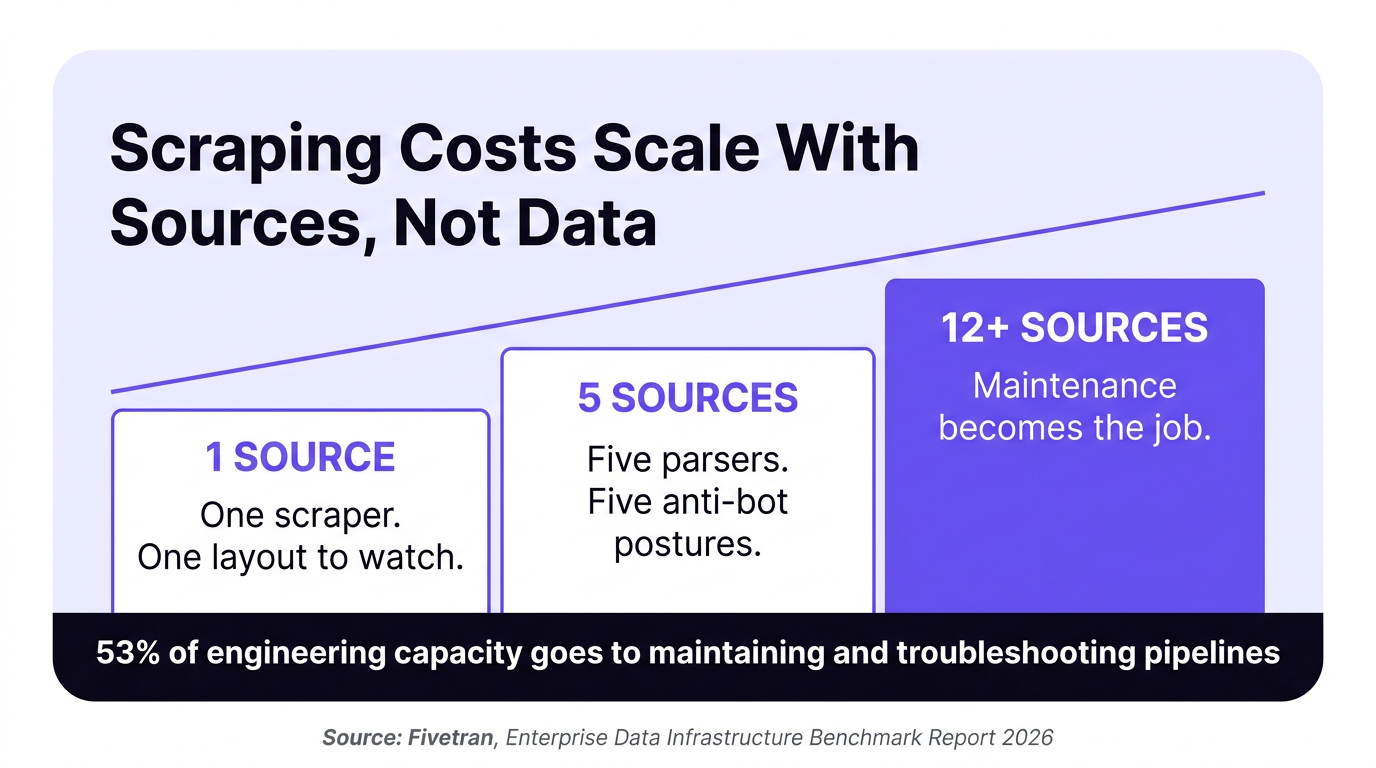
Scraping fails on a predictable curve. It works well at one source, gets tedious at five, and becomes a staffing decision past a dozen. The break happens because the work scales with the number of sources you touch rather than the amount of data you need.
The Maintenance Tax on a Real Estate Data Pipeline
Every scraper is a standing commitment to track someone else's frontend. A real estate data pipeline built on extraction inherits a maintenance obligation proportional to its source count, and that obligation compounds. Ten sources means ten layouts to monitor, ten anti-bot postures to work around, and ten parsers to fix.
The economics are unforgiving. A survey of 400 senior data and technology executives by MIT Technology Review Insights found that 77% report data engineer workloads growing heavier, while the share of their day spent on AI work climbed from 19% in 2023 to 37% in 2025. Adding a fleet of brittle scrapers to that environment is a decision you make once and pay for indefinitely.
The workaround stack rarely makes the original estimate either: throttling logic to stay under detection thresholds, a retry handler that can tell a transient error from a block from a structural change, proxy rotation, and monitoring to catch silent failures. All of it is effort spent on the acquisition layer instead of the product.
The Normalization Problem With Scraped Property Data
Multiply sources and you multiply representations. Square footage appears as 1,450 sq ft on one site and 1450 on another. Bed and bath counts arrive as integers, strings, or ranges. Addresses vary in dozens of ways that all read correctly to a human and none of which match on a string comparison. Getting a usable record out of that requires a normalization layer that often costs more to maintain than the scrapers feeding it.
Field coverage is uneven in a way that is harder to fix. A listing portal may expose price and address but nothing on tax history, ownership, or classification. Building a complete record means stitching partial ones together and resolving conflicts, the same problem bulk transaction data providers already solve at the source.
Why Does Property Type Coverage Decide the Real Estate API vs Web Scraping Question?
Reliability and cost get the attention in this comparison. Coverage forces the migration. Teams rarely abandon scraping because a parser broke. They abandon it because the roadmap added an asset class or a region and the scraping estate could not follow without a rebuild.
One Schema Across Residential, Commercial, and Industrial
Property types live in different places on the web. Residential listings sit on consumer portals, commercial inventory sits on brokerage sites and specialty boards, and industrial and land records often live only in county systems. Those sources share no structure, no field names, and no update rhythm, so a scraping operation covering all three is really three operations wearing one name.

An API that treats residential, commercial, and industrial as one dataset removes that. The same query syntax, field definitions, and response shape apply whether you are pulling a single-family home, an office building, or a warehouse. Property type becomes a filter value rather than an architectural decision.
The difference shows up in what a feature request costs. On a scraped stack, adding commercial coverage means source research, a new parser, a new normalization path, and a new monitoring surface, all of it before the first record lands. On a multi-asset API, it is a parameter change and a round of testing.
What Multi-Asset Coverage Removes From Your Roadmap
Future-proofing is the real benefit, and it is easy to undervalue while a product is still narrow. Most property platforms start residential because residential data is easiest to get. Then an investor customer asks about mixed-use, and underwriting wants industrial comps. Each expansion is cheap on an integration that already holds those records and expensive on one that does not.
The market is moving that way regardless of any single roadmap. PropTech market forecasts through 2035 put the category on a path from $54.66 billion in 2026 to $209.43 billion, with commercial and industrial the fastest-growing segment rather than residential. An acquisition layer that can only see one asset class is a bet against where the category is heading.
Coverage has a geographic dimension too. Providers who package data by metro or region recreate the same scaling friction as scraping, since every new market becomes another negotiation. Full national access under one agreement makes expansion a query change rather than a procurement cycle.
How Do the Costs Compare in 2026?
Scraping looks free because its costs are distributed. There is no invoice, so the spend hides inside salaries, cloud bills, and features that shipped late because two engineers spent a sprint chasing a parser regression. An API cost is legible, which paradoxically makes it look worse in a comparison that only counts line items.
Price it honestly and three categories appear on the scraping side that rarely make the estimate. Engineering time is the largest, and against the maintenance benchmark cited earlier, it is not a rounding error. Infrastructure is second: proxies, headless browsers, and the compute behind them. Failure cost is third, covering both downtime and the harder-to-price damage of decisions made on stale records.
On the API side, pricing structure matters as much as the number. Per-request models charge for the attempt, so failed queries, empty result sets, and retries consume budget whether or not usable data comes back. Per-record credit pricing charges for data delivered, which aligns cost with value received and makes exploratory querying free. That distinction compounds at volume.
Rate limiting belongs in the cost column too, and it is where teams get caught twice. Requests-per-second caps mean you rebuild the same queueing and backoff machinery scraping already forced on you, except now it is attached to a vendor's infrastructure decision rather than a hostile one. An API without artificial throughput limits removes that line item, and a visual portal for exploring coverage before integration removes another, since you can confirm the data fits your use case without writing code first.
5 Questions That Settle the Real Estate API vs Web Scraping Decision
Most teams already know which way they are leaning and want a defensible reason. These five questions produce one quickly. Answer them about the next 18 months rather than the current sprint.
- How many sources will you need in 18 months? One source is a scraper. Twelve sources is a team. If the number is growing and the sources are unrelated, extraction is the wrong architecture no matter how well the first one works.
- How many asset classes does the roadmap touch? If residential is the whole product forever, scraping one portal may hold. If commercial or industrial is anywhere on the plan, a single integration covering all property types saves a rebuild you have not budgeted for.
- Does anything customer-facing depend on the output? Internal research tolerates a broken pipeline for a week. A product does not. The moment a user sees the data, silent failure becomes a support problem rather than an engineering inconvenience.
- What is your actual maintenance budget? Count the hours your team spent on scraper upkeep last quarter and multiply by four. If that number surprises you, the comparison has already been decided and nobody has written it down.
- Can you verify coverage before you commit? With scraping, you find out what a source does not have after you build the parser. With a documented API and a portal to explore the data, you find out in an afternoon. Insist on that before signing anything.
Frequently Asked Questions
These come up most often once a team starts pricing the migration seriously.
Can a Real Estate Data Pipeline Use Both an API and Web Scraping?
Yes, and for many teams that is the end state rather than a compromise. Real estate API vs web scraping is rarely an all-or-nothing choice. The durable pattern is an API for the core record set, where breadth, asset-class coverage, and national reach matter, with scraping reserved for the one or two niche sources that genuinely have no supplier. What that buys you is a scraper count you can hold in your head. The failure mode is the inverse: a dozen scrapers doing the heavy lifting and an API filling gaps, which leaves every maintenance problem intact.
What Property Data Fields Can You Get From a Property Data API?
A well-built property data API covers physical characteristics such as square footage, bed and bath counts, lot size, year built, and property type, plus address and location fields, ownership and transaction history, tax assessment records, and listing status. Coverage varies by provider and by field. Verify that the fields your application depends on are populated consistently rather than merely present in the schema.
Does an API Automatically Mean Better Data Quality Than Scraping?
No. A carefully built scraper against a good source can outperform a careless aggregator, and quality ultimately traces back to sourcing either way. The difference is who carries the work and when you discover the problem. With an API, sourcing and normalization are the provider's obligation and you can evaluate coverage before committing. With a scraper, you own both, and quality gaps tend to announce themselves downstream after the data is already in production.
How Do Real Estate APIs Handle Data Freshness?
Refresh cadence varies by field category. Listing data updates far more often than ownership or tax records, which follow county recorder schedules and can lag by weeks regardless of provider. A credible provider documents refresh cycles per data type rather than quoting one number for everything. If freshness drives your use case, ask which fields update on which cadence before you integrate.
Choosing Between a Real Estate API and Web Scraping in 2026
Real estate API vs web scraping is a question about time horizon. Scraping optimizes for getting something working this week. An API optimizes for still working in two years, across sources you have not identified yet, for asset classes the roadmap has not reached. Both are rational for different problems. The mistake is letting a prototype-stage decision quietly become the production architecture by default.
Coverage is where that mistake surfaces first. A pipeline that can only see residential listings on one portal has a ceiling, and you will find it the same week a customer asks for something outside it. Records spanning residential, commercial, and industrial under one schema, with no artificial throughput limits and no per-region contracts to renegotiate, make the next expansion a configuration change instead of a project.
Datafiniti's structured property data gives development teams more than 280 million records across residential, commercial, and industrial assets, with full national coverage, no rate limiting, and per-record pricing that charges only for data delivered. Teams migrating off scraping stacks generally find the integration smaller than the pipeline it replaces. Start with a demo and see what the data covers before you build against it.
Read the latest articles
Read more

Business Data API: Company Data at Enterprise Scale
How to Build a Product Database With a Product Data API

Property Data API Coverage: What U.S. Datasets Include

Product Data API for Ecommerce Price Monitoring and Repricing

Real-Time Product Data API for Product-Led Growth Teams

Property Ownership Data API for Skip Tracing and Lead Gen

How APIs Make Building a Product Database Easy
Learn how to build a product database with APIs for cleaner imports, updates, search, and scalable product data.

What Is Property Transaction Data and How Does an API Help Get It?
Learn how property transaction data works and how APIs provide structured access for analysis and workflows.

How to Use Real Estate Transaction Data
Learn how to use real estate transaction data for analysis, valuation, underwriting, and market decisions.

How to Leverage Competitor Pricing Data with an API
Use competitor pricing data to build API-driven monitoring, analysis, and smarter pricing decisions.

Price Monitoring API: The Key to E-Commerce Pricing Strategy
Use a price monitoring API to track market changes, improve pricing decisions, and protect ecommerce margins.

How do Product Data APIs Work for E-Commerce Companies?
Learn how a product data API works, from collection and queries to ecommerce integration and use cases.

Bulk Real Estate Data Licensing: Access Datasets at Scale

How to Integrate MLS Listings Using an MLS Data API

GTIN Lookup API: Search Products by Barcode & UPC at Scale

Best Real Estate API 2026: Coverage, Pricing, Data Quality

Best Product Data API 2026: A State-of-the-Market Guide

Product Data API Integration Patterns for Ecommerce Platforms

Build a PropTech MVP With a Property Ownership Data API

3 Benefits of Web Scraping for Real Estate
Boost your research by using web scraping for real estate to gain market insights, automate lead lists, and minimize property risk.
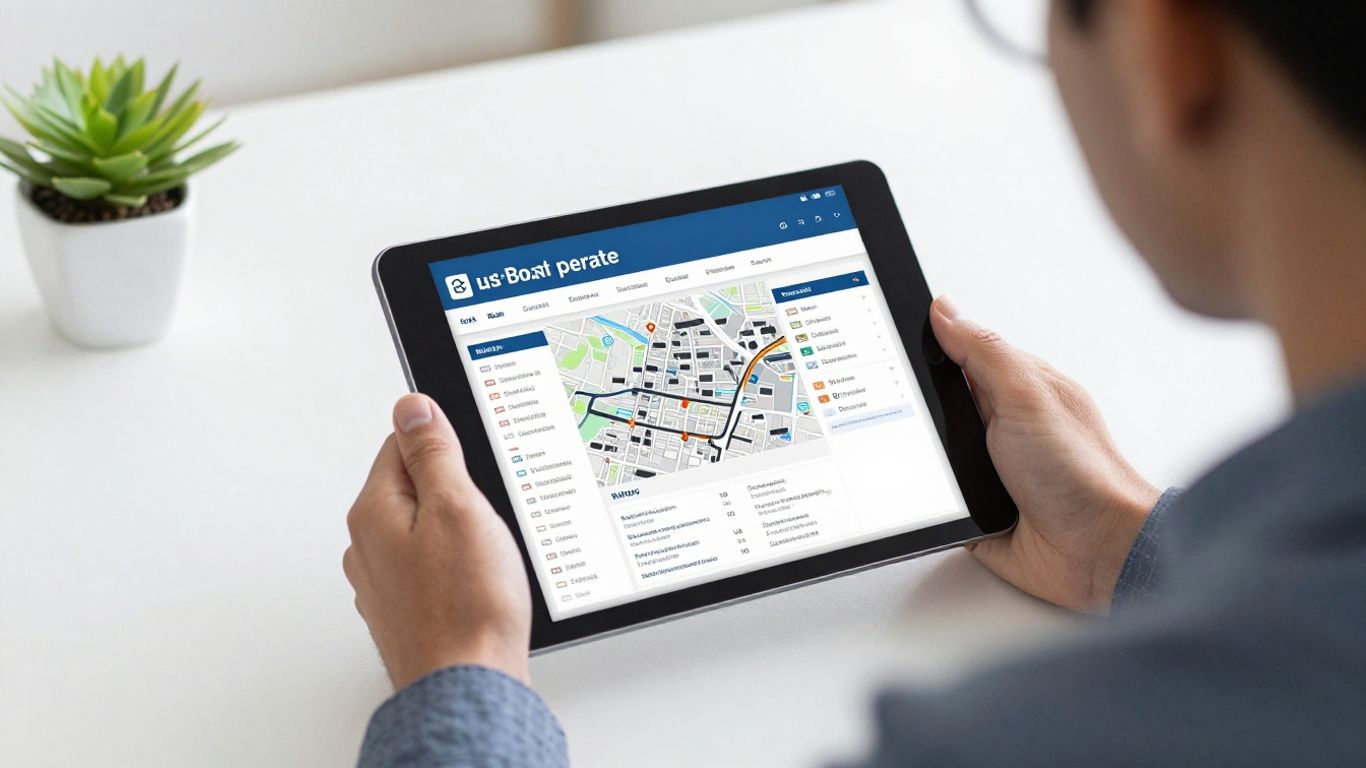
How Real Estate Agents Can Leverage Proptech Data
Leverage proptech data to source leads, speed up valuations, and manage risk with accurate, real-time property insights.

What Is a UPC Lookup API?
Learn about the UPC lookup API, how it works, and its benefits for businesses. Get product data easily.

What Is a GTIN Lookup API?
Learn about the GTIN lookup API and how it can help your business grow. Get product data insights.

How Does a Property Data API Work?
Learn how a property data API works, its features, and how you can use it for real estate and business insights.

What The Best Real Estate APIs Should Have
Discover what makes the best real estate APIs stand out. Learn about essential features for your property data needs.
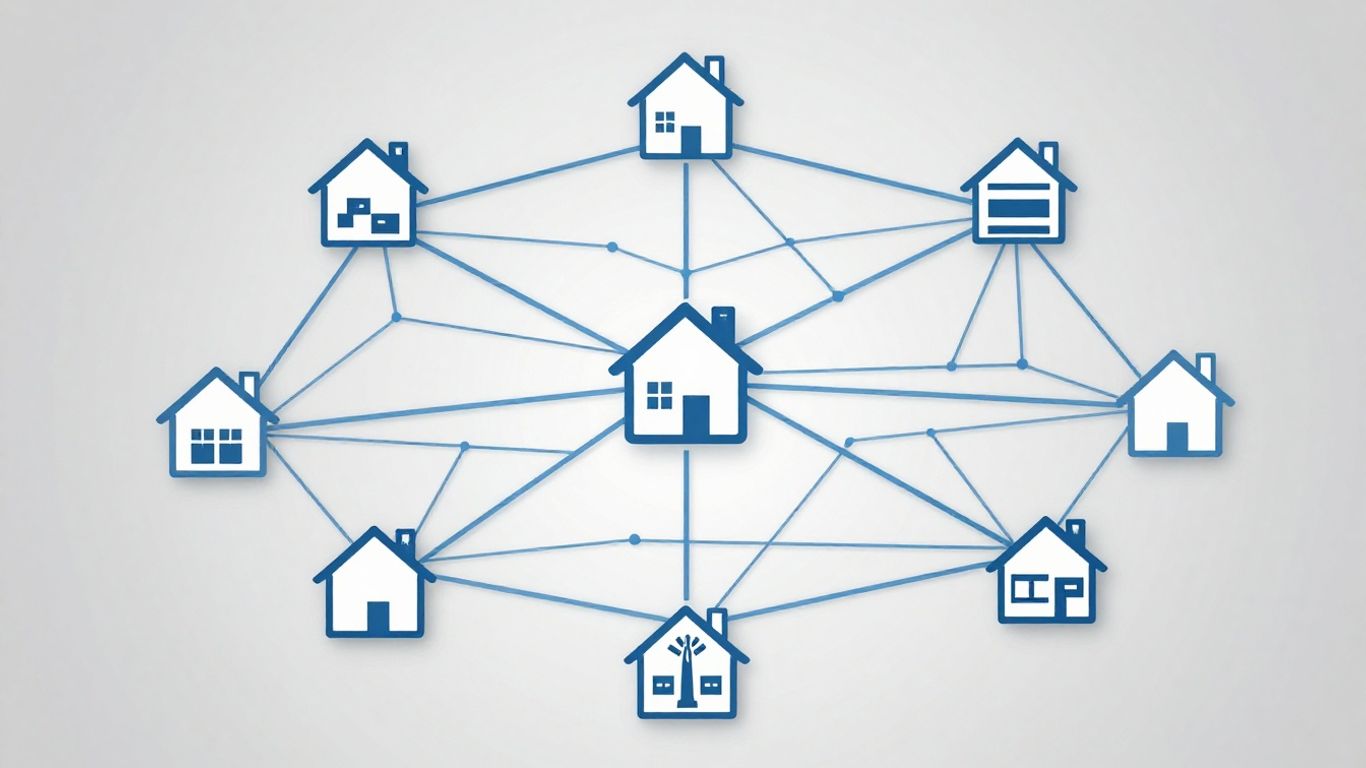
The Benefits of a Real Estate MLS API
Learn about the benefits of a real estate MLS API for streamlining data access and driving business growth.

Why Every Real Estate Pro Needs an MLS Database API
Learn why a MLS database API is vital for real estate pros. Get data, insights, and competitive edge.
How to Access MLS Listing Data
Learn how to access MLS listing data using an MLS data API. Discover Datafiniti's solutions and integration tips.
.png)
How to Enrich Your Product Catalog With a Real-Time API
.jpeg)
Product Data API Buyer's Guide for Ecommerce Teams

Do I Need a Real Estate Listing API?
Explore the benefits and technicalities of a real estate listing API. Learn how to choose the right provider and integrate data for business growth.

Unlocking the MLS Database with APIs
Unlock the MLS database with APIs. Learn how to access property data, gain real estate insights, and integrate MLS data for your business needs.

Why Real Estate Tech Startups Need Property APIs with Ownership Details
Discover how property APIs with ownership details empower real estate tech startups. Learn about data integration, risk mitigation, and driving business value.
The Value of a Product Catalog Sync for Product Managers
Unlock the value of product catalog sync for product managers. Streamline data, improve decisions, and reduce costs with real-time insights.

What is a Product Data Webhook?
Learn about product data webhooks, their components, and how they enable real-time updates for business intelligence and workflow automation.

Why Is a Product Data API Integration Essential for Analysts & Product Managers?
Unlock insights with product data API integration. Essential for analysts & product managers to streamline data access & enhance product strategy.

What Is a Product Data API and Its Benefits
Learn about product data APIs, their benefits, and how they drive business growth. Explore integration and advanced use cases.

What Do eCommerce Data Vendors Do?
Learn what ecommerce data vendors do, their services, and how to choose the right one for your business growth.

How to Compare Product Data Providers: What to Look For
Compare product data providers. Learn what to look for in data quality, structure, and integration features.

How to Get Your Product Data in Real-Time Using APIs
Learn how to leverage real-time product data APIs for e-commerce, competitive analysis, and AI. Get instant access to clean, structured product data.

Best Product Data API: Features to Look for
Find the best product data API with real-time updates, comprehensive coverage, and a user-friendly portal. Explore features to look for.

Unlocking Property Data with an API
Access property data with a powerful property database API. Explore listings, market analysis, investment opportunities, and more. Get started today!

Unlocking CRE with APIs
Unlock commercial real estate insights with a powerful API. Access property data, streamline workflows, and enhance investment strategies.

How to Get a Real-Time Product Feed Using an API
Learn how to get a real-time product feed using an API. Access, leverage, and ensure accuracy of product data for your business needs.

Spying on Competitor Prices: What You Need to Know
Learn how to gather and analyze competitor pricing data to inform your business strategy. Understand key components and ethical considerations.

Product Data Enrichment: What Are You Missing?
Enhance your product data with comprehensive enrichment. Discover insights, drive growth, and choose the right approach for your business.
.png)
IDX vs MLS API: A Developer's Guide to Real Estate Listing Data
.png)
Real Estate API Pricing Models Explained: Subscription vs. Usage-Based
Real Estate API vs Web Scraping: Which Wins in 2026?
.png)
Product Data APIs Explained: Powering Product Search and Catalog Automation

Best Sources for Bulk Real Estate Transaction Data

How to Get the Most out of a Product Catalog API
Learn how to leverage a product catalog API for business growth. Discover data quality, access methods, and strategy for your product catalog API.

Taming Your Ecommerce Product Data Feed
Optimize your ecommerce product data feed for growth. Learn strategies, leverage technology, and ensure data quality for better customer experience and AI initiatives.

Streamlining Your Product Search with an API
Explore the benefits and integration of a product search API. Streamline your product discovery and leverage data for business growth.
.png)
Real Estate Transaction Databases: What You Need to Know
.png)
Best MLS API for Real Estate Software: What Developers Need

How Real Estate Platforms Access MLS Database APIs
.png)
Commercial Real Estate API vs. Residential Property API
.png)
How to Choose a Real Estate Database API for Your MVP
MLS API vs. IDX: What's the Diff?
MLS API vs IDX: Explore the differences in real estate data access, retrieval, and integration. Understand which solution fits your needs.

Scraping vs. APIs: Getting Real Estate Data
Compare web scraping vs real estate API for data acquisition. Learn the pros, cons, and best use cases for each method.

Cracking the Code: Housing Sales Insights
Unlock housing sales analytics insights with Datafiniti. Explore property data, market trends, and advanced techniques for strategic decisions.

Property Valuation API: Your Go-To Real Estate Tool
Leverage the property valuation API for real estate insights. Access comprehensive property data for diverse applications with Datafiniti.

Product Data APIs Explained
Learn about product data APIs explained. Discover how to access, integrate, and utilize product data for e-commerce, analytics, and more.

Unlocking Your Ecommerce Data with APIs
Unlock ecommerce data with APIs for business insights, product catalog enrichment, and competitive analysis. Explore data via portal or API.

Your Guide to Housing Sales APIs
Explore housing sales API data for insights. Access property data, integrate into applications, and gain business intelligence. Get started today!

Real Estate Ownership Data: How to Access, Analyze and Use at Scale
Access, analyze, and use real estate ownership data at scale. Learn how to find, process, and leverage this crucial information for business insights.

Unlocking Opportunities: Navigating Bulk Real Estate Transaction Data
Unlock opportunities with bulk real estate transaction data. Learn how to access, analyze, and leverage property data for investing, marketing, and more.
What Is a Property Sales Database?
Explore what a property sales database is, its core components, how to access data, and key use cases for real estate analysis and more.

Benefits of Obtaining Housing Transaction Data
Unlock insights with housing transaction data. Analyze markets, investments, sales, and risk. Get comprehensive property data for informed decisions.

Understanding Real Estate Transaction Databases
IDX vs MLS API: What Every Real Estate Professional Should Know
Understand IDX vs MLS API differences. Learn about data access, integration, and how Datafiniti's solutions empower real estate professionals.

What Is an MLS Database API?
Explore the MLS database API: understand its components, benefits, and how to access real estate data for various applications. Learn about its core functionality and technical aspects.

How a Property Database API Can Help Real Estate Pros
Learn how a property database API can help real estate pros analyze trends, monitor listings, and optimize strategies. Get data insights.

What Is a Residential Property API?
Explore what a residential property API is, its features, benefits, and real-world applications for real estate professionals and investors.

What Is a Commercial Real Estate API?
Explore commercial real estate API functionality, data integration, and use cases. Learn how to leverage property, business, and people data for insights.

Understanding MVP Data Integration
Learn about MVP data integration, its components, benefits, and strategies for accessing and utilizing data resources effectively.

How to Choose the Best Property Data API
Learn how to choose the best property data API. Explore features, providers, pricing, and integration for real estate insights.

Real Estate Database API: What to Look for
Explore real estate database API options. Learn about data quality, features, and how to choose the right provider for your needs.
.png)
Real Estate Transaction Database: An API Access Guide

How Do Product Data APIs Work?
Understand how a product data API works, its key features, integration methods, and applications for e-commerce and business intelligence.

How Do Data Aggregation Platforms Work?
Explore how data aggregation platforms work, their capabilities, and applications. Learn to choose and implement the right platform for your business intelligence needs.

Why Do Companies Need Property Data Aggregation?
Discover why property data aggregation is crucial for businesses. Streamline access, empower functions, enhance risk management, and drive strategic decisions with authoritative insights.

MLS API: The Complete Guide to Accessing MLS Listing Data

Product Search API vs. Product Data API: What's the Difference?

What Are the Best MLS Data API Features to Look For?
Discover the best MLS data API features, including real-time updates, bulk downloads, and flexible filtering for property data.

What Is a Product Data API?
Explore the functionality and benefits of a product data API. Learn how to integrate, leverage, and choose the right provider for your business insights.
What Is the Difference Between Product Search API and Product Data API?
Understand the difference between Product Search API and Product Data API. Learn how to leverage product data for business intelligence and analytics.

Guide to Accessing Real Estate Transaction Database Via API
Access real estate transaction data via API. Explore property insights, sales, underwriting, and advanced applications with our authoritative guide.
Is a Real Estate MLS API Beneficial?
Explore the benefits of a real estate MLS API for enhanced data access, streamlined workflows, and market responsiveness. Learn about key features and use cases.

What is an MLS Database API?
Explore the MLS database API for comprehensive property data access. Learn about its core functionality, key features, and integration into real estate technology.

What Is a Property Data API?
Explore the capabilities of a property data API. Understand its core functionality, key features for developers, and how to access property information at scale for business insights.
.png)
Real Estate API Pricing: What You Need to Know Before You Build
.jpeg)
How to Choose a Property Market API for Investment Platforms
Choosing the right property market API is critical for investment platforms. Learn how to evaluate data depth, coverage, freshness, and integration quality before you commit.
Data you can trust, delivered in a format your systems can use, at the scale your product requires.