
.png)
IDX vs MLS API: A Developer's Guide to Real Estate Listing Data

Key Takeaways
IDX and MLS API are not the same thing, and confusing them leads to the wrong architecture from day one.
- An MLS is a private cooperative database; IDX is a policy framework governing how listing data can appear publicly.
- RESO Web API is the modern transport standard that replaced RETS and now runs on RESTful, JSON-based architecture.
- Fragmentation across 500-plus independent MLS organizations is the core engineering challenge for any multi-market product.
- Clear, publicly available API documentation is the fastest way to evaluate whether a data provider is worth your integration time.
Developers who understand the full stack before writing code ship faster, scale cleaner, and spend less time on rework.
When developers start building real estate applications, one of the first things they encounter is a tangle of overlapping terms: IDX, MLS, RESO, RETS, real estate listing feeds, idx data feed. Sorting out the IDX vs MLS API distinction early is not a minor detail. Getting it wrong means building on the wrong assumptions, which tends to surface at the worst possible moment. To understand how structured real estate data actually flows from source to application, you need to know what each piece of the stack does and how they relate to each other.
This guide breaks down MLS, IDX, and RESO Web API as distinct concepts, explains how they connect, covers the two main integration architecture patterns, and outlines what to evaluate when choosing a data provider. The Real Estate Standards Organization has published the standards that now govern how most MLS data moves between systems. The goal here is to give you a complete picture before you write a single line of integration code.
Why Do Developers Keep Confusing IDX vs MLS API?
The confusion is understandable. Both terms show up in the same conversations, both relate to real estate listing data, and vendors often use them interchangeably in their marketing. But they describe completely different things, and the distinction has real architectural consequences.
What an MLS Actually Is
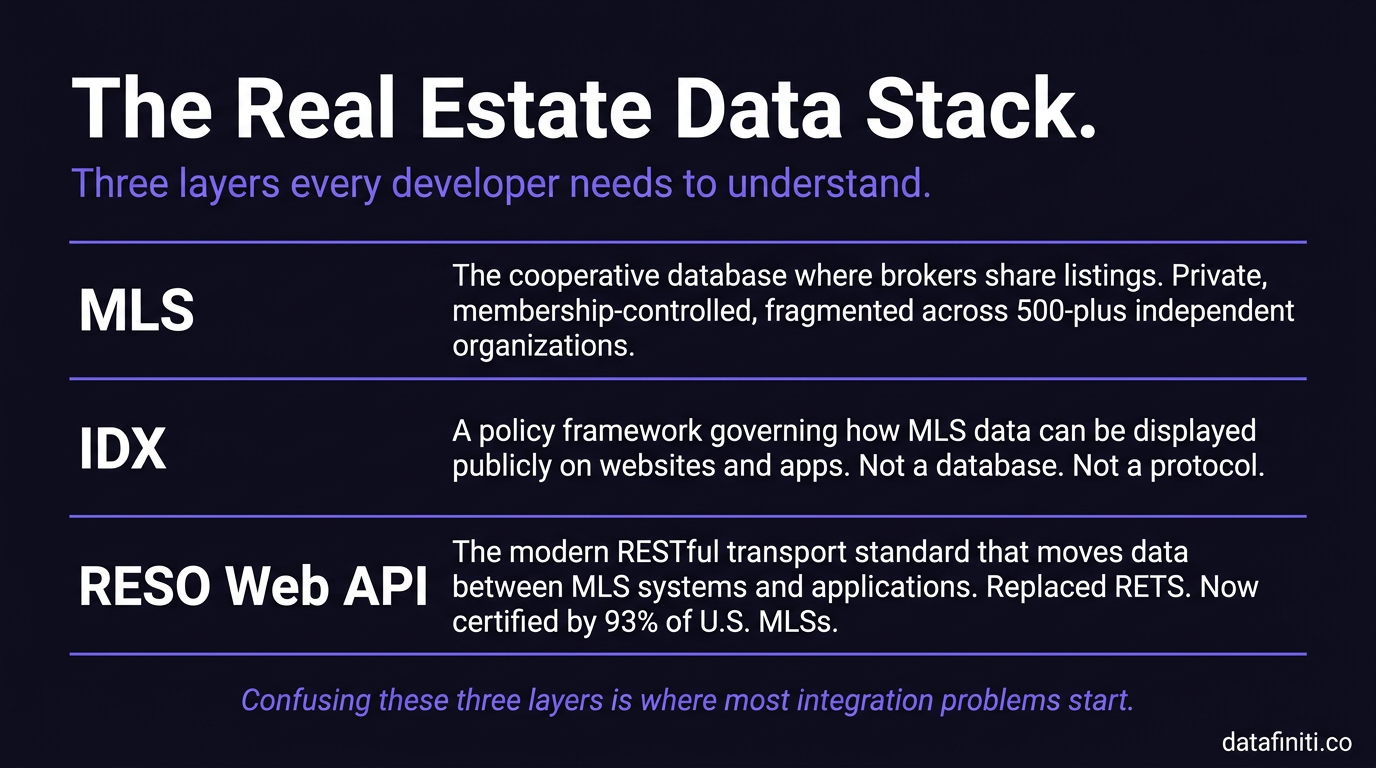
A Multiple Listing Service is a private, cooperative database where licensed real estate brokers share property listings within a market. It is the authoritative source for active listing status, price changes, media assets, open house schedules, days on market, and a large volume of structured property fields. Access is restricted to members and their approved technology partners. The public does not have direct access to MLS data.
The U.S. real estate market is decentralized. There is no single national MLS. Instead, there are more than 500 independent MLS organizations across the country, each operating under its own rules, with its own data fields, licensing policies, and access requirements. That fragmentation is the core engineering challenge for developers building any product that needs to operate across multiple markets. Accessing property data at national scale requires a strategy for dealing with that variation.
When people refer to an MLS API, they typically mean a programmatic interface that gives developers access to listing data from one or more MLS systems. That access is always governed by the MLS's licensing agreement, data use policy, and display requirements.
What IDX Actually Is (and Is Not)
IDX stands for Internet Data Exchange. It is not a database. It is not a technology protocol. IDX is a policy framework and a set of technical patterns that govern how MLS participants can display listing data publicly on websites and applications. When you see a property search widget on a real estate agent's website showing available listings, that is IDX in action.
IDX rules specify what data can appear, how it must be attributed, how frequently it must refresh, and what cannot be done with it. Display requirements vary by MLS. Using an idx data feed means operating within those compliance constraints, which affects UI architecture, caching decisions, and how data is stored.
A related but distinct concept is VOW, or Virtual Office Website. Where IDX governs public-facing display for general consumers, VOW policies apply to authenticated portals where logged-in users can access more detailed listing data. If you are building a consumer search tool, IDX rules apply. If you are building a broker dashboard or an authenticated platform, VOW may be more relevant. Understanding the distinction upfront prevents costly compliance retrofits after launch.
Where Does the RESO Web API Fit into an MLS Integration?
Once you understand that MLS is the data source and IDX is the display policy, the next question is how data actually moves between the MLS and your application. That is where the RESO Web API comes in.
From RETS to RESO: What Changed
For years, the Real Estate Transaction Standard (RETS) was the primary protocol for transferring listing data between MLS systems and real estate applications. It worked, but it was proprietary to the real estate industry, required specialized knowledge, and offered limited compatibility with modern web development practices.
The Real Estate Standards Organization (RESO) replaced RETS with the RESO Web API, a RESTful, JSON-based standard that aligns with how APIs work in other industries. It uses OAuth 2.0 authentication, OData conventions for querying, and a standardized Data Dictionary that defines consistent field names and types across different MLS systems. RETS has been formally deprecated. New integrations should target the RESO Web API standard. Building on RETS today is a dead end.
The adoption numbers reflect how complete this shift has been. According to RESO, 93% of approximately 500 U.S. MLSs are now certified on RESO standards. The practical benefit for developers is significant: a team writing integration code against RESO-certified data from one MLS can reuse that code when adding a second MLS, because the field names and data types are consistent across certified systems.
The Compliance Layer Developers Often Underestimate
Real estate data integrations are regulated in ways that most other API integrations are not. Each MLS defines its own rules around what data can be stored, how long it can be cached, how images must be handled, and how listing attribution must appear. Compliance failures are one of the most common reasons MLS integrations get suspended after they go live.
Before development begins, teams need to clarify the access level they are building for: public consumer search (IDX), authenticated user portal (VOW), internal brokerage tools, or analytics and investment applications. Each has different data permissions and different display requirements. Building for the wrong access level means the compliance layer needs to be rearchitected later, which is expensive.
Treat compliance as a system requirement, not a legal footnote. Encode attribution rules, refresh intervals, and display constraints into the data pipeline from day one. The platforms that handle this well are the ones that can expand into new markets without rebuilding their compliance layer each time.
What Are the Two Main MLS Integration Architectures?
Beyond the compliance and standards layer, there is a fundamental architectural decision every development team building on real estate listing feeds needs to make: query-through or replicate-and-serve. Both patterns are used in production systems, and the right choice depends on your product's requirements.
Query-Through
In a query-through architecture, your application calls the upstream MLS API (or an IDX provider backed by RESO) directly in response to user actions. When someone searches for listings, your app fires a live query and returns results. Storage requirements on your side are minimal.
The tradeoff is that you absorb all the upstream latency, availability risk, and rate limiting into your user experience. Map-based search, recommendations, and similar features that require fast data retrieval become difficult to build reliably. Query-through works for low-traffic applications or when real-time data is a hard requirement and the search surface is limited.
Replicate-and-Serve
In a replicate-and-serve architecture, your team ingests MLS data into your own storage, normalizes it, indexes it for search, and serves users from your own system. This is the more common choice for serious PropTech products because it enables fast map search, recommendation features, and analytics at scale.
The added responsibility is data freshness monitoring, deduplication, and maintaining a compliant public display layer. A typical pipeline includes incremental update jobs (not full reloads), a transformation layer that maps fields into a RESO-aligned canonical model, and separate storage for structured listing data and media metadata. Teams that use well-documented data APIs move through this setup faster because they spend less time reverse-engineering field mappings.
The key principle in either case: normalize your data model early. If the MVP ships without mapping discipline and schema normalization, adding new MLS markets later often means weeks of engineering work rather than days.
5 Questions to Ask Before Committing to an MLS Integration Path
Understanding the IDX vs MLS API distinction is only part of the picture. Choosing between building a direct MLS integration, working through an IDX vendor, or sourcing structured property data through a third-party API is a decision that shapes your engineering roadmap for years. These are the questions worth asking before you commit.
- What access level does my product actually require? Consumer search products need IDX compliance. Authenticated portals need VOW access. Analytics and investment platforms may not need MLS access at all. Defining this upfront determines which integration path is appropriate.
- How many markets do I need to cover, and how quickly? Each MLS is a separate relationship, a separate contract, and a separate data format to normalize. If your product needs to operate across multiple metro areas at launch, a direct multi-MLS integration is a significant project. Third-party providers that have already aggregated MLS data across markets compress that timeline substantially.
- Is the provider's documentation publicly accessible? Most MLS-connected API vendors require a sales conversation before they will share their query structure, schema reference, or data dictionary. That opacity is a red flag. Providers with open, searchable documentation let your team evaluate fit before committing engineering time.
- How does the pricing model handle failed queries? Per-request pricing charges for every API call regardless of what is returned. If your application runs empty queries during map searches or filter changes, those costs accumulate quickly. Credit-based or per-record pricing only charges for data actually delivered, which produces more predictable costs for search-heavy applications.
- What happens when I need to add a market or property type? Some providers offer national coverage under one integration. Others sell regional or metro packages that require separate contracts as you scale. Understanding the expansion model before you start saves the negotiation friction later.

Why Does API Documentation Quality Affect MLS Integration Speed?
Developers evaluate APIs by reading documentation, and in the IDX vs MLS API space, most providers make that harder than it needs to be. Not by scheduling demos. Not by talking to sales. Developers want to read docs, try sample queries, inspect schemas, and determine whether the integration is feasible before writing code. In most industries, this is table stakes. In the real estate data space, it is a genuine differentiator.
Documentation Quality Predicts Integration Speed
The MLS and IDX ecosystem has a well-known documentation problem. Most vendors do not publish schema references, field definitions, or query examples publicly. Getting a basic understanding of how to structure a query often requires agreeing to a terms-of-service, completing a vendor approval process, and waiting for credentials to be provisioned. By the time a developer can evaluate whether the integration will work for their use case, they may have already committed weeks of time.
Clear, publicly accessible documentation changes the evaluation timeline. A developer can determine within hours whether a provider's field coverage matches their data requirements, what filtering and sorting options are available, how pagination works, and what error handling looks like. That is not a minor convenience. It is the difference between a two-week evaluation cycle and a same-day technical decision.
Look for documentation that includes a complete schema reference, concrete query examples, an explanation of authentication flow, and notes on rate limits and error codes. Bonus points for a searchable API reference and a changelog. If a provider requires a sales call to understand basic query structure, that documentation gap will follow you into the integration itself. Teams working with property data APIs that publish open documentation spend less time on setup and more time on product.
Other Evaluation Criteria Worth Checking
Beyond documentation, a few other factors consistently separate providers that are easy to work with from those that are not. Rate limiting is a practical concern for any search-heavy application. Providers that throttle requests force development teams to build retry handlers and backoff logic, which adds engineering overhead that has nothing to do with product features.
Geographic coverage scope matters for growth planning. Providers that package data by metro or region require a new contract each time you expand. Providers with full national access under a single integration remove that friction entirely. Field coverage across property types is also worth checking. If you plan to build for commercial or industrial use cases alongside residential, confirm those property types are included before integrating. Some providers cover residential only and require separate contracts for other commercial property data types.
Finally, check what data sourcing methodology the provider uses. Understanding whether records come from county assessors, tax databases, public deed filings, or live MLS feeds tells you something important about freshness, coverage, and what fields to expect. Providers that can explain their sourcing methodology clearly are generally the ones whose data is easier to trust.
Frequently Asked Questions
What Is the Difference Between an IDX Data Feed and an MLS API?
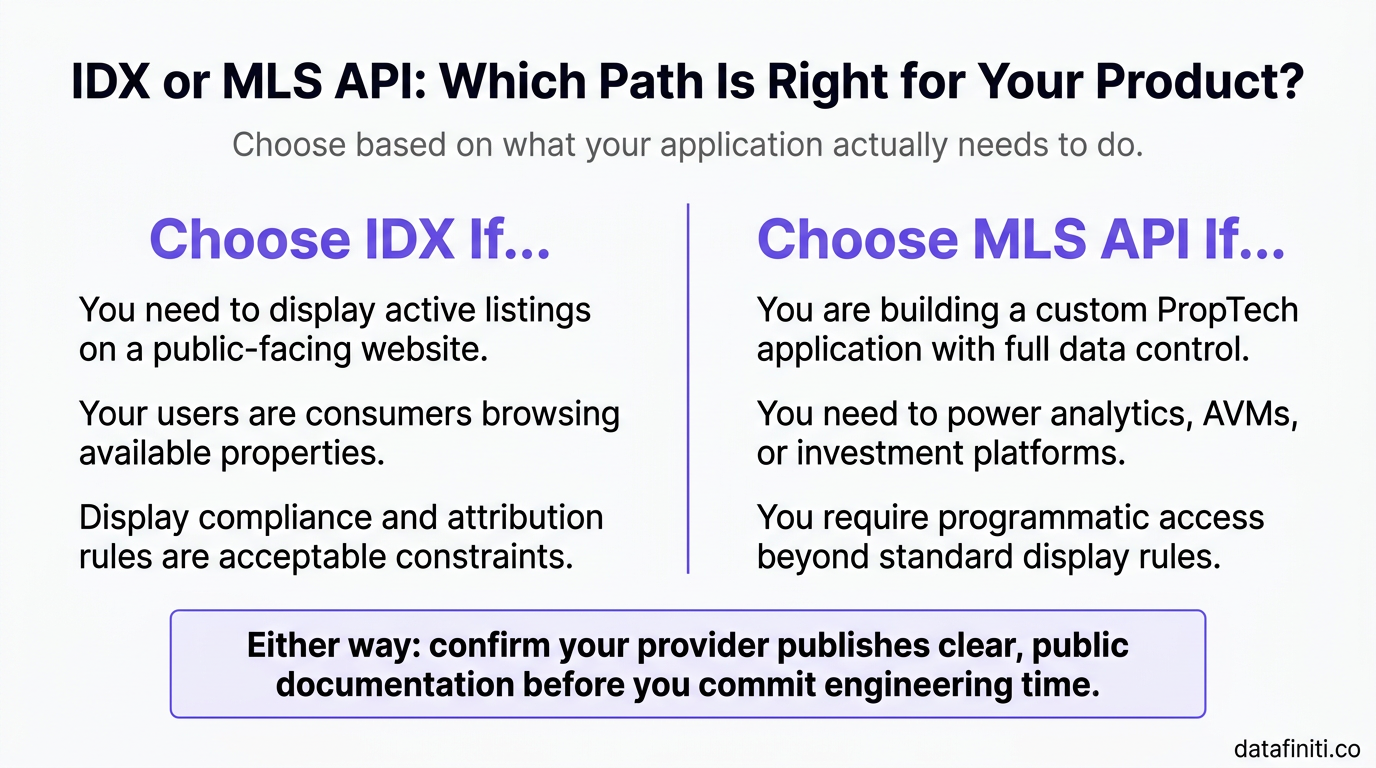
An IDX data feed delivers listing data in a format designed for public display on websites, subject to IDX policy rules around attribution, refresh, and data use. An MLS API gives developers direct programmatic access to listing records for use in custom applications, with more flexibility in how data is retrieved and processed. IDX is appropriate for agent websites showing public listings. A direct MLS API integration is typically the right choice for PropTech platforms, analytics tools, or products that need more control over the data pipeline.
Is RETS Still a Valid Option for New Real Estate Integrations?
No. RETS has been formally deprecated by RESO and is no longer recommended for new integrations. Many vendors have already ended RETS support entirely, with some sunsetting legacy RETS connections in 2024. New integrations should target the RESO Web API, which is RESTful, JSON-based, and backed by a standardized Data Dictionary that makes it easier to build consistently across multiple MLS systems.
Do All MLS APIs Cover the Same Geographic Areas?
No. Because the U.S. real estate market operates through more than 500 independent MLS organizations, there is no single API that covers all markets by default. Third-party data providers aggregate coverage across multiple MLSs and often offer national access through one integration, but the depth of field coverage and data freshness can vary by market. Before integrating, confirm exactly which markets a provider covers and whether their coverage model requires separate contracts for different regions.
How Do I Know if a Real Estate API Provider Has Good Documentation?
The test is simple: can you find the schema reference, sample queries, and authentication documentation without talking to sales? Good documentation is publicly accessible, includes concrete examples, explains pagination and error handling, and has a searchable field reference. If a provider requires a demo call or a signed agreement before you can read their API docs, that is a signal about how the integration experience will go. Open documentation is a direct signal of how a provider thinks about developer experience overall.
Choosing the Right Integration Path for Real Estate Listing Data
The IDX vs MLS API question is really a question about what your application needs to do. Public listing search on an agent or brokerage site operates under IDX rules. Custom applications, analytics platforms, and products that need direct programmatic control over data retrieval require an MLS API integration or a third-party provider with aggregated coverage. RESO Web API is the current standard for that integration, and RETS is a dead end.
Fragmentation across 500-plus independent MLS systems is the structural reality of the U.S. real estate data market. Providers that have done the work to aggregate that coverage, normalize it, and expose it through a single well-documented API save your team from negotiating individual MLS relationships and maintaining separate data pipelines for every market.
Datafiniti gives developers access to structured property data through a single integration with clear public documentation, no rate limiting, and full national coverage across residential, commercial, and industrial property types. Explore what is available through the property data API, or get in touch to talk through your use case.
Read the latest articles

Read more

Build vs Buy: Business Data Enrichment for Growing Teams

Best Business Data APIs for Sales Teams & Prospecting

Business Data API: Company Data at Enterprise Scale

How to Build a Product Database With a Product Data API

Property Data API Coverage: What U.S. Datasets Include

Product Data API for Ecommerce Price Monitoring and Repricing

Real-Time Product Data API for Product-Led Growth Teams

Property Ownership Data API for Skip Tracing and Lead Gen

How APIs Make Building a Product Database Easy
Learn how to build a product database with APIs for cleaner imports, updates, search, and scalable product data.

What Is Property Transaction Data and How Does an API Help Get It?
Learn how property transaction data works and how APIs provide structured access for analysis and workflows.

How to Use Real Estate Transaction Data
Learn how to use real estate transaction data for analysis, valuation, underwriting, and market decisions.

How to Leverage Competitor Pricing Data with an API
Use competitor pricing data to build API-driven monitoring, analysis, and smarter pricing decisions.

Price Monitoring API: The Key to E-Commerce Pricing Strategy
Use a price monitoring API to track market changes, improve pricing decisions, and protect ecommerce margins.

How do Product Data APIs Work for E-Commerce Companies?
Learn how a product data API works, from collection and queries to ecommerce integration and use cases.

Bulk Real Estate Data Licensing: Access Datasets at Scale

How to Integrate MLS Listings Using an MLS Data API

GTIN Lookup API: Search Products by Barcode & UPC at Scale

Best Real Estate API 2026: Coverage, Pricing, Data Quality

Best Product Data API 2026: A State-of-the-Market Guide

Product Data API Integration Patterns for Ecommerce Platforms

Build a PropTech MVP With a Property Ownership Data API

3 Benefits of Web Scraping for Real Estate
Boost your research by using web scraping for real estate to gain market insights, automate lead lists, and minimize property risk.
How Real Estate Agents Can Leverage Proptech Data
Leverage proptech data to source leads, speed up valuations, and manage risk with accurate, real-time property insights.

What Is a UPC Lookup API?
Learn about the UPC lookup API, how it works, and its benefits for businesses. Get product data easily.

What Is a GTIN Lookup API?
Learn about the GTIN lookup API and how it can help your business grow. Get product data insights.

How Does a Property Data API Work?
Learn how a property data API works, its features, and how you can use it for real estate and business insights.

What The Best Real Estate APIs Should Have
Discover what makes the best real estate APIs stand out. Learn about essential features for your property data needs.

The Benefits of a Real Estate MLS API
Learn about the benefits of a real estate MLS API for streamlining data access and driving business growth.

Why Every Real Estate Pro Needs an MLS Database API
Learn why a MLS database API is vital for real estate pros. Get data, insights, and competitive edge.
How to Access MLS Listing Data
Learn how to access MLS listing data using an MLS data API. Discover Datafiniti's solutions and integration tips.
.png)
How to Enrich Your Product Catalog With a Real-Time API
.jpeg)
Product Data API Buyer's Guide for Ecommerce Teams

Do I Need a Real Estate Listing API?
Explore the benefits and technicalities of a real estate listing API. Learn how to choose the right provider and integrate data for business growth.

Unlocking the MLS Database with APIs
Unlock the MLS database with APIs. Learn how to access property data, gain real estate insights, and integrate MLS data for your business needs.

Why Real Estate Tech Startups Need Property APIs with Ownership Details
Discover how property APIs with ownership details empower real estate tech startups. Learn about data integration, risk mitigation, and driving business value.
The Value of a Product Catalog Sync for Product Managers
Unlock the value of product catalog sync for product managers. Streamline data, improve decisions, and reduce costs with real-time insights.

What is a Product Data Webhook?
Learn about product data webhooks, their components, and how they enable real-time updates for business intelligence and workflow automation.

Why Is a Product Data API Integration Essential for Analysts & Product Managers?
Unlock insights with product data API integration. Essential for analysts & product managers to streamline data access & enhance product strategy.

What Is a Product Data API and Its Benefits
Learn about product data APIs, their benefits, and how they drive business growth. Explore integration and advanced use cases.

What Do eCommerce Data Vendors Do?
Learn what ecommerce data vendors do, their services, and how to choose the right one for your business growth.

How to Compare Product Data Providers: What to Look For
Compare product data providers. Learn what to look for in data quality, structure, and integration features.

How to Get Your Product Data in Real-Time Using APIs
Learn how to leverage real-time product data APIs for e-commerce, competitive analysis, and AI. Get instant access to clean, structured product data.

Best Product Data API: Features to Look for
Find the best product data API with real-time updates, comprehensive coverage, and a user-friendly portal. Explore features to look for.

Unlocking Property Data with an API
Access property data with a powerful property database API. Explore listings, market analysis, investment opportunities, and more. Get started today!

Unlocking CRE with APIs
Unlock commercial real estate insights with a powerful API. Access property data, streamline workflows, and enhance investment strategies.

How to Get a Real-Time Product Feed Using an API
Learn how to get a real-time product feed using an API. Access, leverage, and ensure accuracy of product data for your business needs.

Spying on Competitor Prices: What You Need to Know
Learn how to gather and analyze competitor pricing data to inform your business strategy. Understand key components and ethical considerations.

Product Data Enrichment: What Are You Missing?
Enhance your product data with comprehensive enrichment. Discover insights, drive growth, and choose the right approach for your business.
IDX vs MLS API: A Developer's Guide to Real Estate Listing Data
.png)
Real Estate API Pricing Models Explained: Subscription vs. Usage-Based

Real Estate API vs Web Scraping: Which Wins in 2026?
.png)
Product Data APIs Explained: Powering Product Search and Catalog Automation

Best Sources for Bulk Real Estate Transaction Data

How to Get the Most out of a Product Catalog API
Learn how to leverage a product catalog API for business growth. Discover data quality, access methods, and strategy for your product catalog API.

Taming Your Ecommerce Product Data Feed
Optimize your ecommerce product data feed for growth. Learn strategies, leverage technology, and ensure data quality for better customer experience and AI initiatives.

Streamlining Your Product Search with an API
Explore the benefits and integration of a product search API. Streamline your product discovery and leverage data for business growth.
.png)
Real Estate Transaction Databases: What You Need to Know
.png)
Best MLS API for Real Estate Software: What Developers Need

How Real Estate Platforms Access MLS Database APIs
.png)
Commercial Real Estate API vs. Residential Property API
.png)
How to Choose a Real Estate Database API for Your MVP
MLS API vs. IDX: What's the Diff?
MLS API vs IDX: Explore the differences in real estate data access, retrieval, and integration. Understand which solution fits your needs.

Scraping vs. APIs: Getting Real Estate Data
Compare web scraping vs real estate API for data acquisition. Learn the pros, cons, and best use cases for each method.

Cracking the Code: Housing Sales Insights
Unlock housing sales analytics insights with Datafiniti. Explore property data, market trends, and advanced techniques for strategic decisions.

Property Valuation API: Your Go-To Real Estate Tool
Leverage the property valuation API for real estate insights. Access comprehensive property data for diverse applications with Datafiniti.

Product Data APIs Explained
Learn about product data APIs explained. Discover how to access, integrate, and utilize product data for e-commerce, analytics, and more.

Unlocking Your Ecommerce Data with APIs
Unlock ecommerce data with APIs for business insights, product catalog enrichment, and competitive analysis. Explore data via portal or API.

Your Guide to Housing Sales APIs
Explore housing sales API data for insights. Access property data, integrate into applications, and gain business intelligence. Get started today!

Real Estate Ownership Data: How to Access, Analyze and Use at Scale
Access, analyze, and use real estate ownership data at scale. Learn how to find, process, and leverage this crucial information for business insights.

Unlocking Opportunities: Navigating Bulk Real Estate Transaction Data
Unlock opportunities with bulk real estate transaction data. Learn how to access, analyze, and leverage property data for investing, marketing, and more.
What Is a Property Sales Database?
Explore what a property sales database is, its core components, how to access data, and key use cases for real estate analysis and more.

Benefits of Obtaining Housing Transaction Data
Unlock insights with housing transaction data. Analyze markets, investments, sales, and risk. Get comprehensive property data for informed decisions.

Understanding Real Estate Transaction Databases
IDX vs MLS API: What Every Real Estate Professional Should Know
Understand IDX vs MLS API differences. Learn about data access, integration, and how Datafiniti's solutions empower real estate professionals.

What Is an MLS Database API?
Explore the MLS database API: understand its components, benefits, and how to access real estate data for various applications. Learn about its core functionality and technical aspects.

How a Property Database API Can Help Real Estate Pros
Learn how a property database API can help real estate pros analyze trends, monitor listings, and optimize strategies. Get data insights.

What Is a Residential Property API?
Explore what a residential property API is, its features, benefits, and real-world applications for real estate professionals and investors.

What Is a Commercial Real Estate API?
Explore commercial real estate API functionality, data integration, and use cases. Learn how to leverage property, business, and people data for insights.

Understanding MVP Data Integration
Learn about MVP data integration, its components, benefits, and strategies for accessing and utilizing data resources effectively.

How to Choose the Best Property Data API
Learn how to choose the best property data API. Explore features, providers, pricing, and integration for real estate insights.

Real Estate Database API: What to Look for
Explore real estate database API options. Learn about data quality, features, and how to choose the right provider for your needs.
.png)
Real Estate Transaction Database: An API Access Guide

How Do Product Data APIs Work?
Understand how a product data API works, its key features, integration methods, and applications for e-commerce and business intelligence.

How Do Data Aggregation Platforms Work?
Explore how data aggregation platforms work, their capabilities, and applications. Learn to choose and implement the right platform for your business intelligence needs.

Why Do Companies Need Property Data Aggregation?
Discover why property data aggregation is crucial for businesses. Streamline access, empower functions, enhance risk management, and drive strategic decisions with authoritative insights.

MLS API: The Complete Guide to Accessing MLS Listing Data

Product Search API vs. Product Data API: What's the Difference?

What Are the Best MLS Data API Features to Look For?
Discover the best MLS data API features, including real-time updates, bulk downloads, and flexible filtering for property data.

What Is a Product Data API?
Explore the functionality and benefits of a product data API. Learn how to integrate, leverage, and choose the right provider for your business insights.
What Is the Difference Between Product Search API and Product Data API?
Understand the difference between Product Search API and Product Data API. Learn how to leverage product data for business intelligence and analytics.

Guide to Accessing Real Estate Transaction Database Via API
Access real estate transaction data via API. Explore property insights, sales, underwriting, and advanced applications with our authoritative guide.

Is a Real Estate MLS API Beneficial?
Explore the benefits of a real estate MLS API for enhanced data access, streamlined workflows, and market responsiveness. Learn about key features and use cases.

What is an MLS Database API?
Explore the MLS database API for comprehensive property data access. Learn about its core functionality, key features, and integration into real estate technology.

What Is a Property Data API?
Explore the capabilities of a property data API. Understand its core functionality, key features for developers, and how to access property information at scale for business insights.
.png)
Real Estate API Pricing: What You Need to Know Before You Build
.jpeg)
How to Choose a Property Market API for Investment Platforms
Choosing the right property market API is critical for investment platforms. Learn how to evaluate data depth, coverage, freshness, and integration quality before you commit.
Data you can trust, delivered in a format your systems can use, at the scale your product requires.