
.png)
Real Estate API Pricing Models Explained: Subscription vs. Usage-Based

Key Takeaways
The real estate API pricing model you choose shapes your monthly invoice, your development velocity, your scaling costs, and how reliably your platform delivers data.
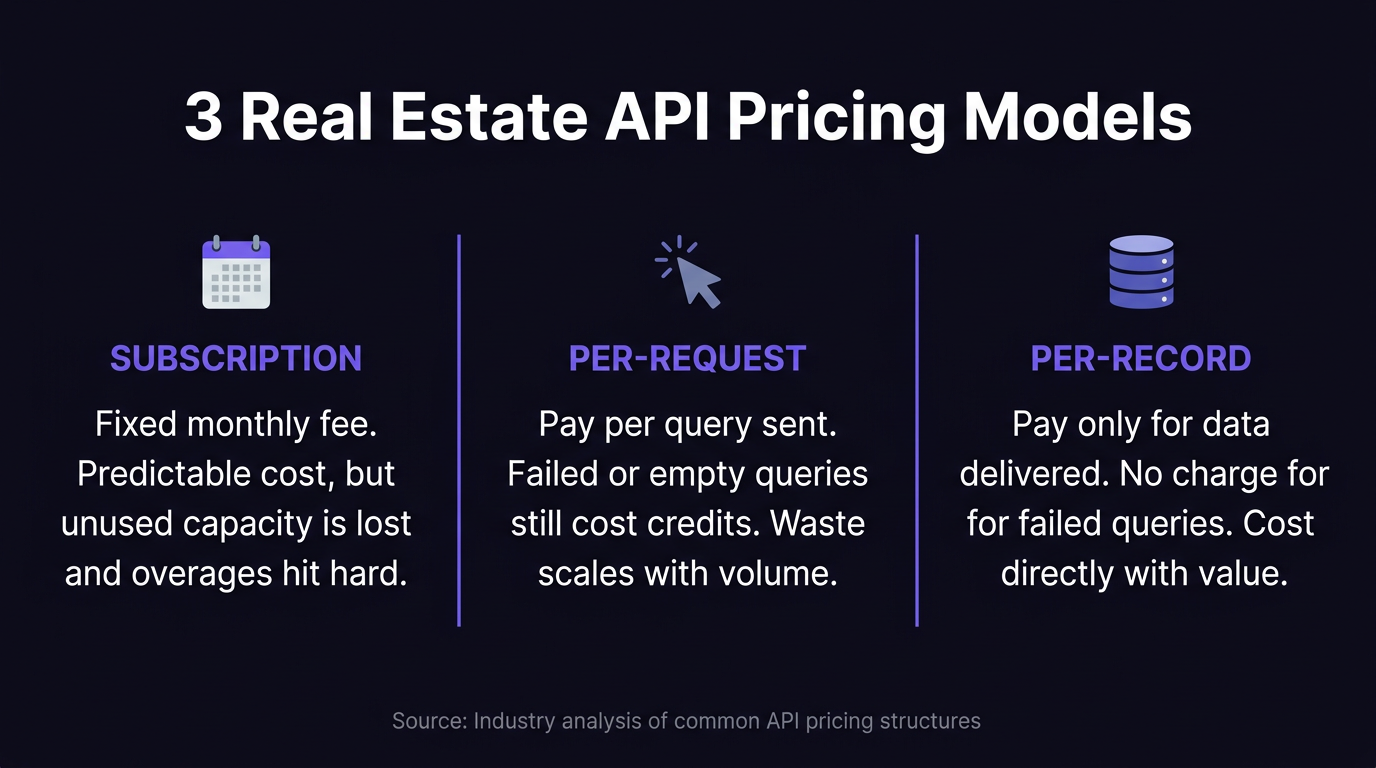
- Subscription models offer predictable billing but often penalize teams that exceed tier limits or underuse their allocation.
- Per-request pricing charges for every query sent, including failed or empty ones, making total cost unpredictable at scale.
- Per-record credit pricing charges only for data actually delivered, which aligns cost directly with value received.
- Rate limits and geographic packaging restrictions inflate the true cost of property data API pricing beyond what the listed plan price suggests.
Before signing any data contract, calculate your all-in cost: plan price plus the engineering overhead of working around the model's limitations.
When developers and data teams evaluate property data APIs, pricing is almost always the first conversation. But the listed plan price is rarely the full story. Real estate API pricing models differ significantly in how they meter usage, handle overages, enforce rate limits, and structure geographic access. Those distinctions are what separates a well-scoped data budget from one that breaks at scale. For a broader look at structured property data access, explore how real estate data APIs work and what they make possible.
The PropTech market is growing fast. According to Fortune Business Insights, the global PropTech market is projected to grow from $44.59 billion in 2026 to over $104 billion by 2034. As more platforms, analytics tools, and investment applications depend on property data at scale, real estate API pricing models have become a core infrastructure decision with real budget consequences.
What Are the Main Real Estate API Pricing Models?
Most property data APIs fall into one of three pricing structures. Each handles volume, variability, and cost predictability differently. Knowing which model a provider uses shapes everything from integration complexity to how you forecast infrastructure costs a year from now.
Flat Subscription Pricing
A flat subscription model charges a fixed monthly or annual fee for access up to a defined volume of API calls or records. The appeal is straightforward: costs are predictable, and teams can plan around a known number. Enterprise procurement teams tend to prefer subscription pricing because it maps cleanly to a budget line item.
The problem is that subscription tiers almost never align perfectly with actual usage. Teams that consistently use a fraction of their allocation are subsidizing capacity they never touch, while those who spike past their tier face overages. According to Zuplo's API pricing analysis, overage pricing in tiered subscription models can create significant cost surprises for teams with variable usage patterns.
Subscription-based property data API pricing also tends to obscure rate limiting: a plan that includes 500,000 requests per month may still enforce hard caps on requests per second, requiring development teams to build throttle handling and retry logic. That engineering overhead never appears on the invoice.
Per-Request (Pay-Per-Call) Pricing
Per-request models bill by the API call, regardless of what the call returns. This sounds usage-aligned, but the problem emerges when queries return partial results, empty datasets, or error responses. In most per-request models, those failed calls still consume credits.
For teams running exploratory queries, testing coverage in new markets, or building systems that retry on empty responses, per-request pricing generates consistent waste. A development sprint that hits a data gap repeatedly can burn through a credit allocation without producing a single usable record. In high-volume environments, this adds up quickly. The Postman 2025 State of the API Report found that 65% of organizations now generate revenue directly from their API programs, which makes pricing model efficiency a direct business concern that affects product margins, not only infrastructure budgets.
Per-request pricing can be cost-effective for very low, predictable volumes. But for any team building a platform that scales, it forces constant usage forecasting and credit monitoring just to avoid bill shock.
Per-Record Credit Pricing
Per-record credit pricing charges only for data actually delivered. If a query returns no results, no credit is consumed. If it returns 50 records, the cost is exactly 50 records worth of credits. There is no charge for the act of querying, no engineering penalty for a miss, and no need to build caching layers or retry throttles to manage waste. Cost and output move together transparently, at any scale.
What Does Property Data API Pricing Actually Include?
Sticker price is one input. The total cost of using a real estate API depends on several factors that rarely appear on a pricing page. Evaluating those factors before signing a contract is what keeps your data budget from expanding unexpectedly after go-live.
Rate Limits and Engineering Overhead
Rate limits are often described as a technical detail, but they translate directly into engineering cost. When a property data API enforces requests-per-second or requests-per-minute caps, integration teams have to build throttle handling, implement retry logic, and manage burst scenarios where legitimate usage spikes hit a ceiling.
That engineering work adds to your integration timeline and creates ongoing maintenance. APIs that remove rate limits entirely shift this cost to zero. Teams can send queries at whatever throughput their infrastructure supports, without building or maintaining throttle logic. For a developer evaluating MLS API cost or broader property data API options, this distinction is worth more than it initially appears on a spec sheet.
Geographic Coverage and Packaging
Geographic packaging is a commonly overlooked cost driver in property data API pricing. Some providers sell national access as a single integration, while others break coverage into regional or metro packages, each sold separately.
If your use case spans multiple markets, per-region pricing means multiple contracts, multiple billing relationships, and no volume discount across your combined footprint. A team that needs data across ten metros may be paying ten separate minimums rather than a single rate that scales with actual use. Full national access under one integration eliminates that fragmentation entirely and removes the friction of renegotiating coverage as your platform expands.
Property Type Scope
Many property data APIs cover residential properties only. Teams that need commercial or industrial coverage often hit this wall after integration has already started, which means a separate contract, separate documentation, and added timeline. If your roadmap includes commercial or industrial use cases, evaluate data access and scope options before committing to a provider that forces a separate contract for every property class.
5 Questions to Ask Before Committing to a Real Estate API Pricing Model
The answers to these questions separate a pricing model that works for your team from one that creates friction at scale. Run through them with any provider before signing a contract.
- What happens when a query returns zero results? In per-request models, a failed query usually still costs a credit. In per-record pricing, no delivered data means no charge. For teams doing exploratory queries or testing coverage in new markets, this distinction affects how quickly you burn through your allocation.
- Are there requests-per-second or requests-per-minute caps? Rate limits that aren't visible on the pricing page still require engineering work. Ask specifically whether the API imposes throughput restrictions and what happens when a burst request hits those limits.
- Is geographic coverage sold as a single integration or in regional packages? If you need data across multiple markets, per-region pricing means multiple contracts and no unified volume discount. Confirm whether national access is included or requires a separate agreement for each market.
- Does the subscription tier include commercial and industrial properties? Many APIs default to residential-only coverage. If your platform serves investors, lenders, or institutional users, confirm that the data scope covers all property types before integration begins rather than after.
- What are the overage rates and how are they triggered? Ask for the exact cost per unit above your tier limit, and confirm whether overages are billed at the end of the billing period or in real time. Overage rates in subscription models are typically a significant premium over in-plan rates, and an unexpected usage spike can substantially alter your monthly bill.

How Do Real Estate API Pricing Models Affect Long-Term Platform Costs?
Pricing decisions made at integration time have compounding effects as a platform grows. A model that looks affordable at 50,000 records per month can produce very different economics at 500,000. The two primary cost drivers that scale nonlinearly are credit waste and geographic expansion.
Credit Waste at Scale
Per-request models generate credit waste in proportion to query failure rate. For a platform running exploratory data pulls, testing coverage boundaries, or operating in markets with inconsistent data density, a meaningful share of queries may return empty results. At low volumes this overhead is manageable. At high volumes, consistently paying for queries that return no data becomes a real budget line, and one that grows alongside your usage.
Per-record credit pricing eliminates this category of waste entirely. There is no cost associated with a failed query, so teams can run exploratory queries freely without rationing them to protect a credit balance. This changes how confidently you can test, iterate, and expand coverage without constantly monitoring your credit burn rate.
Geographic Expansion Costs
Platforms that start in a single market and expand geographically face very different cost curves depending on how their provider structures coverage. In a per-region model, every new market requires a new contract negotiation, often with its own minimum commitment and no volume discount that aggregates across markets.
With full national access under a single integration, geographic expansion adds no new contracting overhead. The same API call structure and pricing apply whether you are pulling data from one state or all fifty. For platforms that anticipate growth, the cost difference between these two models compounds over time. See how business data APIs handle geographic scope as a reference point for how coverage packaging varies across data types.
What Transaction Data Pricing and MLS API Cost Look Like in Practice
Pricing for transaction data and MLS-connected feeds follows the same model structures described above, but with a few additional considerations specific to real estate data. These variables affect how much transaction data pricing varies across providers:
- Data freshness and update frequency. APIs that pull from county recorder offices and deed filings in near real time often carry a premium over providers using monthly batch updates. If your use case depends on current transaction records, confirm the refresh cadence and factor it into your evaluation.
- Field depth per record. A transaction record that includes sale price, recording date, buyer and seller details, ownership chain, and mortgage information is worth more than one that delivers only address and sale price. Understand what field set comes with your plan before comparing prices across providers.
- Delivery format. Some providers offer on-demand API queries, while others deliver bulk datasets via SFTP, S3, or data warehouse connectors like Snowflake. If your platform needs on-demand access rather than batch delivery, confirm this is supported without requiring a separate tier or add-on contract.
For teams specifically evaluating MLS API cost, it's worth noting that MLS-sourced data typically requires separate licensing agreements, display rules compliance, and geographic restrictions based on MLS membership boundaries. Providers that aggregate from public records and deed filings rather than MLS feeds often offer broader geographic flexibility with fewer compliance constraints. Review API documentation before committing to understand exactly what fields, refresh rates, and delivery mechanisms are included at each tier.

Frequently Asked Questions
What Is the Difference Between Per-Request and Per-Record API Pricing?
Per-request pricing charges for every query sent to the API, including queries that return empty results or error responses. Per-record pricing charges only for records actually delivered. Per-request pricing generates credit waste whenever a query fails; per-record pricing aligns cost directly with data received.
Why Do Real Estate API Pricing Models Include Rate Limits?
Rate limits exist primarily as an infrastructure protection mechanism for the provider, capping how many requests a single client can send in a given time window. From the buyer's perspective, rate limits translate into engineering overhead: teams must build throttle handling and retry logic to avoid hitting caps. APIs that remove rate limiting eliminate this engineering cost entirely.
How Does Geographic Coverage Affect Real Estate API Costs?
Providers that package coverage by region or metro require separate contracts for each market, which means separate minimums, no aggregated volume discount, and added procurement overhead as you expand. Full national access under a single integration eliminates all of that friction.
What Is a Good Way to Estimate Real Estate API Costs Before Committing?
Start with your expected monthly record volume and apply the per-unit rate for each pricing model you are evaluating. For per-request models, add a meaningful buffer to account for queries that return no data. For subscription tiers, model both baseline usage and a spike scenario to understand how overages affect your bill. For per-record credit pricing, the estimate is simply expected records multiplied by cost per record.
Does MLS API Cost Differ from Standard Property Data API Pricing?
It often does. MLS-sourced APIs typically carry additional licensing fees, display rules compliance requirements, and geographic restrictions tied to MLS membership territories. APIs built on public record aggregation tend to offer broader geographic access and fewer compliance constraints, often at a more predictable cost structure. For teams prioritizing national coverage without MLS licensing overhead, public-record-based property data APIs frequently offer more flexibility.
Choosing the Right Real Estate API Pricing Model for Your Platform
The real cost of any property data API pricing model includes more than the stated plan price. Rate limits generate engineering overhead. Per-request billing generates credit waste. Geographic packaging generates contracting friction. Subscription tiers generate either unused capacity or expensive overages. Every one of these factors affects your total cost of ownership, and none of them appear on the provider's pricing page.
Before committing to an integration, map your usage patterns against each model's cost behavior at scale. A pricing model that works at launch may not hold up when your platform is processing a million records a month across a dozen markets.
Datafiniti uses a per-record credit model: you pay only for data delivered, with no charges for failed queries, no rate limiting, and full national coverage under a single integration across residential, commercial, and industrial property types. If your team is evaluating real estate API pricing models and wants to see the data before committing, reach out to get started and see what structured property data access looks like in practice.
Read the latest articles

Read more

Build vs Buy: Business Data Enrichment for Growing Teams

Best Business Data APIs for Sales Teams & Prospecting

Business Data API: Company Data at Enterprise Scale

How to Build a Product Database With a Product Data API

Property Data API Coverage: What U.S. Datasets Include

Product Data API for Ecommerce Price Monitoring and Repricing

Real-Time Product Data API for Product-Led Growth Teams

Property Ownership Data API for Skip Tracing and Lead Gen

How APIs Make Building a Product Database Easy
Learn how to build a product database with APIs for cleaner imports, updates, search, and scalable product data.

What Is Property Transaction Data and How Does an API Help Get It?
Learn how property transaction data works and how APIs provide structured access for analysis and workflows.

How to Use Real Estate Transaction Data
Learn how to use real estate transaction data for analysis, valuation, underwriting, and market decisions.

How to Leverage Competitor Pricing Data with an API
Use competitor pricing data to build API-driven monitoring, analysis, and smarter pricing decisions.

Price Monitoring API: The Key to E-Commerce Pricing Strategy
Use a price monitoring API to track market changes, improve pricing decisions, and protect ecommerce margins.

How do Product Data APIs Work for E-Commerce Companies?
Learn how a product data API works, from collection and queries to ecommerce integration and use cases.

Bulk Real Estate Data Licensing: Access Datasets at Scale

How to Integrate MLS Listings Using an MLS Data API

GTIN Lookup API: Search Products by Barcode & UPC at Scale

Best Real Estate API 2026: Coverage, Pricing, Data Quality

Best Product Data API 2026: A State-of-the-Market Guide

Product Data API Integration Patterns for Ecommerce Platforms

Build a PropTech MVP With a Property Ownership Data API

3 Benefits of Web Scraping for Real Estate
Boost your research by using web scraping for real estate to gain market insights, automate lead lists, and minimize property risk.

How Real Estate Agents Can Leverage Proptech Data
Leverage proptech data to source leads, speed up valuations, and manage risk with accurate, real-time property insights.

What Is a UPC Lookup API?
Learn about the UPC lookup API, how it works, and its benefits for businesses. Get product data easily.

What Is a GTIN Lookup API?
Learn about the GTIN lookup API and how it can help your business grow. Get product data insights.

How Does a Property Data API Work?
Learn how a property data API works, its features, and how you can use it for real estate and business insights.

What The Best Real Estate APIs Should Have
Discover what makes the best real estate APIs stand out. Learn about essential features for your property data needs.
The Benefits of a Real Estate MLS API
Learn about the benefits of a real estate MLS API for streamlining data access and driving business growth.

Why Every Real Estate Pro Needs an MLS Database API
Learn why a MLS database API is vital for real estate pros. Get data, insights, and competitive edge.
How to Access MLS Listing Data
Learn how to access MLS listing data using an MLS data API. Discover Datafiniti's solutions and integration tips.
.png)
How to Enrich Your Product Catalog With a Real-Time API
.jpeg)
Product Data API Buyer's Guide for Ecommerce Teams

Do I Need a Real Estate Listing API?
Explore the benefits and technicalities of a real estate listing API. Learn how to choose the right provider and integrate data for business growth.

Unlocking the MLS Database with APIs
Unlock the MLS database with APIs. Learn how to access property data, gain real estate insights, and integrate MLS data for your business needs.

Why Real Estate Tech Startups Need Property APIs with Ownership Details
Discover how property APIs with ownership details empower real estate tech startups. Learn about data integration, risk mitigation, and driving business value.
The Value of a Product Catalog Sync for Product Managers
Unlock the value of product catalog sync for product managers. Streamline data, improve decisions, and reduce costs with real-time insights.

What is a Product Data Webhook?
Learn about product data webhooks, their components, and how they enable real-time updates for business intelligence and workflow automation.

Why Is a Product Data API Integration Essential for Analysts & Product Managers?
Unlock insights with product data API integration. Essential for analysts & product managers to streamline data access & enhance product strategy.

What Is a Product Data API and Its Benefits
Learn about product data APIs, their benefits, and how they drive business growth. Explore integration and advanced use cases.

What Do eCommerce Data Vendors Do?
Learn what ecommerce data vendors do, their services, and how to choose the right one for your business growth.

How to Compare Product Data Providers: What to Look For
Compare product data providers. Learn what to look for in data quality, structure, and integration features.

How to Get Your Product Data in Real-Time Using APIs
Learn how to leverage real-time product data APIs for e-commerce, competitive analysis, and AI. Get instant access to clean, structured product data.

Best Product Data API: Features to Look for
Find the best product data API with real-time updates, comprehensive coverage, and a user-friendly portal. Explore features to look for.

Unlocking Property Data with an API
Access property data with a powerful property database API. Explore listings, market analysis, investment opportunities, and more. Get started today!

Unlocking CRE with APIs
Unlock commercial real estate insights with a powerful API. Access property data, streamline workflows, and enhance investment strategies.

How to Get a Real-Time Product Feed Using an API
Learn how to get a real-time product feed using an API. Access, leverage, and ensure accuracy of product data for your business needs.

Spying on Competitor Prices: What You Need to Know
Learn how to gather and analyze competitor pricing data to inform your business strategy. Understand key components and ethical considerations.

Product Data Enrichment: What Are You Missing?
Enhance your product data with comprehensive enrichment. Discover insights, drive growth, and choose the right approach for your business.
.png)
IDX vs MLS API: A Developer's Guide to Real Estate Listing Data
Real Estate API Pricing Models Explained: Subscription vs. Usage-Based

Real Estate API vs Web Scraping: Which Wins in 2026?
.png)
Product Data APIs Explained: Powering Product Search and Catalog Automation

Best Sources for Bulk Real Estate Transaction Data

How to Get the Most out of a Product Catalog API
Learn how to leverage a product catalog API for business growth. Discover data quality, access methods, and strategy for your product catalog API.

Taming Your Ecommerce Product Data Feed
Optimize your ecommerce product data feed for growth. Learn strategies, leverage technology, and ensure data quality for better customer experience and AI initiatives.

Streamlining Your Product Search with an API
Explore the benefits and integration of a product search API. Streamline your product discovery and leverage data for business growth.
.png)
Real Estate Transaction Databases: What You Need to Know
.png)
Best MLS API for Real Estate Software: What Developers Need

How Real Estate Platforms Access MLS Database APIs
.png)
Commercial Real Estate API vs. Residential Property API
.png)
How to Choose a Real Estate Database API for Your MVP
MLS API vs. IDX: What's the Diff?
MLS API vs IDX: Explore the differences in real estate data access, retrieval, and integration. Understand which solution fits your needs.

Scraping vs. APIs: Getting Real Estate Data
Compare web scraping vs real estate API for data acquisition. Learn the pros, cons, and best use cases for each method.

Cracking the Code: Housing Sales Insights
Unlock housing sales analytics insights with Datafiniti. Explore property data, market trends, and advanced techniques for strategic decisions.

Property Valuation API: Your Go-To Real Estate Tool
Leverage the property valuation API for real estate insights. Access comprehensive property data for diverse applications with Datafiniti.

Product Data APIs Explained
Learn about product data APIs explained. Discover how to access, integrate, and utilize product data for e-commerce, analytics, and more.

Unlocking Your Ecommerce Data with APIs
Unlock ecommerce data with APIs for business insights, product catalog enrichment, and competitive analysis. Explore data via portal or API.

Your Guide to Housing Sales APIs
Explore housing sales API data for insights. Access property data, integrate into applications, and gain business intelligence. Get started today!

Real Estate Ownership Data: How to Access, Analyze and Use at Scale
Access, analyze, and use real estate ownership data at scale. Learn how to find, process, and leverage this crucial information for business insights.

Unlocking Opportunities: Navigating Bulk Real Estate Transaction Data
Unlock opportunities with bulk real estate transaction data. Learn how to access, analyze, and leverage property data for investing, marketing, and more.
What Is a Property Sales Database?
Explore what a property sales database is, its core components, how to access data, and key use cases for real estate analysis and more.

Benefits of Obtaining Housing Transaction Data
Unlock insights with housing transaction data. Analyze markets, investments, sales, and risk. Get comprehensive property data for informed decisions.

Understanding Real Estate Transaction Databases
IDX vs MLS API: What Every Real Estate Professional Should Know
Understand IDX vs MLS API differences. Learn about data access, integration, and how Datafiniti's solutions empower real estate professionals.

What Is an MLS Database API?
Explore the MLS database API: understand its components, benefits, and how to access real estate data for various applications. Learn about its core functionality and technical aspects.

How a Property Database API Can Help Real Estate Pros
Learn how a property database API can help real estate pros analyze trends, monitor listings, and optimize strategies. Get data insights.

What Is a Residential Property API?
Explore what a residential property API is, its features, benefits, and real-world applications for real estate professionals and investors.

What Is a Commercial Real Estate API?
Explore commercial real estate API functionality, data integration, and use cases. Learn how to leverage property, business, and people data for insights.

Understanding MVP Data Integration
Learn about MVP data integration, its components, benefits, and strategies for accessing and utilizing data resources effectively.

How to Choose the Best Property Data API
Learn how to choose the best property data API. Explore features, providers, pricing, and integration for real estate insights.

Real Estate Database API: What to Look for
Explore real estate database API options. Learn about data quality, features, and how to choose the right provider for your needs.
.png)
Real Estate Transaction Database: An API Access Guide

How Do Product Data APIs Work?
Understand how a product data API works, its key features, integration methods, and applications for e-commerce and business intelligence.

How Do Data Aggregation Platforms Work?
Explore how data aggregation platforms work, their capabilities, and applications. Learn to choose and implement the right platform for your business intelligence needs.

Why Do Companies Need Property Data Aggregation?
Discover why property data aggregation is crucial for businesses. Streamline access, empower functions, enhance risk management, and drive strategic decisions with authoritative insights.

MLS API: The Complete Guide to Accessing MLS Listing Data

Product Search API vs. Product Data API: What's the Difference?

What Are the Best MLS Data API Features to Look For?
Discover the best MLS data API features, including real-time updates, bulk downloads, and flexible filtering for property data.

What Is a Product Data API?
Explore the functionality and benefits of a product data API. Learn how to integrate, leverage, and choose the right provider for your business insights.
What Is the Difference Between Product Search API and Product Data API?
Understand the difference between Product Search API and Product Data API. Learn how to leverage product data for business intelligence and analytics.

Guide to Accessing Real Estate Transaction Database Via API
Access real estate transaction data via API. Explore property insights, sales, underwriting, and advanced applications with our authoritative guide.

Is a Real Estate MLS API Beneficial?
Explore the benefits of a real estate MLS API for enhanced data access, streamlined workflows, and market responsiveness. Learn about key features and use cases.

What is an MLS Database API?
Explore the MLS database API for comprehensive property data access. Learn about its core functionality, key features, and integration into real estate technology.

What Is a Property Data API?
Explore the capabilities of a property data API. Understand its core functionality, key features for developers, and how to access property information at scale for business insights.
.png)
Real Estate API Pricing: What You Need to Know Before You Build
.jpeg)
How to Choose a Property Market API for Investment Platforms
Choosing the right property market API is critical for investment platforms. Learn how to evaluate data depth, coverage, freshness, and integration quality before you commit.
Data you can trust, delivered in a format your systems can use, at the scale your product requires.