
.jpeg)
Product Data API Buyer's Guide for Ecommerce Teams
Key Takeaways
A product data API gives applications programmatic access to structured product records, including pricing, availability, descriptions, and identifiers across millions of SKUs from many brands and retailers.
- Evaluate vendors on five dimensions: coverage, schema consistency, documentation accessibility, delivery model, and pricing structure.
- Public, navigable documentation is the most underrated buying criterion. Gated docs cost teams weeks of evaluation time.
- Per-record pricing protects budgets at scale. Per-request models charge for failed queries and inflate costs as catalogs grow.
- Real-time and bulk batch delivery serve different workloads. The right choice depends on use case, not on what a vendor offers by default.
If you can read a vendor's full documentation before talking to sales, you can ship a working prototype in days instead of months.
Global retail ecommerce hit $6.88 trillion in 2026, capturing 21.1% of all retail commerce. Every team competing for that revenue depends on clean, structured product data, whether they are building dynamic pricing tools, enriching catalogs, or training AI shopping assistants. A product data API is how modern ecommerce teams access that data at scale.
In plain terms, this kind of API is a programmatic interface that returns structured product records from a large external dataset: pricing, availability, descriptions, identifiers, images, and reviews across millions of SKUs from many brands and retailers. The right vendor accelerates development. The wrong one creates compounding technical debt and unpredictable bills.
This buyer's guide walks through how to evaluate vendors before signing a contract. The goal is to give ecommerce and data teams a clear framework for comparing feeds, coverage, documentation, delivery models, and pricing.
What Is a Product Data API, and Why Does It Matter Now?
These APIs sit between massive external product datasets and the applications that need them. They power pricing intelligence dashboards, catalog enrichment workflows, search and recommendation engines, and AI shopping experiences. Buyers evaluating vendors need to understand what these tools actually do before comparing features.
Where Product Data Tools Fit in the Ecommerce Stack
Most ecommerce platforms ship with a built-in product catalog API for managing the merchant's own inventory. A third-party data feed is different. It provides access to product records from across the broader market, well beyond a single store. That distinction matters when teams need to compare prices against competitors, fill gaps in their catalogs from external sources, or build search experiences that span more than one merchant.
The global API management market is projected to grow from $6.89 billion in 2025 to $37.43 billion by 2034, according to Fortune Business Insights, with much of that growth driven by ecommerce teams replacing in-house data infrastructure with specialized API providers. The reasoning is simple. Maintaining scrapers and parsers for thousands of retailer sites is expensive, fragile, and slow. APIs externalize that work.
What Strong Vendors Should Actually Deliver
A serious vendor returns more than basic price and title fields. Buyers should expect comprehensive identifiers (UPC, EAN, GTIN, SKU, ASIN), full pricing history, availability signals, structured descriptions, categories, specifications, images, merchant information, and customer reviews. A product search API built on this kind of dataset can filter by brand, price range, or category reliably, and that only works if the underlying record is complete and consistent.
Schema consistency across merchants is often the difference between a useful dataset and a frustrating one. If pricing fields are formatted differently for different retailers, every application that consumes the data has to normalize it. A well-designed ecommerce product data feed normalizes records before delivery, not after.
What Should You Look for When Comparing Vendors?
Before comparing specific vendors, every buyer should work through this evaluation framework. Each criterion ties directly to a real cost or risk that shows up later in the integration. Skip any of them and the problems surface six months in, when changing vendors is expensive.
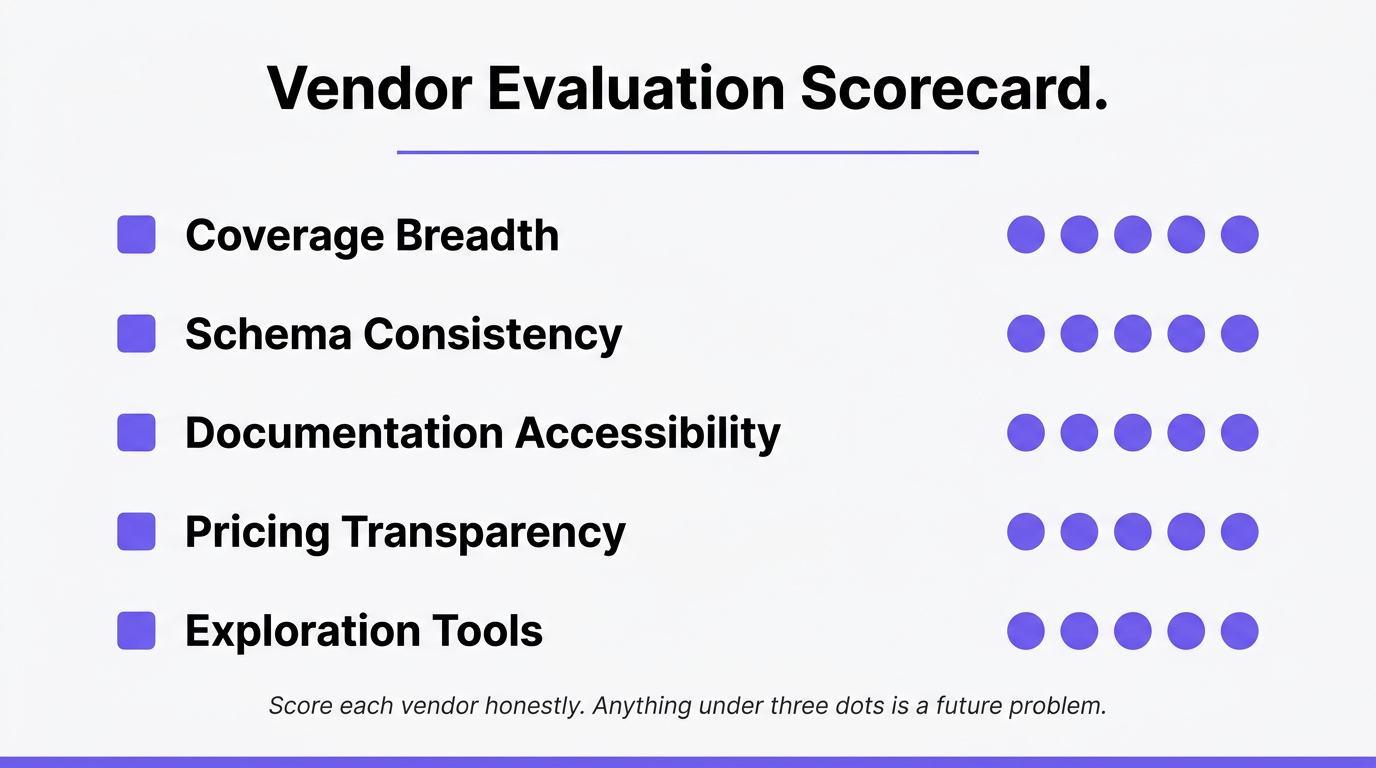
- Coverage breadth. How many SKUs, how many retailers, and which product categories does the dataset include? A product catalog API that only covers one or two marketplaces forces teams to integrate multiple vendors for complete market visibility.
- Schema consistency. Are records normalized across sources, or does the consuming application have to handle merchant-specific field formats? Inconsistent schemas multiply development time and create silent bugs.
- Documentation accessibility. Can you read the full API reference before talking to sales? Vendors that gate documentation behind sales calls add weeks of friction to evaluation and tell you something about how they treat customers.
- Pricing model. Per-record pricing charges only for data actually returned. Per-request models charge for every query, including failed ones, and become punitive at scale. Be especially skeptical of opaque tiering with per-field upcharges.
- Throughput limits. Rate limits force engineering teams to build throttling logic, retry handlers, and queue management. Vendors without rate limits remove that complexity entirely and let workloads scale as needed.
- Exploration tools. Can you query and view sample records before writing integration code? A visual web portal that lets technical and non-technical evaluators inspect the data shortens evaluation from weeks to hours.
Why Is API Documentation the Most Underrated Buying Criterion?
Most buyer's guides skip past documentation as a basic checklist item. That misses the point. Documentation quality predicts almost every other part of the vendor relationship: how quickly engineers integrate, how often support tickets get filed, how reliably the API behaves at scale, and how much institutional knowledge gets locked in vendor-specific sales contacts. Buyers who treat documentation as a primary criterion ship faster and avoid the most common failure modes.

What Public Documentation Tells You Before You Sign
If a vendor publishes complete, navigable API documentation publicly, several things are true at once. The engineering team has the resources and discipline to maintain it. The product surface is stable enough to document. Schema definitions, query syntax, and field-level behavior are written down so teams can evaluate against real requirements before any sales conversation happens.
Compare that to vendors who require a discovery call before releasing API references. Buyers walk into those calls with no way to assess whether the schema actually supports their use case. Engineering teams cannot prototype, and evaluation cycles balloon. Openly published documentation has become a meaningful filter for separating serious vendors from sales-gated ones.
This matters for ecommerce product data feed vendors specifically because schemas are complex. Pricing fields differ across merchants. Availability signals vary by retailer. Identifier coverage is uneven. A buyer cannot make a real decision without seeing how the API handles all of that, and the only honest way to show that is through complete public documentation.
How Documentation Affects Time to First Useful Query
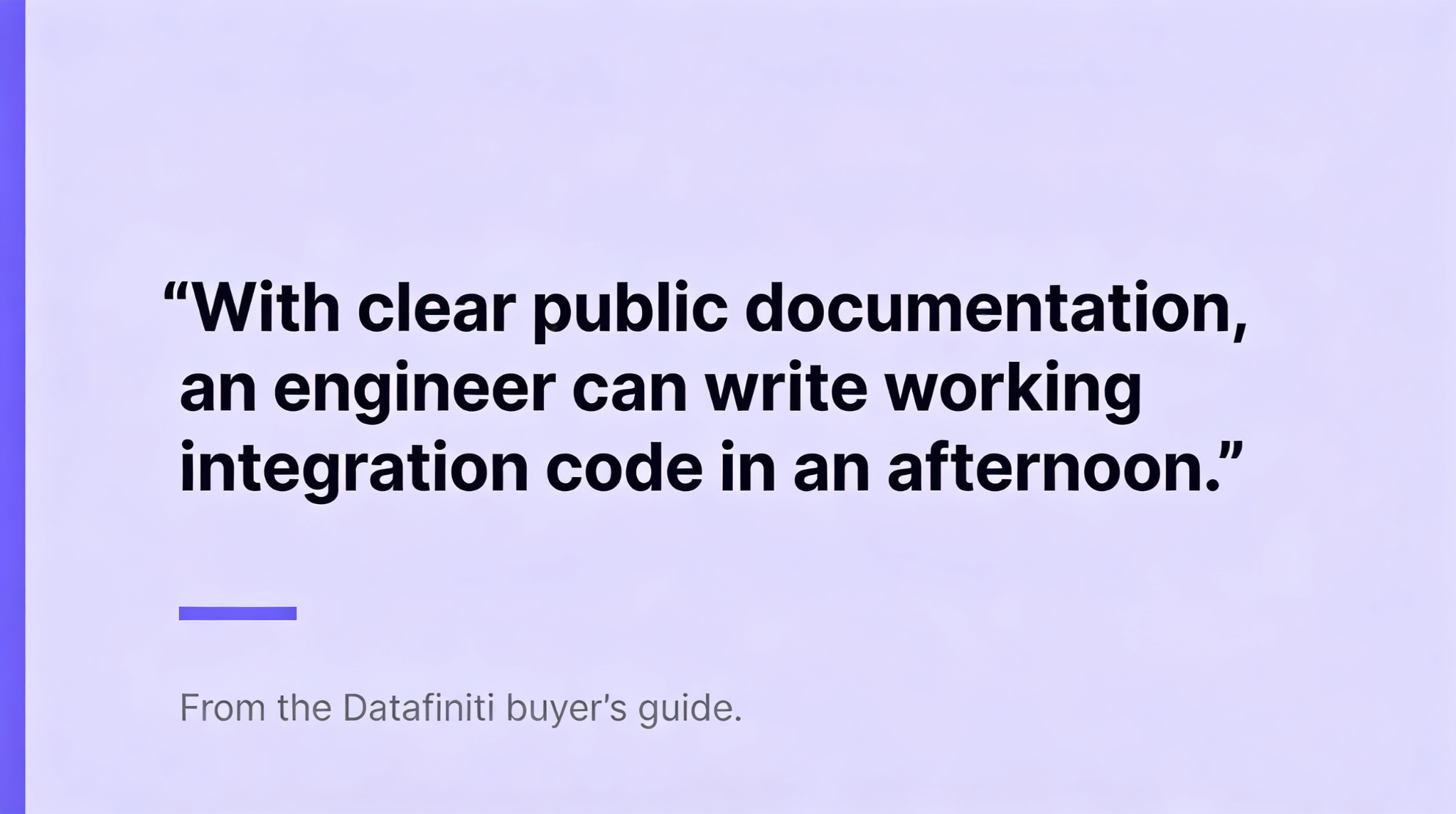
The fastest signal for vendor quality is how long it takes a competent engineer to run their first useful query. With sparse or gated documentation, that timeline extends into weeks, often punctuated by support tickets and follow-up calls. With clear public documentation, an engineer can write working integration code in an afternoon.
That speed compounds. Faster prototypes mean faster validation of business cases. Faster validation means more workloads get approved instead of shelved. Faster approval means competitive advantages get captured instead of missed. None of that happens without documentation that engineers can read on their own.
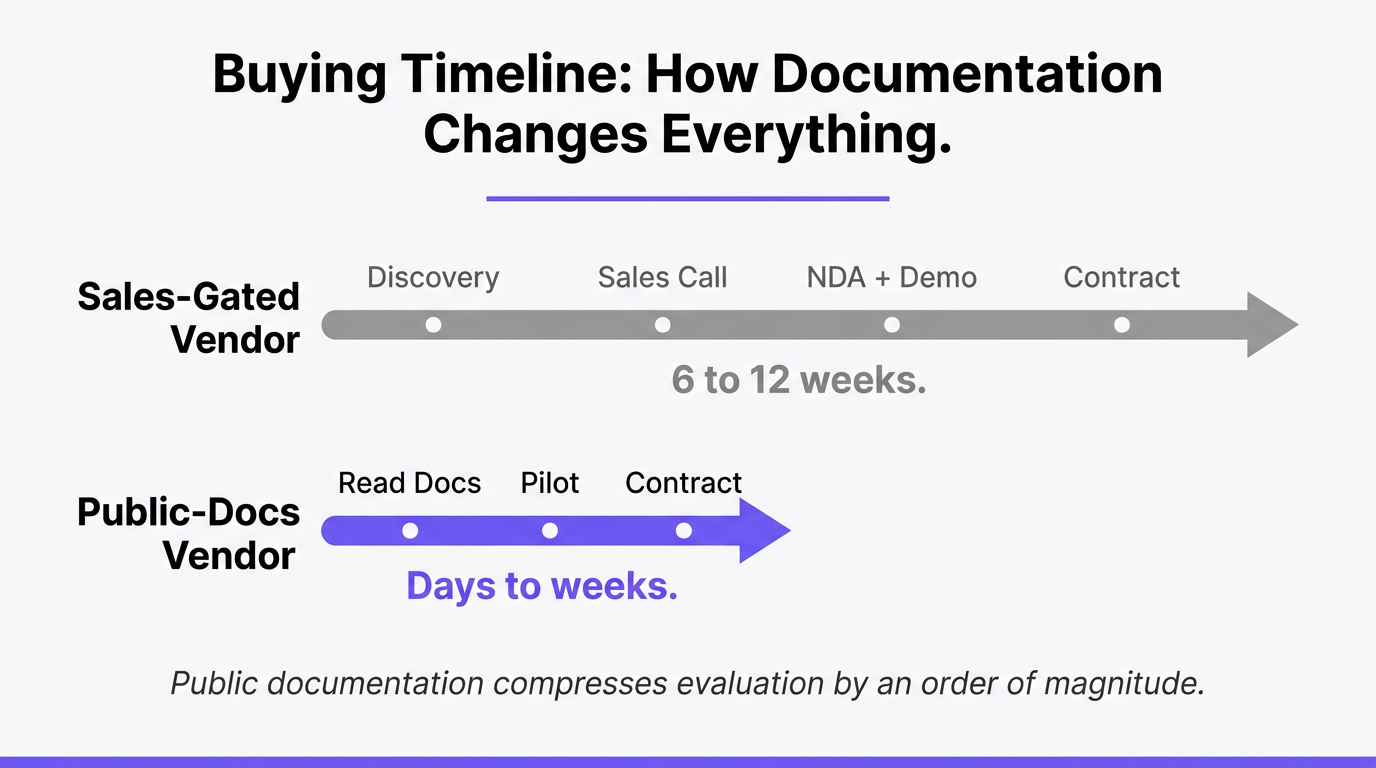
Buyers comparing vendors should treat the documentation site as a primary artifact. If the syntax is unclear, the field definitions are vague, or the examples do not match the real API surface, those problems will show up again later in production.
How Do Pricing Models Compare Across Product Data API Vendors?
Pricing in this market is less standardized than most buyers expect. Vendors use per-request, per-record, subscription tiers, custom enterprise contracts, and various combinations of those structures. Each model has different implications for scaling, predictability, and total cost of ownership.
Per-Request vs. Per-Record Pricing
Per-request pricing charges for every API call regardless of what comes back. A query that returns zero records costs the same as a query that returns a thousand. At small scale, this looks reasonable. At ecommerce scale, where buyers are running millions of queries to build pricing intelligence or catalog enrichment workflows, the model becomes hostile. Teams pay for failed queries, broad searches that return little, and exploratory work that drives no revenue.
Per-record pricing charges only for the data actually delivered. Failed queries cost nothing. Broad exploratory searches return what is available without inflating bills. Teams can iterate on query design without watching costs spiral. The model aligns vendor revenue with customer value: the buyer pays for results, not attempts.
This difference matters most when workloads are unpredictable, which they almost always are. A retailer running a pricing intelligence project might query thousands of SKUs per day during active campaigns and fewer between them. Bulk structured data delivery priced by record makes that volatility manageable. Per-request vendors make it expensive.
How LLM and Bulk Workloads Break Per-Request Pricing
AI-driven ecommerce workflows have changed pricing economics in a way most vendor pricing pages have not caught up with. Training a recommendation model, building an AI shopping assistant, or running a large-scale catalog enrichment job requires fetching hundreds of thousands or millions of records in tight time windows. Under per-request pricing, those workloads are prohibitively expensive.
LLM-ready delivery, where records are returned in clean, structured formats suitable for embedding generation or retrieval-augmented generation pipelines, has become a real requirement for ecommerce data teams. Even a product search API serving an AI shopping assistant needs to return enriched, normalized records fast enough for retrieval workflows. The vendors who price by record and deliver in bulk are the ones who can support those workloads. Vendors who price by request and rate-limit aggressively cannot.
Should You Choose Real-Time or Batch Delivery for an Ecommerce Product Data Feed?
Delivery model is a distinct decision from pricing. Real-time delivery returns the freshest available record for a single product or query on demand, suitable for live pricing displays, search experiences, and customer-facing comparison tools. Batch delivery returns large datasets in bulk, suitable for nightly catalog refreshes, analytical workloads, and model training.
Most ecommerce teams need both. A pricing intelligence platform might pull a daily batch of all competitor SKUs in a category for trend analysis, then hit real-time endpoints during high-velocity repricing windows. A catalog enrichment workflow might run nightly batches against the entire catalog and use real-time queries for newly added SKUs.
The right vendor supports both patterns under one integration. Vendors that force buyers to choose, or that charge separately for batch and real-time access, increase total cost and architectural complexity. Buyers should ask explicitly whether bulk export and on-demand query work the same way and pull from the same underlying dataset.
Schema parity between delivery modes is often where this falls apart. Some vendors return slightly different fields in batch versus real-time, which means application logic has to handle two record formats. A serious provider treats both modes as views into the same underlying data and exposes identical schemas regardless of how the records are requested.
Frequently Asked Questions
These are the questions ecommerce and data teams ask most often when evaluating vendors. Short, direct answers below.
What Is the Difference Between a Product Data API and a Product Catalog API?
A product catalog API typically manages the merchant's own inventory inside an ecommerce platform. An external product data feed provides records from across the broader market, including pricing, descriptions, and identifiers from many brands and retailers. Buyers building competitive pricing tools, search infrastructure, or catalog enrichment workflows generally need the latter, and many of them layer a product search API on top of the feed for filtering and discovery.
How Many SKUs Should a Strong Provider Cover?
Coverage requirements depend on the use case, but serious providers maintain hundreds of millions of product records spanning major retailers and brands. For competitive intelligence and catalog enrichment, breadth matters more than depth in any one category. For specialized use cases, vertical depth becomes the priority.
Can I Evaluate a Vendor Without Talking to Sales First?
Yes, if the provider publishes complete API documentation and offers a sample dataset or visual web portal. Vendors that gate everything behind sales calls make evaluation slower and prevent engineering teams from validating fit before committing. Buyers should treat sales-gated evaluation as a red flag.
How Should I Compare Pricing Across Vendors?
Translate every vendor's pricing into cost per record at your expected query volume and hit rate. Per-request pricing looks cheaper on paper until failed queries and broad searches are factored in. Per-record pricing is more predictable because it scales with delivered data, not with query attempts.
Is Real-Time Product Data Worth the Premium Over Batch?
Only for use cases that genuinely need it: customer-facing price displays, dynamic repricing, live search experiences. For analytical workloads, catalog enrichment, and model training, batch delivery is faster and cheaper. The strongest vendors support both modes against the same underlying dataset, so buyers do not have to choose architecturally.
Building a Final Buying Checklist
Before signing a contract with any vendor, three things should be true. The full API documentation is publicly readable. Sample records or a visual exploration tool are available without a sales call. Pricing is transparent enough to model expected costs against a realistic query workload.
Vendors that meet all three are rare, and they tend to be the ones serious ecommerce and data teams stay with for years. Vendors that meet none of them create exactly the kind of vendor lock-in and cost surprises that good evaluation work is supposed to prevent.
Datafiniti offers a product data API with over 560 million records, fully public documentation, per-record pricing, no rate limiting, and a visual web portal for exploring records before integration. Start a free trial or request a demo to see how the data fits your specific use case.
Read the latest articles

Read more

Best Product Catalog API for Online Retailers: Aggregating Multi-Retailer Catalogs

Build vs Buy: Business Data Enrichment for Growing Teams

Company Data API Pricing: Bulk & Enterprise-Scale Access

Best Business Data APIs for Sales Teams & Prospecting

Business Data API: Company Data at Enterprise Scale

How to Build a Product Database With a Product Data API

Property Data API Coverage: What U.S. Datasets Include

Product Data API for Ecommerce Price Monitoring and Repricing

Real-Time Product Data API for Product-Led Growth Teams

Property Ownership Data API for Skip Tracing and Lead Gen

How APIs Make Building a Product Database Easy
Learn how to build a product database with APIs for cleaner imports, updates, search, and scalable product data.

How to Leverage Competitor Pricing Data with an API
Use competitor pricing data to build API-driven monitoring, analysis, and smarter pricing decisions.

Price Monitoring API: The Key to E-Commerce Pricing Strategy
Use a price monitoring API to track market changes, improve pricing decisions, and protect ecommerce margins.

How do Product Data APIs Work for E-Commerce Companies?
Learn how a product data API works, from collection and queries to ecommerce integration and use cases.

GTIN Lookup API: Search Products by Barcode & UPC at Scale

Best Real Estate API 2026: Coverage, Pricing, Data Quality

Best Product Data API 2026: A State-of-the-Market Guide

Product Data API Integration Patterns for Ecommerce Platforms

Build a PropTech MVP With a Property Ownership Data API
How Real Estate Agents Can Leverage Proptech Data
Leverage proptech data to source leads, speed up valuations, and manage risk with accurate, real-time property insights.

What Is a UPC Lookup API?
Learn about the UPC lookup API, how it works, and its benefits for businesses. Get product data easily.

What Is a GTIN Lookup API?
Learn about the GTIN lookup API and how it can help your business grow. Get product data insights.

How Does a Property Data API Work?
Learn how a property data API works, its features, and how you can use it for real estate and business insights.

What The Best Real Estate APIs Should Have
Discover what makes the best real estate APIs stand out. Learn about essential features for your property data needs.

MLS Listings API: How to Access MLS Listing Data
.png)
How to Enrich Your Product Catalog With a Real-Time API
Product Data API Buyer's Guide for Ecommerce Teams

Why Real Estate Tech Startups Need Property APIs with Ownership Details
Discover how property APIs with ownership details empower real estate tech startups. Learn about data integration, risk mitigation, and driving business value.
The Value of a Product Catalog Sync for Product Managers
Unlock the value of product catalog sync for product managers. Streamline data, improve decisions, and reduce costs with real-time insights.

What is a Product Data Webhook?
Learn about product data webhooks, their components, and how they enable real-time updates for business intelligence and workflow automation.

Why Is a Product Data API Integration Essential for Analysts & Product Managers?
Unlock insights with product data API integration. Essential for analysts & product managers to streamline data access & enhance product strategy.

What Is a Product Data API and Its Benefits
Learn about product data APIs, their benefits, and how they drive business growth. Explore integration and advanced use cases.

What Do eCommerce Data Vendors Do?
Learn what ecommerce data vendors do, their services, and how to choose the right one for your business growth.

How to Compare Product Data Providers: What to Look For
Compare product data providers. Learn what to look for in data quality, structure, and integration features.

How to Get Your Product Data in Real-Time Using APIs
Learn how to leverage real-time product data APIs for e-commerce, competitive analysis, and AI. Get instant access to clean, structured product data.

Best Product Data API: Features to Look for
Find the best product data API with real-time updates, comprehensive coverage, and a user-friendly portal. Explore features to look for.

Unlocking Property Data with an API
Access property data with a powerful property database API. Explore listings, market analysis, investment opportunities, and more. Get started today!

Unlocking CRE with APIs
Unlock commercial real estate insights with a powerful API. Access property data, streamline workflows, and enhance investment strategies.

How to Get a Real-Time Product Feed Using an API
Learn how to get a real-time product feed using an API. Access, leverage, and ensure accuracy of product data for your business needs.

Spying on Competitor Prices: What You Need to Know
Learn how to gather and analyze competitor pricing data to inform your business strategy. Understand key components and ethical considerations.

Product Data Enrichment: What Are You Missing?
Enhance your product data with comprehensive enrichment. Discover insights, drive growth, and choose the right approach for your business.
.png)
Real Estate API Pricing Models Explained: Subscription vs. Usage-Based

Real Estate API vs Web Scraping: The Buy-vs-Build Decision
.png)
Product Data APIs Explained: Powering Product Search and Catalog Automation

How to Get the Most out of a Product Catalog API
Learn how to leverage a product catalog API for business growth. Discover data quality, access methods, and strategy for your product catalog API.

Taming Your Ecommerce Product Data Feed
Optimize your ecommerce product data feed for growth. Learn strategies, leverage technology, and ensure data quality for better customer experience and AI initiatives.

Streamlining Your Product Search with an API
Explore the benefits and integration of a product search API. Streamline your product discovery and leverage data for business growth.

What Is a Real Estate Transaction Database? A Complete Guide
.png)
Commercial Real Estate API vs. Residential Property API
.png)
How to Choose a Real Estate Database API for Your MVP

Property Valuation API: Your Go-To Real Estate Tool
Leverage the property valuation API for real estate insights. Access comprehensive property data for diverse applications with Datafiniti.

Product Data APIs Explained
Learn about product data APIs explained. Discover how to access, integrate, and utilize product data for e-commerce, analytics, and more.

Unlocking Your Ecommerce Data with APIs
Unlock ecommerce data with APIs for business insights, product catalog enrichment, and competitive analysis. Explore data via portal or API.

Real Estate Ownership Data: How to Access, Analyze and Use at Scale
Access, analyze, and use real estate ownership data at scale. Learn how to find, process, and leverage this crucial information for business insights.

IDX vs MLS API: What Every Real Estate Professional Should Know

How a Property Database API Can Help Real Estate Pros
Learn how a property database API can help real estate pros analyze trends, monitor listings, and optimize strategies. Get data insights.

What Is a Residential Property API?
Explore what a residential property API is, its features, benefits, and real-world applications for real estate professionals and investors.

What Is a Commercial Real Estate API?
Explore commercial real estate API functionality, data integration, and use cases. Learn how to leverage property, business, and people data for insights.

Understanding MVP Data Integration
Learn about MVP data integration, its components, benefits, and strategies for accessing and utilizing data resources effectively.

How to Choose the Best Property Data API
Learn how to choose the best property data API. Explore features, providers, pricing, and integration for real estate insights.

How Do Product Data APIs Work?
Understand how a product data API works, its key features, integration methods, and applications for e-commerce and business intelligence.

How Do Data Aggregation Platforms Work?
Explore how data aggregation platforms work, their capabilities, and applications. Learn to choose and implement the right platform for your business intelligence needs.

Why Do Companies Need Property Data Aggregation?
Discover why property data aggregation is crucial for businesses. Streamline access, empower functions, enhance risk management, and drive strategic decisions with authoritative insights.

MLS Database API: How to Choose a Provider and Get Access

Product Search API vs. Product Data API: What's the Difference?

What Is a Product Data API?
Explore the functionality and benefits of a product data API. Learn how to integrate, leverage, and choose the right provider for your business insights.
What Is the Difference Between Product Search API and Product Data API?
Understand the difference between Product Search API and Product Data API. Learn how to leverage product data for business intelligence and analytics.

What Is a Property Data API?
Explore the capabilities of a property data API. Understand its core functionality, key features for developers, and how to access property information at scale for business insights.
.png)
Real Estate API Pricing: What You Need to Know Before You Build
.jpeg)
How to Choose a Property Market API for Investment Platforms
Choosing the right property market API is critical for investment platforms. Learn how to evaluate data depth, coverage, freshness, and integration quality before you commit.
Data you can trust, delivered in a format your systems can use, at the scale your product requires.