

Product Data API Integration Patterns for Ecommerce Platforms
Key Takeaways
A reliable integration depends on a few early decisions: how you authenticate, how data flows, and how you test before you write code.
- Authentication should rely on tokens or API keys that are stored securely and rotated on a schedule.
- Scheduled catalog sync handles bulk refreshes, while webhooks push near real-time changes with far less waste.
- Testing queries in a visual portal before coding prevents expensive rework after launch.
- An API with no rate limits and per-record pricing keeps scaling predictable.
Decide your sync strategy and test against real responses before you write integration code, not after.
Connecting external product data to an ecommerce platform sounds simple until you reach production. A clean product data API integration has to handle authentication, keep catalogs fresh, survive traffic spikes, and recover gracefully when a request fails. Getting those patterns right early saves months of rework, and it starts with knowing how to access reliable structured product data. Demand for this kind of plumbing keeps climbing: the API management market is projected to grow from $7.6 billion in 2024 to $16.9 billion by 2029, a sign of how central API connections have become to commerce.
This guide walks through the integration patterns that matter most for ecommerce teams: authentication flows, batch versus real-time sync, webhook-driven updates, and ways to test a setup before you write a line of code. The aim is an architecture that stays reliable as your catalog and traffic grow.
What Does a Reliable Product Data API Integration Look Like?
A dependable setup is less about one clever endpoint and more about a few decisions you make up front. Authentication, query design, and error handling form the backbone of any ecommerce API integration, and they decide how much maintenance you take on later.
How Should You Handle Authentication?
Most product data APIs authenticate with an API key or a bearer token passed in the request header. Store that credential as an environment variable or in a secrets manager, and keep it out of your codebase entirely. Rotate it on a schedule and scope it to the minimum access your service needs.
Token-based auth also lets you issue separate credentials for staging and production. A leaked test key never touches live data, and you can revoke one environment without disrupting the other.
How Should You Query the Data?
Plan your queries around the fields you actually use. A focused request that pulls product name, price, identifiers, and availability is faster and cheaper than fetching every attribute on every call. Filtering by category, brand, or a last-updated timestamp keeps responses lean.
When you connect to a structured product data API, consistent field names across millions of records mean you write your mapping logic once instead of patching it merchant by merchant. That consistency is what keeps a parser from breaking every time a new source enters the mix.
Batch Sync or Real-Time Updates: Which Data Flow Fits?
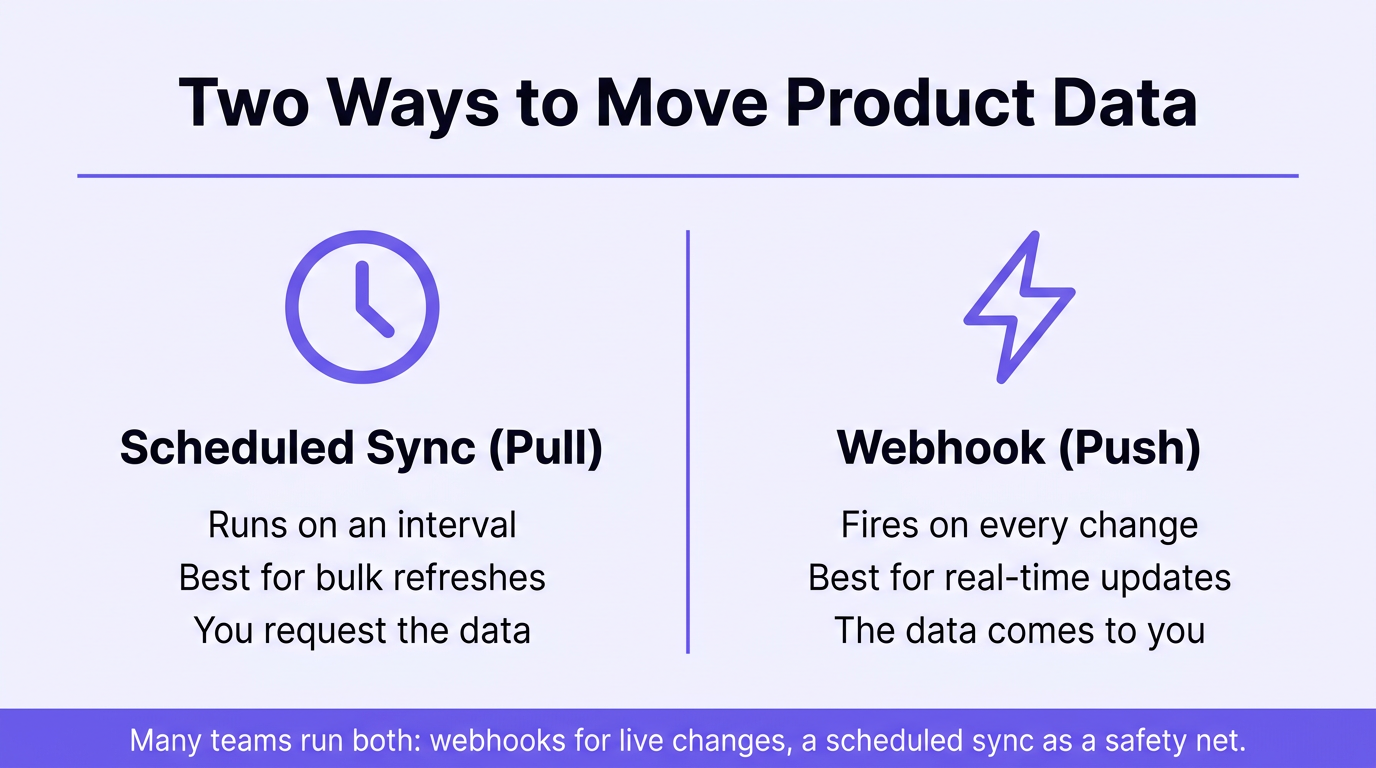
Once authentication and queries are settled, the next decision shapes everything downstream: how often data moves. Two patterns cover most ecommerce needs, and plenty of teams run both at the same time.
When Does Scheduled Catalog Sync Make Sense?
A scheduled job that pulls updates on an interval is the workhorse of catalog management. Run it nightly to refresh descriptions and images, or hourly for pricing in fast-moving categories. A reliable product catalog sync also needs a backfill plan: a full initial load, then incremental pulls that only fetch records changed since the last run.
Track the timestamp of your last successful sync so a missed window does not leave silent gaps in your data. Logging each run also makes it easy to replay a failed batch without re-pulling the entire catalog.
When Should You Use Webhooks Instead?
Polling for changes wastes resources when most checks return nothing new. A product data webhook flips the model: the provider pushes an update to your endpoint the moment a record changes, so you react in near real time. The efficiency gap is large. One analysis found that moving from frequent polling to webhooks can cut redundant network requests by roughly 98%.
To use a product data webhook safely, verify the signature on each incoming payload, respond quickly with a success status, and hand the work to a background queue so a slow job never blocks the next delivery.

How Can You Test a Product Data API Integration Before Writing Code?
The most expensive integration mistakes are the ones you find after shipping. The fastest way to avoid them is to explore the data and shape your queries before committing any code, and a visual portal makes that practical.
A visual web portal lets you browse the available fields, run sample queries, and see exactly what a response looks like for a given product, category, or merchant. You can confirm that the attributes you need are populated, check how values are formatted, and spot edge cases long before they reach your code. That turns integration from a guessing game into a series of confirmed assumptions.

This matters more than it sounds. When you can preview real responses, you design your data model around what the API actually returns rather than what the documentation implies. You build query filters interactively, copy the request structure into your application, and skip the trial-and-error loop of deploy, fail, adjust. For a team scoping a new product data API integration, that visibility can shave days off the first working build.
Pair the portal with clear, public documentation and onboarding stops being a bottleneck. Your developers read the field schema, test a query in the browser, and ship, without waiting on a sales call to learn how the API is even structured.
5 Patterns That Keep a Product Data API Integration Reliable
These habits separate an integration that quietly works from one that pages you in the middle of the night.
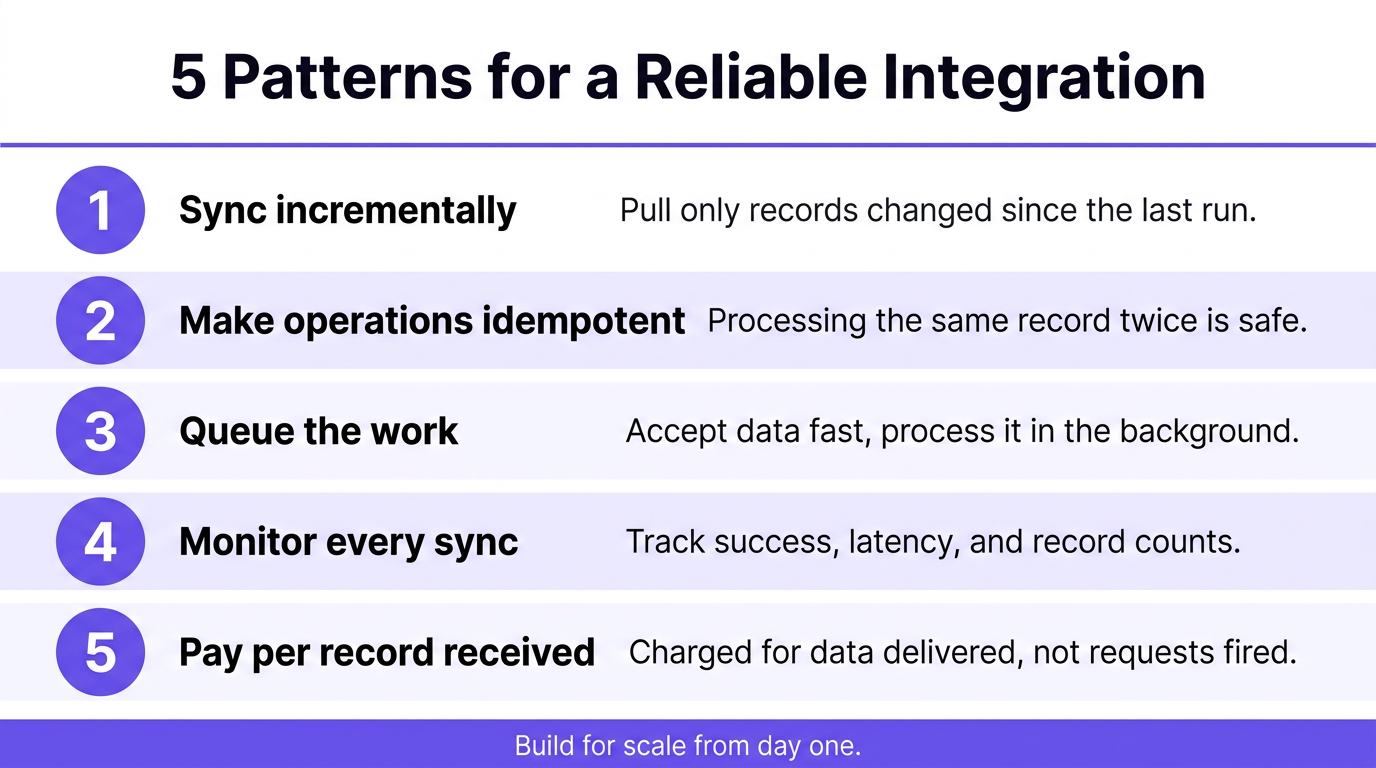
- Sync incrementally, not fully. Pull only the records changed since your last run to cut payload size and keep your product catalog sync fast and cheap.
- Make every operation idempotent. Design update logic so processing the same record or webhook twice produces the same result, which protects you from duplicate deliveries.
- Queue the work. Accept incoming data fast, then process it in a background worker so traffic spikes never overwhelm your endpoint.
- Monitor every sync. Track success rates, latency, and record counts so a silent failure surfaces right away instead of days later when your catalog is already stale.
- Pay for results, not attempts. A per-record model charges you for the data you actually receive rather than every query you fire, which keeps costs predictable as you scale.
What Commonly Slows Down an Integration?
Even a well-designed integration hits friction. Knowing where it usually shows up lets you build around it instead of reacting to it.
- Rate limits and throttling. Many providers cap requests per second, forcing you to add backoff and retry handling. An API without those caps removes that engineering burden entirely.
- Pagination and large result sets. Pulling millions of records calls for cursor-based pagination and careful memory handling, so stream results rather than loading everything at once.
- Inconsistent schemas. When fields change shape across sources, your mapping breaks. Consistent structure across records keeps that logic stable over time.
Each of these is manageable when you plan for it, and several disappear when the underlying API is built for scale from the start.
Frequently Asked Questions
What Is a Product Data API Integration?
It is the connection between your application and an external source of product information, set up so your systems pull or receive product details automatically. A solid integration handles authentication, keeps data current through sync or webhooks, and recovers from errors without manual cleanup.
Should I Use Webhooks or Scheduled Polling?
Use a product data webhook when you need near real-time updates and want to avoid wasted requests, since the provider pushes changes as they happen. Use scheduled polling for predictable bulk refreshes or when a system cannot accept inbound traffic. Many teams combine both, with webhooks for live changes and a periodic sync as a safety net.
How Do I Keep a Product Catalog Sync From Drifting?
Track the timestamp of your last successful run and pull only records changed since then. Run a periodic full reconciliation to catch anything an incremental job or webhook missed. Logging each sync makes it easy to spot and replay a failed window.
What Authentication Method Do Product Data APIs Use?
Most use an API key or a bearer token sent in the request header. The provider issues the credential, and you include it with each call to authorize the request. Separate keys for staging and production limit the damage if one is ever exposed.
How Do I Handle High Request Volume During an Ecommerce API Integration?
Queue incoming work, process it in background workers, and stream large result sets with pagination instead of loading them all at once. Choosing an API without strict rate limits also removes the need to build throttling logic just to stay under a cap.
Building an Integration That Lasts
Strong integrations come down to a handful of choices: secure authentication, queries scoped to what you actually need, the right mix of scheduled sync and webhooks, and a way to test before you build. Get those right and your catalog stays accurate while your engineers spend their time on features instead of firefighting.
Datafiniti gives ecommerce and data teams a visual portal to explore product data and build queries before writing code, plus clear public documentation, no rate limiting, and per-record pricing that keeps costs predictable. If you are scoping a new product data API integration, you can request a demo and see how the data fits your stack before you commit.
Read the latest articles

Read more

Best Product Catalog API for Online Retailers: Aggregating Multi-Retailer Catalogs

Build vs Buy: Business Data Enrichment for Growing Teams

Company Data API Pricing: Bulk & Enterprise-Scale Access

Best Business Data APIs for Sales Teams & Prospecting

Business Data API: Company Data at Enterprise Scale

How to Build a Product Database With a Product Data API

Property Data API Coverage: What U.S. Datasets Include

Product Data API for Ecommerce Price Monitoring and Repricing

Real-Time Product Data API for Product-Led Growth Teams

Property Ownership Data API for Skip Tracing and Lead Gen

How APIs Make Building a Product Database Easy
Learn how to build a product database with APIs for cleaner imports, updates, search, and scalable product data.

How to Leverage Competitor Pricing Data with an API
Use competitor pricing data to build API-driven monitoring, analysis, and smarter pricing decisions.

Price Monitoring API: The Key to E-Commerce Pricing Strategy
Use a price monitoring API to track market changes, improve pricing decisions, and protect ecommerce margins.

How do Product Data APIs Work for E-Commerce Companies?
Learn how a product data API works, from collection and queries to ecommerce integration and use cases.

GTIN Lookup API: Search Products by Barcode & UPC at Scale

Best Real Estate API 2026: Coverage, Pricing, Data Quality

Best Product Data API 2026: A State-of-the-Market Guide
Product Data API Integration Patterns for Ecommerce Platforms

Build a PropTech MVP With a Property Ownership Data API

How Real Estate Agents Can Leverage Proptech Data
Leverage proptech data to source leads, speed up valuations, and manage risk with accurate, real-time property insights.

What Is a UPC Lookup API?
Learn about the UPC lookup API, how it works, and its benefits for businesses. Get product data easily.

What Is a GTIN Lookup API?
Learn about the GTIN lookup API and how it can help your business grow. Get product data insights.

How Does a Property Data API Work?
Learn how a property data API works, its features, and how you can use it for real estate and business insights.

What The Best Real Estate APIs Should Have
Discover what makes the best real estate APIs stand out. Learn about essential features for your property data needs.

MLS Listings API: How to Access MLS Listing Data
.png)
How to Enrich Your Product Catalog With a Real-Time API
.jpeg)
Product Data API Buyer's Guide for Ecommerce Teams

Why Real Estate Tech Startups Need Property APIs with Ownership Details
Discover how property APIs with ownership details empower real estate tech startups. Learn about data integration, risk mitigation, and driving business value.
The Value of a Product Catalog Sync for Product Managers
Unlock the value of product catalog sync for product managers. Streamline data, improve decisions, and reduce costs with real-time insights.

What is a Product Data Webhook?
Learn about product data webhooks, their components, and how they enable real-time updates for business intelligence and workflow automation.

Why Is a Product Data API Integration Essential for Analysts & Product Managers?
Unlock insights with product data API integration. Essential for analysts & product managers to streamline data access & enhance product strategy.

What Is a Product Data API and Its Benefits
Learn about product data APIs, their benefits, and how they drive business growth. Explore integration and advanced use cases.

What Do eCommerce Data Vendors Do?
Learn what ecommerce data vendors do, their services, and how to choose the right one for your business growth.

How to Compare Product Data Providers: What to Look For
Compare product data providers. Learn what to look for in data quality, structure, and integration features.

How to Get Your Product Data in Real-Time Using APIs
Learn how to leverage real-time product data APIs for e-commerce, competitive analysis, and AI. Get instant access to clean, structured product data.

Best Product Data API: Features to Look for
Find the best product data API with real-time updates, comprehensive coverage, and a user-friendly portal. Explore features to look for.

Unlocking Property Data with an API
Access property data with a powerful property database API. Explore listings, market analysis, investment opportunities, and more. Get started today!

Unlocking CRE with APIs
Unlock commercial real estate insights with a powerful API. Access property data, streamline workflows, and enhance investment strategies.

How to Get a Real-Time Product Feed Using an API
Learn how to get a real-time product feed using an API. Access, leverage, and ensure accuracy of product data for your business needs.

Spying on Competitor Prices: What You Need to Know
Learn how to gather and analyze competitor pricing data to inform your business strategy. Understand key components and ethical considerations.

Product Data Enrichment: What Are You Missing?
Enhance your product data with comprehensive enrichment. Discover insights, drive growth, and choose the right approach for your business.
.png)
Real Estate API Pricing Models Explained: Subscription vs. Usage-Based

Real Estate API vs Web Scraping: The Buy-vs-Build Decision
.png)
Product Data APIs Explained: Powering Product Search and Catalog Automation

How to Get the Most out of a Product Catalog API
Learn how to leverage a product catalog API for business growth. Discover data quality, access methods, and strategy for your product catalog API.

Taming Your Ecommerce Product Data Feed
Optimize your ecommerce product data feed for growth. Learn strategies, leverage technology, and ensure data quality for better customer experience and AI initiatives.

Streamlining Your Product Search with an API
Explore the benefits and integration of a product search API. Streamline your product discovery and leverage data for business growth.

What Is a Real Estate Transaction Database? A Complete Guide
.png)
Commercial Real Estate API vs. Residential Property API
.png)
How to Choose a Real Estate Database API for Your MVP

Property Valuation API: Your Go-To Real Estate Tool
Leverage the property valuation API for real estate insights. Access comprehensive property data for diverse applications with Datafiniti.

Product Data APIs Explained
Learn about product data APIs explained. Discover how to access, integrate, and utilize product data for e-commerce, analytics, and more.

Unlocking Your Ecommerce Data with APIs
Unlock ecommerce data with APIs for business insights, product catalog enrichment, and competitive analysis. Explore data via portal or API.

Real Estate Ownership Data: How to Access, Analyze and Use at Scale
Access, analyze, and use real estate ownership data at scale. Learn how to find, process, and leverage this crucial information for business insights.

IDX vs MLS API: What Every Real Estate Professional Should Know

How a Property Database API Can Help Real Estate Pros
Learn how a property database API can help real estate pros analyze trends, monitor listings, and optimize strategies. Get data insights.

What Is a Residential Property API?
Explore what a residential property API is, its features, benefits, and real-world applications for real estate professionals and investors.

What Is a Commercial Real Estate API?
Explore commercial real estate API functionality, data integration, and use cases. Learn how to leverage property, business, and people data for insights.

Understanding MVP Data Integration
Learn about MVP data integration, its components, benefits, and strategies for accessing and utilizing data resources effectively.

How to Choose the Best Property Data API
Learn how to choose the best property data API. Explore features, providers, pricing, and integration for real estate insights.

How Do Product Data APIs Work?
Understand how a product data API works, its key features, integration methods, and applications for e-commerce and business intelligence.

How Do Data Aggregation Platforms Work?
Explore how data aggregation platforms work, their capabilities, and applications. Learn to choose and implement the right platform for your business intelligence needs.

Why Do Companies Need Property Data Aggregation?
Discover why property data aggregation is crucial for businesses. Streamline access, empower functions, enhance risk management, and drive strategic decisions with authoritative insights.

MLS Database API: How to Choose a Provider and Get Access

Product Search API vs. Product Data API: What's the Difference?

What Is a Product Data API?
Explore the functionality and benefits of a product data API. Learn how to integrate, leverage, and choose the right provider for your business insights.
What Is the Difference Between Product Search API and Product Data API?
Understand the difference between Product Search API and Product Data API. Learn how to leverage product data for business intelligence and analytics.

What Is a Property Data API?
Explore the capabilities of a property data API. Understand its core functionality, key features for developers, and how to access property information at scale for business insights.
.png)
Real Estate API Pricing: What You Need to Know Before You Build
.jpeg)
How to Choose a Property Market API for Investment Platforms
Choosing the right property market API is critical for investment platforms. Learn how to evaluate data depth, coverage, freshness, and integration quality before you commit.
Data you can trust, delivered in a format your systems can use, at the scale your product requires.