
.png)
How to Enrich Your Product Catalog With a Real-Time API
Key Takeaways
Product data enrichment is the process of filling missing or inconsistent attributes in a product catalog by pulling structured fields from an external data source, usually through an API call against a SKU, UPC, or GTIN.
- A real-time API turns enrichment from a quarterly cleanup project into a continuous, automated sync that runs every time a new SKU enters the catalog.
- Querying a product data API on a schedule, with each call scoped to records updated since the last sync, keeps catalogs current without standing up batch jobs that quickly fall out of date.
- Cross-merchant coverage and competitor pricing data are only as good as the underlying schema documentation, which is where most providers fall short.
- Per-record pricing models that charge only for data delivered are aligned with enrichment workflows in a way that per-request billing is not, since query attempts on missing SKUs add up fast.
If your catalog still depends on manual SKU cleanup, you are paying the cost of bad data twice: once in operations and again in returns.
Every ecommerce team eventually hits the same wall: the catalog grows faster than the team can clean it. New SKUs arrive from suppliers with half the required fields, titles are inconsistent, and categories are missing. Those gaps have real downstream cost. NRF and Happy Returns estimate that 19.3 percent of online sales will be returned in 2025, and incomplete or misleading product information is a well-documented contributor to that pressure. Product data enrichment is the practical fix, and accessing a structured product data source through a real-time API is what makes it scale.
This guide is for the ops leads and developers wiring up the integration. We will cover what enrichment really means at the API layer, what a real-time call looks like, how scheduled delta queries keep a catalog in sync, and how to evaluate a product catalog API before you commit.
What Is Product Data Enrichment in the Context of an API?
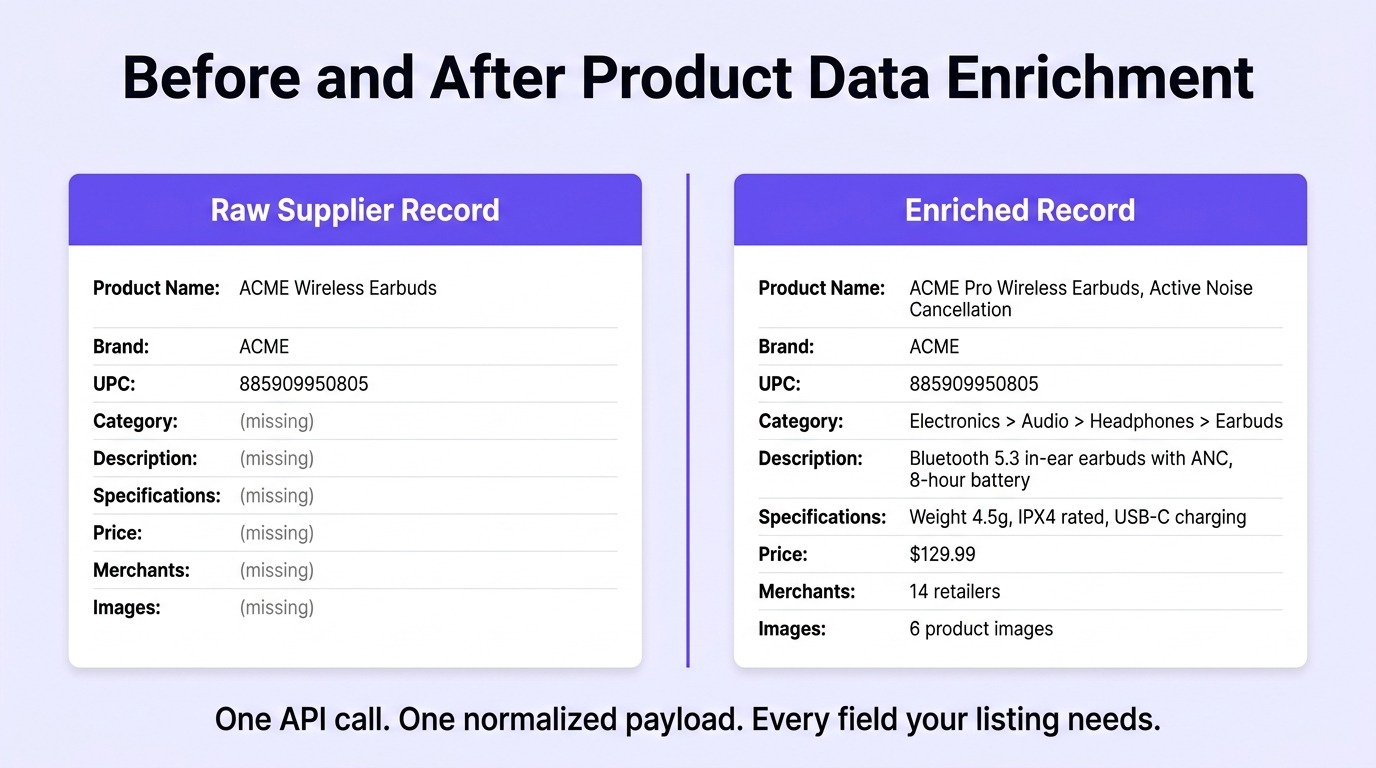
Product data enrichment is the process of completing, correcting, or extending attributes on a product record by pulling structured fields from an external data source. In a manual workflow, a merchandiser copies specs from a supplier PDF into a spreadsheet. In an API workflow, you send a SKU, UPC, GTIN, or model number and receive a normalized JSON payload with everything needed to populate the listing. At a million-SKU scale, the API approach inverts the work: every SKU gets the same baseline treatment automatically, and human review becomes the exception.
A capable product data API returns three layers in one call. The core record gives you title, description, brand, manufacturer part number, primary category, and current pricing. The attribute set provides the specs shoppers filter by: dimensions, weight, material, color variants, and compatibility. The cross-merchant context shows how a single SKU is sold elsewhere, with pricing, availability, and review counts. That third layer is where competitor pricing data becomes actionable rather than aspirational.
What Does a Real-Time Enrichment API Call Look Like?
The simplest pattern is a synchronous request and response. Your application sends a product identifier and a set of requested fields. The API queries its product index, normalizes the matched records against its schema, and returns the payload, typically in well under a second. The exact syntax varies by provider, but the shape is consistent: authentication header, an identifier, and a field selector. The mechanics of retrieving a real-time product feed through this kind of call are similar across providers, though the schema quality and documentation transparency vary widely.
curl -X POST 'https://api.datafiniti.co/v4/products/search' \
-H 'Authorization: Bearer YOUR_API_TOKEN' \
-H 'Content-Type: application/json' \
-d '{
"query": "upc:885909950805",
"num_records": 1,
"fields": ["name", "brand", "manufacturer", "primary_categories", "features", "prices", "merchants", "images"]
}'
The response is a structured JSON object containing the requested fields. Here is roughly what it looks like:
{
"num_found": 1,
"records": [
{
"name": "ACME Pro Wireless Earbuds, Active Noise Cancellation",
"brand": "ACME",
"manufacturer": "ACME Audio Inc.",
"primary_categories": ["Electronics", "Audio", "Headphones"],
"features": [
{"key": "Connectivity", "value": ["Bluetooth 5.3"]},
{"key": "Battery Life", "value": ["8 hours"]},
{"key": "Water Resistance", "value": ["IPX4"]}
],
"prices": [
{"merchant": "Retailer A", "amountMin": 129.99, "currency": "USD", "dateSeen": "2026-01-14T08:22:00Z"},
{"merchant": "Retailer B", "amountMin": 124.50, "currency": "USD", "dateSeen": "2026-01-14T11:05:00Z"},
{"merchant": "Retailer C", "amountMin": 134.99, "currency": "USD", "dateSeen": "2026-01-14T09:47:00Z"}
],
"merchants": ["Retailer A", "Retailer B", "Retailer C"],
"images": [
"https://cdn.example.com/products/885909950805_01.jpg",
"https://cdn.example.com/products/885909950805_02.jpg"
]
}
]
}
Your application maps these fields into your own schema, validates them, and writes the result to your catalog database or PIM. When the API returns multiple merchant records for the same UPC, as in the example above, you decide whether to keep the lowest current price, the average, or all of them as a price history. The API delivers the data; the policy is yours. This pattern works for on-demand work the moment a SKU is created. For larger catalogs and ongoing sync, firing a one-off query every time something changes gets expensive fast.
How Do You Keep an Enriched Catalog in Sync Over Time?
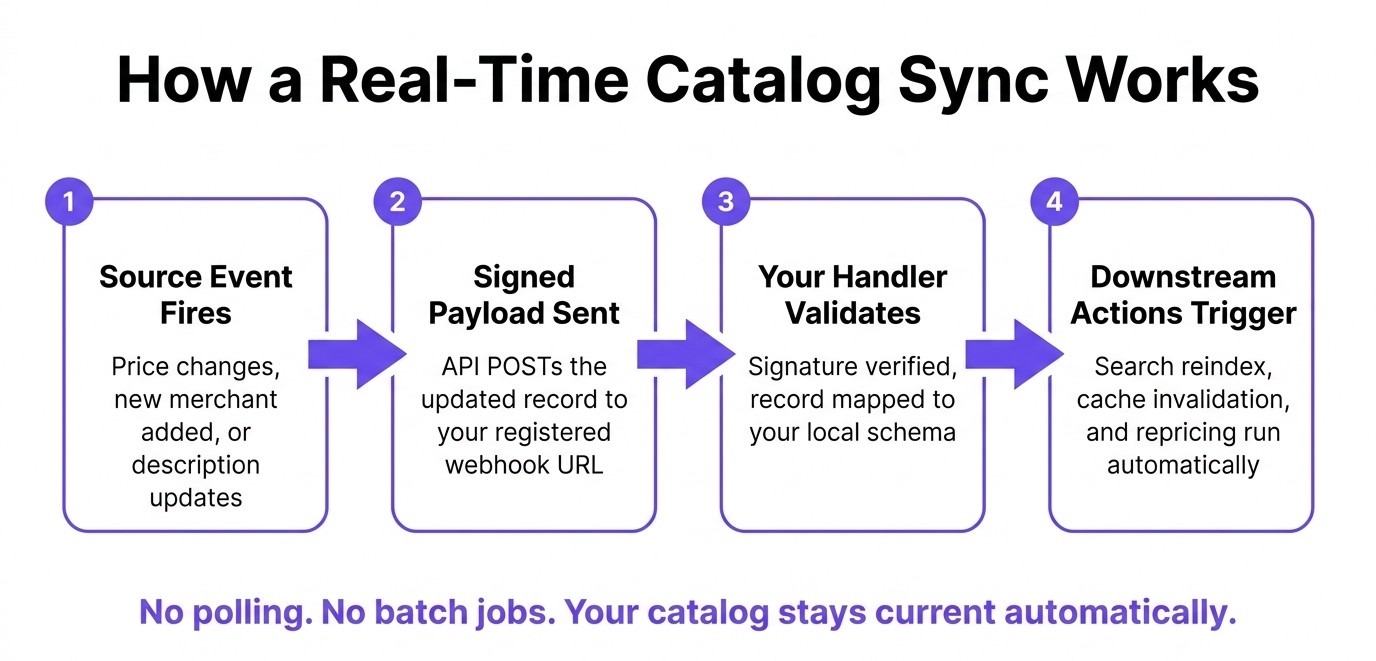
A single fast call solves the moment a SKU is created. The harder question is how to keep that record current as prices shift, new merchants pick up the product, and descriptions evolve. The cleanest pattern is scheduled querying scoped to recent changes, which keeps your catalog fresh without standing up a batch pipeline that breaks overnight.
The mechanic is straightforward. Each sync run queries the product data API for records updated since your last successful pull, using a date filter on the record's last modified timestamp.
The API returns only the SKUs that changed, your handler maps them into your local schema, and downstream processes like search reindex, cache invalidation, or repricing run automatically against the delta. Compared to refreshing the entire catalog on a fixed schedule, this approach moves an order of magnitude less data per run and keeps the catalog within minutes of the source.
Here is what the delta query looks like in practice:
curl -X POST 'https://api.datafiniti.co/v4/products/search' \
-H 'Authorization: Bearer YOUR_API_TOKEN' \
-H 'Content-Type: application/json' \
-d '{
"query": "dateUpdated:[2026-01-15T00:00:00 TO *] AND brand:ACME",
"num_records": 1000,
"fields": ["upc", "name", "prices", "merchants", "dateUpdated"]
}'
Schedule that call as often as your use case demands. Catalog managers running pricing intelligence often pull every fifteen minutes for high-velocity SKUs and hourly for the long tail. The point is that "real-time" in a catalog context rarely means "instantaneous to the millisecond." It means current enough that the pricing engine, search index, and product detail pages all reflect the same truth at any given moment.

Why Documentation Quality Decides Your Integration Timeline
The single most underrated factor in choosing a product catalog API is documentation quality. The Postman 2025 State of the API Report, which surveyed more than 5,700 developers, identifies documentation debt as a persistent industry pain point that has not gone away despite years of tooling investment. For enrichment workflows, where the schema is the integration, this is the whole project. Most product data providers treat their docs as a sales asset. You see a feature page that lists capabilities but never shows a schema. To get the field list, the query syntax, or the rate behavior, you have to talk to someone. By the time a developer has finished that loop, they have lost a week and learned nothing they could not have read in an hour from a public reference.
Strong documentation does the opposite. Every queryable field is listed with its data type, example values, and source coverage. Endpoints have working request and response examples. Query syntax, filter operators, and pagination rules are spelled out. Rate behavior is explicit rather than hinted at.
A developer can read the docs, write an integration in a sandbox, and ship to production before a sales meeting would have been scheduled. Public documentation also matters for AI coding assistants, since modern integrations are increasingly drafted with tools that read the API spec directly. Open docs are now an AI-readability requirement as much as a developer-experience nicety.
Six Questions to Ask Before Picking a Product Data Enrichment Provider
Before you commit to any vendor, run through this checklist. Each item maps to a real integration risk that surfaces only after the contract is signed.
- Can you see the full field schema without a sales call? If field-level coverage is hidden behind a gated portal, the integration will take longer than the vendor promised. Public schemas are non-negotiable.
- What identifier types does the API accept? UPC, GTIN, ASIN, MPN, ISBN, and brand-plus-model strings each have different match rates. A capable API accepts all of them and returns the same normalized record.
- How many merchants are represented per SKU? Single-merchant enrichment is just a catalog lookup. Multi-merchant coverage gives you competitor pricing data and availability across the open web.
- Is there a rate limit? A provider that caps requests per second forces you to build queuing and retry logic into every catalog process. No throttling lets you run enrichment at your own infrastructure's pace.
- How is pricing structured? Per-request billing charges you for every call, including empty ones during testing. Per-record billing only charges for the data you actually receive, aligning cost with value.
- Can you explore data before writing code? A visual web portal that lets your team query the dataset and verify field coverage before any developer writes code shortens evaluation from weeks to an afternoon.
Where a Real-Time Product Feed Pays for Itself
The strongest ROI cases for product data enrichment cluster around a few specific use patterns that ecommerce teams are running today.
Catalog repair after supplier onboarding is the most common. Retailers who acquire inventory from many suppliers receive product feeds in every imaginable format and quality level. An enrichment call on each incoming SKU fills the gaps automatically against a normalized schema, so the catalog reaches publishable quality without weeks of manual cleanup.
Competitive pricing intelligence is the second pattern. Pricing teams that previously stitched together coverage from Amazon-only tools, scraping scripts, and manual checks can run their entire repricing pipeline off a single product data feed. Cross-merchant prices come back in the same payload as the product record itself, and a real-time product feed keeps them current as the market shifts.
Reducing returns is the third. Online return rates run significantly higher than in-store rates, and incomplete or misleading product information is a persistent contributor. Listings missing dimensions, materials, compatibility data, or fit notes generate more returns than listings with complete attribute coverage. Enrichment closes that gap at the catalog layer rather than waiting for customer service to absorb the cost downstream.
Frequently Asked Questions
What Is the Difference Between a Product Data API and a Product Catalog API?
The terms get used interchangeably, but there is a useful distinction. A product catalog API typically refers to the storefront-side interface that lets you create, update, and read products inside your own commerce platform. A product data API refers to an external data infrastructure that returns normalized product records from millions of SKUs across many brands and retailers. Enrichment workflows use the second type to populate the first.
How Often Should I Re-Enrich an Existing Product?
It depends on which fields you care about. Static specs like dimensions or part numbers rarely change once a product is on the market. Pricing, availability, and merchant coverage change constantly and should be refreshed through frequent delta queries scoped to recently updated records. Description and categorization fields fall somewhere in between, and most teams refresh those weekly.
Does Product Data Enrichment Work for Long-Tail or Niche SKUs?
It depends on the breadth of the underlying dataset. A provider that indexes hundreds of millions of records across thousands of merchants will match long-tail SKUs that a smaller catalog would miss. Run a sample list of your hardest-to-match SKUs against a provider's portal or sandbox before committing. Coverage on common products is easy; coverage on long-tail products is the real test.
Can I Use an Enrichment API to Monitor Competitor Pricing?
Yes, and this is one of the highest-leverage use cases. A structured product feed returns merchant-level pricing alongside the core product record, so you can build a continuous pricing intelligence loop without standing up a scraping operation. Pair the data with a repricing engine and you have a closed loop that responds to market shifts in minutes rather than days.
What Identifier Should I Use When My Suppliers Send Inconsistent SKU Data?
Start with whatever standard identifier is available: UPC, GTIN, ASIN, MPN, or ISBN. When suppliers send only proprietary SKUs, query by brand plus model number as a fallback, then store the matched UPC back to your record so future calls are direct. A capable API will accept all of these identifier types and return the same normalized payload, which is the easier path than building your own SKU normalization layer.
Building a Catalog That Maintains Itself
Product data enrichment used to mean a quarterly cleanup project that everyone dreaded. With a real-time API and a scheduled delta-query sync pattern, it becomes the opposite: a catalog that maintains itself. New SKUs get enriched on arrival. Existing SKUs stay current as the underlying market shifts. Your team's effort moves from manual repair to strategic decisions about which fields to surface and how to merchandise them.
The integration decision comes down to two questions. Can you actually see the data and the docs before you commit, or are you signing up for a sales-led discovery cycle? And can the API keep up with your catalog scale without throttling you into batch-and-pray workflows?
Datafiniti's product data API gives developers public documentation, a visual portal to query records before writing integration code, per-record pricing that only charges for the data you receive, and no rate limits on enrichment workloads. Request a demo to see how a real-time enrichment workflow looks against your own catalog.
Read the latest articles

Read more

Business Data API: Company Data at Enterprise Scale

How to Build a Product Database With a Product Data API

Property Data API Coverage: What U.S. Datasets Include

Product Data API for Ecommerce Price Monitoring and Repricing

Real-Time Product Data API for Product-Led Growth Teams

Property Ownership Data API for Skip Tracing and Lead Gen

How APIs Make Building a Product Database Easy
Learn how to build a product database with APIs for cleaner imports, updates, search, and scalable product data.

What Is Property Transaction Data and How Does an API Help Get It?
Learn how property transaction data works and how APIs provide structured access for analysis and workflows.

How to Use Real Estate Transaction Data
Learn how to use real estate transaction data for analysis, valuation, underwriting, and market decisions.

How to Leverage Competitor Pricing Data with an API
Use competitor pricing data to build API-driven monitoring, analysis, and smarter pricing decisions.

Price Monitoring API: The Key to E-Commerce Pricing Strategy
Use a price monitoring API to track market changes, improve pricing decisions, and protect ecommerce margins.

How do Product Data APIs Work for E-Commerce Companies?
Learn how a product data API works, from collection and queries to ecommerce integration and use cases.

Bulk Real Estate Data Licensing: Access Datasets at Scale

How to Integrate MLS Listings Using an MLS Data API

GTIN Lookup API: Search Products by Barcode & UPC at Scale

Best Real Estate API 2026: Coverage, Pricing, Data Quality

Best Product Data API 2026: A State-of-the-Market Guide

Product Data API Integration Patterns for Ecommerce Platforms

Build a PropTech MVP With a Property Ownership Data API

3 Benefits of Web Scraping for Real Estate
Boost your research by using web scraping for real estate to gain market insights, automate lead lists, and minimize property risk.

How Real Estate Agents Can Leverage Proptech Data
Leverage proptech data to source leads, speed up valuations, and manage risk with accurate, real-time property insights.
What Is a UPC Lookup API?
Learn about the UPC lookup API, how it works, and its benefits for businesses. Get product data easily.

What Is a GTIN Lookup API?
Learn about the GTIN lookup API and how it can help your business grow. Get product data insights.

How Does a Property Data API Work?
Learn how a property data API works, its features, and how you can use it for real estate and business insights.

What The Best Real Estate APIs Should Have
Discover what makes the best real estate APIs stand out. Learn about essential features for your property data needs.

The Benefits of a Real Estate MLS API
Learn about the benefits of a real estate MLS API for streamlining data access and driving business growth.

Why Every Real Estate Pro Needs an MLS Database API
Learn why a MLS database API is vital for real estate pros. Get data, insights, and competitive edge.
How to Access MLS Listing Data
Learn how to access MLS listing data using an MLS data API. Discover Datafiniti's solutions and integration tips.
How to Enrich Your Product Catalog With a Real-Time API
.jpeg)
Product Data API Buyer's Guide for Ecommerce Teams

Do I Need a Real Estate Listing API?
Explore the benefits and technicalities of a real estate listing API. Learn how to choose the right provider and integrate data for business growth.

Unlocking the MLS Database with APIs
Unlock the MLS database with APIs. Learn how to access property data, gain real estate insights, and integrate MLS data for your business needs.

Why Real Estate Tech Startups Need Property APIs with Ownership Details
Discover how property APIs with ownership details empower real estate tech startups. Learn about data integration, risk mitigation, and driving business value.
The Value of a Product Catalog Sync for Product Managers
Unlock the value of product catalog sync for product managers. Streamline data, improve decisions, and reduce costs with real-time insights.

What is a Product Data Webhook?
Learn about product data webhooks, their components, and how they enable real-time updates for business intelligence and workflow automation.

Why Is a Product Data API Integration Essential for Analysts & Product Managers?
Unlock insights with product data API integration. Essential for analysts & product managers to streamline data access & enhance product strategy.

What Is a Product Data API and Its Benefits
Learn about product data APIs, their benefits, and how they drive business growth. Explore integration and advanced use cases.

What Do eCommerce Data Vendors Do?
Learn what ecommerce data vendors do, their services, and how to choose the right one for your business growth.

How to Compare Product Data Providers: What to Look For
Compare product data providers. Learn what to look for in data quality, structure, and integration features.

How to Get Your Product Data in Real-Time Using APIs
Learn how to leverage real-time product data APIs for e-commerce, competitive analysis, and AI. Get instant access to clean, structured product data.

Best Product Data API: Features to Look for
Find the best product data API with real-time updates, comprehensive coverage, and a user-friendly portal. Explore features to look for.

Unlocking Property Data with an API
Access property data with a powerful property database API. Explore listings, market analysis, investment opportunities, and more. Get started today!

Unlocking CRE with APIs
Unlock commercial real estate insights with a powerful API. Access property data, streamline workflows, and enhance investment strategies.

How to Get a Real-Time Product Feed Using an API
Learn how to get a real-time product feed using an API. Access, leverage, and ensure accuracy of product data for your business needs.

Spying on Competitor Prices: What You Need to Know
Learn how to gather and analyze competitor pricing data to inform your business strategy. Understand key components and ethical considerations.

Product Data Enrichment: What Are You Missing?
Enhance your product data with comprehensive enrichment. Discover insights, drive growth, and choose the right approach for your business.
.png)
IDX vs MLS API: A Developer's Guide to Real Estate Listing Data
.png)
Real Estate API Pricing Models Explained: Subscription vs. Usage-Based

Real Estate API vs Web Scraping: Which Wins in 2026?
.png)
Product Data APIs Explained: Powering Product Search and Catalog Automation

Best Sources for Bulk Real Estate Transaction Data

How to Get the Most out of a Product Catalog API
Learn how to leverage a product catalog API for business growth. Discover data quality, access methods, and strategy for your product catalog API.

Taming Your Ecommerce Product Data Feed
Optimize your ecommerce product data feed for growth. Learn strategies, leverage technology, and ensure data quality for better customer experience and AI initiatives.

Streamlining Your Product Search with an API
Explore the benefits and integration of a product search API. Streamline your product discovery and leverage data for business growth.
.png)
Real Estate Transaction Databases: What You Need to Know
.png)
Best MLS API for Real Estate Software: What Developers Need

How Real Estate Platforms Access MLS Database APIs
.png)
Commercial Real Estate API vs. Residential Property API
.png)
How to Choose a Real Estate Database API for Your MVP
MLS API vs. IDX: What's the Diff?
MLS API vs IDX: Explore the differences in real estate data access, retrieval, and integration. Understand which solution fits your needs.

Scraping vs. APIs: Getting Real Estate Data
Compare web scraping vs real estate API for data acquisition. Learn the pros, cons, and best use cases for each method.

Cracking the Code: Housing Sales Insights
Unlock housing sales analytics insights with Datafiniti. Explore property data, market trends, and advanced techniques for strategic decisions.

Property Valuation API: Your Go-To Real Estate Tool
Leverage the property valuation API for real estate insights. Access comprehensive property data for diverse applications with Datafiniti.

Product Data APIs Explained
Learn about product data APIs explained. Discover how to access, integrate, and utilize product data for e-commerce, analytics, and more.

Unlocking Your Ecommerce Data with APIs
Unlock ecommerce data with APIs for business insights, product catalog enrichment, and competitive analysis. Explore data via portal or API.

Your Guide to Housing Sales APIs
Explore housing sales API data for insights. Access property data, integrate into applications, and gain business intelligence. Get started today!

Real Estate Ownership Data: How to Access, Analyze and Use at Scale
Access, analyze, and use real estate ownership data at scale. Learn how to find, process, and leverage this crucial information for business insights.

Unlocking Opportunities: Navigating Bulk Real Estate Transaction Data
Unlock opportunities with bulk real estate transaction data. Learn how to access, analyze, and leverage property data for investing, marketing, and more.
What Is a Property Sales Database?
Explore what a property sales database is, its core components, how to access data, and key use cases for real estate analysis and more.

Benefits of Obtaining Housing Transaction Data
Unlock insights with housing transaction data. Analyze markets, investments, sales, and risk. Get comprehensive property data for informed decisions.

Understanding Real Estate Transaction Databases
IDX vs MLS API: What Every Real Estate Professional Should Know
Understand IDX vs MLS API differences. Learn about data access, integration, and how Datafiniti's solutions empower real estate professionals.

What Is an MLS Database API?
Explore the MLS database API: understand its components, benefits, and how to access real estate data for various applications. Learn about its core functionality and technical aspects.

How a Property Database API Can Help Real Estate Pros
Learn how a property database API can help real estate pros analyze trends, monitor listings, and optimize strategies. Get data insights.

What Is a Residential Property API?
Explore what a residential property API is, its features, benefits, and real-world applications for real estate professionals and investors.

What Is a Commercial Real Estate API?
Explore commercial real estate API functionality, data integration, and use cases. Learn how to leverage property, business, and people data for insights.

Understanding MVP Data Integration
Learn about MVP data integration, its components, benefits, and strategies for accessing and utilizing data resources effectively.

How to Choose the Best Property Data API
Learn how to choose the best property data API. Explore features, providers, pricing, and integration for real estate insights.

Real Estate Database API: What to Look for
Explore real estate database API options. Learn about data quality, features, and how to choose the right provider for your needs.
.png)
Real Estate Transaction Database: An API Access Guide

How Do Product Data APIs Work?
Understand how a product data API works, its key features, integration methods, and applications for e-commerce and business intelligence.

How Do Data Aggregation Platforms Work?
Explore how data aggregation platforms work, their capabilities, and applications. Learn to choose and implement the right platform for your business intelligence needs.

Why Do Companies Need Property Data Aggregation?
Discover why property data aggregation is crucial for businesses. Streamline access, empower functions, enhance risk management, and drive strategic decisions with authoritative insights.

MLS API: The Complete Guide to Accessing MLS Listing Data

Product Search API vs. Product Data API: What's the Difference?

What Are the Best MLS Data API Features to Look For?
Discover the best MLS data API features, including real-time updates, bulk downloads, and flexible filtering for property data.

What Is a Product Data API?
Explore the functionality and benefits of a product data API. Learn how to integrate, leverage, and choose the right provider for your business insights.
What Is the Difference Between Product Search API and Product Data API?
Understand the difference between Product Search API and Product Data API. Learn how to leverage product data for business intelligence and analytics.

Guide to Accessing Real Estate Transaction Database Via API
Access real estate transaction data via API. Explore property insights, sales, underwriting, and advanced applications with our authoritative guide.

Is a Real Estate MLS API Beneficial?
Explore the benefits of a real estate MLS API for enhanced data access, streamlined workflows, and market responsiveness. Learn about key features and use cases.

What is an MLS Database API?
Explore the MLS database API for comprehensive property data access. Learn about its core functionality, key features, and integration into real estate technology.

What Is a Property Data API?
Explore the capabilities of a property data API. Understand its core functionality, key features for developers, and how to access property information at scale for business insights.
.png)
Real Estate API Pricing: What You Need to Know Before You Build
.jpeg)
How to Choose a Property Market API for Investment Platforms
Choosing the right property market API is critical for investment platforms. Learn how to evaluate data depth, coverage, freshness, and integration quality before you commit.
Data you can trust, delivered in a format your systems can use, at the scale your product requires.