

Best Property Data API Platforms for U.S. Real Estate: A Buyer's Comparison
Key Takeaways
The best property data API platforms for U.S. real estate are the ones you can verify against your own markets before you sign.
- Vendors fall into five archetypes, and each one fails a different kind of buyer in a predictable way.
- Public documentation is the fastest early filter. If you can't see the query structure without a sales call, expect the integration to drag too.
- Proptech teams need breadth across property types, fintech teams need consistent fields and throughput, and enterprise teams need national coverage under one agreement.
- Most shortlists are decided by questions buyers forget to ask, like how duplicates are resolved and what exit looks like.
Shortlist two vendors, run the same address sample through both, and let the results decide.
A property data API gives software teams programmatic access to U.S. property records, returned as structured, ready-to-query property data your application can use directly. A typical record covers location, characteristics like year built and square footage, tax assessment, ownership, sale history, and listing status. Choosing among the best property data API platforms for U.S. real estate comes down to which vendor covers your markets with the fields your product depends on at a cost that scales with you.
That target keeps moving. According to the latest Census Bureau housing stock estimates, the country had 148.3 million housing units in 2025, 1.4 million more than a year earlier, with the fastest growth in Idaho (2.1%), Arizona (2.0%), and South Carolina (1.9%). A vendor with thin coverage in fast-growing markets can look fine in a demo and fall apart where your users actually are.
What Defines the Best Property Data API Platforms for U.S. Real Estate?
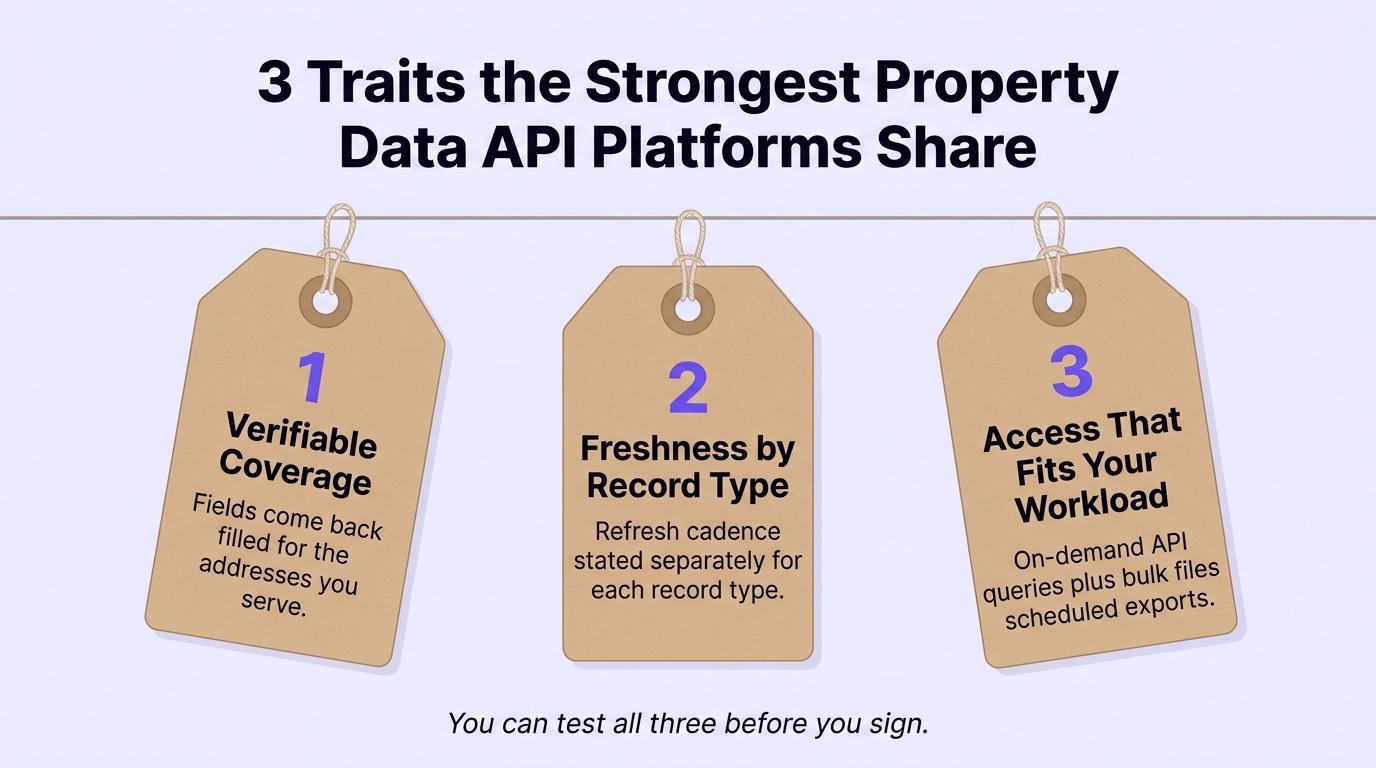
The strongest platforms share three traits: field-level coverage in the markets you serve, refresh cadence stated per record type, and an access model that fits your workload. You can test all three before you sign.
Coverage You Can Verify in Your Own Markets
Coverage is good enough when the fields your product needs come back filled for the addresses you serve. A large national record count can hide thin, stale, or missing coverage in your counties.
The number to measure is fill rate, the share of records in your geography that return each field you rely on. Fill rate is also where the best property data API platforms for U.S. real estate separate from the rest. Pull 200 to 500 of your own addresses, including rural parcels and new construction, and score fill rate on fields like year built, square footage, last sale date, and assessed value. For a field-by-field look at what U.S. datasets typically contain, see Property Data API Coverage.
Freshness That Matches the Record Type
A strong vendor states refresh cadence separately for each record type instead of promising that everything is "updated regularly." Listing status moves fastest, while assessor data usually changes only when a county completes its assessment cycle.
Ask two direct questions. How long after a listing goes pending does the API reflect it? How often are off-market records refreshed? A vague answer usually means the slowest cadence applies everywhere.
An Access Model That Matches Your Workload
Choose a vendor that supports both on-demand API queries and bulk delivery because most teams end up needing both. Some products look up one address at a time, while others load a full state into a warehouse every week.
A capable property data API handles lookups and enrichment on demand, plus bulk files and scheduled exports for large backfills. If a vendor offers only one path, you'll end up building the other yourself. Check the billing unit while you're at it: per-request pricing charges you for lookups that come back empty, and per-record billing doesn't.
What Kinds of Property Data API Vendors Will You Compare?
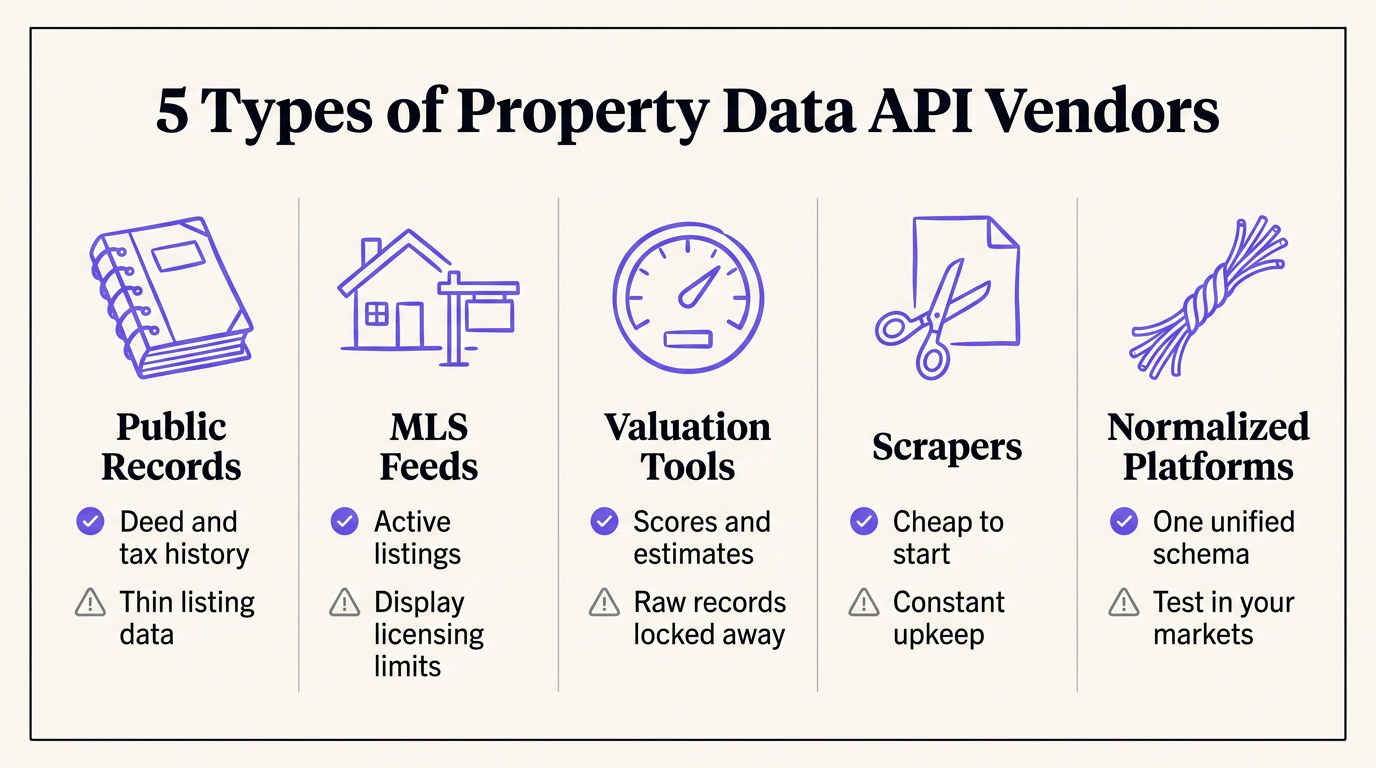
You'll usually compare five kinds of vendors, each built for a different job. Sorting your shortlist by archetype first keeps you from comparing a valuation engine to a listings feed.
- Public-record aggregators. Deep assessor, deed, and mortgage history. Listing activity is often thin or sold separately.
- Listing and MLS feeds. Strong on active inventory and status changes, but governed by licensing rules that restrict display and reuse. Off-market properties fall outside their scope by definition.
- Valuation and analytics specialists. Built around automated valuations and risk scores, with the underlying records often locked behind the model.
- Scraping tools. Cheap to start and fragile to run. You own the parsing, the maintenance, and every layout change on the source site.
- Multi-source normalized platforms. These vendors blend public records, listing data, and other feeds into one schema. The real test is whether that normalization holds up in your markets.
Most products need two of these capabilities, usually parcel-level records plus listing activity. Listing data is the more fragmented half: RESO counts 484 functioning MLS systems in the United States, and each one licenses its data under its own terms. If listings drive your product, Accessing MLS Listing Data walks through those licensing questions in detail.
Why Is Public Documentation the Best Early Filter for Property Data API Vendors?
Public documentation is the best early filter because it's the only part of a vendor you can evaluate on day one, and it predicts how the integration will go. Among the best property data API platforms for U.S. real estate, open docs are also the clearest sign that the vendor expects engineers, not procurement, to make the call.
Documentation problems are common across the industry. In Postman's 2025 State of the API Report, which surveyed more than 5,700 developers and API professionals, 55% of respondents said they struggle with inconsistent API documentation. In property data, it gets worse when providers gate field dictionaries, query syntax, and coverage details until you've booked a call.
What Complete Documentation Answers Before a Sales Call
Complete documentation lets your engineers scope the integration without a meeting. Look for four things: a full field dictionary with data types, query syntax with filter examples, sample responses with real records, and a documented approach to incremental updates.
Pay attention to what's missing too. Docs that describe endpoints but never show a real response often mean the response shape varies by source. Docs that skip error behavior mean you'll discover it in production.
What Gated Documentation Costs Your Team
Gated documentation costs you time and visibility. When query structure only appears after a demo, your evaluation runs on the vendor's calendar, and every question becomes an email thread.
Gated docs also hide change history. If you can't see how a provider communicates schema changes today, you can't predict how many surprises you'll absorb after launch. Treat "docs available on request" as a signal about how the relationship will run.
How Do the Best Property Data API Platforms for U.S. Real Estate Fit Your Team?
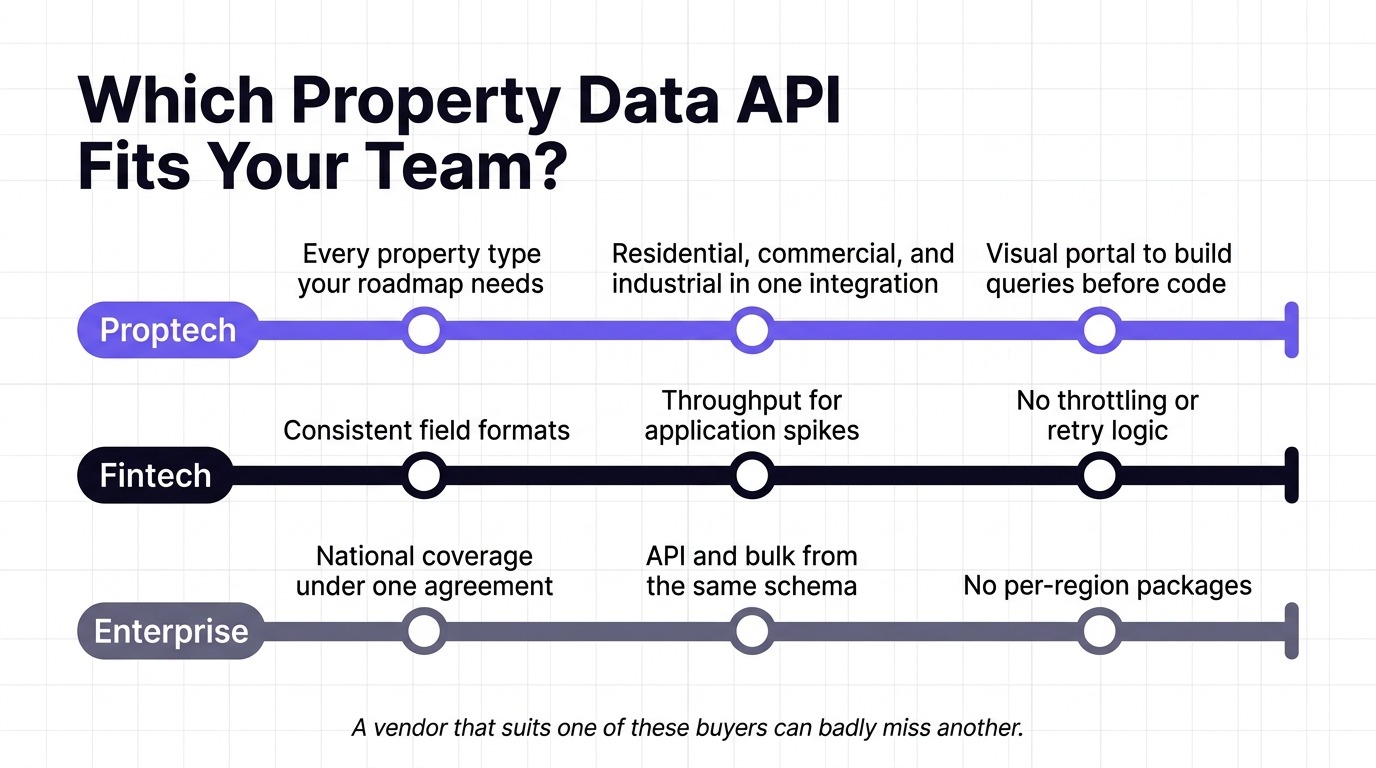
Proptech teams should prioritize property type range, fintech teams should prioritize consistency and throughput, and enterprise teams should prioritize one national contract. A vendor that suits one of these buyers can badly miss another.
Property Data API for Proptech Products
A property data API for proptech should cover every property type your roadmap will need, including multifamily, land, and commercial parcels. Teams that launch with a residential-only provider often hit a wall when users ask for those records, and switching vendors at that point means rewriting the integration.
Picking a provider that covers residential, commercial, and industrial records under one integration future-proofs the product before that request arrives. And because proptech teams ship in small increments, a visual web portal for exploring records and building queries before writing code shortens the path to a working feature.
Property Data API for Fintech and Lending
A property data API for fintech needs consistent field formats and enough throughput to absorb application spikes. It feeds automated decisions like collateral checks, fraud screens, pre-qualification, and portfolio monitoring. If one property type is coded two different ways, a decision engine can't recover gracefully.
Throughput is the second constraint. Providers that cap requests per second force your team to build throttling logic and retry handling just to stay inside the limits. An API with no rate limiting removes that engineering entirely.
Property Data for Enterprise Data Teams
Enterprise teams need full national coverage under one agreement, delivered by API and in bulk from the same schema. They usually evaluate property data API vendors for several use cases at once, from underwriting to site selection.
Their biggest hidden cost is contractual. Vendors that sell coverage by region or metro force separate packages and multiple contracts, and every new market becomes another procurement cycle.
7 Questions to Ask Property Data API Vendors Before You Sign
These seven questions expose the problems feature lists hide, whether you're comparing the best property data API providers in the USA or down to two finalists.
- Can we test with our own addresses? A trial on vendor-picked samples proves little. Measure match rate and field fill on your own list.
- How are duplicate records resolved? Blended sources can return the same parcel under two addresses. Ask how duplicates are merged and which identifier stays stable across updates.
- What happens when a county changes its format? Ask how quickly the normalized schema absorbs source changes and whether you'll see gaps in the meantime.
- How are schema changes communicated? Look for a public changelog and advance notice before fields are renamed or retired. Postman's survey found only 26% use semantic versioning, so don't assume it.
- What are the display and storage limits? Some data can't be shown to end users or cached past a set window, so know the rules before designing your interface.
- How should we keep records current? Ask for the recommended sync pattern. Scheduled delta queries that pull only records updated since your last sync scale cleanly, while full re-pulls get expensive fast.
- What does exit look like? Confirm you can export your full history in a standard format if you ever switch providers.
A vendor that answers all seven clearly and in writing is usually one you can build on for years.
Frequently Asked Questions
Who Are the Best Property Data API Providers in the USA?
The best property data API providers in the USA for your team are the ones whose coverage, fields, and freshness hold up on your own addresses. Documentation that your engineers can read without a sales call is the next filter. Shortlist two vendors from the archetype that matches your product and compare them on identical inputs.
What Data Does a Property Data API Include?
Most property data APIs return location, physical characteristics, tax assessment, ownership, transaction history, and listing activity for each property. Depth varies by vendor and county. Check whether commercial, industrial, and land parcels use the same schema as residential records.
How Much Does a Property Data API Cost?
Cost depends more on the billing unit and your match rate than on the headline price. Suppose 30% of a 10,000-address batch returns no match. Per-request billing charges for all 10,000 calls, while per-record billing charges for the 7,000 records you received. Model cost with your real match rate from a trial.
Can I Use Free Public Property Data Instead of a Paid API?
Free public data works for research across a handful of counties, but it rarely holds up at national scale. Assessor sites use different formats in every jurisdiction, and normalizing them nationwide typically costs more engineering time than licensing an API.
How Long Does It Take to Integrate a Property Data API?
Integration time depends more on documentation quality and your own data model than on the API itself. With public docs and a trial account, your team can validate fields before writing production code. Timelines stretch when field definitions are unclear or the schema needs heavy mapping to yours.
Choosing a Property Data API Platform You Won't Outgrow
Choose the platform that passes your own address test, publishes its documentation, and scales without new contracts. Comparison lists rank the best property data API platforms for U.S. real estate by features, but your product ranks them by how the data holds up in your markets. Read the docs, run your own addresses, and ask the questions vendors would rather skip.
Datafiniti publishes its API documentation openly, bills by the records you actually receive, and covers residential, commercial, and industrial properties nationwide through one integration with no rate limits. On-market records update within 24 hours, and the free trial includes 1,000 property records over two weeks. Start a free trial to query your own markets, or request a property data demo to walk through your use case.
Read the latest articles
Read more

Best Product Catalog API for Online Retailers: Aggregating Multi-Retailer Catalogs

Build vs Buy: Business Data Enrichment for Growing Teams

Company Data API Pricing: Bulk & Enterprise-Scale Access

Best Business Data APIs for Sales Teams & Prospecting

Business Data API: Company Data at Enterprise Scale

How to Build a Product Database With a Product Data API

Property Data API Coverage: What U.S. Datasets Include

Product Data API for Ecommerce Price Monitoring and Repricing

Real-Time Product Data API for Product-Led Growth Teams

Property Ownership Data API for Skip Tracing and Lead Gen

How APIs Make Building a Product Database Easy
Learn how to build a product database with APIs for cleaner imports, updates, search, and scalable product data.

How to Leverage Competitor Pricing Data with an API
Use competitor pricing data to build API-driven monitoring, analysis, and smarter pricing decisions.

Price Monitoring API: The Key to E-Commerce Pricing Strategy
Use a price monitoring API to track market changes, improve pricing decisions, and protect ecommerce margins.

How do Product Data APIs Work for E-Commerce Companies?
Learn how a product data API works, from collection and queries to ecommerce integration and use cases.

GTIN Lookup API: Search Products by Barcode & UPC at Scale

Best Real Estate API 2026: Coverage, Pricing, Data Quality

Best Product Data API 2026: A State-of-the-Market Guide

Product Data API Integration Patterns for Ecommerce Platforms

Build a PropTech MVP With a Property Ownership Data API

How Real Estate Agents Can Leverage Proptech Data
Leverage proptech data to source leads, speed up valuations, and manage risk with accurate, real-time property insights.

What Is a UPC Lookup API?
Learn about the UPC lookup API, how it works, and its benefits for businesses. Get product data easily.

What Is a GTIN Lookup API?
Learn about the GTIN lookup API and how it can help your business grow. Get product data insights.

How Does a Property Data API Work?
Learn how a property data API works, its features, and how you can use it for real estate and business insights.

What The Best Real Estate APIs Should Have
Discover what makes the best real estate APIs stand out. Learn about essential features for your property data needs.

MLS Listings API: How to Access MLS Listing Data

How to Enrich Your Product Catalog With a Real-Time API

Product Data API Buyer's Guide for Ecommerce Teams

Why Real Estate Tech Startups Need Property APIs with Ownership Details
Discover how property APIs with ownership details empower real estate tech startups. Learn about data integration, risk mitigation, and driving business value.
The Value of a Product Catalog Sync for Product Managers
Unlock the value of product catalog sync for product managers. Streamline data, improve decisions, and reduce costs with real-time insights.

What is a Product Data Webhook?
Learn about product data webhooks, their components, and how they enable real-time updates for business intelligence and workflow automation.

Why Is a Product Data API Integration Essential for Analysts & Product Managers?
Unlock insights with product data API integration. Essential for analysts & product managers to streamline data access & enhance product strategy.

What Is a Product Data API and Its Benefits
Learn about product data APIs, their benefits, and how they drive business growth. Explore integration and advanced use cases.

What Do eCommerce Data Vendors Do?
Learn what ecommerce data vendors do, their services, and how to choose the right one for your business growth.

How to Compare Product Data Providers: What to Look For
Compare product data providers. Learn what to look for in data quality, structure, and integration features.

How to Get Your Product Data in Real-Time Using APIs
Learn how to leverage real-time product data APIs for e-commerce, competitive analysis, and AI. Get instant access to clean, structured product data.

Best Product Data API: Features to Look for
Find the best product data API with real-time updates, comprehensive coverage, and a user-friendly portal. Explore features to look for.

Unlocking Property Data with an API
Access property data with a powerful property database API. Explore listings, market analysis, investment opportunities, and more. Get started today!

Unlocking CRE with APIs
Unlock commercial real estate insights with a powerful API. Access property data, streamline workflows, and enhance investment strategies.

How to Get a Real-Time Product Feed Using an API
Learn how to get a real-time product feed using an API. Access, leverage, and ensure accuracy of product data for your business needs.

Spying on Competitor Prices: What You Need to Know
Learn how to gather and analyze competitor pricing data to inform your business strategy. Understand key components and ethical considerations.

Product Data Enrichment: What Are You Missing?
Enhance your product data with comprehensive enrichment. Discover insights, drive growth, and choose the right approach for your business.

Real Estate API Pricing Models Explained: Subscription vs. Usage-Based

Real Estate API vs Web Scraping: The Buy-vs-Build Decision

Product Data APIs Explained: Powering Product Search and Catalog Automation

How to Get the Most out of a Product Catalog API
Learn how to leverage a product catalog API for business growth. Discover data quality, access methods, and strategy for your product catalog API.

Taming Your Ecommerce Product Data Feed
Optimize your ecommerce product data feed for growth. Learn strategies, leverage technology, and ensure data quality for better customer experience and AI initiatives.

Streamlining Your Product Search with an API
Explore the benefits and integration of a product search API. Streamline your product discovery and leverage data for business growth.

What Is a Real Estate Transaction Database? A Complete Guide

Commercial Real Estate API vs. Residential Property API

How to Choose a Real Estate Database API for Your MVP

Property Valuation API: Your Go-To Real Estate Tool
Leverage the property valuation API for real estate insights. Access comprehensive property data for diverse applications with Datafiniti.

Product Data APIs Explained
Learn about product data APIs explained. Discover how to access, integrate, and utilize product data for e-commerce, analytics, and more.

Unlocking Your Ecommerce Data with APIs
Unlock ecommerce data with APIs for business insights, product catalog enrichment, and competitive analysis. Explore data via portal or API.

Real Estate Ownership Data: How to Access, Analyze and Use at Scale
Access, analyze, and use real estate ownership data at scale. Learn how to find, process, and leverage this crucial information for business insights.

IDX vs MLS API: What Every Real Estate Professional Should Know

How a Property Database API Can Help Real Estate Pros
Learn how a property database API can help real estate pros analyze trends, monitor listings, and optimize strategies. Get data insights.

What Is a Residential Property API?
Explore what a residential property API is, its features, benefits, and real-world applications for real estate professionals and investors.

What Is a Commercial Real Estate API?
Explore commercial real estate API functionality, data integration, and use cases. Learn how to leverage property, business, and people data for insights.

Understanding MVP Data Integration
Learn about MVP data integration, its components, benefits, and strategies for accessing and utilizing data resources effectively.

How to Choose the Best Property Data API
Learn how to choose the best property data API. Explore features, providers, pricing, and integration for real estate insights.

How Do Product Data APIs Work?
Understand how a product data API works, its key features, integration methods, and applications for e-commerce and business intelligence.

How Do Data Aggregation Platforms Work?
Explore how data aggregation platforms work, their capabilities, and applications. Learn to choose and implement the right platform for your business intelligence needs.

Why Do Companies Need Property Data Aggregation?
Discover why property data aggregation is crucial for businesses. Streamline access, empower functions, enhance risk management, and drive strategic decisions with authoritative insights.

MLS Database API: How to Choose a Provider and Get Access

Product Search API vs. Product Data API: What's the Difference?

What Is a Product Data API?
Explore the functionality and benefits of a product data API. Learn how to integrate, leverage, and choose the right provider for your business insights.
What Is the Difference Between Product Search API and Product Data API?
Understand the difference between Product Search API and Product Data API. Learn how to leverage product data for business intelligence and analytics.

What Is a Property Data API?
Explore the capabilities of a property data API. Understand its core functionality, key features for developers, and how to access property information at scale for business insights.

Real Estate API Pricing: What You Need to Know Before You Build

How to Choose a Property Market API for Investment Platforms
Choosing the right property market API is critical for investment platforms. Learn how to evaluate data depth, coverage, freshness, and integration quality before you commit.
Data you can trust, delivered in a format your systems can use, at the scale your product requires.