

Company Data API Pricing: Bulk & Enterprise-Scale Access

Key Takeaways
Enterprise-scale company data API pricing looks nearly identical across vendors until you check the billing unit, which is what determines your cost at volume.
- Per-request meters charge for attempts. Per-record meters charge for delivered data, and at volume, that gap compounds badly.
- A record is not a company. Firms, establishments, and locations produce very different counts from the same universe.
- Unit cost falls steeply as committed volume rises, so a rate quoted at ten thousand records tells you little about five million.
- Refresh cadence, not initial load size, drives lifetime cost for any dataset you keep current.
Price the workload you expect to run 18 months from now, not the pilot running this quarter.
Evaluating company data API pricing for large-scale enterprises is mostly an exercise in reading meters. Two providers can quote rates within a few percent of each other and still produce annual invoices that differ substantially because they count different things.
Workload optimization and waste reduction remain the single top current priority for cost management teams, according to the 2026 State of FinOps survey. If you need to access structured business records at volume, business data API pricing shapes your architecture as much as your budget.
What Does Company Data API Pricing for Large-Scale Enterprises Measure?
Most rate cards express a price per unit, and many buyers assume the unit is self-evident. Two definitions do the real damage: what counts as a billable event and what counts as a record.
Records, Requests, and the Unit That Gets Billed
Company data API pricing measures either the queries you send or the records you receive. Per-request billing counts every call against your allocation, including calls that return nothing. Per-record billing counts only the rows delivered back to you.
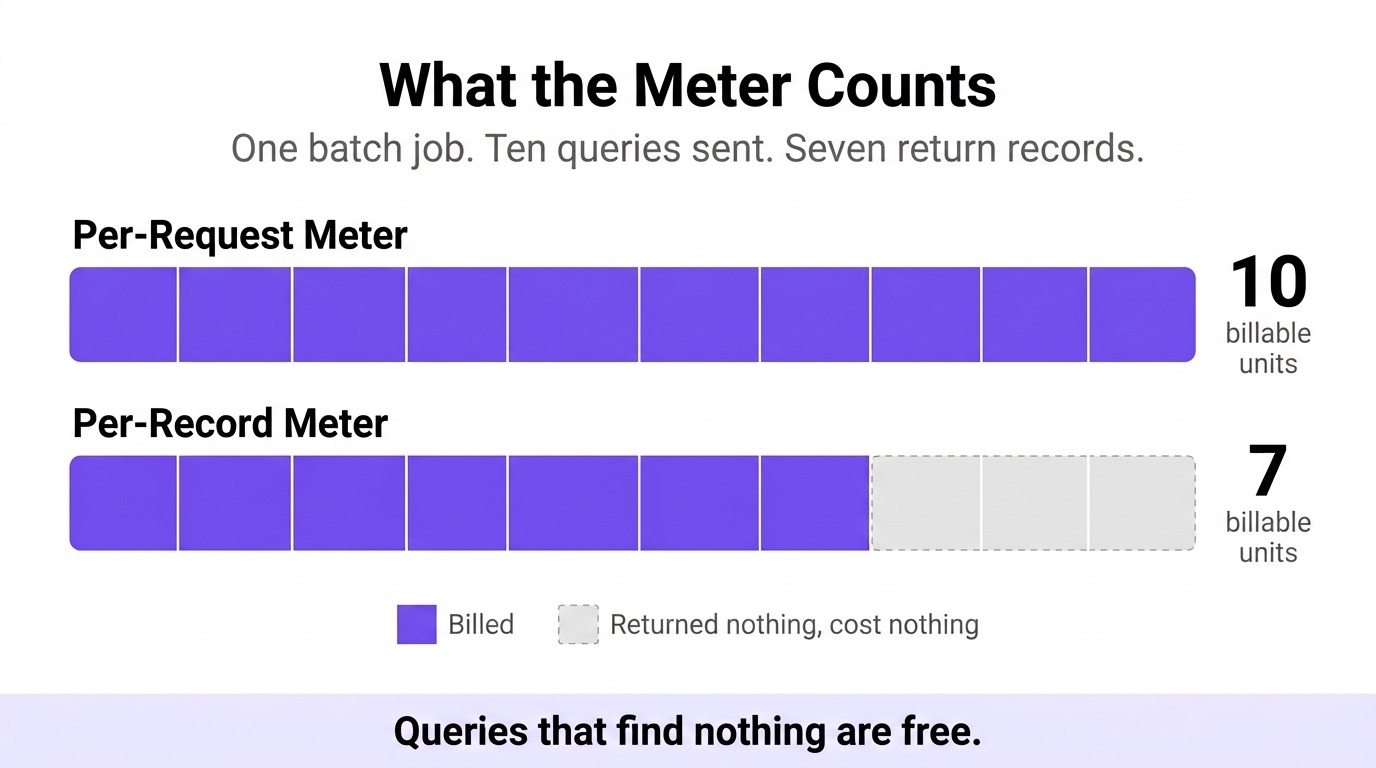
That distinction stays invisible during a pilot on clean data, where nearly every query matches. It dominates in production, where you are hitting long-tail segments, retrying after errors, and sweeping categories with uneven coverage. A batch job matching seven of ten inputs pays full freight for all ten under a per-request meter.
Why a Record Is Not the Same as a Company
A record is a row in a dataset, and the entity that row describes varies by provider. The Census Bureau draws the line cleanly: an establishment is a single physical location, while a firm is an organization made up of one or more establishments under common ownership.
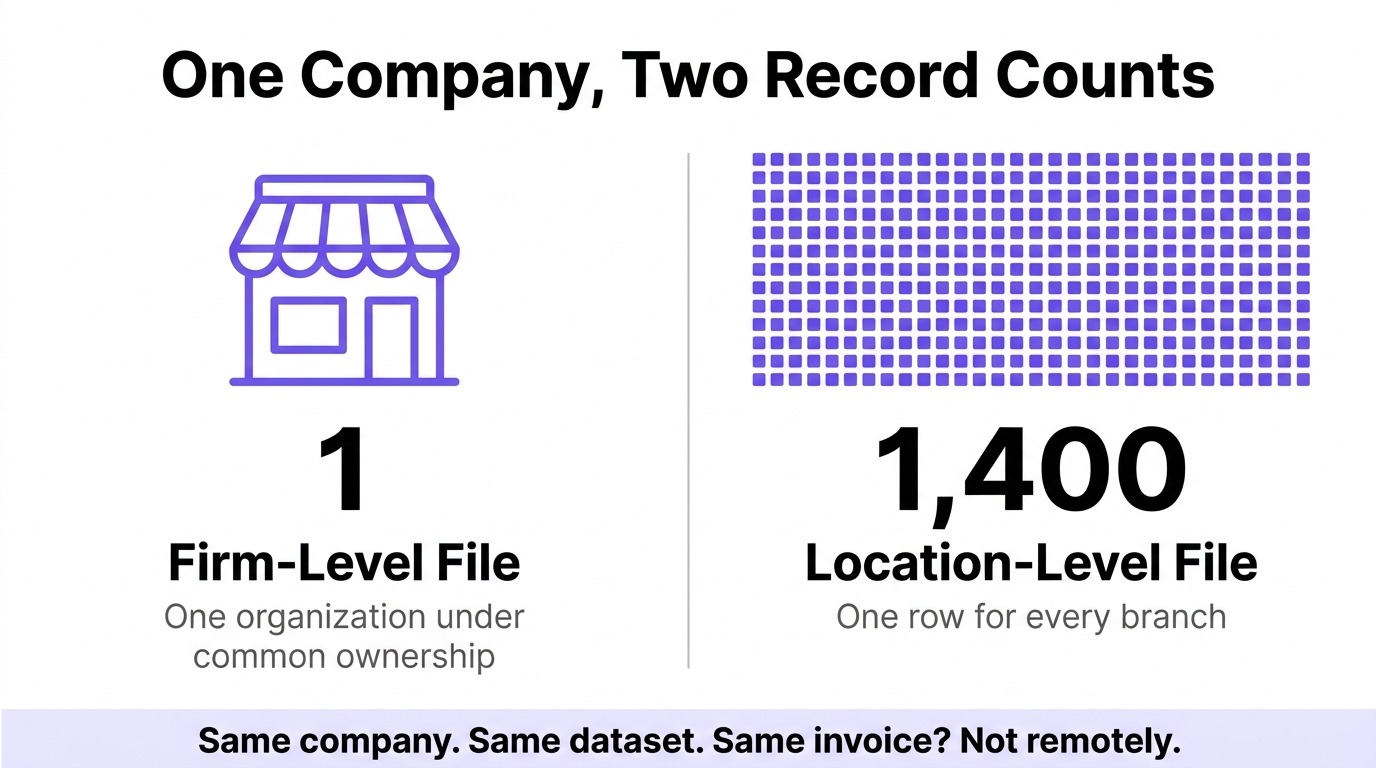
Apply that mentality to a national chain, and the arithmetic shifts fast. One firm with 1,400 branches is a single record in a firm-level file and 1,400 records in a location-level file. Territory planning needs the location count. Account-level CRM enrichment does not, and paying for every branch inflates the bill without improving the model.
For scale, the SBA Office of Advocacy counts 36,207,130 small businesses in the United States. Read coverage claims against a number like that. What matters is not the total a vendor advertises but how much of your target segment sits inside it and how many billable rows that portion produces.
Which Pricing Models Apply to Company Data at Scale?
Providers package the same underlying data in four commercial structures. The model that wins at 50,000 records is often wrong at five million.
Flat Subscription With Included Volume
Subscription pricing bundles a fixed record allowance into a recurring fee, which makes forecasting simple and tends to please procurement.
The weakness is utilization. Allowances that expire monthly convert unused capacity into waste, and project-driven workloads rarely consume evenly across 12 months. If your team runs two large sweeps a year and light lookups otherwise, an allowance sized for the peak strands most of your spend.
Per-Request Usage Billing
Usage-based models charge per API call. Vendors present this option as pay-as-you-go flexibility, and for low-volume prototyping, it is.
At production scale, it's the most expensive structure available because it bills your failure rate alongside your success rate. Empty results, retries, and exploratory queries against thin segments all consume budget while returning nothing usable. This side-by-side comparison of subscription and usage-based models covers the tradeoffs in depth.
Per-Record Credit Billing
Credit models charge for the records a query actually returns rather than for the query itself. That single change makes forecasting tractable because you can model spend from the records your workflow consumes instead of estimating a request count and applying a match rate you haven't measured yet.
Negotiated Bulk and Enterprise Licensing
At the top of the curve, access shifts from metered queries to negotiated licensing: a defined dataset, a delivery schedule, and an annual fee. Bulk company database pricing typically starts at a committed record floor and is quoted per engagement rather than published, so terms deserve as much scrutiny as the rate. Our breakdown of what bulk dataset licensing involves covers the structural questions that apply across data categories.
How Does Cost Behave at Millions of Records?
Enterprise data API pricing is not linear, and buyers who extrapolate a pilot rate straight out to production volume routinely overestimate cost by a wide margin.
The Volume Tier Curve
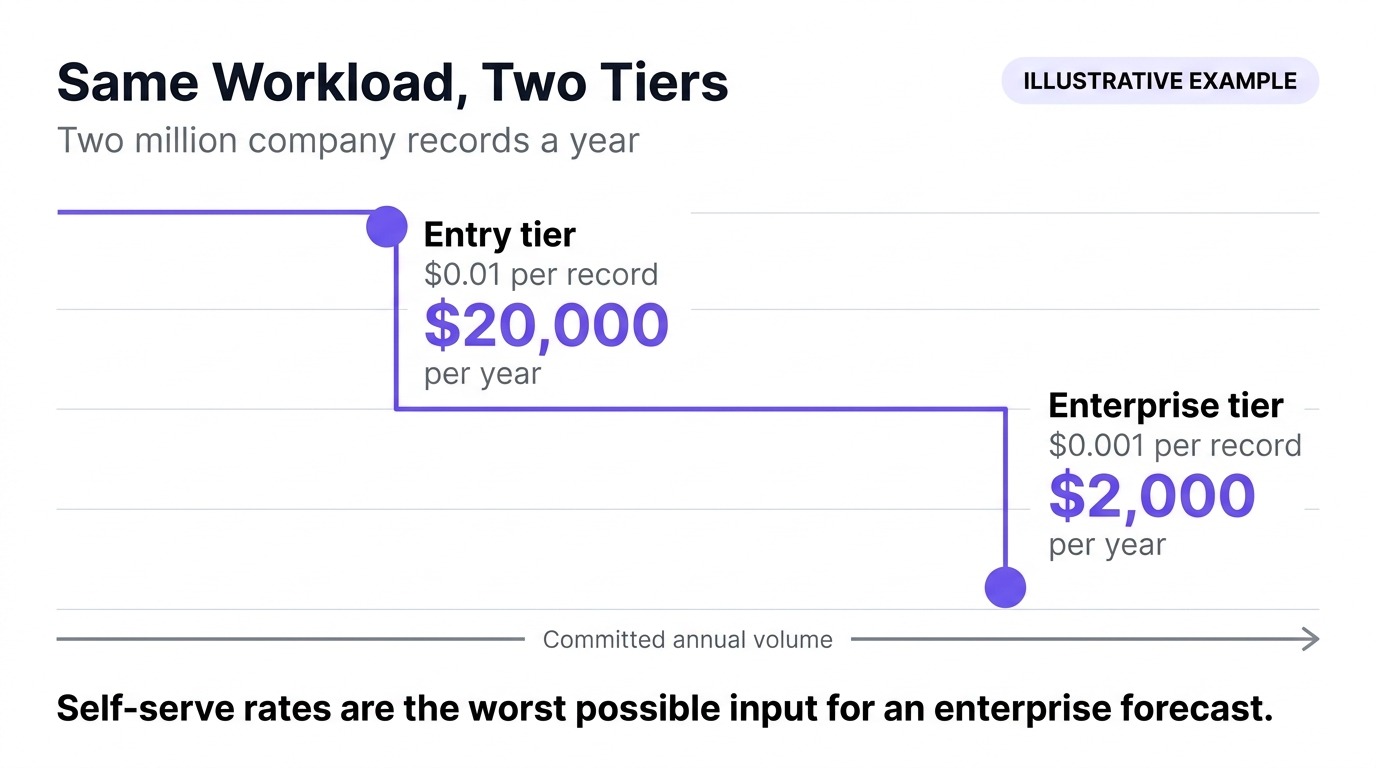
Effective unit cost drops sharply as committed volume rises between entry and enterprise tiers because the marginal cost of serving one more record approaches zero once the dataset exists.
That makes self-serve rates the worst possible input for an enterprise forecast. Take a program consuming two million company records a year. At one cent per record, it costs $20,000 annually. At a tenth of a cent, $2,000. Nothing about the workload changed, only the tier.
Where Bulk Delivery Beats Per-Query Access
On-demand queries fit trigger-driven work, such as enriching an account the moment a rep opens it. Bulk delivery fits work that needs a whole segment resident in your own systems.
The threshold is easier to spot than teams expect. Once you are querying a substantial fraction of a segment on a recurring basis, per-query access is a slower, costlier route to a file you could have received directly. Bulk files and scheduled exports remove per-call overhead and land data where your pipelines can reach it.
Refresh cadence is the variable most often left out. A one-time load and a quarterly-refreshed dataset carry very different lifetime costs under the same rate, since business records change continuously as locations open, close, and reclassify.
Why Per-Record Billing Changes the Enterprise Cost Model
Per-record credit billing removes the most risk from enterprise data API pricing because it closes the gap between what you are charged for and what you can use.
You Pay for Delivered Records, Not Attempts
Under a per-record meter, billing follows the records actually returned. Queries that find nothing are free. That model has an underappreciated second-order effect: it removes the penalty for exploration.
When every call costs money regardless of outcome, engineers defensively narrow queries and analysts stop testing hypotheses that might not pay off. When only delivered records are billed, you can probe an unfamiliar segment, find the coverage thin, and move on, having spent nothing. Access to company and firmographic records becomes something teams use freely rather than ration. Throughput follows the same logic: with no requests-per-second cap, a batch job runs as fast as your infrastructure allows.
Refresh Cycles Under a Per-Record Meter
Keeping company data at scale current is a delta problem, not a full-reload problem. The supported pattern is a scheduled query filtered on a last-updated timestamp, returning only records changed since your previous sync.
Under per-record billing, that pattern is inexpensive by construction. You pay for the changed rows, not for the whole dataset you examined to find them, so a weekly delta against a two-million-record file bills only the fraction that moved.
Two details clean up the arithmetic further: API access carries no separate charge on top of record volume, and exploring the dataset through a web portal costs nothing against your allocation. How data aggregation platforms assemble records explains why marginal delivery cost stays low.
Six Questions to Ask Before Signing a Bulk Contract
Rate cards answer one question. These six questions surface the rest of the cost behind any bulk company database pricing quote.
- What exactly is a billable unit? Get it in writing: Does the meter run on requests or delivered records, and do individual fields bill separately from the base record?
- Is the entity a firm, an establishment, or a location? The same segment can produce 10 times the record count depending on the answer, and so can your invoice.
- What is the rate at my committed volume? Published self-serve rates are not a forecast input for enterprise data API pricing. Ask for the tier matching your real number.
- Does unused volume expire? Monthly expiration against an uneven workload strands spend before you ever query it.
- What does a refresh cost? Price the delta cadence separately from the initial load because that's where multi-year cost accumulates.
- Are there throughput caps or regional restrictions? Rate limits and per-market packages add engineering time and contract overhead that never appear on the rate card itself.
Frequently Asked Questions
Should I Buy National Coverage as One Contract or Several Regional Ones?
One agreement is almost always cheaper to run. Regional packages multiply procurement cycles, renewal dates, and schema differences, and they cap your ability to expand into a new market without a new negotiation.
How Should I Forecast Business Data API Pricing for a New Program?
Estimate the records your workflow will consume per month, not the API calls it will make, then apply the rate for the tier that volume reaches. Add a separate line for refresh cadence and confirm the quoted rate holds for the full term.
Can I Test Coverage Before Committing to a Bulk Company Database Pricing Agreement?
Yes, and you should. Query your hardest segment rather than your cleanest one, since match rates on well-formed records tell you nothing useful. Providers that let you explore the data and export samples before a sales conversation make this straightforward.
Does Bulk Delivery Cost More Than API Access?
Not inherently. Bulk files and scheduled exports typically draw against the same record volume as API queries, so the delivery method is an operational choice rather than a pricing tier.
Choosing Company Data API Pricing You Can Defend in 18 Months
The right structure for accessing company data at scale is the one whose cost you can predict from a number you already control. Record counts are knowable. Request counts multiplied by an assumed match rate are guesses, which turn a business case into a variance conversation.
Work business data API pricing in order: define the entity you need, size the volume at the cadence you need it, then compare rates at that tier rather than the entry point. Escalators and expiring allowances deserve the same scrutiny as the headline number.
Datafiniti prices business data on records actually delivered, with no separate charge for API access, no throughput caps, and full national coverage under one agreement. Request a demo to see the numbers against your own volume.
Read the latest articles

Read more

Build vs Buy: Business Data Enrichment for Growing Teams
Company Data API Pricing: Bulk & Enterprise-Scale Access

Best Business Data APIs for Sales Teams & Prospecting

Business Data API: Company Data at Enterprise Scale

How to Build a Product Database With a Product Data API

Property Data API Coverage: What U.S. Datasets Include

Product Data API for Ecommerce Price Monitoring and Repricing

Real-Time Product Data API for Product-Led Growth Teams

Property Ownership Data API for Skip Tracing and Lead Gen

How APIs Make Building a Product Database Easy
Learn how to build a product database with APIs for cleaner imports, updates, search, and scalable product data.

How to Leverage Competitor Pricing Data with an API
Use competitor pricing data to build API-driven monitoring, analysis, and smarter pricing decisions.

Price Monitoring API: The Key to E-Commerce Pricing Strategy
Use a price monitoring API to track market changes, improve pricing decisions, and protect ecommerce margins.

How do Product Data APIs Work for E-Commerce Companies?
Learn how a product data API works, from collection and queries to ecommerce integration and use cases.

How to Integrate MLS Listings Using an MLS Data API

GTIN Lookup API: Search Products by Barcode & UPC at Scale

Best Real Estate API 2026: Coverage, Pricing, Data Quality

Best Product Data API 2026: A State-of-the-Market Guide

Product Data API Integration Patterns for Ecommerce Platforms

Build a PropTech MVP With a Property Ownership Data API

3 Benefits of Web Scraping for Real Estate
Boost your research by using web scraping for real estate to gain market insights, automate lead lists, and minimize property risk.
How Real Estate Agents Can Leverage Proptech Data
Leverage proptech data to source leads, speed up valuations, and manage risk with accurate, real-time property insights.

What Is a UPC Lookup API?
Learn about the UPC lookup API, how it works, and its benefits for businesses. Get product data easily.

What Is a GTIN Lookup API?
Learn about the GTIN lookup API and how it can help your business grow. Get product data insights.

How Does a Property Data API Work?
Learn how a property data API works, its features, and how you can use it for real estate and business insights.

What The Best Real Estate APIs Should Have
Discover what makes the best real estate APIs stand out. Learn about essential features for your property data needs.
The Benefits of a Real Estate MLS API
Learn about the benefits of a real estate MLS API for streamlining data access and driving business growth.

Why Every Real Estate Pro Needs an MLS Database API
Learn why a MLS database API is vital for real estate pros. Get data, insights, and competitive edge.
How to Access MLS Listing Data
Learn how to access MLS listing data using an MLS data API. Discover Datafiniti's solutions and integration tips.
.png)
How to Enrich Your Product Catalog With a Real-Time API
.jpeg)
Product Data API Buyer's Guide for Ecommerce Teams

Do I Need a Real Estate Listing API?
Explore the benefits and technicalities of a real estate listing API. Learn how to choose the right provider and integrate data for business growth.

Unlocking the MLS Database with APIs
Unlock the MLS database with APIs. Learn how to access property data, gain real estate insights, and integrate MLS data for your business needs.

Why Real Estate Tech Startups Need Property APIs with Ownership Details
Discover how property APIs with ownership details empower real estate tech startups. Learn about data integration, risk mitigation, and driving business value.
The Value of a Product Catalog Sync for Product Managers
Unlock the value of product catalog sync for product managers. Streamline data, improve decisions, and reduce costs with real-time insights.

What is a Product Data Webhook?
Learn about product data webhooks, their components, and how they enable real-time updates for business intelligence and workflow automation.

Why Is a Product Data API Integration Essential for Analysts & Product Managers?
Unlock insights with product data API integration. Essential for analysts & product managers to streamline data access & enhance product strategy.

What Is a Product Data API and Its Benefits
Learn about product data APIs, their benefits, and how they drive business growth. Explore integration and advanced use cases.

What Do eCommerce Data Vendors Do?
Learn what ecommerce data vendors do, their services, and how to choose the right one for your business growth.

How to Compare Product Data Providers: What to Look For
Compare product data providers. Learn what to look for in data quality, structure, and integration features.

How to Get Your Product Data in Real-Time Using APIs
Learn how to leverage real-time product data APIs for e-commerce, competitive analysis, and AI. Get instant access to clean, structured product data.

Best Product Data API: Features to Look for
Find the best product data API with real-time updates, comprehensive coverage, and a user-friendly portal. Explore features to look for.

Unlocking Property Data with an API
Access property data with a powerful property database API. Explore listings, market analysis, investment opportunities, and more. Get started today!

Unlocking CRE with APIs
Unlock commercial real estate insights with a powerful API. Access property data, streamline workflows, and enhance investment strategies.

How to Get a Real-Time Product Feed Using an API
Learn how to get a real-time product feed using an API. Access, leverage, and ensure accuracy of product data for your business needs.

Spying on Competitor Prices: What You Need to Know
Learn how to gather and analyze competitor pricing data to inform your business strategy. Understand key components and ethical considerations.

Product Data Enrichment: What Are You Missing?
Enhance your product data with comprehensive enrichment. Discover insights, drive growth, and choose the right approach for your business.
.png)
IDX vs MLS API: A Developer's Guide to Real Estate Listing Data
.png)
Real Estate API Pricing Models Explained: Subscription vs. Usage-Based

Real Estate API vs Web Scraping: Which Wins in 2026?
.png)
Product Data APIs Explained: Powering Product Search and Catalog Automation

How to Get the Most out of a Product Catalog API
Learn how to leverage a product catalog API for business growth. Discover data quality, access methods, and strategy for your product catalog API.

Taming Your Ecommerce Product Data Feed
Optimize your ecommerce product data feed for growth. Learn strategies, leverage technology, and ensure data quality for better customer experience and AI initiatives.

Streamlining Your Product Search with an API
Explore the benefits and integration of a product search API. Streamline your product discovery and leverage data for business growth.
.png)
What Is a Real Estate Transaction Database? A Complete Guide
.png)
Best MLS API for Real Estate Software: What Developers Need

How Real Estate Platforms Access MLS Database APIs
.png)
Commercial Real Estate API vs. Residential Property API
.png)
How to Choose a Real Estate Database API for Your MVP
MLS API vs. IDX: What's the Diff?
MLS API vs IDX: Explore the differences in real estate data access, retrieval, and integration. Understand which solution fits your needs.

Scraping vs. APIs: Getting Real Estate Data
Compare web scraping vs real estate API for data acquisition. Learn the pros, cons, and best use cases for each method.

Property Valuation API: Your Go-To Real Estate Tool
Leverage the property valuation API for real estate insights. Access comprehensive property data for diverse applications with Datafiniti.

Product Data APIs Explained
Learn about product data APIs explained. Discover how to access, integrate, and utilize product data for e-commerce, analytics, and more.

Unlocking Your Ecommerce Data with APIs
Unlock ecommerce data with APIs for business insights, product catalog enrichment, and competitive analysis. Explore data via portal or API.

Real Estate Ownership Data: How to Access, Analyze and Use at Scale
Access, analyze, and use real estate ownership data at scale. Learn how to find, process, and leverage this crucial information for business insights.
IDX vs MLS API: What Every Real Estate Professional Should Know
Understand IDX vs MLS API differences. Learn about data access, integration, and how Datafiniti's solutions empower real estate professionals.

What Is an MLS Database API?
Explore the MLS database API: understand its components, benefits, and how to access real estate data for various applications. Learn about its core functionality and technical aspects.

How a Property Database API Can Help Real Estate Pros
Learn how a property database API can help real estate pros analyze trends, monitor listings, and optimize strategies. Get data insights.

What Is a Residential Property API?
Explore what a residential property API is, its features, benefits, and real-world applications for real estate professionals and investors.

What Is a Commercial Real Estate API?
Explore commercial real estate API functionality, data integration, and use cases. Learn how to leverage property, business, and people data for insights.

Understanding MVP Data Integration
Learn about MVP data integration, its components, benefits, and strategies for accessing and utilizing data resources effectively.

How to Choose the Best Property Data API
Learn how to choose the best property data API. Explore features, providers, pricing, and integration for real estate insights.

Real Estate Database API: What to Look for
Explore real estate database API options. Learn about data quality, features, and how to choose the right provider for your needs.

How Do Product Data APIs Work?
Understand how a product data API works, its key features, integration methods, and applications for e-commerce and business intelligence.

How Do Data Aggregation Platforms Work?
Explore how data aggregation platforms work, their capabilities, and applications. Learn to choose and implement the right platform for your business intelligence needs.

Why Do Companies Need Property Data Aggregation?
Discover why property data aggregation is crucial for businesses. Streamline access, empower functions, enhance risk management, and drive strategic decisions with authoritative insights.

MLS API: The Complete Guide to Accessing MLS Listing Data

Product Search API vs. Product Data API: What's the Difference?

What Are the Best MLS Data API Features to Look For?
Discover the best MLS data API features, including real-time updates, bulk downloads, and flexible filtering for property data.

What Is a Product Data API?
Explore the functionality and benefits of a product data API. Learn how to integrate, leverage, and choose the right provider for your business insights.
What Is the Difference Between Product Search API and Product Data API?
Understand the difference between Product Search API and Product Data API. Learn how to leverage product data for business intelligence and analytics.

Is a Real Estate MLS API Beneficial?
Explore the benefits of a real estate MLS API for enhanced data access, streamlined workflows, and market responsiveness. Learn about key features and use cases.

What is an MLS Database API?
Explore the MLS database API for comprehensive property data access. Learn about its core functionality, key features, and integration into real estate technology.

What Is a Property Data API?
Explore the capabilities of a property data API. Understand its core functionality, key features for developers, and how to access property information at scale for business insights.
.png)
Real Estate API Pricing: What You Need to Know Before You Build
.jpeg)
How to Choose a Property Market API for Investment Platforms
Choosing the right property market API is critical for investment platforms. Learn how to evaluate data depth, coverage, freshness, and integration quality before you commit.
Data you can trust, delivered in a format your systems can use, at the scale your product requires.