

Product Data API for Ecommerce Price Monitoring and Repricing
Key Takeaways
A product data API turns competitor pricing from a manual research task into a scheduled feed your repricing rules can act on.
- Price alone is not actionable. Repricing needs price, availability, seller identity, and a timestamp in the same record.
- Cross-merchant coverage beats single-marketplace depth, because shoppers compare across brand sites and regional retailers too.
- Scheduled delta queries filtered by last update date keep data current without re-pulling the full catalog on every cycle.
- Throughput caps quietly set the ceiling on how many SKUs a team can realistically monitor per day.
Choose the data access model before you write the pricing rules, because polling cadence decides how fast you can respond.
A product data API is a service that returns structured product records, including price, availability, seller, and a last-updated timestamp, from retailers across the web in one consistent schema. For pricing teams, what that definition replaces matters more than the definition itself: a spreadsheet, a rotating list of competitor URLs, and someone checking them by hand on Tuesday mornings. Deloitte's 2026 retail outlook found that 73% of surveyed retail executives plan to adjust retail prices gradually upward over the year, which means the competitive price map a brand drew in January will not hold through summer. Teams that need to access structured product data at scale usually reach that conclusion after the manual process stops keeping up.
The gap between checking prices weekly and checking them daily is not a matter of diligence. It is a data access problem, and the shape of your access model decides how much of the market stays visible to you and how quickly you can act on what it shows.
What Does a Product Data API Do for Price Monitoring?
Price monitoring sounds like one task, but it breaks into three. You have to find the listings that actually compete with yours, capture their current state, and record that state in a form your rules engine can compare against what it saw yesterday. An in-house scraper pointed at competitor product pages handles the first job unevenly and the third job barely at all, which is why reliable competitor pricing data depends on getting all three right.
The Fields That Make Pricing Data Actionable
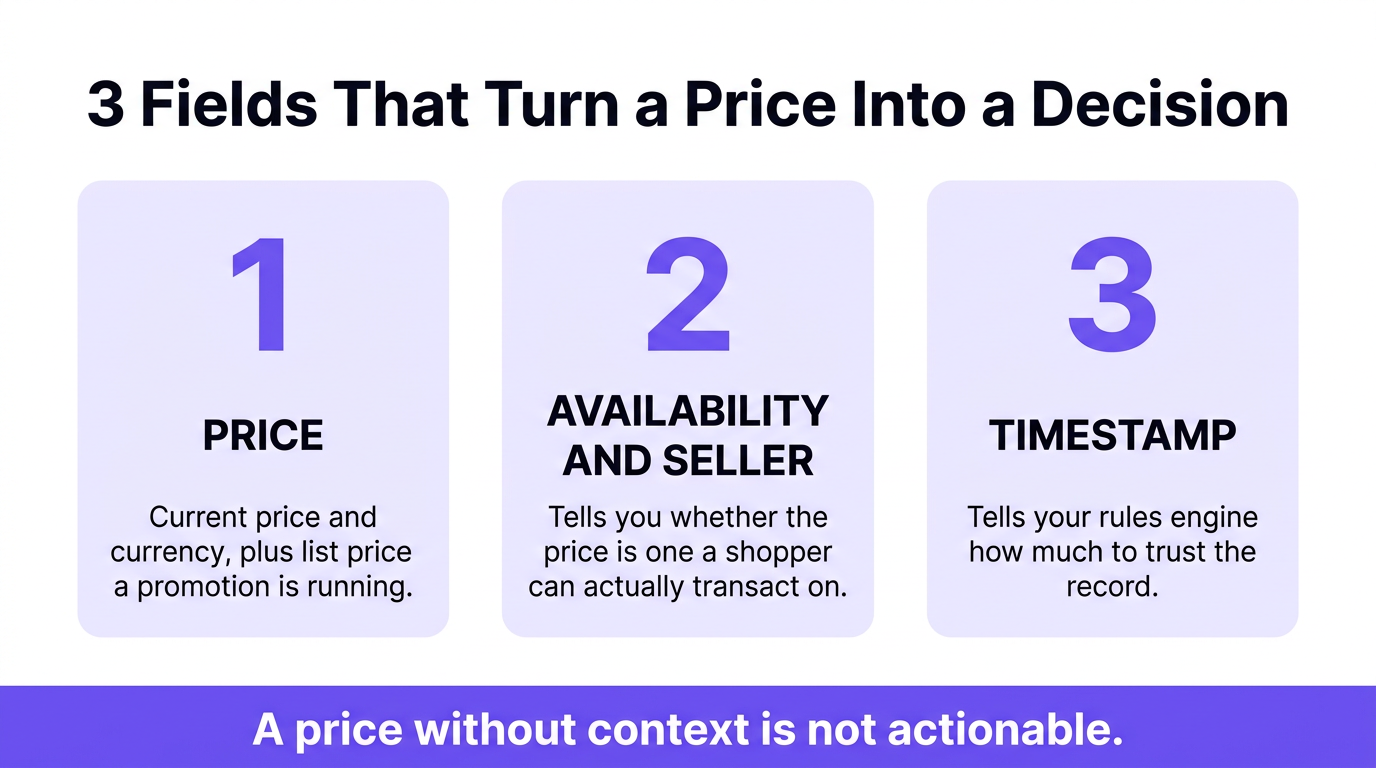
A price on its own is close to useless for repricing. A $79 listing means one thing when the item is in stock and sold directly by the retailer, and something entirely different when it comes from a third-party seller quoting a two-week ship estimate. Useful competitor pricing data pairs the number with the context that makes it comparable.
- Current price and currency, plus list price when a promotion is running.
- Availability and seller identity, so you know whether the price is one a shopper can actually transact on.
- A last-updated timestamp, which tells your rules engine how much to trust the record.
That third field carries more weight than teams expect. Without it, a competitor holding steady and a feed that quietly stopped refreshing three days ago look identical in a dashboard.
Cross-Merchant Coverage Versus Single-Marketplace Depth
Most price monitoring tools began life as marketplace tools, and they report accurately on what happens inside one storefront. Shoppers do not stay inside one storefront. They compare across marketplaces, category specialists, regional chains, and brand-owned sites, and the price that costs you a sale is often one you never measured.
Broad ecommerce product data, drawn from many merchants rather than one, gives repricing rules a view closer to what a shopper actually encounters. Large marketplaces already operate with that view, since their own algorithms react to the same wider field. Online sales reached 16.9 percent of total US retail in the first quarter of 2026 and grew more than twice as fast as retail overall, so the set of merchants worth watching keeps widening rather than consolidating.
Teams assembling a picture of competitor pricing for the first time consistently underestimate how much sits outside their own channel.
How Do You Keep Pricing Data Current Without Over-Polling?
Freshness is where price monitoring projects either work or quietly fail. Pull too rarely and your rules act on a market that has already moved. Pull the entire catalog on every cycle and you spend budget re-downloading records that have not changed since the last run.
Scheduled Delta Queries Are the Practical Sync Pattern
The workable approach is to query the search endpoint on a schedule and filter to records whose last update date falls after your previous sync. You retrieve everything that changed and nothing that did not. Storage stays lean, the comparison job stays fast, and cost tracks actual market movement rather than raw catalog size.
This pattern also produces a clean audit trail. Each sync writes a timestamped snapshot, and diffing consecutive snapshots generates the price change events your repricing API consumes. Teams working through ecommerce API integration patterns tend to arrive at some version of this loop regardless of where they started.
Matching Cadence to Category Volatility
Not every SKU deserves the same polling frequency. Treating fast-moving electronics and slow-turning staples identically means either overspending on stable items or underwatching the ones that move.
Tiering your catalog by volatility is the highest-leverage tuning decision available, and most teams skip it. A workable starting split looks like this:
- Top price-sensitive SKUs on a tight loop, checked several times a day.
- Mid-tier items on a daily cycle, which catches most competitive moves in time to act on them.
- The long tail on a weekly pass, mainly to catch delistings and large resets.
Revisit those tiers quarterly, because categories move between them as seasons and competition shift.

Why Throughput Limits Decide How Much of the Market You Can Watch
A rate limit on your data source sets a hard ceiling on how many SKUs you can monitor and how often. Every design decision above assumes you can actually make the requests, and that assumption is where a lot of price monitoring programs hit a wall they did not plan for.
Most data providers cap requests per second. Once you reach that ceiling, engineering effort shifts away from pricing logic and toward infrastructure that exists only to manage the cap: request queues, exponential backoff, retry handlers, and dead-letter paths for failed calls. None of that code improves a single pricing decision.
The operational cost lands harder than the engineering cost. A cap forces rationing, and rationing shows up as coverage gaps. Teams trim the SKU list, stretch the polling interval, or drop secondary merchants, and every trim removes a slice of the market the rules were built to watch. The cap quietly becomes a pricing strategy nobody chose.
A product data API without requests-per-second caps removes that decision entirely. You size the sync loop to how fast prices actually move in your categories rather than to what a rate limiter permits, and you scale from a pilot on a few hundred SKUs to a full catalog without re-architecting the fetch layer. Widening coverage becomes a budgeting question instead of an engineering project.
Six Questions to Ask Before Choosing a Product Data API for Repricing
Vendor comparisons gravitate toward record counts. These questions surface the things that actually determine whether a feed holds up once it is wired into live pricing rules.
- How is billing calculated? Per-record billing charges for the data you actually receive, so a narrow query that returns little does not cost the same as one that returns a full result set. Per-request models charge whether or not the response was useful.
- Are there requests-per-second caps? A throughput ceiling is a coverage ceiling. It is far easier to discover during evaluation than during a holiday pricing event.
- Which merchants are covered in your categories? Ecommerce product data volume means little when the coverage sits in the wrong verticals, so ask for merchant breadth in the categories you actually sell into.
- Can you filter by last update date? Delta filtering separates a sustainable pipeline from one that re-downloads the world every night.
- Is the documentation publicly readable? Being able to review field schemas and query syntax before a sales call tells you whether integration will be a short exercise or a drawn-out one.
- Can you explore the data before writing code? A visual portal for building queries and previewing results compresses evaluation considerably, because you learn what the data contains before committing engineering time.
Where Price Monitoring Data Earns Its Keep
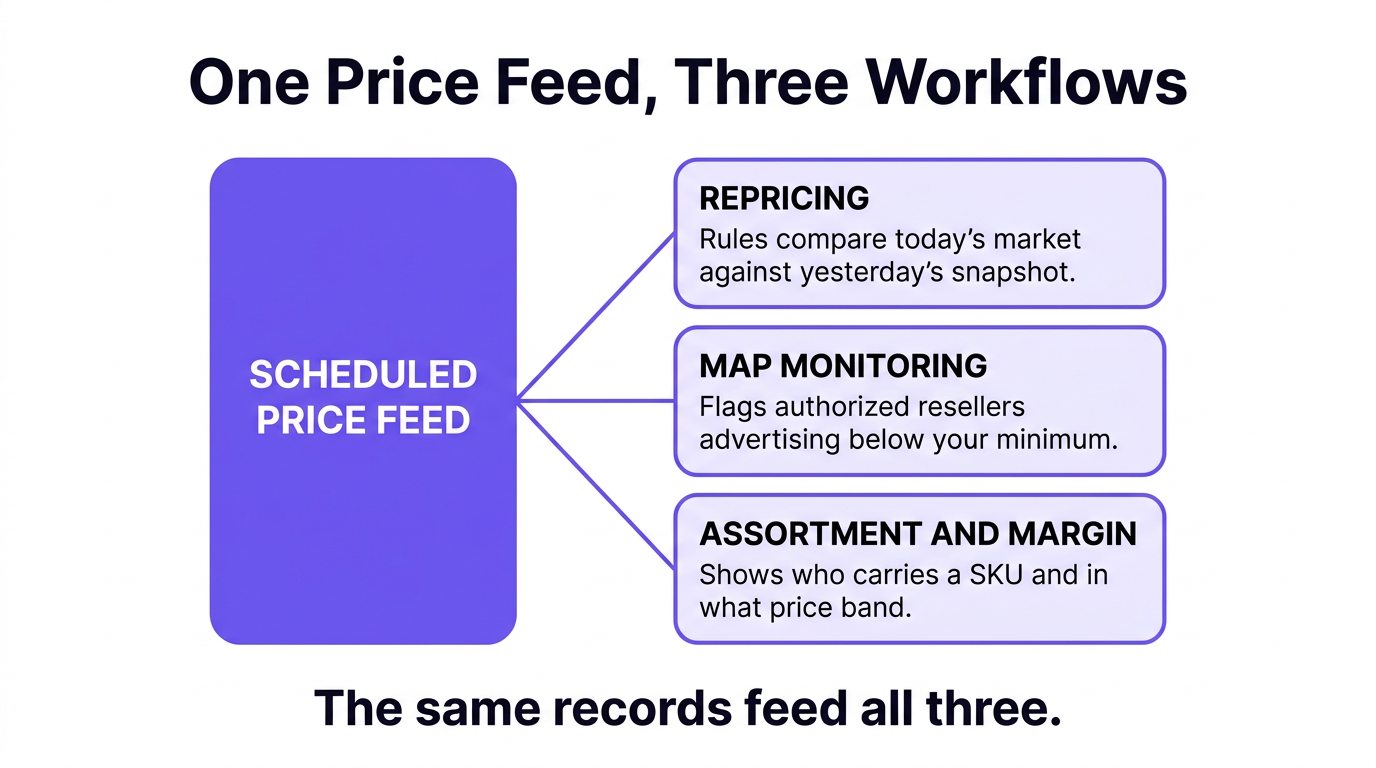
Repricing is the obvious application, but the output of a price monitoring API supports several adjacent workflows that pricing and brand teams usually run as separate manual efforts.
MAP monitoring sits closest. Brands that set a minimum advertised price need to know when an authorized reseller drops below it, and checking dealer sites by hand stops scaling once a dealer network grows past a handful. A scheduled query across merchant listings turns violation detection into a data condition your system evaluates rather than something a person happens to notice.
Assortment and margin analysis is the other. Knowing which competitors carry a SKU at all, and in what price band, informs whether to defend a price or step back from a category. McKinsey reports helping clients achieve sales growth of 2 to 5 percent and margin growth of 5 to 10 percent through dynamic pricing work, and the raw input to programs like that is competitor pricing data refreshed often enough to act on.
Frequently Asked Questions
These come up repeatedly from teams scoping a price monitoring project for the first time.
Can a Product Data API Push Price Changes to My System Automatically?
Delivery generally works through scheduled retrieval rather than automatic push. For pricing work that is usually the better arrangement, because the trigger logic stays on your side, where your margin floors and approval rules already live. A push event would still leave your system deciding whether a given change justifies a reprice, so the decision layer does not move either way.
How Do You Match Competitor Listings to Your Own SKUs?
Matching works best on shared identifiers such as GTIN, UPC, or manufacturer part number, because those survive the differences in how each retailer titles and describes a product. A GTIN lookup API handles that join directly. Where identifiers are missing, teams fall back on brand plus model plus key attributes, which needs spot-checking before it drives pricing. Matching accuracy matters more than polling speed, since a fast feed matched to the wrong product produces confident but wrong repricing decisions.
What Is the Difference Between a Price Monitoring API and a Repricing API?
A price monitoring API supplies observations about the market. A repricing API applies changes to your own listings. The two are complementary rather than competing: monitoring produces the signal, repricing acts on it, and the rules connecting them stay yours to define.
Do I Need Historical Price Data or Only Current Prices?
Current prices drive today's decision, but history is what tells you whether a competitor's discount is a short promotion or a permanent reset. Some providers carry pricing history in the record itself, which spares you from reconstructing it. Where they do not, retaining each sync's snapshot builds the same picture over time, which is one more reason to set up a delta-based pull pattern early.
Making Product Data API Access Work for Pricing Decisions
The pricing rules are usually the easy part. Margin floors, competitive positioning, and promotional guardrails are decisions a team can settle in an afternoon. Building the data layer underneath them takes longer, because ecommerce product data has to be broad enough to be representative, filtered tightly enough to be affordable, and fast enough that the rules fire while the opportunity still exists.
Datafiniti offers a product data API with cross-merchant price and availability records, pricing history, per-record billing, publicly readable documentation, and no requests-per-second caps. Request a demo to see how the data maps to the categories you actually sell in.
Read the latest articles

Read more

Build vs Buy: Business Data Enrichment for Growing Teams

Company Data API Pricing: Bulk & Enterprise-Scale Access

Best Business Data APIs for Sales Teams & Prospecting

Business Data API: Company Data at Enterprise Scale

How to Build a Product Database With a Product Data API

Property Data API Coverage: What U.S. Datasets Include
Product Data API for Ecommerce Price Monitoring and Repricing

Real-Time Product Data API for Product-Led Growth Teams

Property Ownership Data API for Skip Tracing and Lead Gen

How APIs Make Building a Product Database Easy
Learn how to build a product database with APIs for cleaner imports, updates, search, and scalable product data.

How to Leverage Competitor Pricing Data with an API
Use competitor pricing data to build API-driven monitoring, analysis, and smarter pricing decisions.

Price Monitoring API: The Key to E-Commerce Pricing Strategy
Use a price monitoring API to track market changes, improve pricing decisions, and protect ecommerce margins.

How do Product Data APIs Work for E-Commerce Companies?
Learn how a product data API works, from collection and queries to ecommerce integration and use cases.

GTIN Lookup API: Search Products by Barcode & UPC at Scale

Best Real Estate API 2026: Coverage, Pricing, Data Quality

Best Product Data API 2026: A State-of-the-Market Guide

Product Data API Integration Patterns for Ecommerce Platforms

Build a PropTech MVP With a Property Ownership Data API

3 Benefits of Web Scraping for Real Estate
Boost your research by using web scraping for real estate to gain market insights, automate lead lists, and minimize property risk.

How Real Estate Agents Can Leverage Proptech Data
Leverage proptech data to source leads, speed up valuations, and manage risk with accurate, real-time property insights.

What Is a UPC Lookup API?
Learn about the UPC lookup API, how it works, and its benefits for businesses. Get product data easily.

What Is a GTIN Lookup API?
Learn about the GTIN lookup API and how it can help your business grow. Get product data insights.

How Does a Property Data API Work?
Learn how a property data API works, its features, and how you can use it for real estate and business insights.

What The Best Real Estate APIs Should Have
Discover what makes the best real estate APIs stand out. Learn about essential features for your property data needs.
How to Access MLS Listing Data
Learn how to access MLS listing data using an MLS data API. Discover Datafiniti's solutions and integration tips.
.png)
How to Enrich Your Product Catalog With a Real-Time API
.jpeg)
Product Data API Buyer's Guide for Ecommerce Teams

Do I Need a Real Estate Listing API?
Explore the benefits and technicalities of a real estate listing API. Learn how to choose the right provider and integrate data for business growth.

Why Real Estate Tech Startups Need Property APIs with Ownership Details
Discover how property APIs with ownership details empower real estate tech startups. Learn about data integration, risk mitigation, and driving business value.
The Value of a Product Catalog Sync for Product Managers
Unlock the value of product catalog sync for product managers. Streamline data, improve decisions, and reduce costs with real-time insights.

What is a Product Data Webhook?
Learn about product data webhooks, their components, and how they enable real-time updates for business intelligence and workflow automation.

Why Is a Product Data API Integration Essential for Analysts & Product Managers?
Unlock insights with product data API integration. Essential for analysts & product managers to streamline data access & enhance product strategy.

What Is a Product Data API and Its Benefits
Learn about product data APIs, their benefits, and how they drive business growth. Explore integration and advanced use cases.

What Do eCommerce Data Vendors Do?
Learn what ecommerce data vendors do, their services, and how to choose the right one for your business growth.

How to Compare Product Data Providers: What to Look For
Compare product data providers. Learn what to look for in data quality, structure, and integration features.

How to Get Your Product Data in Real-Time Using APIs
Learn how to leverage real-time product data APIs for e-commerce, competitive analysis, and AI. Get instant access to clean, structured product data.

Best Product Data API: Features to Look for
Find the best product data API with real-time updates, comprehensive coverage, and a user-friendly portal. Explore features to look for.

Unlocking Property Data with an API
Access property data with a powerful property database API. Explore listings, market analysis, investment opportunities, and more. Get started today!

Unlocking CRE with APIs
Unlock commercial real estate insights with a powerful API. Access property data, streamline workflows, and enhance investment strategies.

How to Get a Real-Time Product Feed Using an API
Learn how to get a real-time product feed using an API. Access, leverage, and ensure accuracy of product data for your business needs.

Spying on Competitor Prices: What You Need to Know
Learn how to gather and analyze competitor pricing data to inform your business strategy. Understand key components and ethical considerations.

Product Data Enrichment: What Are You Missing?
Enhance your product data with comprehensive enrichment. Discover insights, drive growth, and choose the right approach for your business.
.png)
IDX vs MLS API: A Developer's Guide to Real Estate Listing Data
.png)
Real Estate API Pricing Models Explained: Subscription vs. Usage-Based

Real Estate API vs Web Scraping: The Buy-vs-Build Decision
.png)
Product Data APIs Explained: Powering Product Search and Catalog Automation

How to Get the Most out of a Product Catalog API
Learn how to leverage a product catalog API for business growth. Discover data quality, access methods, and strategy for your product catalog API.

Taming Your Ecommerce Product Data Feed
Optimize your ecommerce product data feed for growth. Learn strategies, leverage technology, and ensure data quality for better customer experience and AI initiatives.

Streamlining Your Product Search with an API
Explore the benefits and integration of a product search API. Streamline your product discovery and leverage data for business growth.
.png)
What Is a Real Estate Transaction Database? A Complete Guide

How Real Estate Platforms Access MLS Database APIs
.png)
Commercial Real Estate API vs. Residential Property API
.png)
How to Choose a Real Estate Database API for Your MVP
MLS API vs. IDX: What's the Diff?
MLS API vs IDX: Explore the differences in real estate data access, retrieval, and integration. Understand which solution fits your needs.

Scraping vs. APIs: Getting Real Estate Data
Compare web scraping vs real estate API for data acquisition. Learn the pros, cons, and best use cases for each method.

Property Valuation API: Your Go-To Real Estate Tool
Leverage the property valuation API for real estate insights. Access comprehensive property data for diverse applications with Datafiniti.

Product Data APIs Explained
Learn about product data APIs explained. Discover how to access, integrate, and utilize product data for e-commerce, analytics, and more.

Unlocking Your Ecommerce Data with APIs
Unlock ecommerce data with APIs for business insights, product catalog enrichment, and competitive analysis. Explore data via portal or API.

Real Estate Ownership Data: How to Access, Analyze and Use at Scale
Access, analyze, and use real estate ownership data at scale. Learn how to find, process, and leverage this crucial information for business insights.
IDX vs MLS API: What Every Real Estate Professional Should Know
Understand IDX vs MLS API differences. Learn about data access, integration, and how Datafiniti's solutions empower real estate professionals.

How a Property Database API Can Help Real Estate Pros
Learn how a property database API can help real estate pros analyze trends, monitor listings, and optimize strategies. Get data insights.

What Is a Residential Property API?
Explore what a residential property API is, its features, benefits, and real-world applications for real estate professionals and investors.

What Is a Commercial Real Estate API?
Explore commercial real estate API functionality, data integration, and use cases. Learn how to leverage property, business, and people data for insights.

Understanding MVP Data Integration
Learn about MVP data integration, its components, benefits, and strategies for accessing and utilizing data resources effectively.

How to Choose the Best Property Data API
Learn how to choose the best property data API. Explore features, providers, pricing, and integration for real estate insights.

Real Estate Database API: What to Look for
Explore real estate database API options. Learn about data quality, features, and how to choose the right provider for your needs.

How Do Product Data APIs Work?
Understand how a product data API works, its key features, integration methods, and applications for e-commerce and business intelligence.

How Do Data Aggregation Platforms Work?
Explore how data aggregation platforms work, their capabilities, and applications. Learn to choose and implement the right platform for your business intelligence needs.

Why Do Companies Need Property Data Aggregation?
Discover why property data aggregation is crucial for businesses. Streamline access, empower functions, enhance risk management, and drive strategic decisions with authoritative insights.

MLS Database API: How to Choose a Provider and Get Access

Product Search API vs. Product Data API: What's the Difference?

What Is a Product Data API?
Explore the functionality and benefits of a product data API. Learn how to integrate, leverage, and choose the right provider for your business insights.
What Is the Difference Between Product Search API and Product Data API?
Understand the difference between Product Search API and Product Data API. Learn how to leverage product data for business intelligence and analytics.

What Is a Property Data API?
Explore the capabilities of a property data API. Understand its core functionality, key features for developers, and how to access property information at scale for business insights.
.png)
Real Estate API Pricing: What You Need to Know Before You Build
.jpeg)
How to Choose a Property Market API for Investment Platforms
Choosing the right property market API is critical for investment platforms. Learn how to evaluate data depth, coverage, freshness, and integration quality before you commit.
Data you can trust, delivered in a format your systems can use, at the scale your product requires.