

Build vs Buy: Business Data Enrichment for Growing Teams

Key Takeaways
The build vs buy data enrichment decision depends on maintenance cost and coverage, not on whether your team can write the initial pipeline.
- Collection code is cheap to write and expensive to keep running because source layouts, identifiers, and category schemes change without warning.
- Coverage should be measured against the segment you sell into, not against a total record count or the raw row count your pipeline produces.
- "Real time" rarely means what buyers assume, and the useful question is how fast a change reaches the record you query.
- Building wins when the enrichment logic is proprietary and narrow. Buying wins when the work is broad coverage and continuous upkeep.
If your engineers spend more time on parsers than on the product consuming the data, the build has already answered the question for you.
Most teams don't set out to build business data enrichment infrastructure. Someone writes a script to fill in missing industry codes on a few thousand accounts, it works, and 18 months later, two engineers are maintaining a parsing layer nobody wants to own. The decision is usually discussed well after the build has begun, which is why it tends to be treated as a sunk cost rather than a forward cost.
That framing is expensive. The costs that settle this question arrive later, into budgets that aren't growing to meet them. In the 2026 State of Analytics Engineering survey, infrastructure spend is outpacing team budgets, with 57% of respondents reporting increased warehouse and compute costs against 36% reporting increased team budgets. So if you're weighing a homegrown pipeline against reliable access to structured business data, compare your third year to theirs, not your first sprint.
What Does Business Data Enrichment Involve?
Business data enrichment is the process of appending verified attributes to company records you already hold, using an identifier you already have. You supply a name, domain, address, or phone number, and the process returns industry classification, location details, operating attributes, and contact information for that entity.
Two distinct jobs hide inside that description, and conflating them is where most build estimates go wrong.
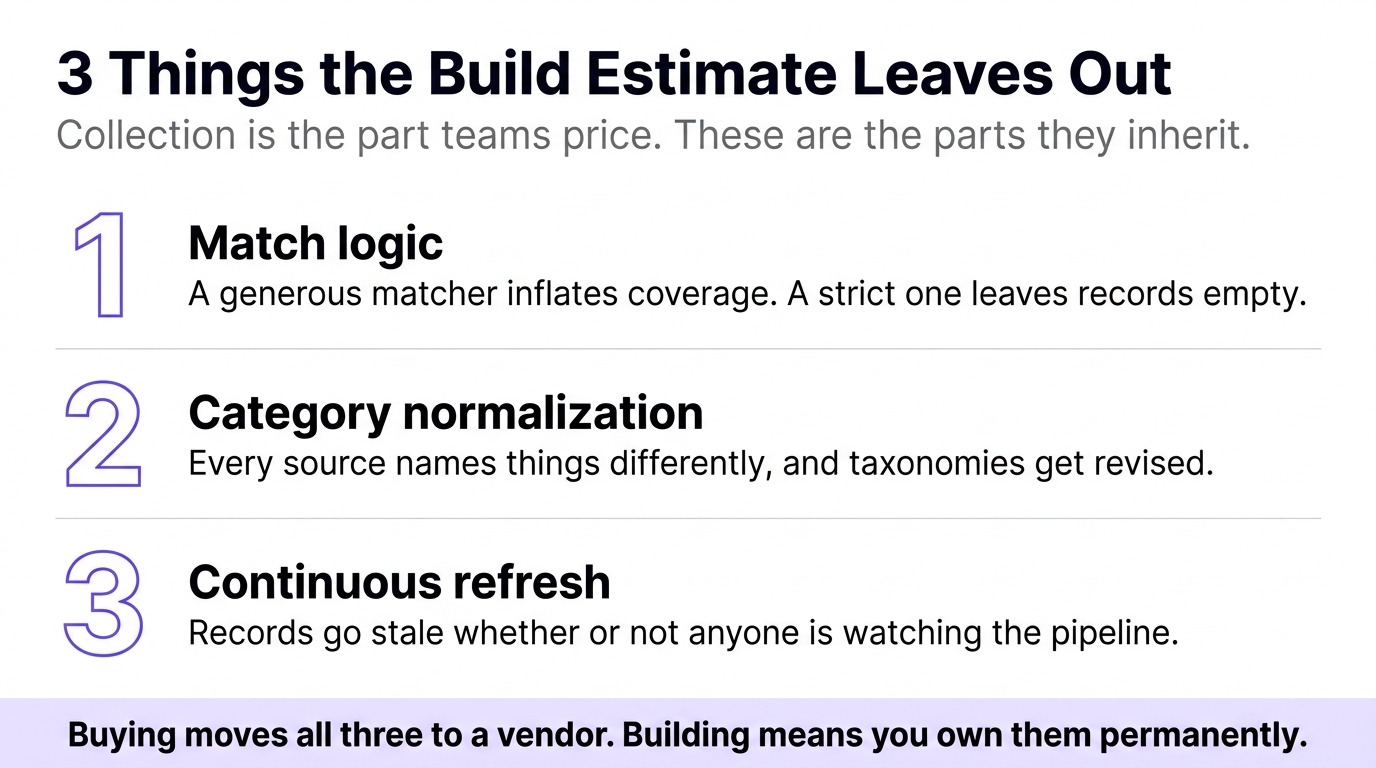
The first is matching. Before anything gets appended, the system has to decide that the "Acme Corp" in your CRM and the "Acme Corporation" in the source are the same establishment or correctly decide they aren't. Match logic carries the accuracy risk for the entire pipeline. A generous matcher inflates your coverage numbers and poisons your segmentation. A strict one leaves usable records empty.
The second is normalization. Source A says "Restaurants," source B uses a six-digit NAICS code, source C says "Food & Beverage." Someone has to reconcile those differences into one scheme your systems can filter on, then keep reconciling as sources revise their taxonomies.
Buying moves both jobs to a vendor. Building means you own them permanently, including every edge case you haven't met yet.
What Does It Cost to Build Business Data Enrichment In-House?
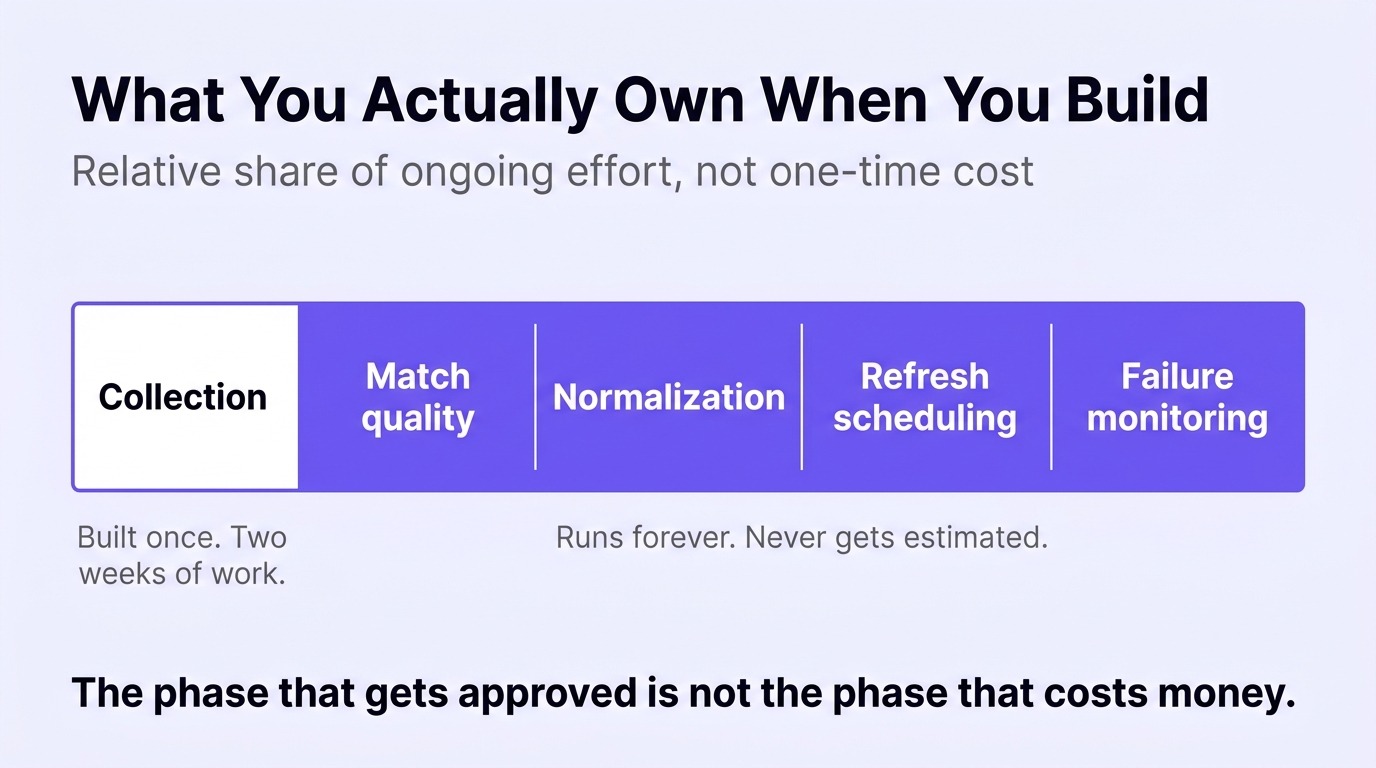
Build estimates almost always scope the wrong phase. Teams price the collection work, ship it, and then meet the actual cost profile.
Collection Code Is the Cheap Part
Writing a parser against a known source is well-understood work. A competent engineer can extract structured fields and land them in a warehouse table in a couple of weeks. This phase gets estimated, demoed, and approved.
It's also the phase that never repeats cleanly. Sources restructure pages, rename fields, and alter identifier formats. Each change is small alone. Together, they turn a finished project into a standing obligation, and the tell is when your pipeline starts filing its own incident tickets.
The Maintenance Curve Nobody Budgets For
Put a number on that obligation. The Bureau of Labor Statistics reports a median annual wage for software developers of $135,980 as of May 2025, before benefits, overhead, or a manager's review time. Half of one engineer's year spent on parser upkeep and match triage is real money against a line item that ships no new capability.
The two cost curves also point in different directions. A build scales with the number of sources you stitch together. A purchased dataset scales with the records you consume, and per-record billing means you pay for what comes back rather than for every query you attempt.
There's a subtler cost too. Every hour spent on pipeline maintenance is an hour not spent on the scoring model or the product feature that differentiates you. Company data enrichment is rarely the thing you win on.
How Do Coverage and Freshness Hold Up in a Build?
Coverage and freshness degrade first in a homegrown pipeline, and they degrade invisibly. Nothing in your monitoring fires when a source subtly returns fewer records than it should.
Why Raw Row Counts Overstate Coverage
The scale problem is bigger than most build plans assume. The Census Bureau's establishment universe for County Business Patterns spans more than 6 million single-unit establishments and more than 2 million multi-unit establishments, and that count excludes non-employer businesses entirely. A pipeline aimed at three or four accessible sources covers a slice of that, weighted toward whatever those sources index well.
The weighting is the trap. Accessible sources skew toward larger businesses, urban markets, and consumer-facing categories. If you sell to regional industrial suppliers or independent healthcare practices, the sources easiest to collect are the ones least likely to cover you.
So measure business data enrichment coverage as a ratio against your own segment. Take 500 companies you know exist in your target market, run them through the pipeline, and count what returns complete. Do the same with any vendor before signing. National access under one agreement matters here because closing gaps with regional or vertical sources means a separate integration for each one.
What Real-Time Company Data Means in Practice
Real-time company data is a marketing term more often than a technical one. No provider watches a business change its hours or close its doors at the moment it happens. What varies is the lag between a change occurring, appearing in an observable source, and landing in the record you query.
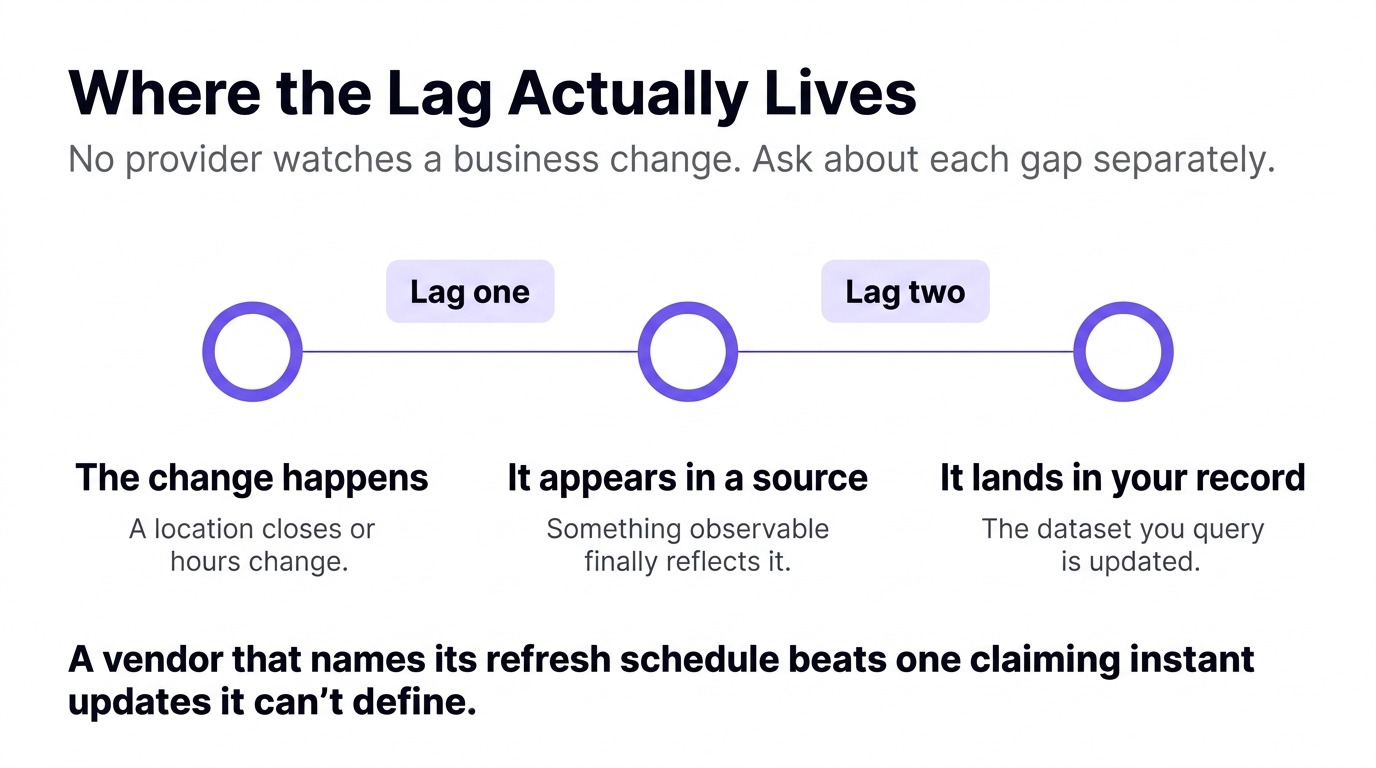
Ask about that lag at each of the three stages. A vendor that refreshes on rolling schedules and says so plainly is more useful than one claiming instant updates it can't define.
For your own systems, run a scheduled delta query. Poll on a cadence you control, filtered to records changed since your last successful sync, and reconcile against your store. That pattern is auditable, replayable after a failure, and doesn't require keeping an endpoint permanently available.
Why One Schema Across Every Business Category Changes the Math
Here's the line item that rarely appears in a build estimate. Collecting from multiple sources means inheriting the job of making them agree with each other, and that job never finishes.
Restaurants, clinics, manufacturers, and franchise locations carry different meaningful attributes. Reconciling them into one queryable structure compounds every time you add a source or expand into a category you weren't originally covering.
What Normalization Costs When You Own It
A dataset that already delivers business data across every category under one schema takes that work off your roadmap. Records arrive standardized, deduplicated, and aligned to a consistent structure, so a query written against restaurant records behaves identically against manufacturing records. You write one integration and one set of field mappings instead of maintaining a normalization layer per source.
The effect shows up when requirements change. Expanding from retail into healthcare providers becomes a filter change rather than a new collection project, plus a new taxonomy negotiation. Understanding how data aggregation platforms work is useful context because normalization is exactly what you're paying an aggregator to run for you.
When Does a Data Enrichment API Win?
Neither answer is universally right. The distinction is whether a given piece of business data enrichment work differentiates you or is merely necessary.
- Build when the logic is proprietary. A scoring model trained on your conversion history, or a fit algorithm encoding your sales team's judgment, is worth owning. Nobody sells that.
- Buy when the work is coverage and upkeep. Broad establishment data, category normalization, and continuous refresh are commodity inputs. Running them yourself produces no edge over a competitor buying the same thing.
- Watch the boundary. Teams that regret building usually crossed from the first case into the second without noticing.
A data enrichment API earns its cost when it removes an obligation instead of adding a dependency.
Six Questions to Answer Before You Commit
Work through these questions before the build vs buy data enrichment decision reaches a budget owner. Each has a factual answer, and the answers tend to settle the argument faster than the discussion does.
- What share of your target segment can you match today? If you've never measured it, you know your row count, not your coverage.
- How many engineer hours went into pipeline upkeep last quarter? Pull the tickets. The number is almost always higher than the team's estimate of it.
- How many sources would close your known gaps? Multiply by the cost of the first one, then add the normalization work each new source creates.
- What breaks downstream when a source changes format? If you find out from a sales rep, your freshness monitoring doesn't exist yet.
- Can you inspect the field structure without a sales call? Readable public documentation and a portal you can query before writing integration code show you what the data contains. A gated demo shows you what the vendor wants you to see.
- What happens to throughput at 10 times your volume? Rate-limited access forces you to build retry and throttling logic, which is more pipeline code you own on top of a service you already pay for.
Frequently Asked Questions
Is Company Data Enrichment Different From Contact Enrichment?
Yes, and treating them as one purchase causes problems. Company data enrichment returns attributes about an establishment: industry, location, category, and operating details. Contact enrichment returns attributes about an individual person, which is a separate dataset with different sourcing and compliance considerations. Confirm which one you're buying and whether people data is included or priced separately.
How Often Should You Refresh Enriched Company Records?
Match the cadence to how the attribute behaves. Locations, categories, and operating status change slowly enough that a weekly or monthly delta sync serves most workflows. Vendors selling real-time company data often encourage a faster default than your fields warrant. Refreshing everything on the quickest schedule any single field needs spends volume on records that haven't moved.
Can You Take a Hybrid Approach?
Most mature teams end up here. Buy the base layer of coverage, normalization, and refresh through a data enrichment API, then build the proprietary logic on top. Your scoring and routing rules stay in-house where they belong. The hybrid fails only when the boundary is undefined and both sides rebuild the same fields.
What Should You Do With Records No Provider Can Match?
Plan for them because a residual unmatched tail always exists. Decide in advance whether those records get suppressed, routed to manual review, or passed through with a confidence flag, and design the tail so you can see it growing. A rising unmatched rate usually signals input data quality rather than provider coverage.
Making the Build vs Buy Data Enrichment Call
The decision reduces to one comparison. Put your realistic three-year maintenance cost, including the coverage gaps you haven't closed, next to the price of buying the same inputs. Then ask whether the pipeline produces anything a competitor could not simply purchase.
If the answer is no, your business data enrichment build is consuming engineering capacity that belongs somewhere else. Growing teams rarely lose because they bought a dataset. They lose because three engineers spent a year maintaining parsers while the roadmap waited.
Datafiniti offers a data enrichment API backed by a single normalized dataset covering business categories nationwide, with per-record billing, no rate limits, and both API and bulk delivery. You can talk through your enrichment workload and test coverage against your own segment before committing.
Read the latest articles

Read more
Build vs Buy: Business Data Enrichment for Growing Teams
Best Business Data APIs for Sales Teams & Prospecting

Business Data API: Company Data at Enterprise Scale

How to Build a Product Database With a Product Data API

Property Data API Coverage: What U.S. Datasets Include

Product Data API for Ecommerce Price Monitoring and Repricing

Real-Time Product Data API for Product-Led Growth Teams

Property Ownership Data API for Skip Tracing and Lead Gen

How APIs Make Building a Product Database Easy
Learn how to build a product database with APIs for cleaner imports, updates, search, and scalable product data.

What Is Property Transaction Data and How Does an API Help Get It?
Learn how property transaction data works and how APIs provide structured access for analysis and workflows.

How to Use Real Estate Transaction Data
Learn how to use real estate transaction data for analysis, valuation, underwriting, and market decisions.

How to Leverage Competitor Pricing Data with an API
Use competitor pricing data to build API-driven monitoring, analysis, and smarter pricing decisions.

Price Monitoring API: The Key to E-Commerce Pricing Strategy
Use a price monitoring API to track market changes, improve pricing decisions, and protect ecommerce margins.

How do Product Data APIs Work for E-Commerce Companies?
Learn how a product data API works, from collection and queries to ecommerce integration and use cases.

Bulk Real Estate Data Licensing: Access Datasets at Scale

How to Integrate MLS Listings Using an MLS Data API

GTIN Lookup API: Search Products by Barcode & UPC at Scale

Best Real Estate API 2026: Coverage, Pricing, Data Quality

Best Product Data API 2026: A State-of-the-Market Guide

Product Data API Integration Patterns for Ecommerce Platforms

Build a PropTech MVP With a Property Ownership Data API

3 Benefits of Web Scraping for Real Estate
Boost your research by using web scraping for real estate to gain market insights, automate lead lists, and minimize property risk.
How Real Estate Agents Can Leverage Proptech Data
Leverage proptech data to source leads, speed up valuations, and manage risk with accurate, real-time property insights.

What Is a UPC Lookup API?
Learn about the UPC lookup API, how it works, and its benefits for businesses. Get product data easily.

What Is a GTIN Lookup API?
Learn about the GTIN lookup API and how it can help your business grow. Get product data insights.

How Does a Property Data API Work?
Learn how a property data API works, its features, and how you can use it for real estate and business insights.

What The Best Real Estate APIs Should Have
Discover what makes the best real estate APIs stand out. Learn about essential features for your property data needs.
The Benefits of a Real Estate MLS API
Learn about the benefits of a real estate MLS API for streamlining data access and driving business growth.

Why Every Real Estate Pro Needs an MLS Database API
Learn why a MLS database API is vital for real estate pros. Get data, insights, and competitive edge.
How to Access MLS Listing Data
Learn how to access MLS listing data using an MLS data API. Discover Datafiniti's solutions and integration tips.
.png)
How to Enrich Your Product Catalog With a Real-Time API
.jpeg)
Product Data API Buyer's Guide for Ecommerce Teams

Do I Need a Real Estate Listing API?
Explore the benefits and technicalities of a real estate listing API. Learn how to choose the right provider and integrate data for business growth.

Unlocking the MLS Database with APIs
Unlock the MLS database with APIs. Learn how to access property data, gain real estate insights, and integrate MLS data for your business needs.

Why Real Estate Tech Startups Need Property APIs with Ownership Details
Discover how property APIs with ownership details empower real estate tech startups. Learn about data integration, risk mitigation, and driving business value.
The Value of a Product Catalog Sync for Product Managers
Unlock the value of product catalog sync for product managers. Streamline data, improve decisions, and reduce costs with real-time insights.

What is a Product Data Webhook?
Learn about product data webhooks, their components, and how they enable real-time updates for business intelligence and workflow automation.

Why Is a Product Data API Integration Essential for Analysts & Product Managers?
Unlock insights with product data API integration. Essential for analysts & product managers to streamline data access & enhance product strategy.

What Is a Product Data API and Its Benefits
Learn about product data APIs, their benefits, and how they drive business growth. Explore integration and advanced use cases.

What Do eCommerce Data Vendors Do?
Learn what ecommerce data vendors do, their services, and how to choose the right one for your business growth.

How to Compare Product Data Providers: What to Look For
Compare product data providers. Learn what to look for in data quality, structure, and integration features.

How to Get Your Product Data in Real-Time Using APIs
Learn how to leverage real-time product data APIs for e-commerce, competitive analysis, and AI. Get instant access to clean, structured product data.

Best Product Data API: Features to Look for
Find the best product data API with real-time updates, comprehensive coverage, and a user-friendly portal. Explore features to look for.

Unlocking Property Data with an API
Access property data with a powerful property database API. Explore listings, market analysis, investment opportunities, and more. Get started today!

Unlocking CRE with APIs
Unlock commercial real estate insights with a powerful API. Access property data, streamline workflows, and enhance investment strategies.

How to Get a Real-Time Product Feed Using an API
Learn how to get a real-time product feed using an API. Access, leverage, and ensure accuracy of product data for your business needs.

Spying on Competitor Prices: What You Need to Know
Learn how to gather and analyze competitor pricing data to inform your business strategy. Understand key components and ethical considerations.

Product Data Enrichment: What Are You Missing?
Enhance your product data with comprehensive enrichment. Discover insights, drive growth, and choose the right approach for your business.
.png)
IDX vs MLS API: A Developer's Guide to Real Estate Listing Data
.png)
Real Estate API Pricing Models Explained: Subscription vs. Usage-Based

Real Estate API vs Web Scraping: Which Wins in 2026?
.png)
Product Data APIs Explained: Powering Product Search and Catalog Automation

Best Sources for Bulk Real Estate Transaction Data

How to Get the Most out of a Product Catalog API
Learn how to leverage a product catalog API for business growth. Discover data quality, access methods, and strategy for your product catalog API.

Taming Your Ecommerce Product Data Feed
Optimize your ecommerce product data feed for growth. Learn strategies, leverage technology, and ensure data quality for better customer experience and AI initiatives.

Streamlining Your Product Search with an API
Explore the benefits and integration of a product search API. Streamline your product discovery and leverage data for business growth.
.png)
Real Estate Transaction Databases: What You Need to Know
.png)
Best MLS API for Real Estate Software: What Developers Need

How Real Estate Platforms Access MLS Database APIs
.png)
Commercial Real Estate API vs. Residential Property API
.png)
How to Choose a Real Estate Database API for Your MVP
MLS API vs. IDX: What's the Diff?
MLS API vs IDX: Explore the differences in real estate data access, retrieval, and integration. Understand which solution fits your needs.

Scraping vs. APIs: Getting Real Estate Data
Compare web scraping vs real estate API for data acquisition. Learn the pros, cons, and best use cases for each method.

Cracking the Code: Housing Sales Insights
Unlock housing sales analytics insights with Datafiniti. Explore property data, market trends, and advanced techniques for strategic decisions.

Property Valuation API: Your Go-To Real Estate Tool
Leverage the property valuation API for real estate insights. Access comprehensive property data for diverse applications with Datafiniti.

Product Data APIs Explained
Learn about product data APIs explained. Discover how to access, integrate, and utilize product data for e-commerce, analytics, and more.

Unlocking Your Ecommerce Data with APIs
Unlock ecommerce data with APIs for business insights, product catalog enrichment, and competitive analysis. Explore data via portal or API.

Your Guide to Housing Sales APIs
Explore housing sales API data for insights. Access property data, integrate into applications, and gain business intelligence. Get started today!

Real Estate Ownership Data: How to Access, Analyze and Use at Scale
Access, analyze, and use real estate ownership data at scale. Learn how to find, process, and leverage this crucial information for business insights.

Unlocking Opportunities: Navigating Bulk Real Estate Transaction Data
Unlock opportunities with bulk real estate transaction data. Learn how to access, analyze, and leverage property data for investing, marketing, and more.
What Is a Property Sales Database?
Explore what a property sales database is, its core components, how to access data, and key use cases for real estate analysis and more.

Benefits of Obtaining Housing Transaction Data
Unlock insights with housing transaction data. Analyze markets, investments, sales, and risk. Get comprehensive property data for informed decisions.

Understanding Real Estate Transaction Databases
IDX vs MLS API: What Every Real Estate Professional Should Know
Understand IDX vs MLS API differences. Learn about data access, integration, and how Datafiniti's solutions empower real estate professionals.

What Is an MLS Database API?
Explore the MLS database API: understand its components, benefits, and how to access real estate data for various applications. Learn about its core functionality and technical aspects.

How a Property Database API Can Help Real Estate Pros
Learn how a property database API can help real estate pros analyze trends, monitor listings, and optimize strategies. Get data insights.

What Is a Residential Property API?
Explore what a residential property API is, its features, benefits, and real-world applications for real estate professionals and investors.

What Is a Commercial Real Estate API?
Explore commercial real estate API functionality, data integration, and use cases. Learn how to leverage property, business, and people data for insights.

Understanding MVP Data Integration
Learn about MVP data integration, its components, benefits, and strategies for accessing and utilizing data resources effectively.

How to Choose the Best Property Data API
Learn how to choose the best property data API. Explore features, providers, pricing, and integration for real estate insights.

Real Estate Database API: What to Look for
Explore real estate database API options. Learn about data quality, features, and how to choose the right provider for your needs.
.png)
Real Estate Transaction Database: An API Access Guide

How Do Product Data APIs Work?
Understand how a product data API works, its key features, integration methods, and applications for e-commerce and business intelligence.

How Do Data Aggregation Platforms Work?
Explore how data aggregation platforms work, their capabilities, and applications. Learn to choose and implement the right platform for your business intelligence needs.

Why Do Companies Need Property Data Aggregation?
Discover why property data aggregation is crucial for businesses. Streamline access, empower functions, enhance risk management, and drive strategic decisions with authoritative insights.

MLS API: The Complete Guide to Accessing MLS Listing Data

Product Search API vs. Product Data API: What's the Difference?

What Are the Best MLS Data API Features to Look For?
Discover the best MLS data API features, including real-time updates, bulk downloads, and flexible filtering for property data.

What Is a Product Data API?
Explore the functionality and benefits of a product data API. Learn how to integrate, leverage, and choose the right provider for your business insights.
What Is the Difference Between Product Search API and Product Data API?
Understand the difference between Product Search API and Product Data API. Learn how to leverage product data for business intelligence and analytics.

Guide to Accessing Real Estate Transaction Database Via API
Access real estate transaction data via API. Explore property insights, sales, underwriting, and advanced applications with our authoritative guide.

Is a Real Estate MLS API Beneficial?
Explore the benefits of a real estate MLS API for enhanced data access, streamlined workflows, and market responsiveness. Learn about key features and use cases.

What is an MLS Database API?
Explore the MLS database API for comprehensive property data access. Learn about its core functionality, key features, and integration into real estate technology.

What Is a Property Data API?
Explore the capabilities of a property data API. Understand its core functionality, key features for developers, and how to access property information at scale for business insights.
.png)
Real Estate API Pricing: What You Need to Know Before You Build
.jpeg)
How to Choose a Property Market API for Investment Platforms
Choosing the right property market API is critical for investment platforms. Learn how to evaluate data depth, coverage, freshness, and integration quality before you commit.
Data you can trust, delivered in a format your systems can use, at the scale your product requires.