

Best Product Data API 2026: A State-of-the-Market Guide
The product data market in 2026 has split into a handful of distinct provider types, and choosing the best product data API now depends on freshness, schema consistency, and access terms that survive real-time, high-volume workloads.
- The market is large and increasingly machine-mediated. Global ecommerce reached an estimated $6.88 trillion in 2026, and AI assistants sit between shoppers and product pages at scale, which raises the bar for clean, structured, queryable product data.
- Five vendor archetypes dominate the field. Official marketplace APIs, scraper and proxy networks, product information management platforms, niche category specialists, and aggregated structured-data APIs each solve a different slice of the problem.
- Pricing models, not headline prices, decide your real cost. Per-request, per-record, subscription, and enterprise models behave very differently once you scale.
- Rate limiting is the constraint most teams underestimate. Real-time pricing feeds across thousands of SKUs are exactly where per-second caps break a project.
Evaluate a product data API by how it behaves under your heaviest, most time-sensitive workload because that's where the differences between providers show up.
Global ecommerce reached an estimated $6.88 trillion in 2026, about 21.1% of all retail, and the way that commerce gets discovered, priced, and transacted is changing faster than most data strategies have kept up with. Teams that used to scrape a few marketplaces by hand now need structured product data at scale, refreshed often enough to feed pricing engines, analytics models, and AI systems that expect current information.
This report maps the 2026 product data API landscape so you can evaluate providers with clear criteria. We'll define what separates a strong API from a weak one, break down the five provider archetypes you'll encounter, compare pricing models honestly, and walk through the use cases that should drive your decision.
A product data API is a service that returns structured information about retail products, including titles, descriptions, identifiers, categories, images, seller details, and pricing, through programmatic requests rather than manual collection. The best product data API in 2026 is one that delivers comprehensive catalog coverage, frequent or real-time updates, a consistent schema across sources, and access terms that don't throttle high-volume or time-sensitive workloads.
What Is the Product Data API Landscape in 2026?
The product data API landscape is the set of providers and access models that supply structured retail product information to businesses, ranging from official marketplace endpoints to third-party aggregators that normalize data across many sources. Collectively, these ecommerce data vendors form the supply side of a fast-growing market. Understanding that landscape starts with understanding why demand for this data has climbed so sharply.
Two forces are reshaping it at once. The first is sheer scale: more products, more marketplaces, and more price changes per day than any manual process can track. The second is the arrival of AI as a buyer-facing layer, which is a genuinely new development this year.
Consider the shift in how shoppers reach products. Adobe reported that AI-driven traffic to U.S. retail sites grew 393% year over year in the first quarter of 2026, continuing the surge it measured over the 2025 holiday season. Salesforce, meanwhile, estimated that AI agents and generative AI tools influenced more than 20% of global online sales during the 2025 holiday season.
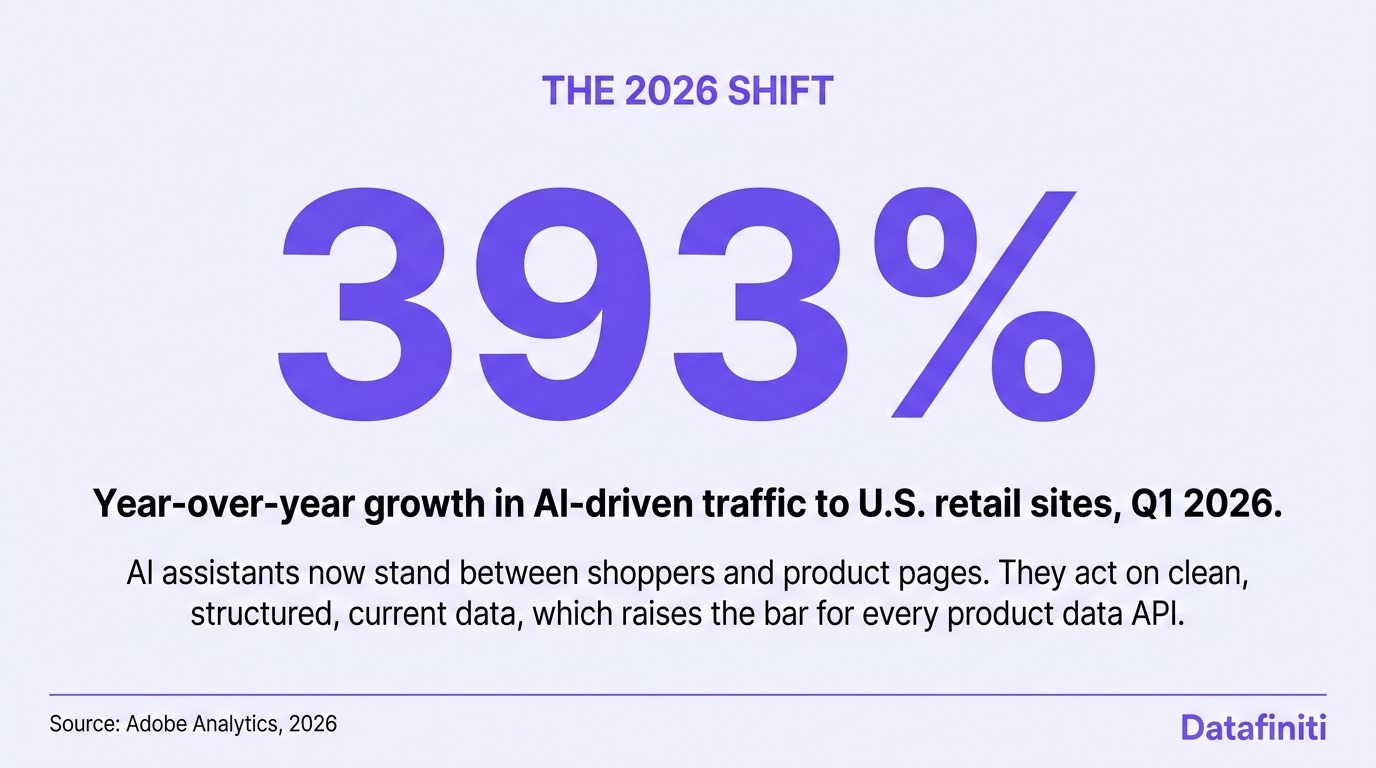
AI systems are far more sensitive to data quality and freshness than a human browsing a page. An assistant recommending a product, or an agent completing a purchase, needs accurate, current, machine-readable attributes to act on. When the underlying data is stale or inconsistent, the recommendation is wrong, and the transaction fails.
Why 2026 Raised the Bar for Product Data
The same Adobe research flagged a structural gap that defines the year: a meaningful share of retail content isn't fully readable by the models now generating that traffic. Adobe found that retail product pages scored an average of 66% on its AI content visibility measure, meaning roughly a third of the information on the pages where purchase decisions happen is effectively invisible to large language models.
For anyone building on product data, that's the core 2026 lesson. The web is full of product information, but a growing portion of the value now depends on whether that information is structured cleanly enough for software, and increasingly for AI, to consume reliably. A product data API earns its place by solving that problem for you, returning normalized fields instead of raw, half-readable HTML.
So the bar has moved. In earlier years, "good enough" meant broad coverage. In 2026, the best providers are judged on whether their output is clean, consistent, and current enough to power automated and AI-driven decisions without constant cleanup on your side.

What Makes the Best Product Data API?
No single feature makes a product data API the strongest option. What separates strong providers is how they perform across coverage, freshness, schema consistency, and access terms. Get the first three right, and you have usable data. Get the fourth wrong, and you can't actually use it the way you need to.
Let's take the first three here, then give access terms, specifically rate limiting, its own section, because it's the one teams most often discover too late.
Coverage and Breadth
Coverage is the obvious starting point, and it's where most vendor comparisons begin and end. The strongest providers index hundreds of millions of products across tens of thousands of merchants, spanning multiple categories rather than a single vertical. Breadth matters because real use cases rarely stay neatly inside one marketplace or one product type.
The subtler point is consistency of coverage. A provider that's deep on electronics but thin on apparel forces you to stitch sources together, which reintroduces the integration burden an API is supposed to remove. When you evaluate a comprehensive product data API, test it against your actual category mix, not a demo dataset chosen to look impressive.
Breadth also future-proofs you. If your roadmap might expand into new categories or new merchant types, a provider that already covers them saves you a painful migration later. Coverage you don't need yet is cheap insurance against a re-platform you can't predict.
Data Freshness and Real-Time Feeds
Pricing, availability, and promotions change constantly, and a daily snapshot is useless for any workflow that reacts to those changes. If you're matching or beating competitor prices, monitoring stockouts, or feeding an AI system that answers shopper questions, you need data that reflects the market now, not yesterday.
Real-time and near-real-time delivery has become a primary evaluation criterion. The ability to get product data in real time, through frequent polling or event-driven updates, makes price monitoring and dynamic decisioning possible at all.
Ask how often each field actually updates, not how often the provider can technically be queried. A provider can offer a fast endpoint while still serving data that's days old underneath, and that distinction is easy to miss in a sales demo.
Schema Consistency and Normalization
Schema consistency is the dimension that determines your engineering cost. When every record follows the same structure, with the same field names, the same units, and reliable identifiers like UPC, GTIN, or MPN, you can build once and trust the output. When the schema drifts between sources or over time, your team spends its days writing reconciliation logic instead of shipping features.
Normalization across merchants is the harder version of this problem. The same product sold by three different sellers will be described three different ways in raw data. A strong product data API resolves those into a single consistent record, so you're comparing like with like instead of guessing whether two listings are the same item.
This performance category is also where AI readiness comes from. Clean, consistent, well-identified records are exactly what language models and agents need to accurately reason about products, which ties back to the machine-readability gap that defines the 2026 market.
The Vendor Landscape: Five Archetypes of Product Data Providers
The field of ecommerce data vendors looks crowded, but most product data providers fall into one of five archetypes. Knowing which type you're talking to tells you more about fit than any feature list because each archetype carries inherent strengths and limits. Here's how to read the field.
- Official marketplace APIs. These come directly from large marketplaces and platforms. They're authoritative for their own catalog, but they're typically gated behind approval processes, restrict which data points you can access, and enforce strict request limits. They also only cover their own marketplace, so you'll need several integrations to see the broader market.
- Scraper and proxy networks. These sell you the raw capability to extract data yourself, usually through scraping infrastructure and proxy access. They offer flexibility and reach, but they push the hard work onto your team. You build and maintain the extraction logic, handle layout changes, and normalize the messy output into something usable.
- Product information management platforms. These manage and syndicate your own catalog across sales channels, with rich attribute management and quality scoring. They're built for distributing data you already own, though, rather than supplying external market and competitor data, so they answer a different question than the one most evaluators are asking.
- Niche category specialists. These go deep on a single vertical, such as a specific retail category or region. The depth can be excellent, but the narrowness becomes a problem the moment your needs cross categories or geographies, forcing you back into multi-vendor stitching.
- Aggregated structured-data APIs. These collect, normalize, and serve product data from many sources through a single, consistent interface. The advantage is that the aggregation and cleanup are done for you, so you query one schema across many merchants. The differences among providers in this category come down to coverage breadth, update frequency, and access terms, which is where careful evaluation pays off.
Most serious buyers will compare product data providers across more than one of these archetypes before deciding. The right answer depends on whether you need to own the extraction work, how many sources you need, and how clean you need the output to be on arrival.
How Do Product Data API Pricing Models Compare?
Pricing is where providers diverge most and where headline numbers mislead. Two providers can advertise similar rates and cost wildly different amounts in practice because the pricing model shapes your real spend far more than the sticker price does. Four models dominate the 2026 landscape.
The per-request model charges for every API call you make. It's simple to understand, but it has a hidden cost: you pay for calls that return little or no data, which means failed or empty queries still draw down your budget. At exploratory or high-volume scale, that overhead adds up in ways that are hard to forecast.
The per-record model charges only for records actually delivered. Because cost tracks the data you receive rather than the attempts you make, spend aligns more directly with value, and exploratory querying carries less penalty. Most teams find this model predictable once they're operating at scale.
Subscription and seat-based models offer a flat tier with usage caps. They're easy to budget, but the caps can become a ceiling, and overage terms vary enough that you should read them closely before committing.
Enterprise and custom models are negotiated individually and often packaged as large dataset purchases or bespoke contracts, which suits very large or very specific needs but offers little transparency for everyone else.
Model your expected query and record volumes against each pricing structure before you sign. The cheapest option on a feature page is frequently the most expensive one in production.
Why Rate Limiting Is the Hidden Constraint in 2026
Rate limiting is the most underestimated factor in choosing a product data API. A rate limit is a cap on how many requests you can make in a given window, and when your use case depends on volume or speed, that cap stops being an inconvenience and becomes a hard wall.
Real-time pricing feeds across thousands of SKUs require a constant, high-throughput stream of requests. Competitive monitoring across a large catalog means querying continuously, not occasionally. AI and agent-driven workflows multiply this further because automated systems request data far more aggressively than humans do. Every one of these is a high-frequency pattern, and every one of them collides with per-second request caps.
When a provider throttles your throughput, the cost lands on your engineering team. You end up building queue management, backoff and retry logic, and request scheduling, all to work around an artificial ceiling rather than to deliver anything your business values.
The downstream effect is worse than wasted effort. Throttling introduces latency, and latency means your data is stale by the time it arrives, which defeats the entire point of a real-time feed. A price that's correct 10 minutes late is a price you can't act on.
So when you evaluate a product data API for high-volume or time-sensitive work, treat the absence of restrictive rate limits as a top-tier requirement, not a footnote. A provider that lets you pull data at the speed your use case demands removes an entire category of engineering work and an entire class of failure. Ask directly what the throughput limits are, and be skeptical of vague answers. This detail is easy to gloss over in a demo and painful to discover in production.
Product Data API Use Cases: A 2026 Matrix
Different use cases demand different things from a product data API, and matching the two is the heart of a good evaluation. The same provider can be perfect for one workflow and a poor fit for another. Here's how the leading 2026 use cases map to what they actually require.
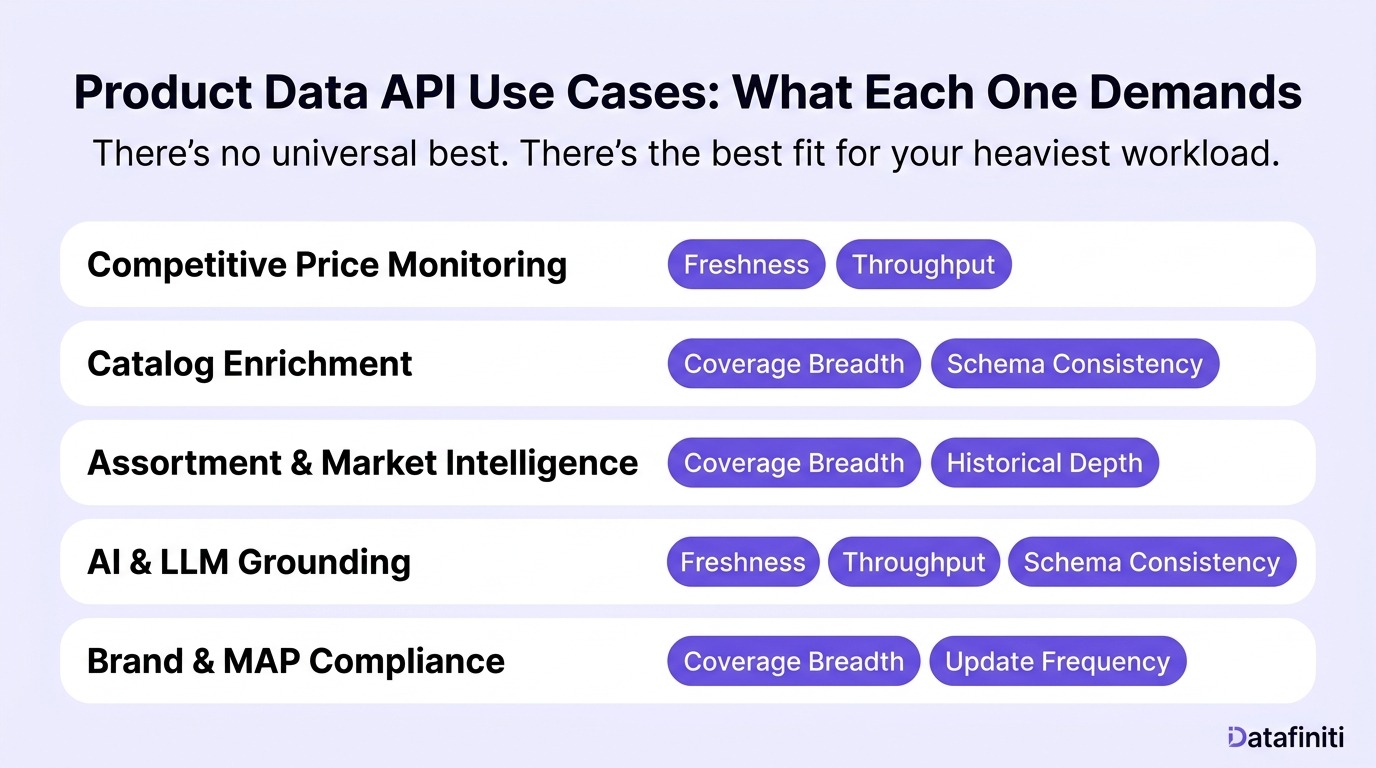
Competitive price monitoring demands freshness and throughput above all. You're tracking how competitors price across many SKUs, often many times a day, so you need frequent updates and the ability to query at volume without throttling. This use case is most punished by rate limits.
Catalog enrichment and product information hydration demand breadth and schema consistency. You're filling gaps in your own listings with attributes, images, descriptions, and identifiers pulled from external sources, so reliable matching keys and a clean schema matter more than raw speed.
Assortment and market intelligence demand coverage and historical depth. You're analyzing what's selling, at what price points, across which categories. Wide, consistent coverage across merchants and time makes the analysis trustworthy.
AI and LLM grounding, including agentic commerce feeds, demand all of the above at once: current, clean, well-identified data delivered fast enough to keep an automated system accurate. This is the most demanding use case in the 2026 landscape, and it's growing the fastest. Understanding what ecommerce data vendors do for AI workloads specifically is becoming a core part of vendor selection.
Brand and MAP compliance monitoring demands coverage and update frequency targeted at where your products are sold. You're watching for unauthorized sellers and pricing violations, so the value is in catching changes quickly across the relevant merchant set.
The pattern across all five is that there's no universal best. There's the best fit for your dominant workload, which is why you should weight your evaluation toward whichever use case will drive most of your queries.
How to Evaluate the Best Product Data API
Once you understand the archetypes, pricing models, and use cases, evaluation becomes a structured exercise rather than a guessing game. The best product data API for your situation scores well on the criteria your dominant use case cares about most. Run any shortlisted provider through this checklist:
- Coverage against your real category and merchant mix, tested on your data, not a curated demo. Look for breadth across product types, since covering every type under one integration future-proofs you against expansion.
- Update frequency by field, asking specifically how often pricing and availability refresh underneath the endpoint.
- Schema consistency and identifier reliability, confirming you get UPC, GTIN, or MPN coverage strong enough to confidently match records.
- Access terms and throughput, with explicit answers on rate limits and what happens under your heaviest load.
- Geographic and contractual scope, favoring providers that give you full coverage under a single integration rather than fragmenting access into regional packages and multiple contracts.
Two practical signals separate mature providers from immature ones. The first is documentation: the strongest providers publish clear, openly accessible documentation you can read before you ever talk to sales, while weaker ones hide basic query structure behind a sales conversation. The second is a way to explore the data before you write integration code, such as a visual portal that lets you preview coverage and build queries first, which turns evaluation from a leap of faith into a quick test. Pair those two signals with a transparent, per-record-friendly pricing model, and you have a provider you can actually trust at scale.
Frequently Asked Questions
What Is the Best Product Data API in 2026?
The best product data API in 2026 combines broad, consistent coverage across merchants and categories, frequent or real-time updates, a normalized schema with reliable product identifiers, and access terms that don't throttle high-volume or time-sensitive workloads. No single provider wins on every axis, so the best choice is the one that scores highest on the dimensions your primary use case depends on most.
What Is the Difference Between a Product Data API and Web Scraping?
A product data API returns clean, structured, normalized records through a programmatic interface, while web scraping is the do-it-yourself process of extracting and parsing raw data from pages. With an API, the extraction and normalization are handled for you, so you query a consistent schema. With scraping, your team owns the maintenance, cleanup, and breakage when source layouts change.
How Much Does a Product Data API Cost?
Cost depends far more on the pricing model than on the headline rate. Per-request models charge for every call, including ones that return little data, while per-record models charge only for data delivered, which tends to be more predictable at scale. Subscription tiers offer budget certainty with usage caps, and enterprise contracts are negotiated individually. Model your expected volumes against each structure before committing.
Why Do Rate Limits Matter for Product Data?
Rate limits cap how many requests you can make in a time window, which constrains real-time and high-volume use cases like price monitoring, large-catalog tracking, and AI-driven workflows. When a provider throttles throughput, your team has to build retry and queueing logic to compensate, and the resulting latency makes time-sensitive data stale by the time it arrives.
Which Product Data Provider Is Best for AI and LLM Use Cases?
The best fit for AI and LLM use cases is a provider that delivers clean, consistently structured, well-identified records, refreshed frequently, and accessible at high throughput. AI systems are more sensitive to data quality and freshness than human users, so normalization and update frequency matter more here than in any other use case, and restrictive rate limits are especially damaging to agent-driven workflows.
Choosing the Best Product Data API for Production
Choosing among product data providers in 2026 comes down to a single discipline: evaluate every option against your heaviest, most time-sensitive workload because that's where the real differences surface. Coverage gets you in the door, but freshness, schema consistency, and unthrottled access are what determine whether the data actually works in production.
Datafiniti offers a product data API that's built for exactly that kind of scrutiny, with broad coverage, clean and consistent records, transparent documentation, and no artificial rate limits standing between you and real-time data. Request a demo to explore the data and see how it holds up against your toughest use case.
Read the latest articles
Read more

Best Property Data API Platforms for U.S. Real Estate: A Buyer's Comparison

Best Product Catalog API for Online Retailers: Aggregating Multi-Retailer Catalogs

Build vs Buy: Business Data Enrichment for Growing Teams

Company Data API Pricing: Bulk & Enterprise-Scale Access

Best Business Data APIs for Sales Teams & Prospecting

Business Data API: Company Data at Enterprise Scale

How to Build a Product Database With a Product Data API

Property Data API Coverage: What U.S. Datasets Include

Product Data API for Ecommerce Price Monitoring and Repricing

Real-Time Product Data API for Product-Led Growth Teams

Property Ownership Data API for Skip Tracing and Lead Gen

How APIs Make Building a Product Database Easy
Learn how to build a product database with APIs for cleaner imports, updates, search, and scalable product data.

How to Leverage Competitor Pricing Data with an API
Use competitor pricing data to build API-driven monitoring, analysis, and smarter pricing decisions.

Price Monitoring API: The Key to E-Commerce Pricing Strategy
Use a price monitoring API to track market changes, improve pricing decisions, and protect ecommerce margins.

How do Product Data APIs Work for E-Commerce Companies?
Learn how a product data API works, from collection and queries to ecommerce integration and use cases.

GTIN Lookup API: Search Products by Barcode & UPC at Scale

Best Real Estate API 2026: Coverage, Pricing, Data Quality
Best Product Data API 2026: A State-of-the-Market Guide

Product Data API Integration Patterns for Ecommerce Platforms

Build a PropTech MVP With a Property Ownership Data API

How Real Estate Agents Can Leverage Proptech Data
Leverage proptech data to source leads, speed up valuations, and manage risk with accurate, real-time property insights.
What Is a UPC Lookup API?
Learn about the UPC lookup API, how it works, and its benefits for businesses. Get product data easily.

What Is a GTIN Lookup API?
Learn about the GTIN lookup API and how it can help your business grow. Get product data insights.

How Does a Property Data API Work?
Learn how a property data API works, its features, and how you can use it for real estate and business insights.

What The Best Real Estate APIs Should Have
Discover what makes the best real estate APIs stand out. Learn about essential features for your property data needs.

MLS Listings API: How to Access MLS Listing Data
.png)
How to Enrich Your Product Catalog With a Real-Time API
.jpeg)
Product Data API Buyer's Guide for Ecommerce Teams

Why Real Estate Tech Startups Need Property APIs with Ownership Details
Discover how property APIs with ownership details empower real estate tech startups. Learn about data integration, risk mitigation, and driving business value.
The Value of a Product Catalog Sync for Product Managers
Unlock the value of product catalog sync for product managers. Streamline data, improve decisions, and reduce costs with real-time insights.

What is a Product Data Webhook?
Learn about product data webhooks, their components, and how they enable real-time updates for business intelligence and workflow automation.

Why Is a Product Data API Integration Essential for Analysts & Product Managers?
Unlock insights with product data API integration. Essential for analysts & product managers to streamline data access & enhance product strategy.

What Is a Product Data API and Its Benefits
Learn about product data APIs, their benefits, and how they drive business growth. Explore integration and advanced use cases.

What Do eCommerce Data Vendors Do?
Learn what ecommerce data vendors do, their services, and how to choose the right one for your business growth.

How to Compare Product Data Providers: What to Look For
Compare product data providers. Learn what to look for in data quality, structure, and integration features.

How to Get Your Product Data in Real-Time Using APIs
Learn how to leverage real-time product data APIs for e-commerce, competitive analysis, and AI. Get instant access to clean, structured product data.

Best Product Data API: Features to Look for
Find the best product data API with real-time updates, comprehensive coverage, and a user-friendly portal. Explore features to look for.

Unlocking Property Data with an API
Access property data with a powerful property database API. Explore listings, market analysis, investment opportunities, and more. Get started today!

Unlocking CRE with APIs
Unlock commercial real estate insights with a powerful API. Access property data, streamline workflows, and enhance investment strategies.

How to Get a Real-Time Product Feed Using an API
Learn how to get a real-time product feed using an API. Access, leverage, and ensure accuracy of product data for your business needs.

Spying on Competitor Prices: What You Need to Know
Learn how to gather and analyze competitor pricing data to inform your business strategy. Understand key components and ethical considerations.

Product Data Enrichment: What Are You Missing?
Enhance your product data with comprehensive enrichment. Discover insights, drive growth, and choose the right approach for your business.
.png)
Real Estate API Pricing Models Explained: Subscription vs. Usage-Based

Real Estate API vs Web Scraping: The Buy-vs-Build Decision
.png)
Product Data APIs Explained: Powering Product Search and Catalog Automation

How to Get the Most out of a Product Catalog API
Learn how to leverage a product catalog API for business growth. Discover data quality, access methods, and strategy for your product catalog API.

Taming Your Ecommerce Product Data Feed
Optimize your ecommerce product data feed for growth. Learn strategies, leverage technology, and ensure data quality for better customer experience and AI initiatives.

Streamlining Your Product Search with an API
Explore the benefits and integration of a product search API. Streamline your product discovery and leverage data for business growth.

What Is a Real Estate Transaction Database? A Complete Guide
.png)
Commercial Real Estate API vs. Residential Property API
.png)
How to Choose a Real Estate Database API for Your MVP

Property Valuation API: Your Go-To Real Estate Tool
Leverage the property valuation API for real estate insights. Access comprehensive property data for diverse applications with Datafiniti.

Product Data APIs Explained
Learn about product data APIs explained. Discover how to access, integrate, and utilize product data for e-commerce, analytics, and more.

Unlocking Your Ecommerce Data with APIs
Unlock ecommerce data with APIs for business insights, product catalog enrichment, and competitive analysis. Explore data via portal or API.

Real Estate Ownership Data: How to Access, Analyze and Use at Scale
Access, analyze, and use real estate ownership data at scale. Learn how to find, process, and leverage this crucial information for business insights.

IDX vs MLS API: What Every Real Estate Professional Should Know

How a Property Database API Can Help Real Estate Pros
Learn how a property database API can help real estate pros analyze trends, monitor listings, and optimize strategies. Get data insights.

What Is a Residential Property API?
Explore what a residential property API is, its features, benefits, and real-world applications for real estate professionals and investors.

What Is a Commercial Real Estate API?
Explore commercial real estate API functionality, data integration, and use cases. Learn how to leverage property, business, and people data for insights.

Understanding MVP Data Integration
Learn about MVP data integration, its components, benefits, and strategies for accessing and utilizing data resources effectively.

How to Choose the Best Property Data API
Learn how to choose the best property data API. Explore features, providers, pricing, and integration for real estate insights.

How Do Product Data APIs Work?
Understand how a product data API works, its key features, integration methods, and applications for e-commerce and business intelligence.

How Do Data Aggregation Platforms Work?
Explore how data aggregation platforms work, their capabilities, and applications. Learn to choose and implement the right platform for your business intelligence needs.

Why Do Companies Need Property Data Aggregation?
Discover why property data aggregation is crucial for businesses. Streamline access, empower functions, enhance risk management, and drive strategic decisions with authoritative insights.

MLS Database API: How to Choose a Provider and Get Access

Product Search API vs. Product Data API: What's the Difference?

What Is a Product Data API?
Explore the functionality and benefits of a product data API. Learn how to integrate, leverage, and choose the right provider for your business insights.
What Is the Difference Between Product Search API and Product Data API?
Understand the difference between Product Search API and Product Data API. Learn how to leverage product data for business intelligence and analytics.

What Is a Property Data API?
Explore the capabilities of a property data API. Understand its core functionality, key features for developers, and how to access property information at scale for business insights.
.png)
Real Estate API Pricing: What You Need to Know Before You Build
.jpeg)
How to Choose a Property Market API for Investment Platforms
Choosing the right property market API is critical for investment platforms. Learn how to evaluate data depth, coverage, freshness, and integration quality before you commit.
Data you can trust, delivered in a format your systems can use, at the scale your product requires.