

How to Build a Product Database With a Product Data API
Key Takeaways
Teams that set out to build a product database usually underestimate the maintenance, not the initial modeling work.
- Sourcing sets the ceiling on schema quality, so decide where records come from before you design tables.
- Barcode numbers change whenever packaging does, which makes them unreliable as a standalone primary key.
- Attributes like size and color resist a single column type, which is the hardest thing to retrofit later.
- A product database API removes the collection and refresh burden while leaving schema control with your team.
The real question is not how to model product data, but who keeps it current once you have.
A product database looks like a schema problem at first. Most of the difficulty sits upstream, in where records come from and how quickly they go stale. Plenty of teams end up with an elegant data model holding rows nobody has refreshed in months.
The stakes are real. E-commerce accounted for 16.4 percent of total U.S. retail sales in 2025, and the catalogs behind those sales change constantly. Prices move, listings appear and vanish, and packaging changes force new identifiers.
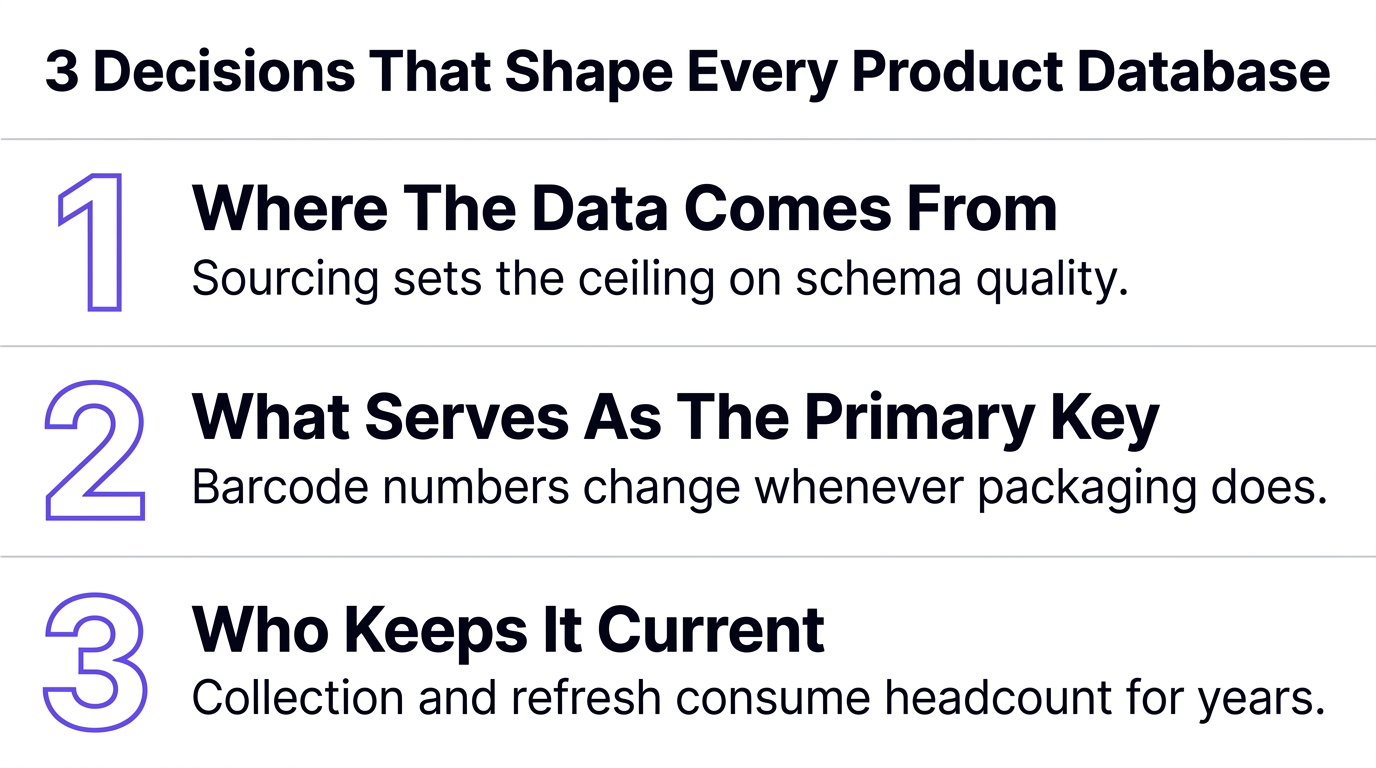
Teams that need reliable structured product records face the same three decisions: where to source data, how to model it, and whether to build the collection layer or connect to a product database API. This guide walks through each in order.
What Does a Product Database API Actually Store?
A product database API is an interface that returns structured product records, including identifiers, attributes, pricing, and availability, from a maintained data store rather than from your own collection pipeline. Before evaluating one, get precise about what a record contains and which parts you genuinely need.
Core Entities and Fields
Most product data models settle on three entities. The product carries name, brand, description, and category. Variants capture size, color, and configuration differences under a shared parent. Offers tie a specific seller to a specific price at a specific moment.
Separating offers from products matters more than it sounds. One item can be listed by dozens of merchants at different prices, and collapsing that into a single price column destroys the comparison you built the database for. Beyond those entities, add identifiers, images, specifications, and review signals, but start narrow, since fields are easier to add than to backfill accurately.
Reference Data Versus Your Own Catalog
A product catalog database holds items you sell. A reference database holds items that exist in the market, whether or not you carry them. Merchandising and assortment analysis depend on seeing past your own shelf, and a model with no room for products you do not stock cannot answer questions about gaps.
The practical approach is one canonical product table populated from external data, with your internal SKUs linked to it. Your product catalog database stays operational while the reference layer carries breadth.
Where Does Product Data Come From?
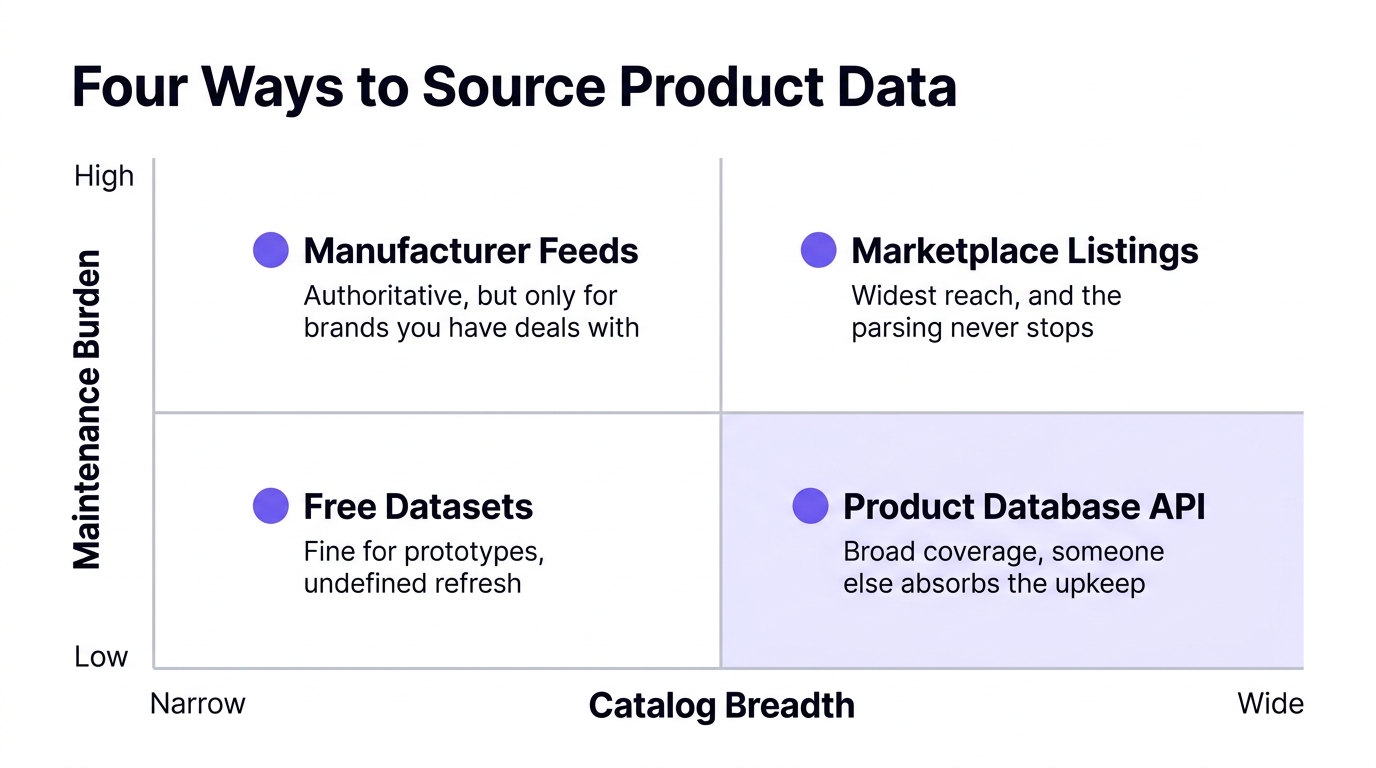
Three sourcing routes dominate, and most teams blend two of them. Each trades coverage against the engineering hours needed to keep it running.
Manufacturer Feeds and Marketplace Listings
Manufacturer and supplier feeds give you authoritative attributes straight from the brand owner. Coverage is excellent for brands you have relationships with and nonexistent for everyone else, and formats vary enough to require custom parsing per supplier.
Public marketplace and retailer listings solve the breadth problem. They show what is actually for sale, at what price, from which seller, across the long tail of brands you will never sign a feed agreement with. The cost is collection infrastructure that needs maintenance as page structures shift. Feeds supply depth on core brands, listings supply market-wide pricing.
Why a Free Product Database Falls Short
Open datasets and sample APIs are genuinely useful for prototyping. A free product database lets you validate your schema and build a working interface before anyone approves budget, then stops being useful the moment you need production coverage.
- Coverage is shallow and usually confined to consumer packaged goods or a handful of demo categories.
- Records are contributed rather than verified, so attribute accuracy varies and duplicates are common.
- Refresh cadence is undefined, which makes pricing and availability fields effectively decorative.
Use a free product database to prove the design works, then plan the replacement before you launch. Trial access to a production source is a cheaper way to test real coverage than discovering the gaps after go-live.
How Should You Design the Schema?
Two decisions carry most of the long-term weight: what serves as your primary key, and how you handle attributes that mean different things in different categories. Either one is expensive to unwind after you have loaded millions of rows.
Choosing a Stable Primary Key
The instinct is to key on GTIN, since it is standardized and globally unique. That instinct causes problems, because the number identifies a specific packaged trade item rather than a product concept.
The GS1 standard is explicit. Any new product requires a new GTIN, and so does a change to primary brand or declared net content, or a dimension change above 20 percent. The same shampoo in a bonus-size bottle gets a different number, and so does the identical product after a brand name change.
The workable pattern is an internal surrogate key, with identifiers stored in a separate one-to-many table. One product row can then carry several GTINs, a UPC, an EAN, and an MPN at once. If you are building barcode and identifier lookup into your application, that structure is what makes matching reliable.

Normalizing Attributes Across Categories
Attribute normalization is where in-house builds stall. Color stays a simple string until you have forty spellings of the same shade. Size means a number for footwear, a letter for apparel, and a volume for beverages.
The usual solution is a hybrid model. Fields shared by everything, such as brand and price, live in typed columns, while category-specific attributes live in a flexible key-value structure. Taxonomy needs the same treatment: build a canonical category tree and a mapping layer as data rather than code, because it will change often.
Should You Build the Collection Layer or Buy It?
Modeling and storage are parts most teams handle comfortably. Collection and refresh quietly consume headcount for years, which is why the build-versus-buy line falls between them. Connecting a product data API covers the second half without surrendering the first.
The pattern shows up across the discipline. In a 2026 survey of data practitioners and leaders, a majority reported spending most of their time maintaining or organizing datasets. Product data is a harsh version of that problem, since sources change without notice and volume is enormous.
Building the full stack makes sense in narrow circumstances:
- Your category is small enough that a handful of supplier feeds gives you near-complete coverage.
- Your attribute requirements are unusual enough that no general-purpose source captures them.
- You already run collection infrastructure for another purpose, so the marginal cost is low.
Outside those cases, buying collection and owning the schema is the better split. You keep control of your data model while someone else absorbs parsing, deduplication, and refresh. Per-record billing helps, since you pay for records you receive rather than every query you attempt.
One Schema Across Every Product Category
Here is the constraint that shapes the whole project: the number of integrations you maintain scales with the number of categories you cover, unless your source normalizes them for you.
Teams that assemble coverage vendor by vendor end up with a grocery source, an electronics source, an apparel source, and separate parsing logic for each, since every one brings its own field names and category labels. The normalization layer you were trying to avoid gets rebuilt internally, one connector at a time.
A single product data source covering every category removes that. Records arrive from tens of thousands of merchants already deduplicated and mapped into one consistent schema, so the field holding a brand name holds a brand name whether the item is a laptop or a bag of coffee.
Adding a category then becomes a query change rather than an integration project. That is the difference between a database that grows with the business and one that gets rewritten every time merchandising enters a new vertical.

Six Questions to Ask Before You Choose a Product Database API
Vendor evaluations of any product data API tend to fixate on record counts. These questions surface what actually determines whether the integration works six months in.
- Which identifiers come back with every record? Ask about GTIN, UPC, EAN, and MPN coverage rates, rather than whether the fields exist.
- How wide is category coverage? A source strong in electronics and thin in grocery forces a second vendor eventually. Test what you plan to expand into.
- Can you inspect the schema before integrating? Public documentation and a browsable data portal let you validate fields and run sample queries before writing integration code. Sources that require a sales call to show a response body are hiding something.
- What does a full backfill cost? Seeding a product catalog database means pulling millions of records at once, usually the largest single line item.
- Are there throughput limits? Requests-per-second caps mean building throttling and retry logic before you write anything useful. A source without them saves weeks.
- How do you retrieve only what changed? Confirm a date-updated field is exposed in the query interface, and check that it moves when attributes change rather than only when listings are new.
On that last point, use a scheduled delta query: poll on a cadence, filter to records updated since your last sync, and upsert the results. Several proven integration patterns for ecommerce platforms build on that loop, which scales far better than re-pulling your entire catalog.
Frequently Asked Questions
A few questions come up consistently once teams move from planning into implementation.
How Do You Match the Same Product Across Different Sources?
Start with exact identifier matches on GTIN or MPN, which resolve most of a catalog cleanly. The remainder needs fuzzy matching on brand, model, and normalized attributes, with a confidence threshold below which records stay separate. Avoid matching on title alone, since sellers rewrite titles constantly for search visibility.
How Often Does Product Data Need to Refresh?
It depends on the field. Pricing and availability go stale within hours in competitive categories, while descriptions, specifications, and images change rarely. Splitting your sync into fast and slow tracks cuts volume sharply without hurting accuracy.
Do You Still Need Your Own Database When Using a Product Data API?
Usually yes. Querying an external source live on every page load is slow and expensive, and it leaves you unable to run analytics across your own historical snapshots. The common architecture syncs into local storage on a schedule, then queries your own tables at runtime.
Building the Database Is the Easy Part
The schema decisions in this guide take a few days of careful thought. Identifier strategy, normalization, and taxonomy mapping are solvable problems with well-understood patterns. What separates a product database that lasts from one that decays is whether anyone can keep it populated after the initial build ships.
That is a sourcing question. Answer it before the first migration runs rather than after a quarter of stale pricing complaints.
Datafiniti gives teams a product database API with broad merchant coverage normalized into one schema across every category, with per-record pricing and no throughput caps to engineer around. Request a demo to see the data against your own categories before you commit to a build.
Read the latest articles

Read more

Build vs Buy: Business Data Enrichment for Growing Teams

Company Data API Pricing: Bulk & Enterprise-Scale Access

Best Business Data APIs for Sales Teams & Prospecting

Business Data API: Company Data at Enterprise Scale
How to Build a Product Database With a Product Data API

Property Data API Coverage: What U.S. Datasets Include

Product Data API for Ecommerce Price Monitoring and Repricing

Real-Time Product Data API for Product-Led Growth Teams

Property Ownership Data API for Skip Tracing and Lead Gen

How APIs Make Building a Product Database Easy
Learn how to build a product database with APIs for cleaner imports, updates, search, and scalable product data.

How to Leverage Competitor Pricing Data with an API
Use competitor pricing data to build API-driven monitoring, analysis, and smarter pricing decisions.

Price Monitoring API: The Key to E-Commerce Pricing Strategy
Use a price monitoring API to track market changes, improve pricing decisions, and protect ecommerce margins.

How do Product Data APIs Work for E-Commerce Companies?
Learn how a product data API works, from collection and queries to ecommerce integration and use cases.

GTIN Lookup API: Search Products by Barcode & UPC at Scale

Best Real Estate API 2026: Coverage, Pricing, Data Quality

Best Product Data API 2026: A State-of-the-Market Guide

Product Data API Integration Patterns for Ecommerce Platforms

Build a PropTech MVP With a Property Ownership Data API

3 Benefits of Web Scraping for Real Estate
Boost your research by using web scraping for real estate to gain market insights, automate lead lists, and minimize property risk.

How Real Estate Agents Can Leverage Proptech Data
Leverage proptech data to source leads, speed up valuations, and manage risk with accurate, real-time property insights.
What Is a UPC Lookup API?
Learn about the UPC lookup API, how it works, and its benefits for businesses. Get product data easily.

What Is a GTIN Lookup API?
Learn about the GTIN lookup API and how it can help your business grow. Get product data insights.

How Does a Property Data API Work?
Learn how a property data API works, its features, and how you can use it for real estate and business insights.

What The Best Real Estate APIs Should Have
Discover what makes the best real estate APIs stand out. Learn about essential features for your property data needs.
How to Access MLS Listing Data
Learn how to access MLS listing data using an MLS data API. Discover Datafiniti's solutions and integration tips.
.png)
How to Enrich Your Product Catalog With a Real-Time API
.jpeg)
Product Data API Buyer's Guide for Ecommerce Teams

Do I Need a Real Estate Listing API?
Explore the benefits and technicalities of a real estate listing API. Learn how to choose the right provider and integrate data for business growth.

Why Real Estate Tech Startups Need Property APIs with Ownership Details
Discover how property APIs with ownership details empower real estate tech startups. Learn about data integration, risk mitigation, and driving business value.
The Value of a Product Catalog Sync for Product Managers
Unlock the value of product catalog sync for product managers. Streamline data, improve decisions, and reduce costs with real-time insights.

What is a Product Data Webhook?
Learn about product data webhooks, their components, and how they enable real-time updates for business intelligence and workflow automation.

Why Is a Product Data API Integration Essential for Analysts & Product Managers?
Unlock insights with product data API integration. Essential for analysts & product managers to streamline data access & enhance product strategy.

What Is a Product Data API and Its Benefits
Learn about product data APIs, their benefits, and how they drive business growth. Explore integration and advanced use cases.

What Do eCommerce Data Vendors Do?
Learn what ecommerce data vendors do, their services, and how to choose the right one for your business growth.

How to Compare Product Data Providers: What to Look For
Compare product data providers. Learn what to look for in data quality, structure, and integration features.

How to Get Your Product Data in Real-Time Using APIs
Learn how to leverage real-time product data APIs for e-commerce, competitive analysis, and AI. Get instant access to clean, structured product data.

Best Product Data API: Features to Look for
Find the best product data API with real-time updates, comprehensive coverage, and a user-friendly portal. Explore features to look for.

Unlocking Property Data with an API
Access property data with a powerful property database API. Explore listings, market analysis, investment opportunities, and more. Get started today!

Unlocking CRE with APIs
Unlock commercial real estate insights with a powerful API. Access property data, streamline workflows, and enhance investment strategies.

How to Get a Real-Time Product Feed Using an API
Learn how to get a real-time product feed using an API. Access, leverage, and ensure accuracy of product data for your business needs.

Spying on Competitor Prices: What You Need to Know
Learn how to gather and analyze competitor pricing data to inform your business strategy. Understand key components and ethical considerations.

Product Data Enrichment: What Are You Missing?
Enhance your product data with comprehensive enrichment. Discover insights, drive growth, and choose the right approach for your business.
.png)
IDX vs MLS API: A Developer's Guide to Real Estate Listing Data
.png)
Real Estate API Pricing Models Explained: Subscription vs. Usage-Based

Real Estate API vs Web Scraping: The Buy-vs-Build Decision
.png)
Product Data APIs Explained: Powering Product Search and Catalog Automation

How to Get the Most out of a Product Catalog API
Learn how to leverage a product catalog API for business growth. Discover data quality, access methods, and strategy for your product catalog API.

Taming Your Ecommerce Product Data Feed
Optimize your ecommerce product data feed for growth. Learn strategies, leverage technology, and ensure data quality for better customer experience and AI initiatives.

Streamlining Your Product Search with an API
Explore the benefits and integration of a product search API. Streamline your product discovery and leverage data for business growth.
.png)
What Is a Real Estate Transaction Database? A Complete Guide

How Real Estate Platforms Access MLS Database APIs
.png)
Commercial Real Estate API vs. Residential Property API
.png)
How to Choose a Real Estate Database API for Your MVP
MLS API vs. IDX: What's the Diff?
MLS API vs IDX: Explore the differences in real estate data access, retrieval, and integration. Understand which solution fits your needs.

Scraping vs. APIs: Getting Real Estate Data
Compare web scraping vs real estate API for data acquisition. Learn the pros, cons, and best use cases for each method.

Property Valuation API: Your Go-To Real Estate Tool
Leverage the property valuation API for real estate insights. Access comprehensive property data for diverse applications with Datafiniti.

Product Data APIs Explained
Learn about product data APIs explained. Discover how to access, integrate, and utilize product data for e-commerce, analytics, and more.

Unlocking Your Ecommerce Data with APIs
Unlock ecommerce data with APIs for business insights, product catalog enrichment, and competitive analysis. Explore data via portal or API.

Real Estate Ownership Data: How to Access, Analyze and Use at Scale
Access, analyze, and use real estate ownership data at scale. Learn how to find, process, and leverage this crucial information for business insights.
IDX vs MLS API: What Every Real Estate Professional Should Know
Understand IDX vs MLS API differences. Learn about data access, integration, and how Datafiniti's solutions empower real estate professionals.

How a Property Database API Can Help Real Estate Pros
Learn how a property database API can help real estate pros analyze trends, monitor listings, and optimize strategies. Get data insights.

What Is a Residential Property API?
Explore what a residential property API is, its features, benefits, and real-world applications for real estate professionals and investors.

What Is a Commercial Real Estate API?
Explore commercial real estate API functionality, data integration, and use cases. Learn how to leverage property, business, and people data for insights.

Understanding MVP Data Integration
Learn about MVP data integration, its components, benefits, and strategies for accessing and utilizing data resources effectively.

How to Choose the Best Property Data API
Learn how to choose the best property data API. Explore features, providers, pricing, and integration for real estate insights.

Real Estate Database API: What to Look for
Explore real estate database API options. Learn about data quality, features, and how to choose the right provider for your needs.

How Do Product Data APIs Work?
Understand how a product data API works, its key features, integration methods, and applications for e-commerce and business intelligence.

How Do Data Aggregation Platforms Work?
Explore how data aggregation platforms work, their capabilities, and applications. Learn to choose and implement the right platform for your business intelligence needs.

Why Do Companies Need Property Data Aggregation?
Discover why property data aggregation is crucial for businesses. Streamline access, empower functions, enhance risk management, and drive strategic decisions with authoritative insights.

MLS Database API: How to Choose a Provider and Get Access

Product Search API vs. Product Data API: What's the Difference?

What Is a Product Data API?
Explore the functionality and benefits of a product data API. Learn how to integrate, leverage, and choose the right provider for your business insights.
What Is the Difference Between Product Search API and Product Data API?
Understand the difference between Product Search API and Product Data API. Learn how to leverage product data for business intelligence and analytics.

What Is a Property Data API?
Explore the capabilities of a property data API. Understand its core functionality, key features for developers, and how to access property information at scale for business insights.
.png)
Real Estate API Pricing: What You Need to Know Before You Build
.jpeg)
How to Choose a Property Market API for Investment Platforms
Choosing the right property market API is critical for investment platforms. Learn how to evaluate data depth, coverage, freshness, and integration quality before you commit.
Data you can trust, delivered in a format your systems can use, at the scale your product requires.