

Business Data API: Company Data at Enterprise Scale

Key Takeaways
A business data API gives engineering and analytics teams programmatic access to structured company records covering identity, location, industry classification, and operating attributes.
- Establishment churn is constant, so any company dataset you load today starts drifting immediately and needs a defined refresh path.
- Provider and buyer can end up on different NAICS vintages without either side noticing, which surfaces as a phantom coverage gap.
- Rate limits convert into permanent engineering work: backoff, retry handling, queueing, and monitoring to keep all of it alive.
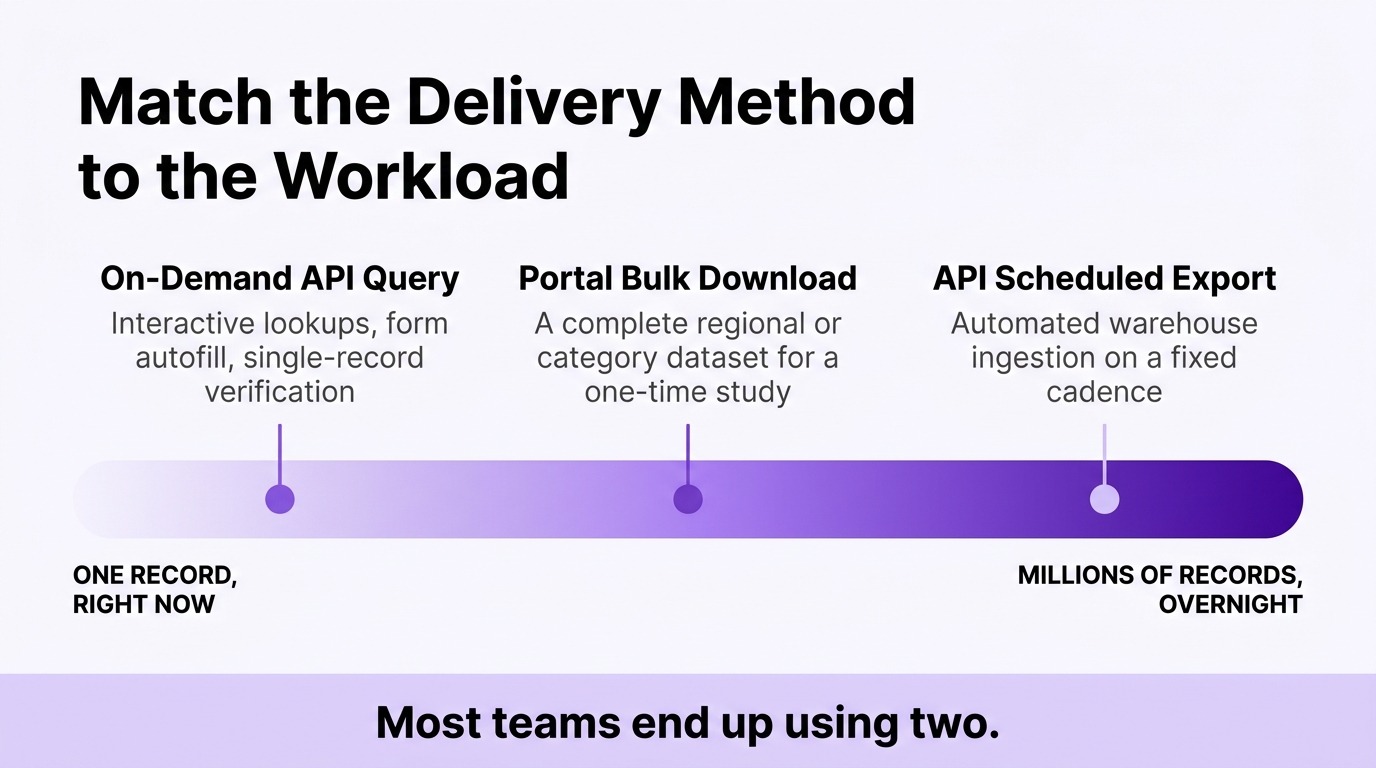
- Interactive lookups, nightly enrichment, and full category refreshes each want a different transport, and most teams end up using two.
Headline record totals describe a dataset you will never query in full, so size the segment you actually need before anything else.
A business data API is a programmatic interface that returns structured records about companies, including business name, physical address, industry classification, category, operating hours, and contact details. Vendors also market the same capability as a company data API. Instead of assembling company information from directory scrapes, government filings, and manual research, you query a single endpoint and get consistent JSON that your systems can consume.
The subject moves constantly. In the fourth quarter of 2025 alone, Bureau of Labor Statistics figures recorded 338,000 private-sector establishment births, and in the most recent quarter with published death data, 284,000 establishments closed permanently. A company file that was accurate in January is measurably wrong by April.
Four questions decide a vendor: what the records contain, how fast they go stale, whether the API sustains your query volume, and how the data reaches your warehouse.
What Is a Business Data API, and What Does It Return?
The term covers a category rather than a single product shape. Some providers focus on B2B sales intelligence, some on point-of-interest and location data, and some on general-purpose company reference data. What they share is the delivery model: authenticated requests in, structured records out.
What Fields a Company Data API Returns
Records are organized into a few stable field groups. Business identity covers legal and operating names plus known aliases. Location covers street address, city, state, postal code, and geocoordinates. Classification covers NAICS or SIC codes with human-readable category labels. Most providers add operating hours, phone numbers, websites, descriptive text, and sometimes chain or franchise relationships.
The practical test is whether the fields you need are populated at a usable rate, not whether they appear in the schema. A field documented but null for 70% of independent retailers is not something you can build on.
How a Firmographic Data API Differs From Contact Data
A firmographic data API describes organizations. A contact database describes the individuals who work at them. The two carry different compliance obligations, different match logic, and different refresh cadences.
Firmographics answer questions about the entity: what it does, where it operates, how large it is, and what category it belongs to. Providers typically maintain people data as a separate dataset with its own schema and access terms.
Conflating the two is expensive. Teams buy a company dataset expecting decision-maker contacts, or a contact database expecting location-level coverage of every branch. Decide which entity your workload keys on before you shortlist anyone.
Why Does Enterprise Company Data Go Stale So Quickly?
Company records decay for two independent reasons, and most teams plan for only the first. Businesses change, and the classification systems used to describe them change on a separate cycle.

Establishment Churn Never Stops
The churn figures above are not an artifact of one volatile quarter. Locations relocate, chains close branches, independents change ownership and rebrand, and hours shift seasonally. For lead generation, stale records mean outreach against businesses that no longer exist. For location intelligence, they mean site selection models built on a landscape that has already moved.
Any serious evaluation should include a decay test. Pull several hundred records in a market you know well, verify them against reality, and count how many are wrong. That number tells you more than any vendor freshness claim.
Classification Vintages Drift Independently
Industry codes are revised on a fixed cycle with a long transition period. The Census Bureau notes that NAICS is revised every five years and expects its own economic programs to finish adopting the 2022 vintage by the end of calendar year 2027.
That revision eliminated Subsector 454, Nonstore Retailers, and reclassified those establishments by what they sell rather than how they sell it. If your taxonomy runs on 2022 NAICS and your provider still emits 2017 codes, your online retail segments will not reconcile, and the mismatch will look like a coverage gap rather than a versioning problem.
How to Keep Records Current Over Time
The durable pattern for ongoing sync is a scheduled delta query. You poll the search endpoint on a defined cadence with a dateUpdated filter set to your last successful sync, then upsert only the records that changed. This practice keeps ingestion proportional to actual change rather than to total dataset size.
Build the job so that silent failures surface. A delta query returning zero records looks identical to one that failed to authenticate, and the second will freeze your data for a month if nothing alerts on it.
What Does Coverage Actually Mean at Enterprise Scale?
A headline record total is the least useful number when you're sizing enterprise company data because it says nothing about whether the slice you query is dense. Three dimensions are worth checking directly:
- Category breadth. Confirm your industries are represented at depth rather than merely present. Food service and retail are covered almost everywhere. Specialized B2B services, light manufacturing, and professional practices vary widely between providers.
- Geographic depth. National coverage should mean one dataset for the whole country, without metro add-ons layered on top. Regional licensing creates contract sprawl and forces renegotiation every time you expand.
- Attribute completeness. Run a fill-rate check on the fields your product depends on, segmented by market type. Aggregate completeness hides thin coverage in exactly the places you'll need it.
Providers that publish business data coverage by category make this process faster because you can size the relevant segment before spending a sprint on a proof of concept.
Can a Business Data API Sustain Enterprise Throughput?
Throughput is the constraint that determines whether a company data API works at scale, and it's the one most evaluations skip. Teams compare record counts and field lists, sign a contract, then discover during the first full refresh that the API caps them at a few requests per second.
Consumption patterns are moving in a direction that makes this problem worse. Postman's 2025 State of the API Report found that 24.3% of developers are already designing APIs for AI agents, a shift toward machine-scale consumption that runs continuously and in parallel rather than in human-paced bursts.

What Rate Limits Cost Your Team
A requests-per-second ceiling is not a minor inconvenience. It becomes engineering work you build, own, and maintain permanently.
You write a token bucket, exponential backoff with jitter, and retry handling that distinguishes a 429 from a real failure. You build queue infrastructure to smooth bursts, monitoring to catch when it backs up, and alerting so someone knows before the nightly job misses its window. None of that produces business value. It works around a supplier constraint, and your team maintains it as long as the integration lives.
Designing for Unthrottled Batch Runs
Without throughput caps, the architecture collapses to something simpler. You parallelize workers to whatever your own infrastructure supports, run the batch, and finish when the data is done rather than when the throttle permits.
That adaptation changes what's feasible. A full category refresh across a national footprint becomes an overnight job instead of a multi-day rolling process. Enrichment against a large account list runs in one pass rather than chunked across a week.
It also changes how you experiment. When a broad query costs nothing in retry logic or queue latency, exploratory analysis stops being a scheduling negotiation. Paired with billing that counts records actually returned rather than requests attempted, the cost of asking a wide question drops to the cost of the answer.
How Should Company Data Reach Your Systems?
Your delivery method should follow your workload shape, and most teams eventually need more than one.
On-Demand Queries Through a Real-Time Company Data API
A real-time company data API is best understood as real-time retrieval. You issue a request and receive current records immediately, which is what you want for interactive lookups, form autofill, single-record verification, and enrichment triggered by user action.
What it does not mean is that physical-world changes reach you the instant they occur. Records refresh on rolling collection schedules, and no provider observes a business changing its hours as it happens. Treat "real-time" as a claim about query latency, and treat freshness as a separate question with a separate answer.
Bulk Files and Scheduled Exports
Large analytical workloads belong in bulk delivery. Pulling several million records through paginated calls is slower, more failure-prone, and more expensive to operate than requesting the same set as files.
Portal-driven bulk downloads suit analysts who need a complete regional or category dataset for a one-time study. API-driven scheduled exports suit engineering teams automating warehouse ingestion, where the same filtered slice lands on a fixed cadence. Because both follow the API's schema, you can prototype against query responses and move to bulk without rewriting your parser.
Location intelligence often combines sources this way, joining company records against property attributes so a site selection model sees both the competitive landscape and the physical footprint, a pattern that also appears in commercial real estate API workflows.
Seven Questions to Ask Before You Commit to a Business Data API
Run these questions before the contract, not after the first failed refresh.
- Which NAICS vintage do you emit? Confirm whether 2017 and 2022 codes are both available and how reclassified establishments are handled.
- What is the throughput ceiling? Ask for the specific requests-per-second limit. "Contact us for higher tiers" is a rate limit with extra steps.
- Are record identifiers stable across refreshes? If a business's ID changes when its address or category is corrected, your joins subtly break, and duplicates accumulate downstream.
- What does the update timestamp actually mean? Confirm whether it marks a verified change to the business or any touch to the record. The two produce very different delta volumes.
- How are chains and multi-location brands modeled? Confirm whether each location is its own record and whether a parent identifier links them, since rollup logic differs sharply between providers.
- Can I evaluate before integrating? A visual portal for searching, filtering, and exporting sample records removes weeks of guesswork versus reading a schema and hoping.
- How are sources normalized? Deduplication logic determines whether you inherit clean records or someone else's merge conflicts, so knowing how data aggregation platforms work helps here.
Frequently Asked Questions
How Much Does a Business Data API Cost?
Pricing is usually tiered by monthly record volume, with per-record rates falling as commitment rises. The variable that matters most is the billing unit. Paying for records delivered protects you from charges on exploratory queries that return nothing useful, while per-request pricing bills the attempt regardless of outcome.
Can I Match Company Records Against My Existing CRM?
Matching a company data API against CRM records works, though rates depend on the identifiers you hold. Domain, or exact business name plus address, produces the strongest results. Name-only matching generates false positives, particularly for franchises and chains with many locations. Run a sample match on a few thousand of your own records before committing to a full enrichment run.
How Do I Test a Real-Time Company Data API Before Buying?
Run your own worst-case query shape rather than the vendor's sample request. Check response times under concurrency instead of on a single call, and page all the way through a large result set to see whether deep pagination degrades. Trials that only exercise single-record lookups tell you almost nothing about production behavior.
Does a Firmographic Data API Include International Companies?
Coverage varies, and many providers marketing globally are far thinner outside their home region. Test each target country separately rather than trusting a global record count, and confirm which classification standard applies outside North America.
Choosing Enterprise Company Data That Scales With Your Workload
The criteria that matter are unglamorous. A stated refresh cadence and a working delta pattern beat a vague freshness claim. Throughput headroom beats a longer field list because a field you can't retrieve at volume is a field you don't have. Stable identifiers beat a wider schema because unstable ones corrupt every join you build on them.
Most of these criteria are verifiable in an afternoon with a trial account and a few hundred records from a market you already know well. Vendors describe averages, and your workload lives in specifics.
Datafiniti Business Data provides U.S. company and firmographic records with category, location, and operating attributes under a consistent schema, reachable through a visual portal, an API with no rate limits, and bulk files or scheduled exports. Request a demo to see the coverage in your markets before you build.
Read the latest articles

Read more

Best Product Catalog API for Online Retailers: Aggregating Multi-Retailer Catalogs

Build vs Buy: Business Data Enrichment for Growing Teams

Company Data API Pricing: Bulk & Enterprise-Scale Access

Best Business Data APIs for Sales Teams & Prospecting
Business Data API: Company Data at Enterprise Scale

How to Build a Product Database With a Product Data API

Property Data API Coverage: What U.S. Datasets Include

Product Data API for Ecommerce Price Monitoring and Repricing

Real-Time Product Data API for Product-Led Growth Teams

Property Ownership Data API for Skip Tracing and Lead Gen

How APIs Make Building a Product Database Easy
Learn how to build a product database with APIs for cleaner imports, updates, search, and scalable product data.

How to Leverage Competitor Pricing Data with an API
Use competitor pricing data to build API-driven monitoring, analysis, and smarter pricing decisions.

Price Monitoring API: The Key to E-Commerce Pricing Strategy
Use a price monitoring API to track market changes, improve pricing decisions, and protect ecommerce margins.

How do Product Data APIs Work for E-Commerce Companies?
Learn how a product data API works, from collection and queries to ecommerce integration and use cases.

GTIN Lookup API: Search Products by Barcode & UPC at Scale

Best Real Estate API 2026: Coverage, Pricing, Data Quality

Best Product Data API 2026: A State-of-the-Market Guide

Product Data API Integration Patterns for Ecommerce Platforms

Build a PropTech MVP With a Property Ownership Data API
How Real Estate Agents Can Leverage Proptech Data
Leverage proptech data to source leads, speed up valuations, and manage risk with accurate, real-time property insights.

What Is a UPC Lookup API?
Learn about the UPC lookup API, how it works, and its benefits for businesses. Get product data easily.

What Is a GTIN Lookup API?
Learn about the GTIN lookup API and how it can help your business grow. Get product data insights.

How Does a Property Data API Work?
Learn how a property data API works, its features, and how you can use it for real estate and business insights.

What The Best Real Estate APIs Should Have
Discover what makes the best real estate APIs stand out. Learn about essential features for your property data needs.

MLS Listings API: How to Access MLS Listing Data
.png)
How to Enrich Your Product Catalog With a Real-Time API
.jpeg)
Product Data API Buyer's Guide for Ecommerce Teams

Why Real Estate Tech Startups Need Property APIs with Ownership Details
Discover how property APIs with ownership details empower real estate tech startups. Learn about data integration, risk mitigation, and driving business value.
The Value of a Product Catalog Sync for Product Managers
Unlock the value of product catalog sync for product managers. Streamline data, improve decisions, and reduce costs with real-time insights.

What is a Product Data Webhook?
Learn about product data webhooks, their components, and how they enable real-time updates for business intelligence and workflow automation.

Why Is a Product Data API Integration Essential for Analysts & Product Managers?
Unlock insights with product data API integration. Essential for analysts & product managers to streamline data access & enhance product strategy.

What Is a Product Data API and Its Benefits
Learn about product data APIs, their benefits, and how they drive business growth. Explore integration and advanced use cases.

What Do eCommerce Data Vendors Do?
Learn what ecommerce data vendors do, their services, and how to choose the right one for your business growth.

How to Compare Product Data Providers: What to Look For
Compare product data providers. Learn what to look for in data quality, structure, and integration features.

How to Get Your Product Data in Real-Time Using APIs
Learn how to leverage real-time product data APIs for e-commerce, competitive analysis, and AI. Get instant access to clean, structured product data.

Best Product Data API: Features to Look for
Find the best product data API with real-time updates, comprehensive coverage, and a user-friendly portal. Explore features to look for.

Unlocking Property Data with an API
Access property data with a powerful property database API. Explore listings, market analysis, investment opportunities, and more. Get started today!

Unlocking CRE with APIs
Unlock commercial real estate insights with a powerful API. Access property data, streamline workflows, and enhance investment strategies.

How to Get a Real-Time Product Feed Using an API
Learn how to get a real-time product feed using an API. Access, leverage, and ensure accuracy of product data for your business needs.

Spying on Competitor Prices: What You Need to Know
Learn how to gather and analyze competitor pricing data to inform your business strategy. Understand key components and ethical considerations.

Product Data Enrichment: What Are You Missing?
Enhance your product data with comprehensive enrichment. Discover insights, drive growth, and choose the right approach for your business.
.png)
Real Estate API Pricing Models Explained: Subscription vs. Usage-Based

Real Estate API vs Web Scraping: The Buy-vs-Build Decision
.png)
Product Data APIs Explained: Powering Product Search and Catalog Automation

How to Get the Most out of a Product Catalog API
Learn how to leverage a product catalog API for business growth. Discover data quality, access methods, and strategy for your product catalog API.

Taming Your Ecommerce Product Data Feed
Optimize your ecommerce product data feed for growth. Learn strategies, leverage technology, and ensure data quality for better customer experience and AI initiatives.

Streamlining Your Product Search with an API
Explore the benefits and integration of a product search API. Streamline your product discovery and leverage data for business growth.

What Is a Real Estate Transaction Database? A Complete Guide
.png)
Commercial Real Estate API vs. Residential Property API
.png)
How to Choose a Real Estate Database API for Your MVP

Property Valuation API: Your Go-To Real Estate Tool
Leverage the property valuation API for real estate insights. Access comprehensive property data for diverse applications with Datafiniti.

Product Data APIs Explained
Learn about product data APIs explained. Discover how to access, integrate, and utilize product data for e-commerce, analytics, and more.

Unlocking Your Ecommerce Data with APIs
Unlock ecommerce data with APIs for business insights, product catalog enrichment, and competitive analysis. Explore data via portal or API.

Real Estate Ownership Data: How to Access, Analyze and Use at Scale
Access, analyze, and use real estate ownership data at scale. Learn how to find, process, and leverage this crucial information for business insights.

IDX vs MLS API: What Every Real Estate Professional Should Know

How a Property Database API Can Help Real Estate Pros
Learn how a property database API can help real estate pros analyze trends, monitor listings, and optimize strategies. Get data insights.

What Is a Residential Property API?
Explore what a residential property API is, its features, benefits, and real-world applications for real estate professionals and investors.

What Is a Commercial Real Estate API?
Explore commercial real estate API functionality, data integration, and use cases. Learn how to leverage property, business, and people data for insights.

Understanding MVP Data Integration
Learn about MVP data integration, its components, benefits, and strategies for accessing and utilizing data resources effectively.

How to Choose the Best Property Data API
Learn how to choose the best property data API. Explore features, providers, pricing, and integration for real estate insights.

How Do Product Data APIs Work?
Understand how a product data API works, its key features, integration methods, and applications for e-commerce and business intelligence.

How Do Data Aggregation Platforms Work?
Explore how data aggregation platforms work, their capabilities, and applications. Learn to choose and implement the right platform for your business intelligence needs.

Why Do Companies Need Property Data Aggregation?
Discover why property data aggregation is crucial for businesses. Streamline access, empower functions, enhance risk management, and drive strategic decisions with authoritative insights.

MLS Database API: How to Choose a Provider and Get Access

Product Search API vs. Product Data API: What's the Difference?

What Is a Product Data API?
Explore the functionality and benefits of a product data API. Learn how to integrate, leverage, and choose the right provider for your business insights.
What Is the Difference Between Product Search API and Product Data API?
Understand the difference between Product Search API and Product Data API. Learn how to leverage product data for business intelligence and analytics.

What Is a Property Data API?
Explore the capabilities of a property data API. Understand its core functionality, key features for developers, and how to access property information at scale for business insights.
.png)
Real Estate API Pricing: What You Need to Know Before You Build
.jpeg)
How to Choose a Property Market API for Investment Platforms
Choosing the right property market API is critical for investment platforms. Learn how to evaluate data depth, coverage, freshness, and integration quality before you commit.
Data you can trust, delivered in a format your systems can use, at the scale your product requires.