

Real-Time Product Data API for Product-Led Growth Teams
Key Takeaways
A real-time product data API earns its place in a product-led growth stack when it can answer a query fast enough to change what a user sees in the session they are already in.
- Freshness and latency are separate measurements, and a vendor can be strong on one while being weak on the other.
- Sync design matters more than a vendor's headline speed number, because it decides what happens the first time your pipeline goes down.
- Product-led growth data only works in-app when the schema holds steady across categories, since interface logic cannot branch on fields that appear inconsistently.
- Time to first working call is a legitimate buying criterion, and public documentation is what makes that time short.
Evaluate a real-time data api the way your own users evaluate your product: by trying it before anyone asks you to book a call.
Product-led growth teams live or die by the first session. A user signs up, drops in a SKU, and sees a blank field where a price should be. The activation moment is gone, and no email sequence recovers it.
That pressure is what moves product teams toward a real-time product data API instead of a nightly export, because the data has to arrive while the user is still watching. Mixpanel's 2026 guidance on product-led growth, drawing on a report that analyzed more than 12,000 companies, named the product itself as the new primary growth channel, which puts unusual weight on whether the data behind that product shows up on time. Teams that need to access structured product data at that speed are making an infrastructure decision rather than a vendor preference.
What Is a Real-Time Product Data API?
A real-time product data API is an interface that returns current product records, including price, availability, images, identifiers, and attributes, on demand at query time rather than on a fixed export schedule. That distinction changes what you can build. A nightly file supports a dashboard someone reviews in the morning. An on-demand query supports an interface a user is looking at right now.
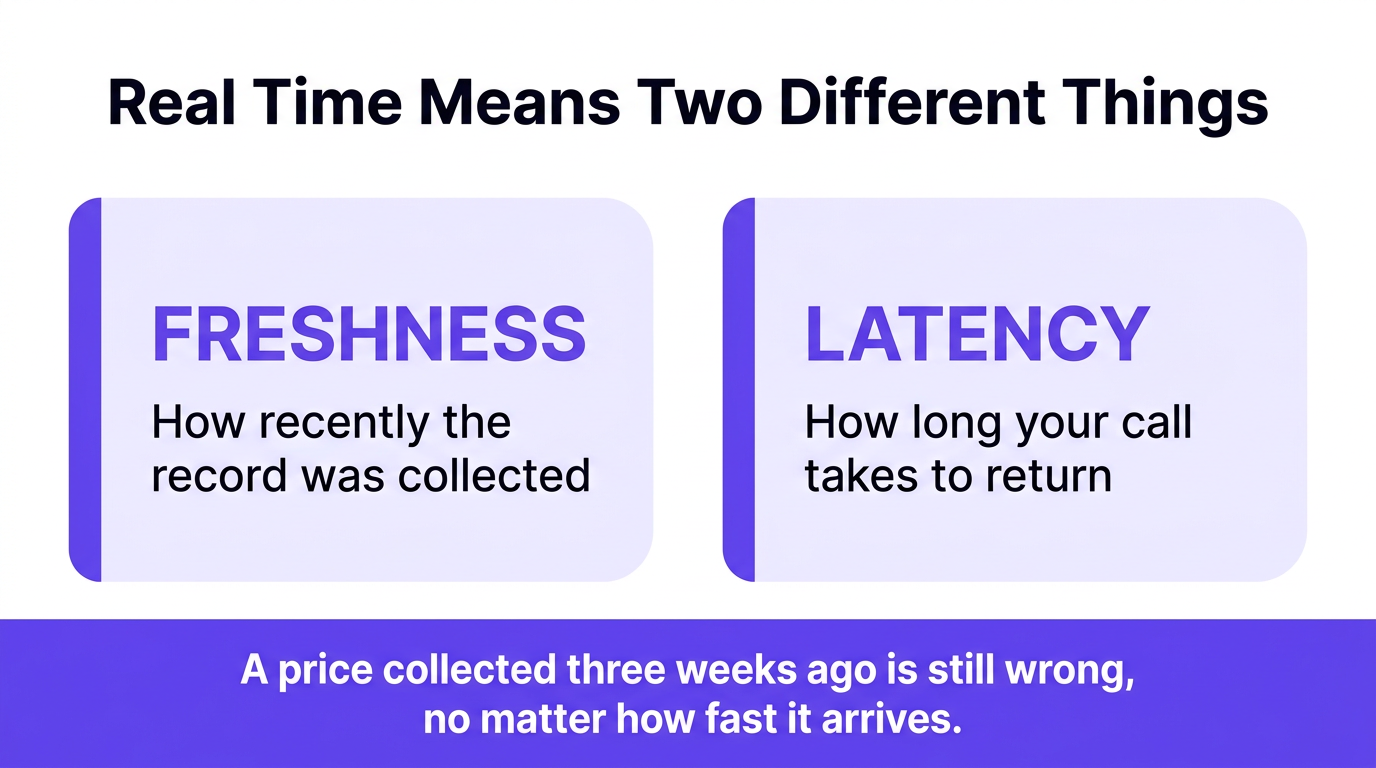
Two separate properties get collapsed into the phrase real time, and pulling them apart is the first useful thing an evaluation can do.
Freshness Versus Latency
Freshness describes how recently the record was collected. Latency describes how long your call takes to return. A response arriving in eighty milliseconds carrying a price collected three weeks ago is fast and wrong. A response carrying this morning's price that takes nine seconds is accurate and unusable inside a signup flow.
Ask for the two figures separately. Vendors quote latency because it is flattering and easy to measure, while freshness varies by category, merchant, and field. Price and availability move constantly while brand and title barely move at all, so a blended average tells you close to nothing.
Why Parsing Merchant Pages In-House Breaks Down
Teams that build their own collection layer underestimate how unstable the source is. Retail product pages are written for shoppers rather than parsers, and their structure shifts whenever a merchant ships a redesign. Adobe's April 2026 analysis of U.S. retail sites found that individual product pages averaged 66 percent on its machine readability benchmark, meaning roughly a third of a typical product page is not cleanly readable by machines to begin with.
An in-house scraper pointed at those pages inherits every one of those gaps, then inherits them again each time a template changes. The cost rarely surfaces during the build. It surfaces later, when a redesign silently empties a field and nobody notices until a customer does.
How Do Product-Led Growth Teams Use Real-Time Product Data?
Product-led growth data has one central job here: it removes the empty-state problem. A user who arrives to a blank account has nothing to be impressed by, and the fastest fix is filling their workspace with real information about products they already care about.
Onboarding and Time to First Value
Activation depends on how quickly a new user sees something recognizable. A tool that demands a CSV upload first has put a chore between signup and the moment that matters. One that accepts a single URL or barcode, resolves it against a real-time data api, and returns a populated record with current competitor pricing has compressed that gap to seconds.
Freshness becomes a retention question here. The first record a user sees sets their belief about whether the whole product is accurate, and if it is stale, everything after it reads as suspect.

Catalog and Record Enrichment
Enrichment is the highest-volume use of product data in most PLG applications. A user connects a store or pastes a list of identifiers, and the application fills in what they lack: images, categories, brand, specifications, and pricing across merchants. Teams that enrich a product catalog usually run it twice, once at connection time to backfill and then continuously as new items appear. How cleanly that resolves depends on whether the provider can match products by barcode or UPC and not only by proprietary SKU.
The volume pattern is spiky by nature. A single enterprise customer connecting a large catalog can generate a burst that dwarfs your ordinary daily volume, and throughput caps turn that burst into a queue during their first hour.
In-App Experiences and Personalization
Product-led growth data also drives what users see after activation: comparison views, price-drop indicators, availability badges, and recommendation surfaces. These render inside a page the user is already looking at, so schema consistency matters more here than anywhere else. A field present for electronics but absent for apparel forces defensive code into every component that touches it.
How Do You Keep a Product Data Feed Current After Launch?
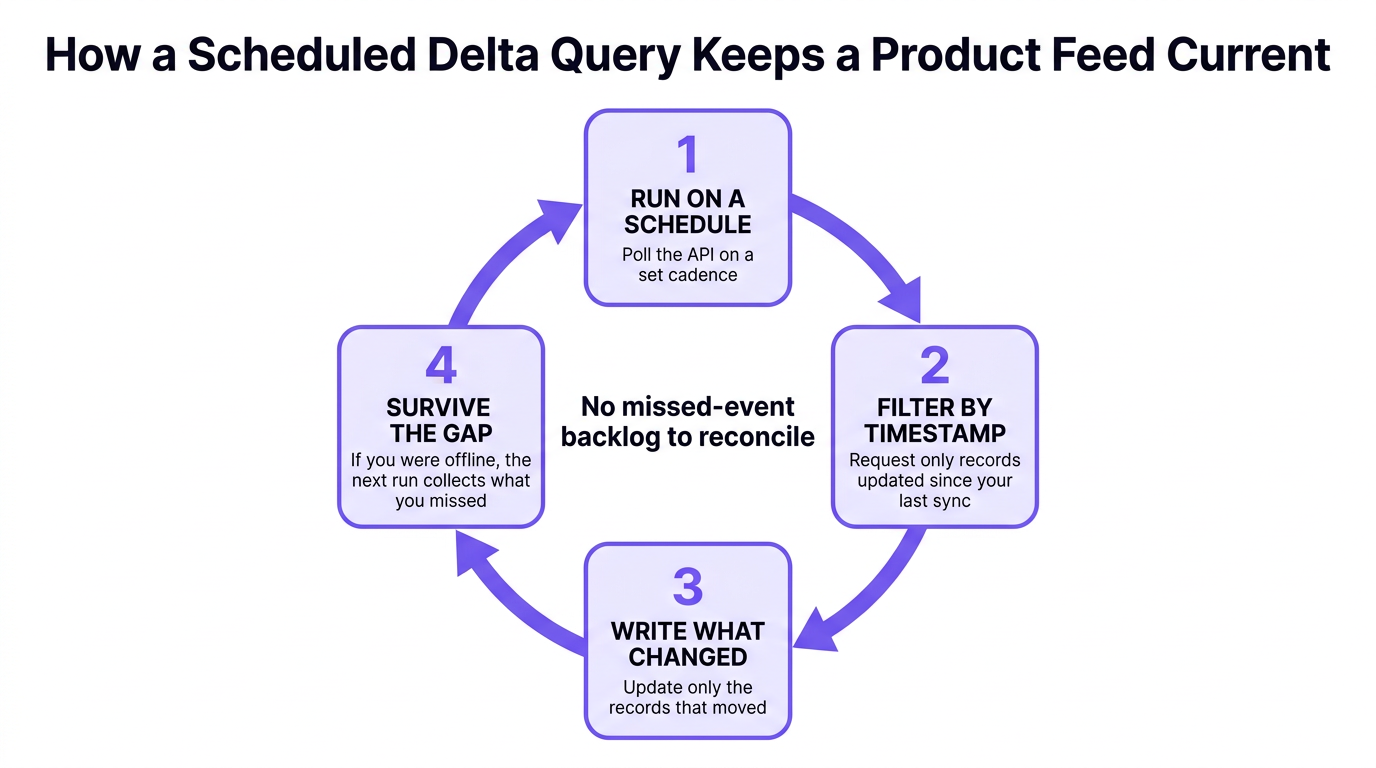
Keeping a product data feed current is a scheduling problem, and the pattern that survives contact with production is the scheduled delta query. You poll on a cadence, filter to records whose last-updated timestamp falls after your previous sync, and write only what changed.
Why Scheduled Delta Queries Hold Up
A delta query gives you replayability. If your consumer goes down for two hours, the next scheduled run collects everything that changed in the gap, because a timestamp filter does not care that you were offline. There is no missed-event backlog to reconcile.
Cadence should follow volatility rather than one global setting. Pricing on your most-watched items may warrant an hourly pass, while descriptive attributes across a long tail can run weekly without anyone noticing. Deciding those tiers before you design the scheduler will save you a rewrite.
Setting a Freshness Target You Can Defend
Set a target per surface instead of one for the whole application. A comparison view a user refreshes by hand can tolerate an hour. An alert promising to notify someone when a price drops cannot, because the promise is explicit and the user will check it against reality.
Then instrument the sync itself. The common failure mode is not a loud error. It is a job that keeps completing successfully while returning zero changed records, because a filter parameter drifted and nobody was watching. Alert on unexpected silence, not only on exceptions.
Why Public Documentation Decides How Fast You Can Ship
The most PLG-native question you can put to a real-time product data API vendor is how long it takes one developer to make a first working call without speaking to anyone. Product-led companies were built on the premise that people should evaluate software by using it. A vendor that gates query structure behind a discovery call asks you to abandon that premise on the supply side while preaching it on the demand side.
Documentation quality is a measurable and widely acknowledged problem. Postman's State of the API research found that 55 percent of surveyed API professionals struggle with inconsistent documentation, one of the most persistent collaboration challenges the report tracks.
What Self-Serve Evaluation Actually Looks Like
Genuinely public documentation lets an engineer settle the questions that decide a build in a single afternoon: which fields exist, what the query syntax is, how filtering and pagination behave, and what a real record contains.
The practical test is quick. Open the documentation from a private browser window. If you can read the full field reference and build a valid query without an account, the vendor has done the work. If you hit a form instead, budget calendar time for scheduling and a discovery call before your team learns what a web page could have shown them immediately.
A browsable portal extends the same idea past the documentation. Running a query visually and looking at real records before writing integration code answers the coverage question, which documentation by itself cannot settle.
Seven Questions to Ask Before Choosing a Real-Time Product Data API
Work through these before committing sprint capacity. Each one has produced an unpleasant surprise for somebody well after the contract was signed.
- How fresh is each field, separately? Pull a live sample in your own category and read the last-updated timestamps yourself rather than accepting a stated average.
- What happens at peak volume? Confirm whether throughput caps exist. An API without requests-per-second limits removes the throttling and retry logic you would otherwise maintain.
- Is the schema identical across categories? Request samples from three unrelated categories and compare the field sets side by side rather than trusting a curated demo.
- How does billing work? Per-record billing charges for records returned, while per-request models charge for attempts, including queries that come back empty.
- Is the documentation current with the API? Compare the published field list against what a live response actually returns, since documentation drift breaks mappings quietly.
- How do identifiers resolve? Matching the same physical item across merchants is where most integrations quietly lose accuracy, and it rarely surfaces in a scripted demo.
- What is coverage like outside your test set? Vendors demo with the categories they are strongest in. Coverage that spans many merchants and categories is what keeps you from bolting on a second provider a year later.
Frequently Asked Questions
A few questions surface in nearly every evaluation, usually right after the first technical call.
What Is the Difference Between a Real-Time Data API and a Product Data Feed?
The difference is who decides what arrives. With a real-time data api, your query determines the result set and the timing. A product data feed delivers a predetermined set on a schedule the provider controls. Most production systems run both, leaning on a scheduled feed or bulk file for baseline volume and reserving queries for anything a user is waiting on.
What Should Happen When a Record Comes Back Missing?
Decide the fallback behavior before launch, because gaps will occur. The realistic options are omitting the missing field, falling back to the last known value with a visible timestamp, or suppressing the item entirely. Showing a stale value without labeling it as stale damages user trust, so rule it out even though it is easiest to implement.
Does Real-Time Product Data Matter for AI Features?
It matters a great deal, because retrieval-based features are only as current as the records behind them. An assistant answering a pricing question from a catalog synced last quarter produces a confident wrong answer, which is worse for trust than no answer at all. Once AI surfaces run on product records, freshness becomes a correctness requirement.
Choosing a Real-Time Product Data API You Will Not Outgrow
Three things can be tested before you sign anything: whether the freshness claim holds at the field level, whether the sync pattern survives your own outages, and whether your engineers can evaluate the API without asking permission. Those three set the ceiling on what you can build.
Datafiniti's product data API gives product teams public documentation, a browsable portal for exploring records before writing integration code, per-record pricing that charges only for the data you actually receive, and no rate limits when a customer connects a large catalog at once. To find out whether the coverage holds up against your own categories, start with a short demo.
Read the latest articles

Read more

Build vs Buy: Business Data Enrichment for Growing Teams

Company Data API Pricing: Bulk & Enterprise-Scale Access

Best Business Data APIs for Sales Teams & Prospecting

Business Data API: Company Data at Enterprise Scale

How to Build a Product Database With a Product Data API

Property Data API Coverage: What U.S. Datasets Include

Product Data API for Ecommerce Price Monitoring and Repricing
Real-Time Product Data API for Product-Led Growth Teams

Property Ownership Data API for Skip Tracing and Lead Gen

How APIs Make Building a Product Database Easy
Learn how to build a product database with APIs for cleaner imports, updates, search, and scalable product data.

How to Leverage Competitor Pricing Data with an API
Use competitor pricing data to build API-driven monitoring, analysis, and smarter pricing decisions.

Price Monitoring API: The Key to E-Commerce Pricing Strategy
Use a price monitoring API to track market changes, improve pricing decisions, and protect ecommerce margins.

How do Product Data APIs Work for E-Commerce Companies?
Learn how a product data API works, from collection and queries to ecommerce integration and use cases.

How to Integrate MLS Listings Using an MLS Data API

GTIN Lookup API: Search Products by Barcode & UPC at Scale

Best Real Estate API 2026: Coverage, Pricing, Data Quality

Best Product Data API 2026: A State-of-the-Market Guide

Product Data API Integration Patterns for Ecommerce Platforms

Build a PropTech MVP With a Property Ownership Data API

3 Benefits of Web Scraping for Real Estate
Boost your research by using web scraping for real estate to gain market insights, automate lead lists, and minimize property risk.

How Real Estate Agents Can Leverage Proptech Data
Leverage proptech data to source leads, speed up valuations, and manage risk with accurate, real-time property insights.

What Is a UPC Lookup API?
Learn about the UPC lookup API, how it works, and its benefits for businesses. Get product data easily.

What Is a GTIN Lookup API?
Learn about the GTIN lookup API and how it can help your business grow. Get product data insights.

How Does a Property Data API Work?
Learn how a property data API works, its features, and how you can use it for real estate and business insights.

What The Best Real Estate APIs Should Have
Discover what makes the best real estate APIs stand out. Learn about essential features for your property data needs.

The Benefits of a Real Estate MLS API
Learn about the benefits of a real estate MLS API for streamlining data access and driving business growth.

Why Every Real Estate Pro Needs an MLS Database API
Learn why a MLS database API is vital for real estate pros. Get data, insights, and competitive edge.
How to Access MLS Listing Data
Learn how to access MLS listing data using an MLS data API. Discover Datafiniti's solutions and integration tips.
.png)
How to Enrich Your Product Catalog With a Real-Time API
.jpeg)
Product Data API Buyer's Guide for Ecommerce Teams

Do I Need a Real Estate Listing API?
Explore the benefits and technicalities of a real estate listing API. Learn how to choose the right provider and integrate data for business growth.

Unlocking the MLS Database with APIs
Unlock the MLS database with APIs. Learn how to access property data, gain real estate insights, and integrate MLS data for your business needs.

Why Real Estate Tech Startups Need Property APIs with Ownership Details
Discover how property APIs with ownership details empower real estate tech startups. Learn about data integration, risk mitigation, and driving business value.
The Value of a Product Catalog Sync for Product Managers
Unlock the value of product catalog sync for product managers. Streamline data, improve decisions, and reduce costs with real-time insights.

What is a Product Data Webhook?
Learn about product data webhooks, their components, and how they enable real-time updates for business intelligence and workflow automation.

Why Is a Product Data API Integration Essential for Analysts & Product Managers?
Unlock insights with product data API integration. Essential for analysts & product managers to streamline data access & enhance product strategy.

What Is a Product Data API and Its Benefits
Learn about product data APIs, their benefits, and how they drive business growth. Explore integration and advanced use cases.

What Do eCommerce Data Vendors Do?
Learn what ecommerce data vendors do, their services, and how to choose the right one for your business growth.

How to Compare Product Data Providers: What to Look For
Compare product data providers. Learn what to look for in data quality, structure, and integration features.

How to Get Your Product Data in Real-Time Using APIs
Learn how to leverage real-time product data APIs for e-commerce, competitive analysis, and AI. Get instant access to clean, structured product data.

Best Product Data API: Features to Look for
Find the best product data API with real-time updates, comprehensive coverage, and a user-friendly portal. Explore features to look for.

Unlocking Property Data with an API
Access property data with a powerful property database API. Explore listings, market analysis, investment opportunities, and more. Get started today!

Unlocking CRE with APIs
Unlock commercial real estate insights with a powerful API. Access property data, streamline workflows, and enhance investment strategies.

How to Get a Real-Time Product Feed Using an API
Learn how to get a real-time product feed using an API. Access, leverage, and ensure accuracy of product data for your business needs.

Spying on Competitor Prices: What You Need to Know
Learn how to gather and analyze competitor pricing data to inform your business strategy. Understand key components and ethical considerations.

Product Data Enrichment: What Are You Missing?
Enhance your product data with comprehensive enrichment. Discover insights, drive growth, and choose the right approach for your business.
.png)
IDX vs MLS API: A Developer's Guide to Real Estate Listing Data
.png)
Real Estate API Pricing Models Explained: Subscription vs. Usage-Based

Real Estate API vs Web Scraping: Which Wins in 2026?
.png)
Product Data APIs Explained: Powering Product Search and Catalog Automation

How to Get the Most out of a Product Catalog API
Learn how to leverage a product catalog API for business growth. Discover data quality, access methods, and strategy for your product catalog API.

Taming Your Ecommerce Product Data Feed
Optimize your ecommerce product data feed for growth. Learn strategies, leverage technology, and ensure data quality for better customer experience and AI initiatives.

Streamlining Your Product Search with an API
Explore the benefits and integration of a product search API. Streamline your product discovery and leverage data for business growth.
.png)
What Is a Real Estate Transaction Database? A Complete Guide
.png)
Best MLS API for Real Estate Software: What Developers Need

How Real Estate Platforms Access MLS Database APIs
.png)
Commercial Real Estate API vs. Residential Property API
.png)
How to Choose a Real Estate Database API for Your MVP
MLS API vs. IDX: What's the Diff?
MLS API vs IDX: Explore the differences in real estate data access, retrieval, and integration. Understand which solution fits your needs.

Scraping vs. APIs: Getting Real Estate Data
Compare web scraping vs real estate API for data acquisition. Learn the pros, cons, and best use cases for each method.

Property Valuation API: Your Go-To Real Estate Tool
Leverage the property valuation API for real estate insights. Access comprehensive property data for diverse applications with Datafiniti.

Product Data APIs Explained
Learn about product data APIs explained. Discover how to access, integrate, and utilize product data for e-commerce, analytics, and more.

Unlocking Your Ecommerce Data with APIs
Unlock ecommerce data with APIs for business insights, product catalog enrichment, and competitive analysis. Explore data via portal or API.

Real Estate Ownership Data: How to Access, Analyze and Use at Scale
Access, analyze, and use real estate ownership data at scale. Learn how to find, process, and leverage this crucial information for business insights.
IDX vs MLS API: What Every Real Estate Professional Should Know
Understand IDX vs MLS API differences. Learn about data access, integration, and how Datafiniti's solutions empower real estate professionals.

What Is an MLS Database API?
Explore the MLS database API: understand its components, benefits, and how to access real estate data for various applications. Learn about its core functionality and technical aspects.

How a Property Database API Can Help Real Estate Pros
Learn how a property database API can help real estate pros analyze trends, monitor listings, and optimize strategies. Get data insights.

What Is a Residential Property API?
Explore what a residential property API is, its features, benefits, and real-world applications for real estate professionals and investors.

What Is a Commercial Real Estate API?
Explore commercial real estate API functionality, data integration, and use cases. Learn how to leverage property, business, and people data for insights.

Understanding MVP Data Integration
Learn about MVP data integration, its components, benefits, and strategies for accessing and utilizing data resources effectively.

How to Choose the Best Property Data API
Learn how to choose the best property data API. Explore features, providers, pricing, and integration for real estate insights.

Real Estate Database API: What to Look for
Explore real estate database API options. Learn about data quality, features, and how to choose the right provider for your needs.

How Do Product Data APIs Work?
Understand how a product data API works, its key features, integration methods, and applications for e-commerce and business intelligence.

How Do Data Aggregation Platforms Work?
Explore how data aggregation platforms work, their capabilities, and applications. Learn to choose and implement the right platform for your business intelligence needs.

Why Do Companies Need Property Data Aggregation?
Discover why property data aggregation is crucial for businesses. Streamline access, empower functions, enhance risk management, and drive strategic decisions with authoritative insights.

MLS API: The Complete Guide to Accessing MLS Listing Data

Product Search API vs. Product Data API: What's the Difference?

What Are the Best MLS Data API Features to Look For?
Discover the best MLS data API features, including real-time updates, bulk downloads, and flexible filtering for property data.

What Is a Product Data API?
Explore the functionality and benefits of a product data API. Learn how to integrate, leverage, and choose the right provider for your business insights.
What Is the Difference Between Product Search API and Product Data API?
Understand the difference between Product Search API and Product Data API. Learn how to leverage product data for business intelligence and analytics.

Is a Real Estate MLS API Beneficial?
Explore the benefits of a real estate MLS API for enhanced data access, streamlined workflows, and market responsiveness. Learn about key features and use cases.

What is an MLS Database API?
Explore the MLS database API for comprehensive property data access. Learn about its core functionality, key features, and integration into real estate technology.

What Is a Property Data API?
Explore the capabilities of a property data API. Understand its core functionality, key features for developers, and how to access property information at scale for business insights.
.png)
Real Estate API Pricing: What You Need to Know Before You Build
.jpeg)
How to Choose a Property Market API for Investment Platforms
Choosing the right property market API is critical for investment platforms. Learn how to evaluate data depth, coverage, freshness, and integration quality before you commit.
Data you can trust, delivered in a format your systems can use, at the scale your product requires.