

Property Data API Coverage: What U.S. Datasets Include
Key Takeaways
Record counts describe how big a database is, never how much of it is actually filled in where you operate.
- Every layer inside a record arrives from a different pipeline, and the weakest pipeline sets the ceiling for that field.
- Listing data fragments across hundreds of independent regional systems, while sale history depends on thousands of county recorders with different rules.
- Geographic depth varies far more than headline coverage does, and rural markets are where a dataset's real limits surface.
- Published field dictionaries and open trial access reveal more than any headline figure a sales team quotes.
Evaluate a dataset the way you will use it: by layer, by market, and by field.
Every provider of U.S. real estate data publishes a headline number, and the numbers all land in roughly the same place. That is not a coincidence. The U.S. housing stock passed 149 million units in mid-2026, so any dataset claiming national reach reports a figure in that neighborhood. What a headline number cannot tell you is whether the fields your product depends on will be populated for the addresses you actually query.
Coverage is a layered question, and a property data API answers it differently at each layer. Listing activity, sale history, ownership, valuations, and parcel geometry arrive from separate sources, refresh on separate schedules, and thin out in different places. Teams that evaluate structured U.S. real estate data one layer at a time find the gaps during a trial rather than after launch.
What Does Coverage Mean in a Property Data API?
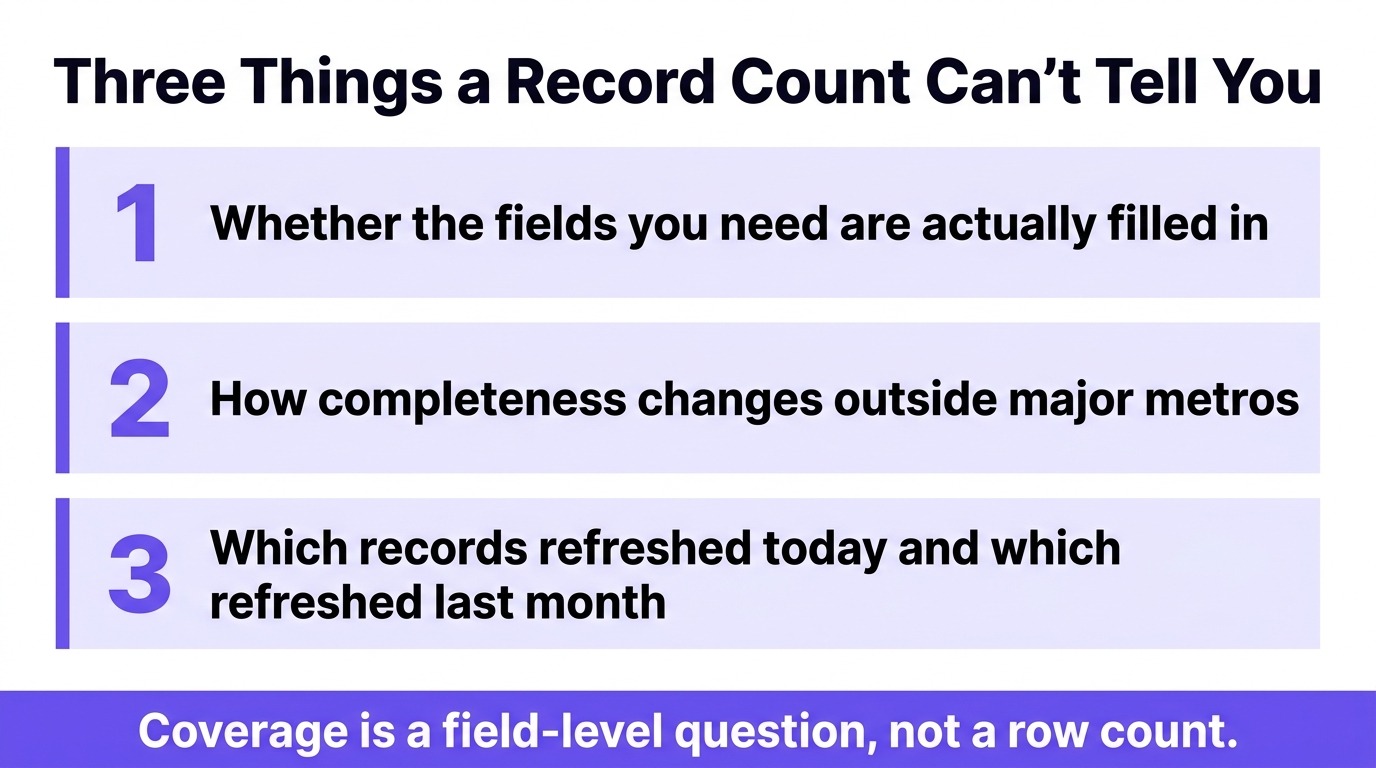
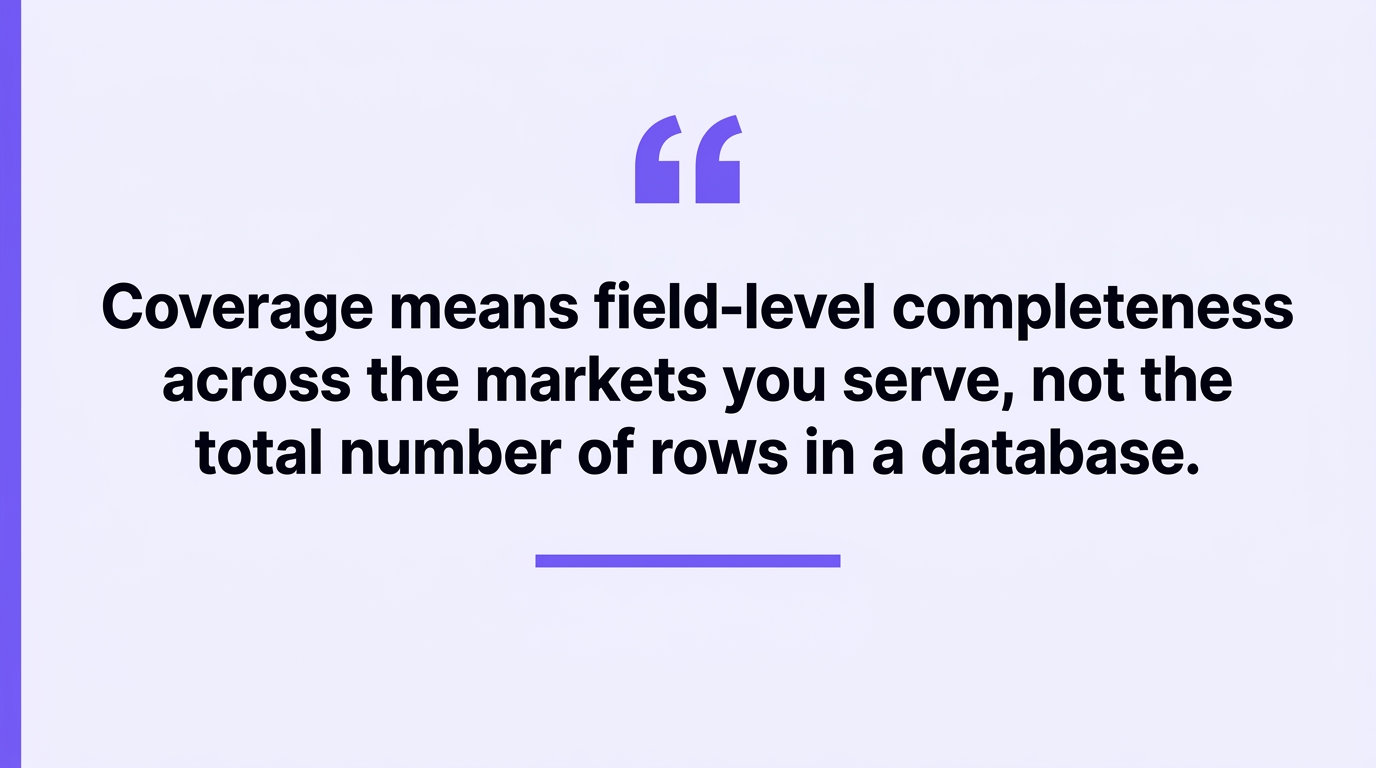
Coverage means field-level completeness across the markets you serve, not the total number of rows in a database. Two providers can quote the same percentage and mean entirely different things by it, so pinning the term down starts with what a record count actually counts.
Record Counts Measure Rows, Not Completeness
The gap between the two shows up field by field. A dataset can hold a row for every parcel in the country and still return null for sale price in the states where you underwrite, or leave lot size empty across most of the rural records you pull. Neither shortfall moves the headline count by a single row.
That distinction decides whether an integration works. Judging the best property data API by database size alone selects for whichever provider defines a record most loosely.
Which Data Layers Do U.S. Real Estate Datasets Include?
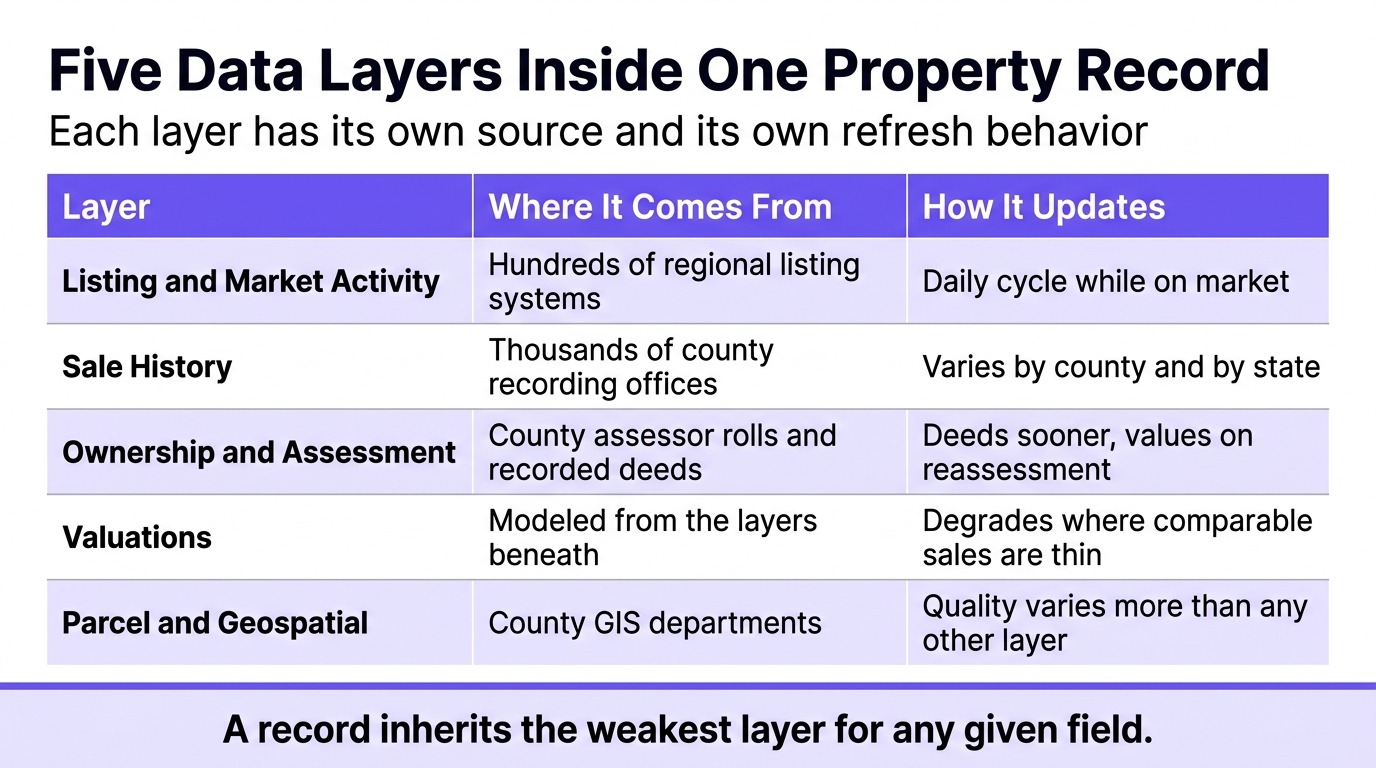
Each property record is a merge of separately sourced feeds joined on an address or parcel identifier, and every feed carries its own coverage rate. A record inherits the weakest rate for any given field, which is why property dataset coverage has to be read layer by layer rather than in aggregate.
Five layers appear in nearly every commercial dataset. Identifying which one your use case depends on narrows an evaluation, because strength in one says little about the others.
Listing and Market Activity
Listing data covers what is on the market right now: list price, status, days on market, and agent remarks. It is also the most fragmented layer in U.S. real estate data. RESO tracks 489 MLS systems in the United States, each with its own membership rules, field conventions, and licensing terms.
Coverage here depends less on database size than on how many of those systems a provider reaches. The access models behind that plumbing are worth understanding first, and how platforms access MLS listing data walks through them.
Sale History and Transaction Records
Sale history records what a property sold for and when, along with the deed and mortgage instruments behind the transfer. It originates locally. There are 3,069 counties, parishes and boroughs in the United States, and each sets its own recording format, digitization schedule, and release policy.
Several states are non-disclosure states, where sale prices are not required to be disclosed in public records. Providers either infer a price from other signals or leave the field empty, and those behaviors look very different inside a pipeline. Our guide to real estate transaction databases covers how these records get assembled.
Ownership and Assessment Data
Ownership data names the current owner of record and, in most datasets, the mailing address tied to that owner. Assessment data adds the assessor's valuation, tax amounts, and structural attributes such as square footage, year built, and lot size.
Assessed values move on a statutory reassessment cycle, while ownership changes flow from recorded deeds and can surface sooner. Teams building lead lists should confirm what a property ownership data API actually returns for owner name and mailing address before assuming those fields are populated nationwide.
Valuations and Derived Fields
Valuation fields are computed rather than observed. An automated value estimate, a rent estimate, or a confidence score is model output resting on the layers beneath it.
Where comparable sales are thin, in rural counties and across non-disclosure states, the model has less to work with and the estimate degrades. The field still returns a number, which is exactly the problem. Any confidence score attached to it deserves equal scrutiny.
Parcel and Geospatial Data
Parcel data supplies the legal boundary, the assessor parcel number, and the geometry behind mapping and spatial joins. Boundary files come from county GIS departments, and quality varies more here than in any other layer.
Some counties publish clean, current polygons. Others publish nothing, leaving providers to fall back on geocoded point coordinates. If your product renders lot lines or runs radius searches against boundaries rather than centroids, test this layer separately.
How Do Geography and Refresh Cadence Change Property Dataset Coverage?
Geography and refresh cadence cut across all five layers at once, and together they explain most of the gap between two datasets quoting similar totals. Where a property sits changes what is available for it, and how recently a record was touched changes whether the data is usable.
Coverage Thins Outside Major Metros
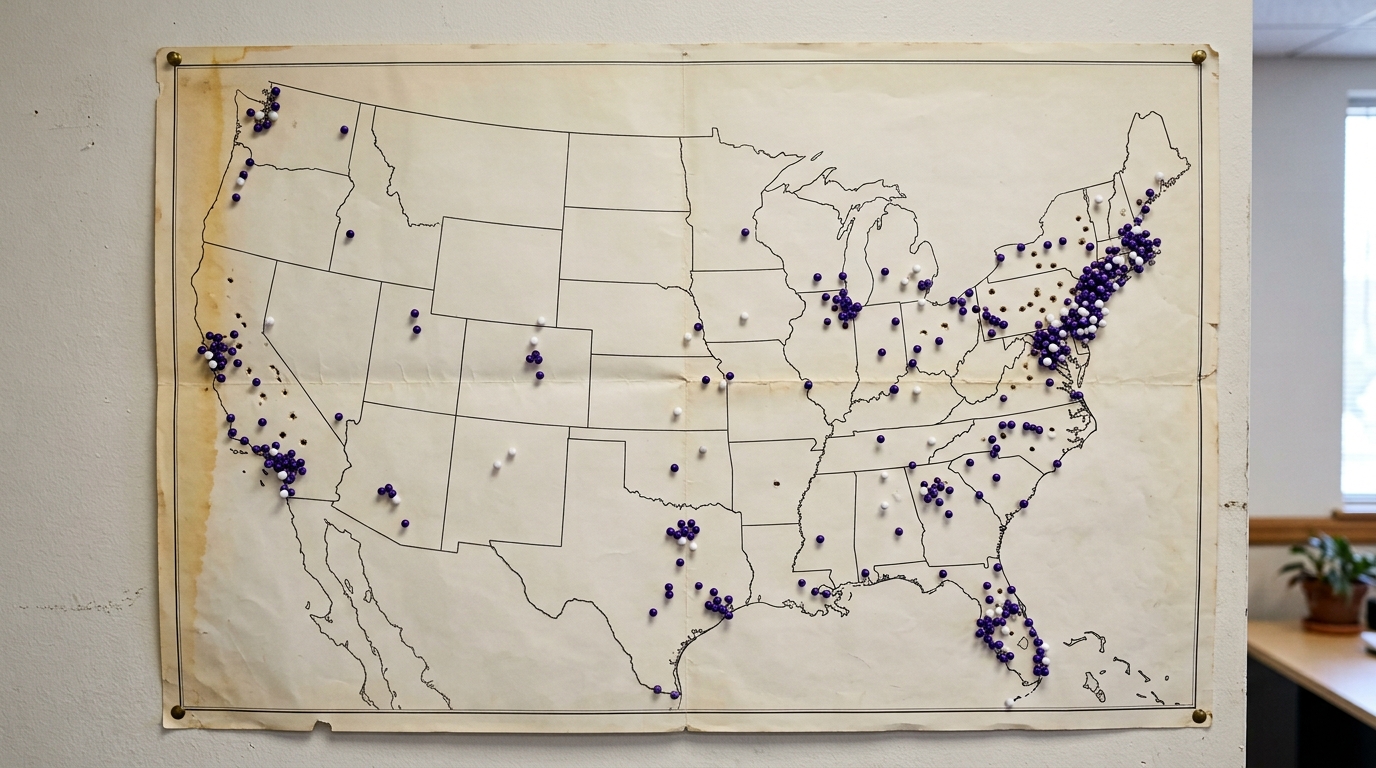
National coverage is a claim about rows, not about depth. Dense metros generate more listing activity, more recent comparable sales, and better-maintained assessor and GIS files, so records there tend to be fully populated. Rural counties transact less and digitize more slowly, which surfaces as older sale dates and missing characteristics.
Any evaluation that samples only the largest markets overstates what a dataset delivers everywhere else. Providers that sell national coverage as one dataset rather than as regional packages make that test cheap to run, because checking a rural county does not require negotiating a second contract. Three sampling habits keep a coverage test honest:
- Pull records from a rural county in every state you serve, not only that state's largest metro.
- Include a non-disclosure state to see how sale price behaves when it is genuinely unavailable.
- Compare a mid-size metro against your largest market and measure how far completeness drops.

Freshness Is Rarely Uniform Across a Dataset
Refresh cadence usually varies by record status rather than applying evenly across a file. On-market records typically move on a daily cycle, because listing changes are the highest-velocity events in a dataset. Off-market records, which make up the large majority of any national file, commonly refresh on multi-week cycles.
Providers who state that split plainly are easier to build against than those quoting one update frequency for everything. Ongoing sync becomes a scheduled query filtered to records changed since your last pull, sized to the slower cadence.
Why Public Documentation Is the Real Test of Property Dataset Coverage
The fastest way to judge a property data API is to read its documentation before you speak to anyone. A published field dictionary states which fields exist, what type each holds, and how they are named, which is what you need to decide whether a schema fits your model. Most providers do not publish it.
Basic query structure sits behind a sales call, and the first real look at the data arrives after a contract discussion has started. When the field list stays private, you cannot tell whether a gap reflects a licensing boundary, a source limitation, or a field nobody collected. You find out during integration.
Open documentation pairs naturally with open evaluation. A trial that exposes every visible field, limited only by record volume, lets an engineer measure null rates across their own markets in an afternoon. A browsable web portal does the same for analysts who would rather filter than write a query. Providers publishing property data coverage by property type alongside their schema are making a checkable claim rather than a marketing one.
Two further signals separate a checkable claim from a pitch: billing that charges for records you actually receive rather than requests you attempted, and throughput that does not force retry logic just to sample at scale.
6 Questions to Ask Before You Trust a Coverage Claim
The best property data API for a given team is the one whose gaps fall outside the markets and fields that team depends on. These questions surface the gaps early.
- Which fields are populated, and at what rate? Ask for null rates by field in your states, not a national average that dense metros flatter.
- Which record statuses refresh on which schedule? A single quoted frequency usually hides an on-market and off-market split.
- How are sale prices handled in non-disclosure states? Inferred, omitted, and silently zeroed behave very differently downstream.
- Are commercial, land, and manufactured housing in the same schema? Some providers scope these into separate contracts, which becomes a join you build and maintain.
- Can you read the field dictionary before a sales call? If the schema is gated, plan on discovering its limits during build.
- How is usage metered? Per record returned and per request attempted produce very different bills at equal volume.
Frequently Asked Questions
A few questions surface in nearly every coverage evaluation, usually right after the first sample export.
Why Does New Construction Take Longer to Appear in Property Data?
A newly built home has to be assigned a parcel record, assessed, and in many cases sold before it carries the fields most datasets expose. Listing feeds usually pick it up first, while assessment and ownership values fill in over later cycles. If you are building on new inventory, ask specifically how quickly newly added parcels enter the file.
What Is the Difference Between Assessed Value and a Valuation Estimate?
Assessed value is set by a county assessor for taxation and updates on a statutory cycle that typically lags the market. A valuation estimate is model output refreshed far more frequently. Substituting one for the other introduces state-specific bias, since assessment ratios and reassessment intervals are set at the state level.
Why Do Two Datasets Show Different Sale Prices for the Same Home?
They are usually reading different instruments. A recorded deed, a transfer tax filing, and a listing close price can each produce a different figure for the same transaction, captured at different moments. Deciding which source is authoritative for your use case matters more than which figure looks higher.
Choosing a Property Data API on Coverage You Can Verify
Headline coverage claims converge because the denominator is the same for everyone. What varies is field completeness, geographic depth, refresh behavior by status, and how much of that a provider will show you before you sign. Those four decide whether your integration ships on schedule.
All four are testable in about a week, provided the data is reachable without a procurement cycle. Teams that run that test first choose the best property data API on evidence rather than on whichever homepage carries the largest number.
Datafiniti publishes its property type breakdown and field structure openly, meters usage on records actually returned rather than requests attempted, and opens the full field set during a trial so teams can verify completeness against their own address samples. Request a demo to review coverage in your own target markets.
Read the latest articles

Read more

Build vs Buy: Business Data Enrichment for Growing Teams

Company Data API Pricing: Bulk & Enterprise-Scale Access
Best Business Data APIs for Sales Teams & Prospecting

Business Data API: Company Data at Enterprise Scale

How to Build a Product Database With a Product Data API
Property Data API Coverage: What U.S. Datasets Include

Product Data API for Ecommerce Price Monitoring and Repricing

Real-Time Product Data API for Product-Led Growth Teams

Property Ownership Data API for Skip Tracing and Lead Gen

How APIs Make Building a Product Database Easy
Learn how to build a product database with APIs for cleaner imports, updates, search, and scalable product data.

How to Leverage Competitor Pricing Data with an API
Use competitor pricing data to build API-driven monitoring, analysis, and smarter pricing decisions.

Price Monitoring API: The Key to E-Commerce Pricing Strategy
Use a price monitoring API to track market changes, improve pricing decisions, and protect ecommerce margins.

How do Product Data APIs Work for E-Commerce Companies?
Learn how a product data API works, from collection and queries to ecommerce integration and use cases.

GTIN Lookup API: Search Products by Barcode & UPC at Scale

Best Real Estate API 2026: Coverage, Pricing, Data Quality

Best Product Data API 2026: A State-of-the-Market Guide

Product Data API Integration Patterns for Ecommerce Platforms

Build a PropTech MVP With a Property Ownership Data API

3 Benefits of Web Scraping for Real Estate
Boost your research by using web scraping for real estate to gain market insights, automate lead lists, and minimize property risk.
How Real Estate Agents Can Leverage Proptech Data
Leverage proptech data to source leads, speed up valuations, and manage risk with accurate, real-time property insights.

What Is a UPC Lookup API?
Learn about the UPC lookup API, how it works, and its benefits for businesses. Get product data easily.

What Is a GTIN Lookup API?
Learn about the GTIN lookup API and how it can help your business grow. Get product data insights.

How Does a Property Data API Work?
Learn how a property data API works, its features, and how you can use it for real estate and business insights.

What The Best Real Estate APIs Should Have
Discover what makes the best real estate APIs stand out. Learn about essential features for your property data needs.
How to Access MLS Listing Data
Learn how to access MLS listing data using an MLS data API. Discover Datafiniti's solutions and integration tips.
.png)
How to Enrich Your Product Catalog With a Real-Time API
.jpeg)
Product Data API Buyer's Guide for Ecommerce Teams

Do I Need a Real Estate Listing API?
Explore the benefits and technicalities of a real estate listing API. Learn how to choose the right provider and integrate data for business growth.

Why Real Estate Tech Startups Need Property APIs with Ownership Details
Discover how property APIs with ownership details empower real estate tech startups. Learn about data integration, risk mitigation, and driving business value.
The Value of a Product Catalog Sync for Product Managers
Unlock the value of product catalog sync for product managers. Streamline data, improve decisions, and reduce costs with real-time insights.

What is a Product Data Webhook?
Learn about product data webhooks, their components, and how they enable real-time updates for business intelligence and workflow automation.

Why Is a Product Data API Integration Essential for Analysts & Product Managers?
Unlock insights with product data API integration. Essential for analysts & product managers to streamline data access & enhance product strategy.

What Is a Product Data API and Its Benefits
Learn about product data APIs, their benefits, and how they drive business growth. Explore integration and advanced use cases.

What Do eCommerce Data Vendors Do?
Learn what ecommerce data vendors do, their services, and how to choose the right one for your business growth.

How to Compare Product Data Providers: What to Look For
Compare product data providers. Learn what to look for in data quality, structure, and integration features.

How to Get Your Product Data in Real-Time Using APIs
Learn how to leverage real-time product data APIs for e-commerce, competitive analysis, and AI. Get instant access to clean, structured product data.

Best Product Data API: Features to Look for
Find the best product data API with real-time updates, comprehensive coverage, and a user-friendly portal. Explore features to look for.

Unlocking Property Data with an API
Access property data with a powerful property database API. Explore listings, market analysis, investment opportunities, and more. Get started today!

Unlocking CRE with APIs
Unlock commercial real estate insights with a powerful API. Access property data, streamline workflows, and enhance investment strategies.

How to Get a Real-Time Product Feed Using an API
Learn how to get a real-time product feed using an API. Access, leverage, and ensure accuracy of product data for your business needs.

Spying on Competitor Prices: What You Need to Know
Learn how to gather and analyze competitor pricing data to inform your business strategy. Understand key components and ethical considerations.

Product Data Enrichment: What Are You Missing?
Enhance your product data with comprehensive enrichment. Discover insights, drive growth, and choose the right approach for your business.
.png)
IDX vs MLS API: A Developer's Guide to Real Estate Listing Data
.png)
Real Estate API Pricing Models Explained: Subscription vs. Usage-Based

Real Estate API vs Web Scraping: The Buy-vs-Build Decision
.png)
Product Data APIs Explained: Powering Product Search and Catalog Automation

How to Get the Most out of a Product Catalog API
Learn how to leverage a product catalog API for business growth. Discover data quality, access methods, and strategy for your product catalog API.

Taming Your Ecommerce Product Data Feed
Optimize your ecommerce product data feed for growth. Learn strategies, leverage technology, and ensure data quality for better customer experience and AI initiatives.

Streamlining Your Product Search with an API
Explore the benefits and integration of a product search API. Streamline your product discovery and leverage data for business growth.
.png)
What Is a Real Estate Transaction Database? A Complete Guide

How Real Estate Platforms Access MLS Database APIs
.png)
Commercial Real Estate API vs. Residential Property API
.png)
How to Choose a Real Estate Database API for Your MVP
MLS API vs. IDX: What's the Diff?
MLS API vs IDX: Explore the differences in real estate data access, retrieval, and integration. Understand which solution fits your needs.

Scraping vs. APIs: Getting Real Estate Data
Compare web scraping vs real estate API for data acquisition. Learn the pros, cons, and best use cases for each method.

Property Valuation API: Your Go-To Real Estate Tool
Leverage the property valuation API for real estate insights. Access comprehensive property data for diverse applications with Datafiniti.

Product Data APIs Explained
Learn about product data APIs explained. Discover how to access, integrate, and utilize product data for e-commerce, analytics, and more.

Unlocking Your Ecommerce Data with APIs
Unlock ecommerce data with APIs for business insights, product catalog enrichment, and competitive analysis. Explore data via portal or API.

Real Estate Ownership Data: How to Access, Analyze and Use at Scale
Access, analyze, and use real estate ownership data at scale. Learn how to find, process, and leverage this crucial information for business insights.
IDX vs MLS API: What Every Real Estate Professional Should Know
Understand IDX vs MLS API differences. Learn about data access, integration, and how Datafiniti's solutions empower real estate professionals.

How a Property Database API Can Help Real Estate Pros
Learn how a property database API can help real estate pros analyze trends, monitor listings, and optimize strategies. Get data insights.

What Is a Residential Property API?
Explore what a residential property API is, its features, benefits, and real-world applications for real estate professionals and investors.

What Is a Commercial Real Estate API?
Explore commercial real estate API functionality, data integration, and use cases. Learn how to leverage property, business, and people data for insights.

Understanding MVP Data Integration
Learn about MVP data integration, its components, benefits, and strategies for accessing and utilizing data resources effectively.

How to Choose the Best Property Data API
Learn how to choose the best property data API. Explore features, providers, pricing, and integration for real estate insights.

Real Estate Database API: What to Look for
Explore real estate database API options. Learn about data quality, features, and how to choose the right provider for your needs.

How Do Product Data APIs Work?
Understand how a product data API works, its key features, integration methods, and applications for e-commerce and business intelligence.

How Do Data Aggregation Platforms Work?
Explore how data aggregation platforms work, their capabilities, and applications. Learn to choose and implement the right platform for your business intelligence needs.

Why Do Companies Need Property Data Aggregation?
Discover why property data aggregation is crucial for businesses. Streamline access, empower functions, enhance risk management, and drive strategic decisions with authoritative insights.

MLS Database API: How to Choose a Provider and Get Access

Product Search API vs. Product Data API: What's the Difference?

What Is a Product Data API?
Explore the functionality and benefits of a product data API. Learn how to integrate, leverage, and choose the right provider for your business insights.
What Is the Difference Between Product Search API and Product Data API?
Understand the difference between Product Search API and Product Data API. Learn how to leverage product data for business intelligence and analytics.

What Is a Property Data API?
Explore the capabilities of a property data API. Understand its core functionality, key features for developers, and how to access property information at scale for business insights.
.png)
Real Estate API Pricing: What You Need to Know Before You Build
.jpeg)
How to Choose a Property Market API for Investment Platforms
Choosing the right property market API is critical for investment platforms. Learn how to evaluate data depth, coverage, freshness, and integration quality before you commit.
Data you can trust, delivered in a format your systems can use, at the scale your product requires.