

Best Product Catalog API for Online Retailers: Aggregating Multi-Retailer Catalogs
Key Takeaways
Choosing the best product catalog API for online retailers comes down to three questions: which retailers it covers, how reliably it resolves the same product across them, and how consistently it normalizes attributes into one schema.
- Two different products share the name "product catalog API." One syndicates your catalog outward to sales channels. The other pulls competitor catalogs inward. They aren't interchangeable.
- Extraction is the cheap part. Entity resolution across retailers is where projects stall and where vendors differ most.
- Headline record counts describe a vendor's catalog, not your coverage. The relevant number is a ratio against your own assortment.
- Buying retailer by retailer converts a data problem into a contract problem, and the bill arrives as engineering time.
Run a few hundred of your own SKUs through a trial before you sign anything. That number is the only honest forecast you'll get.
Search for the best product catalog API for online retailers, and you'll find two kinds of vendors solving opposite problems. One syndicates your own catalog outward to Shopify, Google Shopping, and marketplace listings. The other pulls product records inward from retailers you don't control. If you're building a price comparison, assortment gap analysis, or a marketplace that needs to launch with real products in it, you want the second kind, and most of what ranks describes the first.
E-commerce reached 16.9% of total U.S. retail sales in early 2026, growing 9.8% year over year against 3.9% for total retail. More sellers list in more categories every year, so teams that collect product catalogs from multiple retailers eventually stop writing per-source collectors and start looking for one place to work with structured product data.
What Does the Best Product Catalog API for Online Retailers Actually Do?
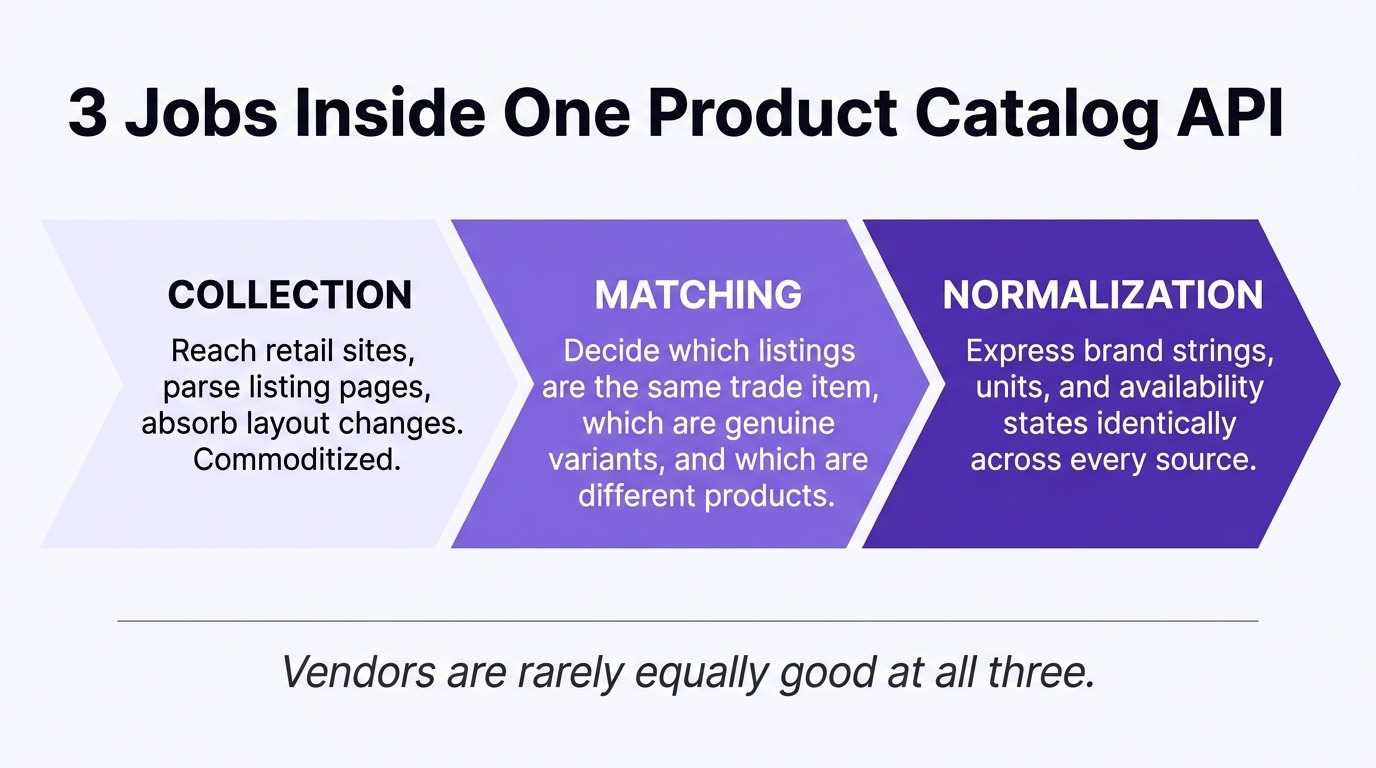
A product catalog aggregation API collects listings from many retail sources, resolves listings that describe the same physical product into a single record, and returns those records through one schema and one query interface. Collection, resolution, and normalization are three separate jobs, and vendors are rarely equally good at all three.
The failure modes differ at each stage, which is why the distinction is worth holding onto.
Collection, Matching, and Normalization Are Different Problems
Collection is the visible work: reaching retail sites, parsing listing pages, and absorbing layout changes. It's what most vendors demonstrate and the part that has been commoditized. Plenty of tools will hand you raw listings from a retailer you name.
Matching is where the value concentrates. A single dish soap appears at eight retailers under eight titles, four category paths, and three pack configurations. Deciding which listings are the same trade item, which are genuine variants, and which are different products entirely is judgment encoded as logic. Normalization then has to hold that result together, expressing brand strings, units, and availability states identically across sources.
Where Platform APIs Stop and Aggregation Begins
A commerce platform API reads and writes the catalog of the store it's attached to. It's authoritative there and blind to everything outside, which makes it right for syncing your own listings across your own channels and wrong for everything discussed here.
Aggregation starts where that authority ends. You're reading catalogs you have no account with, so records get reconciled from public listings. Teams sometimes bridge the gap by pulling partner feeds one retailer at a time, which works for three sources and falls apart at 20 because each feed carries its own schema, refresh behavior, and commercial terms.
Why Is It Hard to Collect Product Catalogs From Multiple Retailers?
Most of the difficulty in multi-retailer product data is identity rather than access. The same item wears a different name, a different identifier, and a different set of attributes at every place it's sold.
The Same Product Has Several Legitimate Identities
Retailers assign internal SKUs that mean nothing outside their own systems. The identifier that travels is the GTIN, assigned by the brand owner rather than the retailer, which makes it usable as a join key.
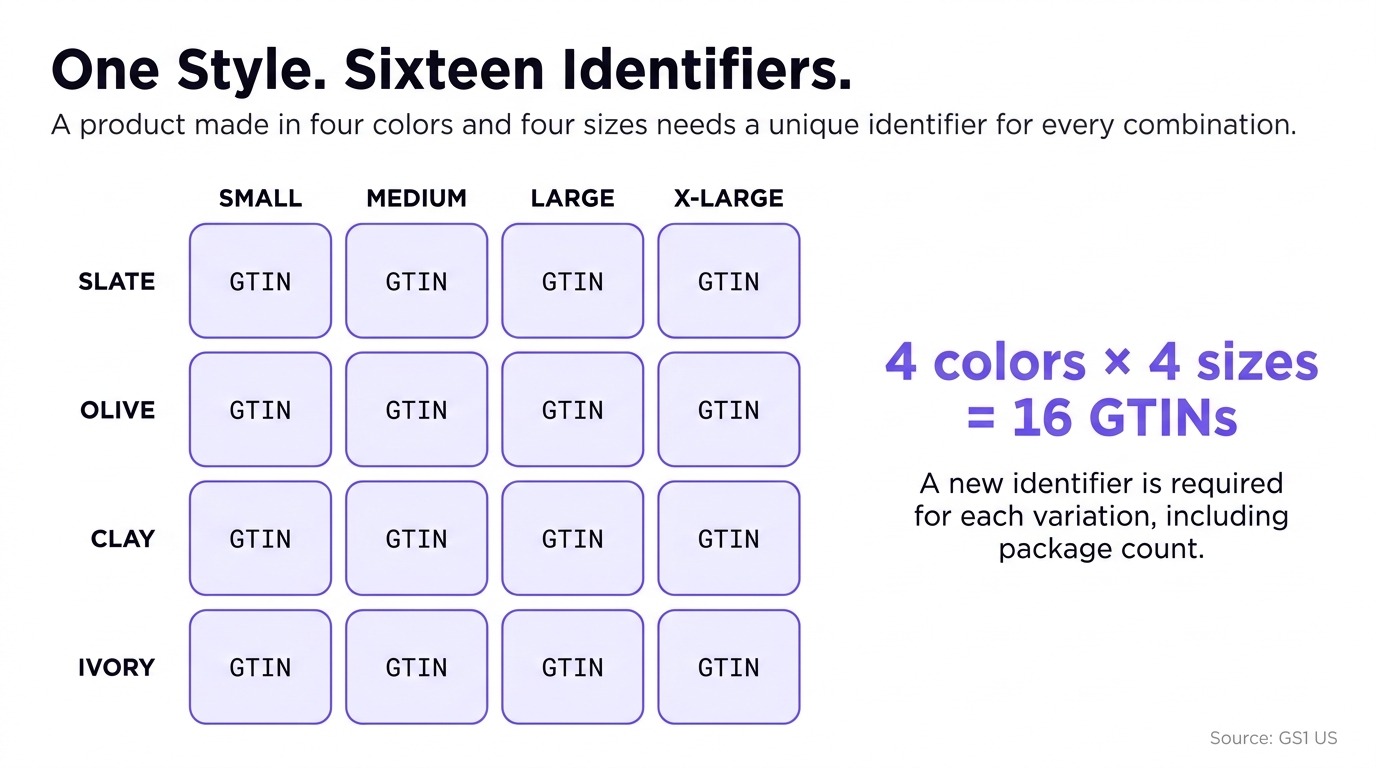
GTINs multiply, though. GS1 US notes that a style produced in four colors and four sizes requires 16 unique GTINs, with a new one for each variation, including package count. So "the same product" is ambiguous by design. A comparison tool needs those 16 collapsed under one style for browsing and kept separate for pricing. A GTIN lookup API for barcode search handles the lookup direction, but reconciliation is a property of the dataset itself.
Attributes Don't Line Up Across Sources
Two retailers listing the same monitor describe it differently. One puts screen size in the title, another in a spec table, a third in a feature list. Units drift between inches and centimeters, and one finish becomes "Graphite," "Space Gray," and "Dark Grey."
Taxonomy is worse because every retailer invents its own tree. A cast iron skillet lands under Home, Kitchen, Cookware, or Outdoor, depending on where you look. When a product data API doesn't impose one taxonomy across sources, your first sprint after integration is writing a mapping layer. Without normalized attributes, you can retrieve records, but you can't compare them.
Coverage Thins Out Below the Largest Retailers
Every vendor covers the top five retailers. Differentiation starts at the next tier and sharpens below it, among the mid-market and specialty merchants that often matter most for category work. A headline record count, therefore, tells you almost nothing. Hundreds of millions of records concentrated in categories you don't sell in is a large number and a useless one.
The figure that matters when you collect product catalogs from multiple retailers is what fraction of your assortment at your competitors comes back populated.
How Should You Evaluate Match Quality in a Product Catalog Aggregation API?
Match quality separates a dataset you can build on from one you'll spend a quarter cleaning. It's the hardest thing to judge from a vendor site and the easiest to measure yourself, which is why it should decide your shortlist.
Test Against Your Own SKU List
Vendor demos use products that match well. Take 300 SKUs from your actual catalog, weighted toward your hardest categories, and run them through a trial. Count how many return a record, how many return the correct record, and how many return populated values in the fields your application depends on.
Those three numbers will differ, sometimes sharply. A record that matches but arrives with an empty brand field is a match on paper and a miss in production. Weight the test toward whatever is awkward in your catalog: multipacks, refurbished units, seasonal items, and regional exclusives.
Ask What Happens When There Is No Identifier
A meaningful share of retail assortment carries no GTIN. Google's product data specification notes that store-brand and private-label products often have no GTIN assigned, with brand plus manufacturer part number as the fallback and accurate matching unassured when the GTIN is missing.
Private label is not a rounding error. It's a large and growing share of grocery, apparel, and household categories. Ask any product catalog aggregation API vendor how those records get matched. One who has thought about it will describe fallback logic. One who hasn't will change the subject to record counts.
One Dataset Across Every Retailer, or One Integration Per Source?
Here's the decision that determines total cost, and it isn't about data quality at all. It's about how access is packaged.
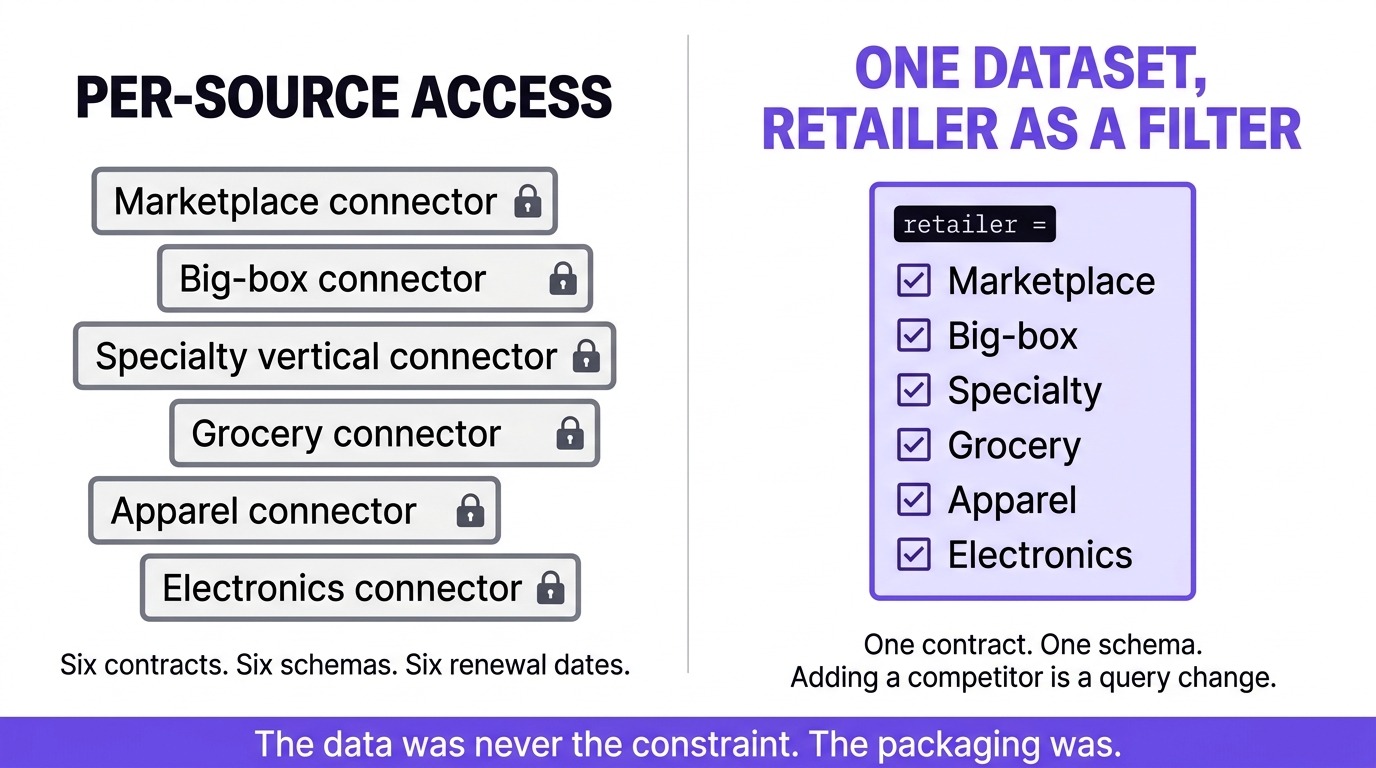
Some providers sell by source. You license a connector for one marketplace, another for a big-box retailer, another for a specialty vertical, each with its own contract, schema, and renewal date. Adding a retailer becomes a procurement cycle before it becomes an engineering ticket. Your category team asks for six mid-market competitors, and the answer is a quarter of negotiation followed by six integrations against six response formats. The data was never the constraint. The packaging was.
The alternative is one dataset that already spans the retailers, with the source treated as a filter rather than a product line. You query by retailer the same way you query by category or price band, so adding a competitor to your monitoring set is a change to a query parameter that happens the afternoon someone asks for it. That is what a structured product data API built around unified access looks like: one contract, one schema, one authentication flow, and retailer coverage that expands without renegotiation.
The engineering saving is real but secondary. The larger effect is that analysts stop pre-filtering their questions to fit the contracts they happen to have. When every new source costs money and a signature, teams only investigate competitors they're already sure matter, which is precisely backward.
How Do You Keep Multi-Retailer Product Data Current?
Freshness in aggregated catalogs is field-specific, and treating it as one global number leads to bad architecture decisions. Prices and availability move constantly. Specifications barely move. Assortment changes in bursts around seasonal resets. A dataset on rolling refresh schedules is therefore very current on some fields and stable on others, which makes "how fresh is your data" unanswerable as usually asked.
The pattern for staying synchronized is a scheduled delta query. You poll on a cadence that suits your use case and filter to records with a dateUpdated value later than your last sync, so each run returns changes rather than the full catalog. Hourly suits pricing surveillance, daily suits assortment tracking, and weekly suits enrichment. For initial loads and periodic full refreshes, scheduled bulk exports move more efficiently than paginated queries, and most teams run both. The same delta pattern supports ecommerce price monitoring workflows without a second pipeline.
Match polling cadence to how fast decisions actually get made downstream. Pulling hourly to feed a weekly report is spend without benefit.
Seven Questions to Ask Before You Buy
These questions go past the standard checklist and expose real differences between candidates for the best product catalog API for online retailers. Bring them to the trial, not to the second sales call.
- Which retailers are in the dataset, by name? Vague answers about "major retailers" usually mean the long tail is thin.
- How are variants represented at the record level? Sixteen colorway and size combinations can arrive as 16 records, one record with nested variants, or something between.
- Do you keep the retailer's original values alongside the normalized ones? Normalization occasionally guesses wrong, and source values let you audit instead of filing a ticket.
- Can I map your taxonomy to mine? One taxonomy across sources is the difference between a query and a project.
- Which fields refresh on which cadence? A vendor who answers precisely has thought about it. One that says "real time" has not.
- What counts as a billable record? Billing on records actually returned means an exploratory query that finds nothing costs nothing.
- How do schema changes get communicated? Find out whether you'll hear in advance or discover it when a nightly job fails.
Two more worth confirming: whether throughput caps will force you to build retry and backoff logic before running a full-catalog job, and whether the documentation is public enough that your engineers can evaluate query structure without booking a sales call.
Frequently Asked Questions
What Is the Difference Between a Product Catalog API and a PIM System?
A PIM is a system of record for product information your company owns, managing authoring, approvals, and distribution to channels. An aggregation-style product data API is a source of external product information you don't own. Most teams that use both feed the second into the first.
Can I Use Multi-Retailer Product Data to Launch a New Marketplace?
Yes, and it's a common cold-start use case. Aggregated records give you real titles, images, specifications, and category structure to populate listings before sellers arrive. Confirm that licensing terms cover redistribution, since permitted use varies by provider and by field.
How Much Price History Do These APIs Typically Retain?
Depth varies widely and is worth asking about explicitly. Some datasets expose pricing history as a field group on the record, which supports trend analysis without your having to accumulate observations first. If you need a multi-year history, verify it before building against it.
Do I Still Need My Own Scrapers If I Use an Aggregation API?
Usually not for breadth, sometimes for depth. If your workflow needs a field a provider doesn't carry or a niche retailer outside their coverage, a narrow supplementary collector can fill the gap. The economics favor buying the broad layer and building only the exception.
Choosing Well Is Mostly a Matter of Testing Honestly
The best product catalog API for online retailers is the one that returns your products from your competitors in a shape that your systems can use without a translation layer. Every other criterion is downstream of those three. Most evaluations go wrong by comparing feature lists instead of results.
Datafiniti brings product records from tens of thousands of merchants into a single normalized dataset, bills on the records you actually receive, and gives your team a portal to check coverage against your own categories before anyone writes integration code. Request a demo to test your catalog against it.
Read the latest articles
Read more

Best Business Data APIs for Sales Teams & Prospecting

Business Data API: Company Data at Enterprise Scale

How to Build a Product Database With a Product Data API

Property Data API Coverage: What U.S. Datasets Include

Product Data API for Ecommerce Price Monitoring and Repricing

Real-Time Product Data API for Product-Led Growth Teams

Property Ownership Data API for Skip Tracing and Lead Gen

How APIs Make Building a Product Database Easy
Learn how to build a product database with APIs for cleaner imports, updates, search, and scalable product data.

What Is Property Transaction Data and How Does an API Help Get It?
Learn how property transaction data works and how APIs provide structured access for analysis and workflows.

How to Use Real Estate Transaction Data
Learn how to use real estate transaction data for analysis, valuation, underwriting, and market decisions.

How to Leverage Competitor Pricing Data with an API
Use competitor pricing data to build API-driven monitoring, analysis, and smarter pricing decisions.

Price Monitoring API: The Key to E-Commerce Pricing Strategy
Use a price monitoring API to track market changes, improve pricing decisions, and protect ecommerce margins.

How do Product Data APIs Work for E-Commerce Companies?
Learn how a product data API works, from collection and queries to ecommerce integration and use cases.

Bulk Real Estate Data Licensing: Access Datasets at Scale

How to Integrate MLS Listings Using an MLS Data API

GTIN Lookup API: Search Products by Barcode & UPC at Scale

Best Real Estate API 2026: Coverage, Pricing, Data Quality

Best Product Data API 2026: A State-of-the-Market Guide

Product Data API Integration Patterns for Ecommerce Platforms

Build a PropTech MVP With a Property Ownership Data API

3 Benefits of Web Scraping for Real Estate
Boost your research by using web scraping for real estate to gain market insights, automate lead lists, and minimize property risk.
How Real Estate Agents Can Leverage Proptech Data
Leverage proptech data to source leads, speed up valuations, and manage risk with accurate, real-time property insights.
What Is a UPC Lookup API?
Learn about the UPC lookup API, how it works, and its benefits for businesses. Get product data easily.

What Is a GTIN Lookup API?
Learn about the GTIN lookup API and how it can help your business grow. Get product data insights.

How Does a Property Data API Work?
Learn how a property data API works, its features, and how you can use it for real estate and business insights.

What The Best Real Estate APIs Should Have
Discover what makes the best real estate APIs stand out. Learn about essential features for your property data needs.

The Benefits of a Real Estate MLS API
Learn about the benefits of a real estate MLS API for streamlining data access and driving business growth.

Why Every Real Estate Pro Needs an MLS Database API
Learn why a MLS database API is vital for real estate pros. Get data, insights, and competitive edge.
How to Access MLS Listing Data
Learn how to access MLS listing data using an MLS data API. Discover Datafiniti's solutions and integration tips.
.png)
How to Enrich Your Product Catalog With a Real-Time API
.jpeg)
Product Data API Buyer's Guide for Ecommerce Teams

Do I Need a Real Estate Listing API?
Explore the benefits and technicalities of a real estate listing API. Learn how to choose the right provider and integrate data for business growth.

Unlocking the MLS Database with APIs
Unlock the MLS database with APIs. Learn how to access property data, gain real estate insights, and integrate MLS data for your business needs.

Why Real Estate Tech Startups Need Property APIs with Ownership Details
Discover how property APIs with ownership details empower real estate tech startups. Learn about data integration, risk mitigation, and driving business value.
The Value of a Product Catalog Sync for Product Managers
Unlock the value of product catalog sync for product managers. Streamline data, improve decisions, and reduce costs with real-time insights.

What is a Product Data Webhook?
Learn about product data webhooks, their components, and how they enable real-time updates for business intelligence and workflow automation.

Why Is a Product Data API Integration Essential for Analysts & Product Managers?
Unlock insights with product data API integration. Essential for analysts & product managers to streamline data access & enhance product strategy.

What Is a Product Data API and Its Benefits
Learn about product data APIs, their benefits, and how they drive business growth. Explore integration and advanced use cases.

What Do eCommerce Data Vendors Do?
Learn what ecommerce data vendors do, their services, and how to choose the right one for your business growth.

How to Compare Product Data Providers: What to Look For
Compare product data providers. Learn what to look for in data quality, structure, and integration features.

How to Get Your Product Data in Real-Time Using APIs
Learn how to leverage real-time product data APIs for e-commerce, competitive analysis, and AI. Get instant access to clean, structured product data.

Best Product Data API: Features to Look for
Find the best product data API with real-time updates, comprehensive coverage, and a user-friendly portal. Explore features to look for.

Unlocking Property Data with an API
Access property data with a powerful property database API. Explore listings, market analysis, investment opportunities, and more. Get started today!

Unlocking CRE with APIs
Unlock commercial real estate insights with a powerful API. Access property data, streamline workflows, and enhance investment strategies.

How to Get a Real-Time Product Feed Using an API
Learn how to get a real-time product feed using an API. Access, leverage, and ensure accuracy of product data for your business needs.

Spying on Competitor Prices: What You Need to Know
Learn how to gather and analyze competitor pricing data to inform your business strategy. Understand key components and ethical considerations.

Product Data Enrichment: What Are You Missing?
Enhance your product data with comprehensive enrichment. Discover insights, drive growth, and choose the right approach for your business.
.png)
IDX vs MLS API: A Developer's Guide to Real Estate Listing Data
.png)
Real Estate API Pricing Models Explained: Subscription vs. Usage-Based

Real Estate API vs Web Scraping: Which Wins in 2026?
.png)
Product Data APIs Explained: Powering Product Search and Catalog Automation

Best Sources for Bulk Real Estate Transaction Data

How to Get the Most out of a Product Catalog API
Learn how to leverage a product catalog API for business growth. Discover data quality, access methods, and strategy for your product catalog API.

Taming Your Ecommerce Product Data Feed
Optimize your ecommerce product data feed for growth. Learn strategies, leverage technology, and ensure data quality for better customer experience and AI initiatives.

Streamlining Your Product Search with an API
Explore the benefits and integration of a product search API. Streamline your product discovery and leverage data for business growth.
.png)
Real Estate Transaction Databases: What You Need to Know
.png)
Best MLS API for Real Estate Software: What Developers Need

How Real Estate Platforms Access MLS Database APIs
.png)
Commercial Real Estate API vs. Residential Property API
.png)
How to Choose a Real Estate Database API for Your MVP
MLS API vs. IDX: What's the Diff?
MLS API vs IDX: Explore the differences in real estate data access, retrieval, and integration. Understand which solution fits your needs.

Scraping vs. APIs: Getting Real Estate Data
Compare web scraping vs real estate API for data acquisition. Learn the pros, cons, and best use cases for each method.

Cracking the Code: Housing Sales Insights
Unlock housing sales analytics insights with Datafiniti. Explore property data, market trends, and advanced techniques for strategic decisions.

Property Valuation API: Your Go-To Real Estate Tool
Leverage the property valuation API for real estate insights. Access comprehensive property data for diverse applications with Datafiniti.

Product Data APIs Explained
Learn about product data APIs explained. Discover how to access, integrate, and utilize product data for e-commerce, analytics, and more.

Unlocking Your Ecommerce Data with APIs
Unlock ecommerce data with APIs for business insights, product catalog enrichment, and competitive analysis. Explore data via portal or API.

Your Guide to Housing Sales APIs
Explore housing sales API data for insights. Access property data, integrate into applications, and gain business intelligence. Get started today!

Real Estate Ownership Data: How to Access, Analyze and Use at Scale
Access, analyze, and use real estate ownership data at scale. Learn how to find, process, and leverage this crucial information for business insights.

Unlocking Opportunities: Navigating Bulk Real Estate Transaction Data
Unlock opportunities with bulk real estate transaction data. Learn how to access, analyze, and leverage property data for investing, marketing, and more.
What Is a Property Sales Database?
Explore what a property sales database is, its core components, how to access data, and key use cases for real estate analysis and more.

Benefits of Obtaining Housing Transaction Data
Unlock insights with housing transaction data. Analyze markets, investments, sales, and risk. Get comprehensive property data for informed decisions.

Understanding Real Estate Transaction Databases
IDX vs MLS API: What Every Real Estate Professional Should Know
Understand IDX vs MLS API differences. Learn about data access, integration, and how Datafiniti's solutions empower real estate professionals.

What Is an MLS Database API?
Explore the MLS database API: understand its components, benefits, and how to access real estate data for various applications. Learn about its core functionality and technical aspects.

How a Property Database API Can Help Real Estate Pros
Learn how a property database API can help real estate pros analyze trends, monitor listings, and optimize strategies. Get data insights.

What Is a Residential Property API?
Explore what a residential property API is, its features, benefits, and real-world applications for real estate professionals and investors.

What Is a Commercial Real Estate API?
Explore commercial real estate API functionality, data integration, and use cases. Learn how to leverage property, business, and people data for insights.

Understanding MVP Data Integration
Learn about MVP data integration, its components, benefits, and strategies for accessing and utilizing data resources effectively.

How to Choose the Best Property Data API
Learn how to choose the best property data API. Explore features, providers, pricing, and integration for real estate insights.

Real Estate Database API: What to Look for
Explore real estate database API options. Learn about data quality, features, and how to choose the right provider for your needs.
.png)
Real Estate Transaction Database: An API Access Guide

How Do Product Data APIs Work?
Understand how a product data API works, its key features, integration methods, and applications for e-commerce and business intelligence.

How Do Data Aggregation Platforms Work?
Explore how data aggregation platforms work, their capabilities, and applications. Learn to choose and implement the right platform for your business intelligence needs.

Why Do Companies Need Property Data Aggregation?
Discover why property data aggregation is crucial for businesses. Streamline access, empower functions, enhance risk management, and drive strategic decisions with authoritative insights.

MLS API: The Complete Guide to Accessing MLS Listing Data

Product Search API vs. Product Data API: What's the Difference?

What Are the Best MLS Data API Features to Look For?
Discover the best MLS data API features, including real-time updates, bulk downloads, and flexible filtering for property data.

What Is a Product Data API?
Explore the functionality and benefits of a product data API. Learn how to integrate, leverage, and choose the right provider for your business insights.
What Is the Difference Between Product Search API and Product Data API?
Understand the difference between Product Search API and Product Data API. Learn how to leverage product data for business intelligence and analytics.

Guide to Accessing Real Estate Transaction Database Via API
Access real estate transaction data via API. Explore property insights, sales, underwriting, and advanced applications with our authoritative guide.

Is a Real Estate MLS API Beneficial?
Explore the benefits of a real estate MLS API for enhanced data access, streamlined workflows, and market responsiveness. Learn about key features and use cases.

What is an MLS Database API?
Explore the MLS database API for comprehensive property data access. Learn about its core functionality, key features, and integration into real estate technology.

What Is a Property Data API?
Explore the capabilities of a property data API. Understand its core functionality, key features for developers, and how to access property information at scale for business insights.
.png)
Real Estate API Pricing: What You Need to Know Before You Build
.jpeg)
How to Choose a Property Market API for Investment Platforms
Choosing the right property market API is critical for investment platforms. Learn how to evaluate data depth, coverage, freshness, and integration quality before you commit.
Data you can trust, delivered in a format your systems can use, at the scale your product requires.