

Property Ownership Data API for Skip Tracing and Lead Gen
Key Takeaways
Owner-of-record data decides how much of a skip tracing or lead generation budget reaches an actual person, and most of that outcome is set before the first call goes out.
- Owner name, mailing address, and ownership tenure originate in county records, so field completeness shifts by jurisdiction rather than by vendor marketing claims.
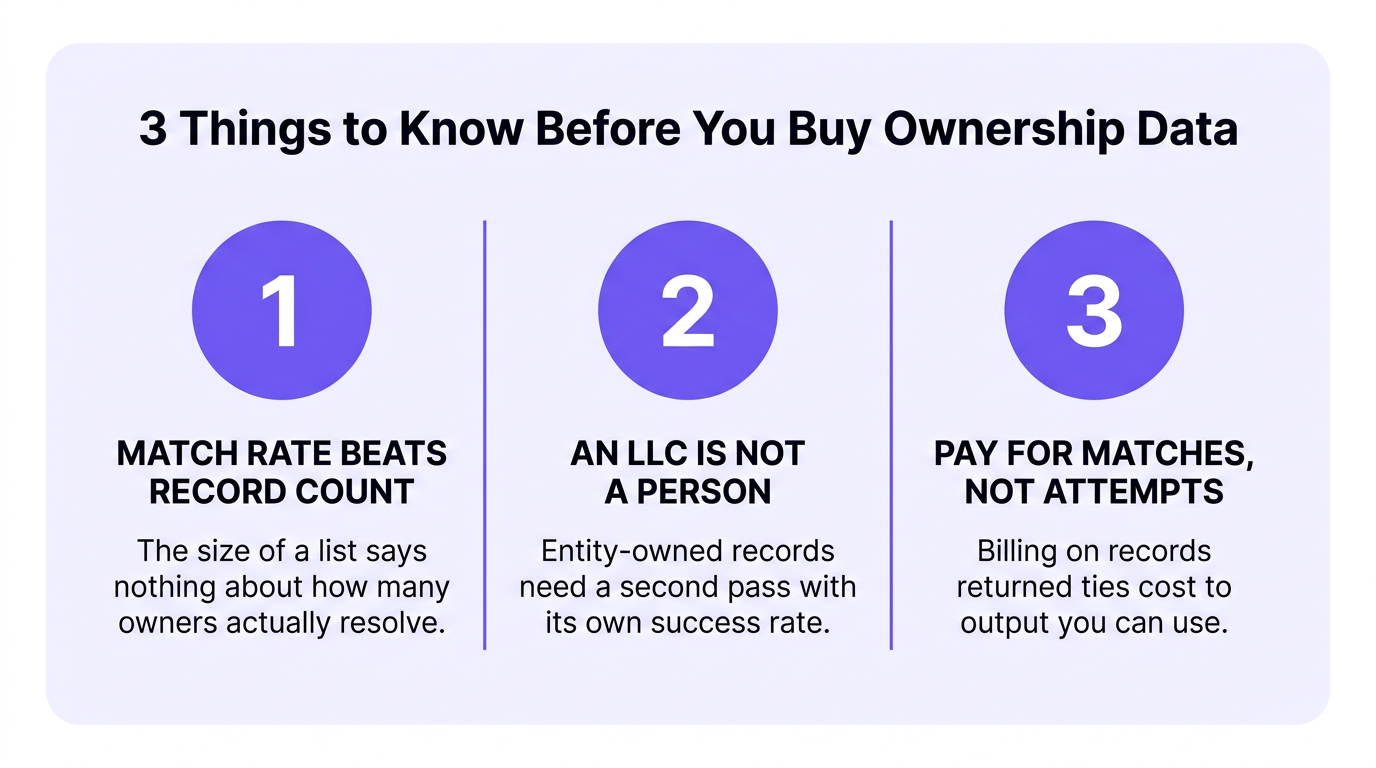
- Match rate governs cost more than record count does, because the size of a list tells you nothing about how many owners it will actually resolve.
- Properties held by LLCs and trusts defeat simple name matching, and connecting a business entity to a real person is a separate step with its own success rate.
- Paying only for the records a provider actually hands back keeps the cost of a batch tied to output you can act on.
Run a sample batch of your own addresses before signing anything, because a coverage claim and your real match rate are two different numbers.
Finding out who owns a property is harder than it looks, because the person living at an address often holds no title. The U.S. homeownership rate sat at 65.0 percent in the second quarter of 2026, according to Census figures, which leaves roughly a third of occupied homes in the hands of someone other than the occupant.
Skip tracers, wholesalers, agents, lenders, and recovery teams all run this same query, though a solo investor might run fifty in a month and a national lender fifty thousand. A property ownership data API serves both ends of that range, letting teams access structured property records programmatically instead of working county sites one at a time.
What Does a Property Ownership Data API Return?
A property ownership data API returns the name on the deed, the mailing address the assessor keeps on file, ownership tenure, and the transaction context surrounding a parcel. Those four elements do most of the work in skip tracing and lead qualification, and the gap between a usable provider and a frustrating one shows up in how completely each field is populated.
Owner of Record and Mailing Address
The owner of record is the name on the deed as filed with the county, which may be an individual, a couple, a trust, or a business entity. Alongside it sits the mailing address used for tax correspondence, and that second field carries more signal than people expect. When it differs from the property address, the owner does not live there.
That comparison alone identifies absentee owners, out-of-state landlords, and inherited properties with no extra enrichment, which is why it anchors so many lead filters. A property owner lookup returning only a name leaves you stuck, while one returning the name, mailing address, and a match confidence score gives you something you can route straight into an outreach queue. Better providers cover residential, commercial, and industrial parcels under one integration, so mixed portfolios resolve without stitching together separate sources of property data.
Tenure, Equity Signals, and Transaction History
Ownership length and purchase history turn a name into a prioritized lead. An owner who bought in 2004 and still holds the property carries a different equity position than one who closed last spring, which shapes both the pitch and the odds of a reply.
Most ownership records join cleanly to sale dates, recorded prices, and deed types from the same county filings. Pairing them with real estate transaction data supports motivation scoring rather than flat address lists. Assessed value against the last recorded sale price also yields a rough equity estimate at no extra cost.
Why Do Property Owner Lookup Match Rates Vary?
Match rates vary because ownership records originate in thousands of separate local offices rather than one national registry. There are 3,069 counties, parishes, and boroughs in the United States, and each sets its own recording practices, file formats, and publication schedules. No property ownership data API standardizes all of them equally well.
County Records Are Not a Single Dataset
Some counties publish clean, current assessor files with owner names and mailing addresses in structured fields. Others publish scanned images, refresh on long lags, or omit mailing addresses entirely under state privacy law.
A vendor quoting one national match rate should prompt a follow-up about your own markets, since a team working Dallas and Phoenix will see different results than one working rural counties across three states. National coverage without regional add-on contracts matters here, because buying market by market means renegotiating every time you expand.
Entity Ownership Breaks Simple Name Matching
A meaningful share of investment property sits under LLCs, trusts, and partnerships, and those records return a business name where your workflow expects a person. Skip tracing data that stops at the entity name is legally accurate and operationally useless.

Getting from an entity to a contactable individual takes a second pass against registered agent filings, officer records, or address history, and that step carries its own success rate worth measuring separately. Enrichment through a people data source handles the phone and email layer once a name exists. Trusts behave the same way, listing a trustee who may answer directly or an attorney's office.
How Does Per-Record Billing Change Skip Tracing Economics?
Charging for matched records instead of submitted queries is the single largest cost variable in high-volume owner research. No provider resolves every address you submit, so the gap between those two models compounds across every batch and widens exactly as volume grows.
You Pay for Records Returned, Not Queries Attempted
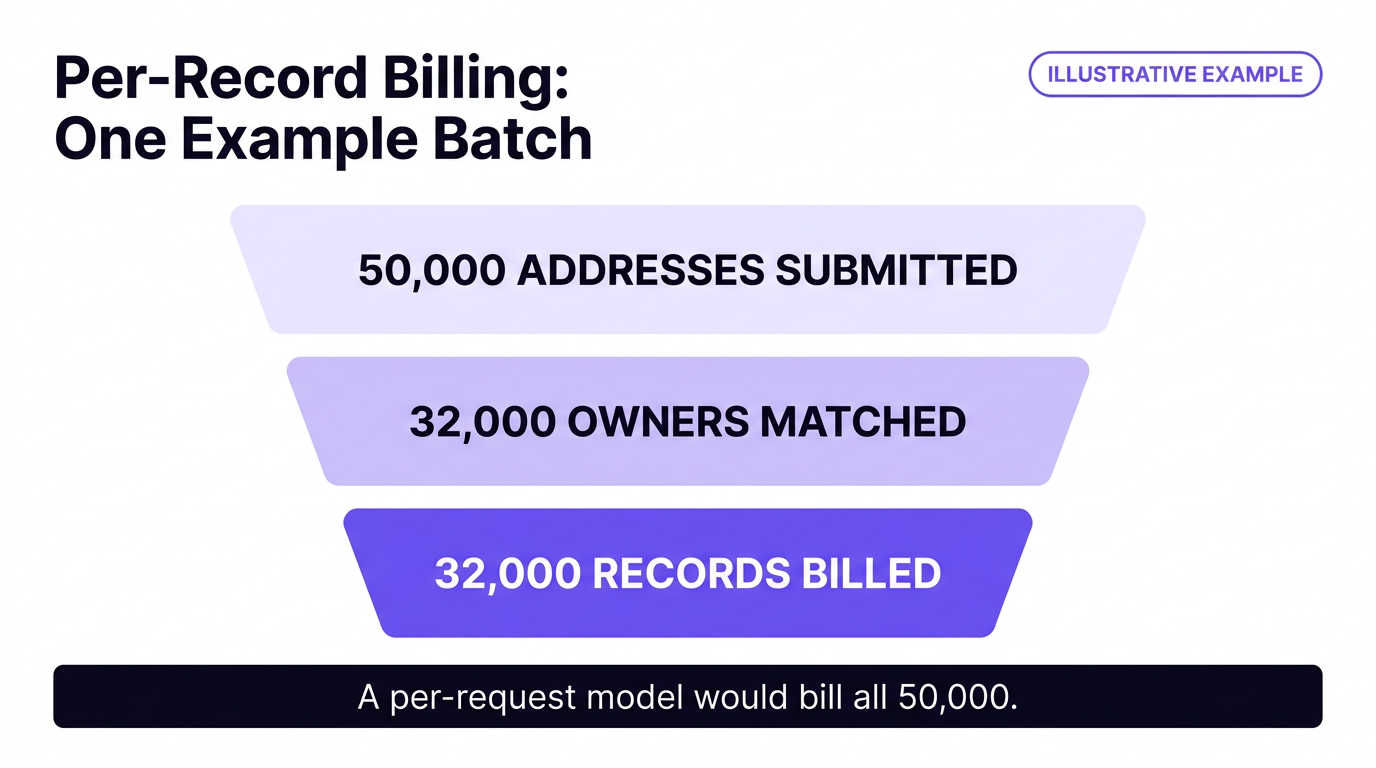
Under a per-request model, every query consumes budget whether it resolves or not. Say you submit 50,000 addresses and match 32,000: you have paid full freight for 18,000 empty responses.
Per-record credit pricing inverts that. You are charged for the records the system actually hands back, so a batch matching at 64 percent costs 64 percent of a fully matched batch. It also fixes an incentive problem, since a vendor billing per request bears no cost for a mediocre match rate, a dynamic that runs through most real estate API pricing models.
What This Means for a Batch Run
Batch economics become predictable once the billing unit is tied to output. A monthly list refresh that surfaces fewer matches in a slow month costs less that month, so spend tracks the leads delivered rather than the volume attempted.
Throughput is the other half of the equation. A property ownership data API that imposes requests-per-second caps forces you to build throttling and retry logic before processing a large address file, engineering work that produces no leads. Volume-based plans also let smaller operations start narrow, since a wholesaler testing one metro needs a different commitment than a national lender.
What Rules Apply to Real Estate Lead Generation Data?
Ownership records are public, but the outreach built on them is regulated, and that distinction trips up plenty of teams. The National Do Not Call Registry held more than 258 million active registrations at the close of fiscal year 2025 per the FTC's annual data book, so a substantial portion of any phone list you assemble carries restrictions before you dial.
Three considerations shape day-to-day use:
- Telephone outreach falls under Do Not Call and robocall rules, so appended phone numbers generally require scrubbing against the registry plus documentation of any exemption claimed.
- Consumer reporting law attaches to purpose rather than to the records themselves. Marketing sits outside that framework, while using the same fields to decide credit, insurance, employment, or tenancy pulls you into it.
- State rules add another layer, with several imposing calling windows, registration requirements, or consent standards stricter than the federal baseline.
None of this makes skip tracing data hard to use. It does mean compliance belongs in the pipeline design rather than bolted on after the first campaign, and whoever owns outreach should be able to name the exemption they rely on.
Seven Questions to Ask Before Choosing a Property Ownership Data API
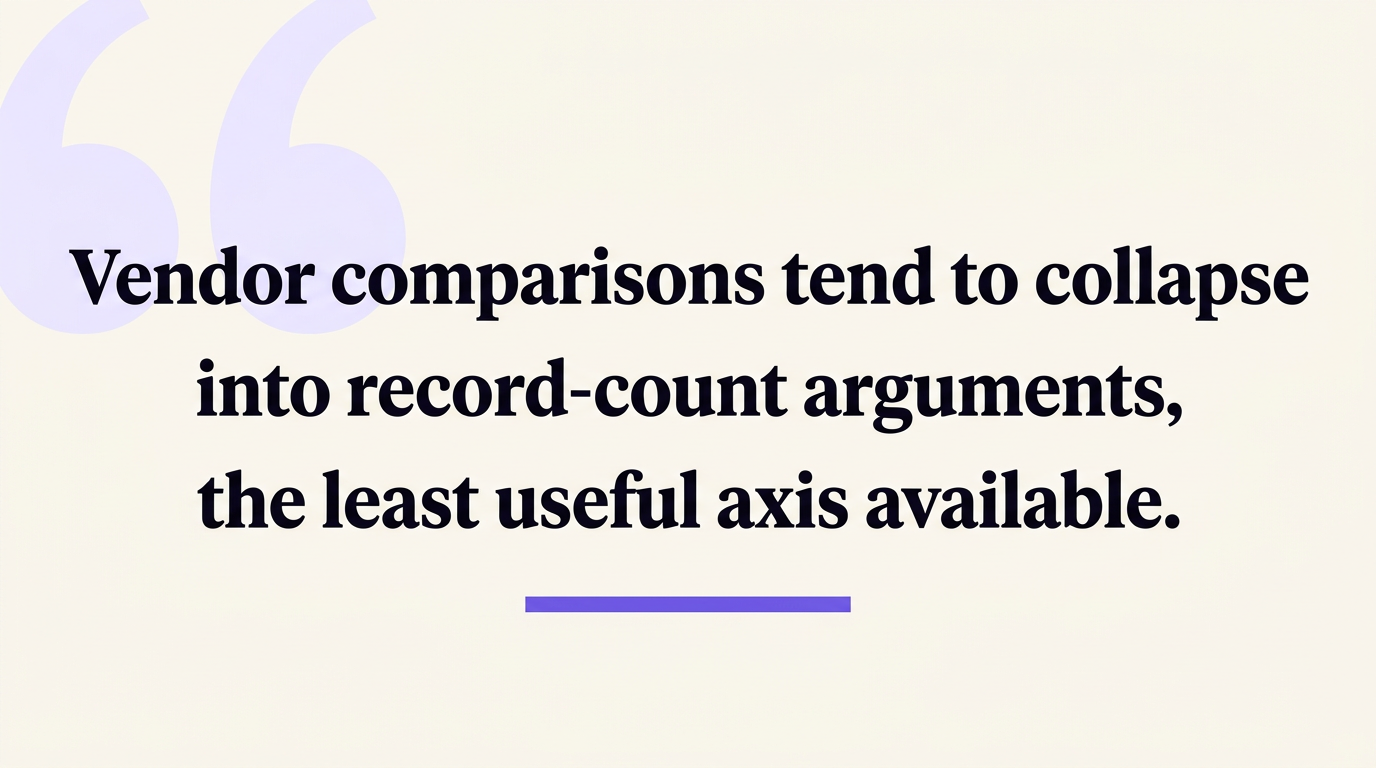
Vendor comparisons tend to collapse into record-count arguments, the least useful axis available. These questions surface the differences that actually change the quality of your real estate lead generation data.
- How is the match rate measured and reported? Ask whether partial hits count toward the figure, and whether the provider will break it out by county instead of nationally.
- Am I billed for matches or for attempts? This sets the true cost per usable lead, and the two models diverge sharply once skip tracing data hits production volume.
- How are entity-owned properties handled? Find out whether LLC and trust records resolve any further, and what that costs.
- Does each match carry a confidence score? A result with no indication of certainty forces your team to treat a weak hit and a strong one identically.
- Can I evaluate the data before writing integration code? A searchable portal with real records answers coverage questions in an afternoon that a sales call cannot.
- Is the documentation public? Field dictionaries and query examples readable without a signed agreement say a lot about how a vendor treats developers.
- What happens when I expand to new markets? Confirm whether national coverage is included or whether each new region triggers a separate contract.
Frequently Asked Questions
Two themes drive most follow-up questions: where the data stops, and how quickly it goes stale.
What Is the Difference Between Skip Tracing and a Property Owner Lookup?
A property owner lookup starts with an address and returns who holds title. Skip tracing starts with a known person and finds current contact information for them, often after they have moved. Real estate workflows chain the two, running the lookup first and tracing the name it returns.
How Current Is Ownership Data Compared to Listing Data?
Ownership fields refresh far more slowly than listing fields, and conflating the two causes real problems. Listing status can change within a day, while deed transfers and assessment updates arrive on cycles measured in weeks, since those filings have to be recorded at the county and published before any provider can pick them up.
Can I Get Phone Numbers Directly From Property Records?
No. County records carry owner names and mailing addresses, never phone numbers or emails. Contact details come from a separate identity dataset matched against the name and address, which is why phone coverage and ownership coverage are quoted as two different figures.
How Should I Keep an Owner List Current Over Time?
Query on a schedule and filter to records changed since your last pull using a date-updated parameter. A nightly or weekly job requesting only modified records keeps your database aligned without re-pulling the full dataset, and keeps billing proportional to actual change.
Building a Reliable Ownership Pipeline
Ownership data rewards teams that treat it as an operating input rather than a list purchase. A record either reaches someone who can transact or it does not, and nearly every criterion worth applying traces back to that one test.
Start with one market, get the outreach pipeline running end to end, then widen the footprint. If you are still deciding how real estate lead generation data should feed the rest of your stack, the walkthrough on building an early-stage property product covers the integration sequence in more depth.
Datafiniti pairs a nationwide property ownership data API with a separate identity dataset for contact enrichment, billed per record returned, with no regional contracts and a web portal for checking coverage before you write a line of code. Request a demo to get started and see how the match rate holds up in your markets.
Read the latest articles

Read more

Build vs Buy: Business Data Enrichment for Growing Teams

Company Data API Pricing: Bulk & Enterprise-Scale Access

Best Business Data APIs for Sales Teams & Prospecting

Business Data API: Company Data at Enterprise Scale

How to Build a Product Database With a Product Data API

Property Data API Coverage: What U.S. Datasets Include

Product Data API for Ecommerce Price Monitoring and Repricing

Real-Time Product Data API for Product-Led Growth Teams
Property Ownership Data API for Skip Tracing and Lead Gen

How APIs Make Building a Product Database Easy
Learn how to build a product database with APIs for cleaner imports, updates, search, and scalable product data.

How to Leverage Competitor Pricing Data with an API
Use competitor pricing data to build API-driven monitoring, analysis, and smarter pricing decisions.

Price Monitoring API: The Key to E-Commerce Pricing Strategy
Use a price monitoring API to track market changes, improve pricing decisions, and protect ecommerce margins.

How do Product Data APIs Work for E-Commerce Companies?
Learn how a product data API works, from collection and queries to ecommerce integration and use cases.

How to Integrate MLS Listings Using an MLS Data API

GTIN Lookup API: Search Products by Barcode & UPC at Scale

Best Real Estate API 2026: Coverage, Pricing, Data Quality

Best Product Data API 2026: A State-of-the-Market Guide

Product Data API Integration Patterns for Ecommerce Platforms

Build a PropTech MVP With a Property Ownership Data API

3 Benefits of Web Scraping for Real Estate
Boost your research by using web scraping for real estate to gain market insights, automate lead lists, and minimize property risk.
How Real Estate Agents Can Leverage Proptech Data
Leverage proptech data to source leads, speed up valuations, and manage risk with accurate, real-time property insights.

What Is a UPC Lookup API?
Learn about the UPC lookup API, how it works, and its benefits for businesses. Get product data easily.

What Is a GTIN Lookup API?
Learn about the GTIN lookup API and how it can help your business grow. Get product data insights.

How Does a Property Data API Work?
Learn how a property data API works, its features, and how you can use it for real estate and business insights.

What The Best Real Estate APIs Should Have
Discover what makes the best real estate APIs stand out. Learn about essential features for your property data needs.
The Benefits of a Real Estate MLS API
Learn about the benefits of a real estate MLS API for streamlining data access and driving business growth.

Why Every Real Estate Pro Needs an MLS Database API
Learn why a MLS database API is vital for real estate pros. Get data, insights, and competitive edge.
How to Access MLS Listing Data
Learn how to access MLS listing data using an MLS data API. Discover Datafiniti's solutions and integration tips.
.png)
How to Enrich Your Product Catalog With a Real-Time API
.jpeg)
Product Data API Buyer's Guide for Ecommerce Teams

Do I Need a Real Estate Listing API?
Explore the benefits and technicalities of a real estate listing API. Learn how to choose the right provider and integrate data for business growth.

Unlocking the MLS Database with APIs
Unlock the MLS database with APIs. Learn how to access property data, gain real estate insights, and integrate MLS data for your business needs.

Why Real Estate Tech Startups Need Property APIs with Ownership Details
Discover how property APIs with ownership details empower real estate tech startups. Learn about data integration, risk mitigation, and driving business value.
The Value of a Product Catalog Sync for Product Managers
Unlock the value of product catalog sync for product managers. Streamline data, improve decisions, and reduce costs with real-time insights.

What is a Product Data Webhook?
Learn about product data webhooks, their components, and how they enable real-time updates for business intelligence and workflow automation.

Why Is a Product Data API Integration Essential for Analysts & Product Managers?
Unlock insights with product data API integration. Essential for analysts & product managers to streamline data access & enhance product strategy.

What Is a Product Data API and Its Benefits
Learn about product data APIs, their benefits, and how they drive business growth. Explore integration and advanced use cases.

What Do eCommerce Data Vendors Do?
Learn what ecommerce data vendors do, their services, and how to choose the right one for your business growth.

How to Compare Product Data Providers: What to Look For
Compare product data providers. Learn what to look for in data quality, structure, and integration features.

How to Get Your Product Data in Real-Time Using APIs
Learn how to leverage real-time product data APIs for e-commerce, competitive analysis, and AI. Get instant access to clean, structured product data.

Best Product Data API: Features to Look for
Find the best product data API with real-time updates, comprehensive coverage, and a user-friendly portal. Explore features to look for.

Unlocking Property Data with an API
Access property data with a powerful property database API. Explore listings, market analysis, investment opportunities, and more. Get started today!

Unlocking CRE with APIs
Unlock commercial real estate insights with a powerful API. Access property data, streamline workflows, and enhance investment strategies.

How to Get a Real-Time Product Feed Using an API
Learn how to get a real-time product feed using an API. Access, leverage, and ensure accuracy of product data for your business needs.

Spying on Competitor Prices: What You Need to Know
Learn how to gather and analyze competitor pricing data to inform your business strategy. Understand key components and ethical considerations.

Product Data Enrichment: What Are You Missing?
Enhance your product data with comprehensive enrichment. Discover insights, drive growth, and choose the right approach for your business.
.png)
IDX vs MLS API: A Developer's Guide to Real Estate Listing Data
.png)
Real Estate API Pricing Models Explained: Subscription vs. Usage-Based

Real Estate API vs Web Scraping: Which Wins in 2026?
.png)
Product Data APIs Explained: Powering Product Search and Catalog Automation

How to Get the Most out of a Product Catalog API
Learn how to leverage a product catalog API for business growth. Discover data quality, access methods, and strategy for your product catalog API.

Taming Your Ecommerce Product Data Feed
Optimize your ecommerce product data feed for growth. Learn strategies, leverage technology, and ensure data quality for better customer experience and AI initiatives.

Streamlining Your Product Search with an API
Explore the benefits and integration of a product search API. Streamline your product discovery and leverage data for business growth.
.png)
What Is a Real Estate Transaction Database? A Complete Guide
.png)
Best MLS API for Real Estate Software: What Developers Need

How Real Estate Platforms Access MLS Database APIs
.png)
Commercial Real Estate API vs. Residential Property API
.png)
How to Choose a Real Estate Database API for Your MVP
MLS API vs. IDX: What's the Diff?
MLS API vs IDX: Explore the differences in real estate data access, retrieval, and integration. Understand which solution fits your needs.

Scraping vs. APIs: Getting Real Estate Data
Compare web scraping vs real estate API for data acquisition. Learn the pros, cons, and best use cases for each method.

Property Valuation API: Your Go-To Real Estate Tool
Leverage the property valuation API for real estate insights. Access comprehensive property data for diverse applications with Datafiniti.

Product Data APIs Explained
Learn about product data APIs explained. Discover how to access, integrate, and utilize product data for e-commerce, analytics, and more.

Unlocking Your Ecommerce Data with APIs
Unlock ecommerce data with APIs for business insights, product catalog enrichment, and competitive analysis. Explore data via portal or API.

Real Estate Ownership Data: How to Access, Analyze and Use at Scale
Access, analyze, and use real estate ownership data at scale. Learn how to find, process, and leverage this crucial information for business insights.
IDX vs MLS API: What Every Real Estate Professional Should Know
Understand IDX vs MLS API differences. Learn about data access, integration, and how Datafiniti's solutions empower real estate professionals.

What Is an MLS Database API?
Explore the MLS database API: understand its components, benefits, and how to access real estate data for various applications. Learn about its core functionality and technical aspects.

How a Property Database API Can Help Real Estate Pros
Learn how a property database API can help real estate pros analyze trends, monitor listings, and optimize strategies. Get data insights.

What Is a Residential Property API?
Explore what a residential property API is, its features, benefits, and real-world applications for real estate professionals and investors.

What Is a Commercial Real Estate API?
Explore commercial real estate API functionality, data integration, and use cases. Learn how to leverage property, business, and people data for insights.

Understanding MVP Data Integration
Learn about MVP data integration, its components, benefits, and strategies for accessing and utilizing data resources effectively.

How to Choose the Best Property Data API
Learn how to choose the best property data API. Explore features, providers, pricing, and integration for real estate insights.

Real Estate Database API: What to Look for
Explore real estate database API options. Learn about data quality, features, and how to choose the right provider for your needs.

How Do Product Data APIs Work?
Understand how a product data API works, its key features, integration methods, and applications for e-commerce and business intelligence.

How Do Data Aggregation Platforms Work?
Explore how data aggregation platforms work, their capabilities, and applications. Learn to choose and implement the right platform for your business intelligence needs.

Why Do Companies Need Property Data Aggregation?
Discover why property data aggregation is crucial for businesses. Streamline access, empower functions, enhance risk management, and drive strategic decisions with authoritative insights.

MLS API: The Complete Guide to Accessing MLS Listing Data

Product Search API vs. Product Data API: What's the Difference?

What Are the Best MLS Data API Features to Look For?
Discover the best MLS data API features, including real-time updates, bulk downloads, and flexible filtering for property data.

What Is a Product Data API?
Explore the functionality and benefits of a product data API. Learn how to integrate, leverage, and choose the right provider for your business insights.
What Is the Difference Between Product Search API and Product Data API?
Understand the difference between Product Search API and Product Data API. Learn how to leverage product data for business intelligence and analytics.

Is a Real Estate MLS API Beneficial?
Explore the benefits of a real estate MLS API for enhanced data access, streamlined workflows, and market responsiveness. Learn about key features and use cases.

What is an MLS Database API?
Explore the MLS database API for comprehensive property data access. Learn about its core functionality, key features, and integration into real estate technology.

What Is a Property Data API?
Explore the capabilities of a property data API. Understand its core functionality, key features for developers, and how to access property information at scale for business insights.
.png)
Real Estate API Pricing: What You Need to Know Before You Build
.jpeg)
How to Choose a Property Market API for Investment Platforms
Choosing the right property market API is critical for investment platforms. Learn how to evaluate data depth, coverage, freshness, and integration quality before you commit.
Data you can trust, delivered in a format your systems can use, at the scale your product requires.