

Best Real Estate API 2026: Coverage, Pricing, Data Quality
Key Takeaways
The best real estate API for your product is the one whose coverage, pricing model, and data quality hold up at the scale you actually plan to reach, not the one with the biggest record count on its homepage.
- Coverage gaps surface late. Regional licensing looks fine in a pilot and becomes contract sprawl the moment you expand.
- Pricing models differ more than prices do. Per-request billing charges for queries that return nothing. Per-record billing charges only for data delivered.
- Data quality is mostly a schema question. Consistent field names across markets are what keep integration cost down.
- Documentation you can read without booking a sales call is a legitimate evaluation signal.
Test coverage and schema behavior against your own addresses before you sign anything. Vendor claims are cheap. Your edge cases are not.
Searching for the best real estate API returns page after page of vendor listicles, many of them published by vendors that appear in their own rankings. That is a difficult way to make an infrastructure decision you will live with for years. The category itself is growing quickly: the global PropTech market is projected to reach $209.43 billion by 2035, up from $54.66 billion in 2026, which means more providers, more marketing, and more noise between you and a clear answer.
This guide takes the buyer's side. Instead of ranking brands, it covers the three axes that actually determine fit, which are coverage, pricing structure, and data quality, and how to pressure-test each before you commit. The goal is to help you access reliable structured property data without discovering an expensive gap in month four.
What Makes the Best Real Estate API in 2026?
A real estate API is a service that returns structured property information over HTTP endpoints, typically as JSON, covering records such as ownership, sales and deed history, tax assessments, building characteristics, and active listings. Every provider delivers some subset of that. The differences that matter are which subset, at what geographic reach, under what billing model, and with what consistency.
Most comparison content asks which provider is biggest. The better question is which provider still works at ten times your current volume, in the markets you have not entered yet, for the property types you have not modeled yet.
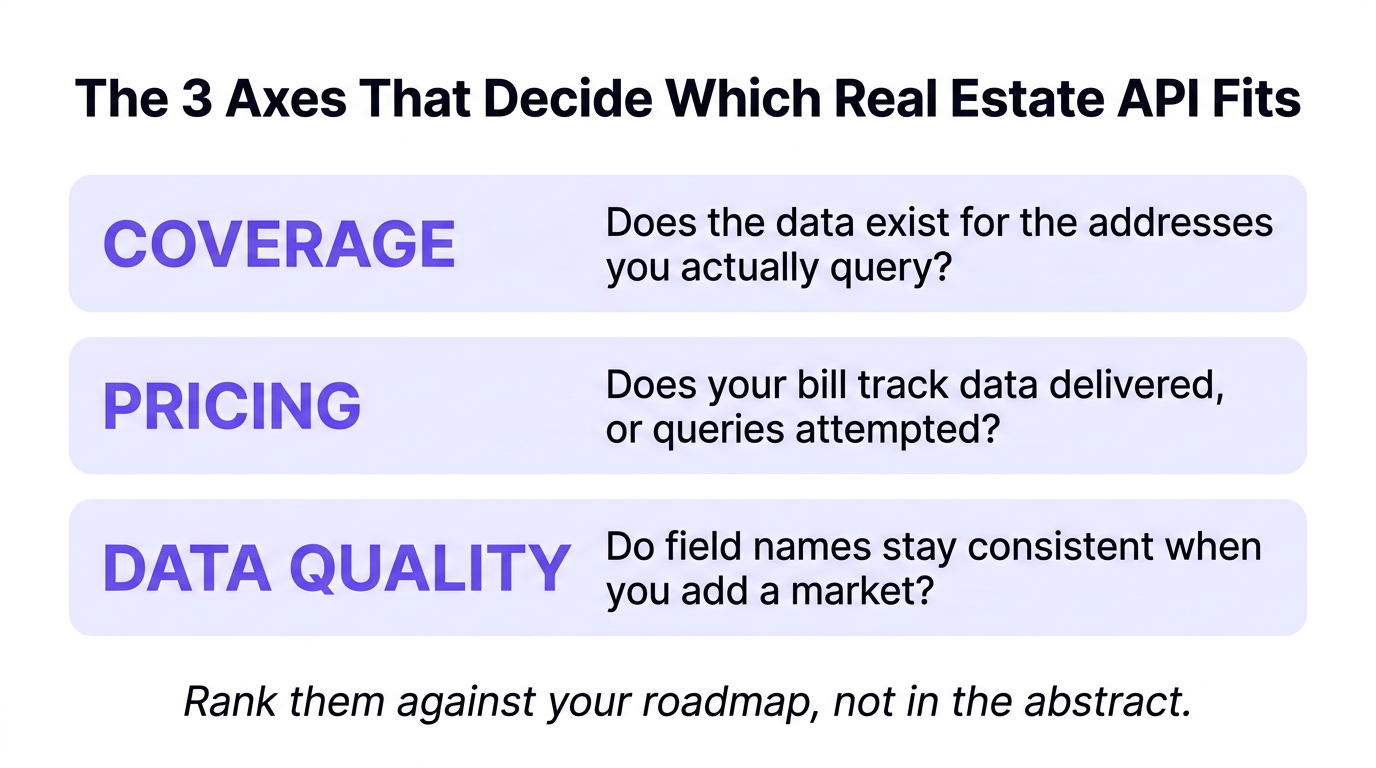
Rank coverage, pricing, and data quality against your roadmap rather than in the abstract. A team building a single-metro rental tool weights them very differently from a team building a national underwriting model, and any real estate API comparison that ignores that context is theater.
Record Counts Are a Weak Proxy
Nearly every ranking of the best real estate APIs leads with record totals, and those numbers resist comparison because providers count different things. One counts parcels. Another counts parcels plus historical transactions plus listing events, inflating the headline without adding a single new property.
An impressive total also says nothing about density in your specific markets. Two providers can both claim national reach while one leaves half your target counties with null values in the fields your model depends on.
How Should You Evaluate Coverage in a Real Estate API Comparison?
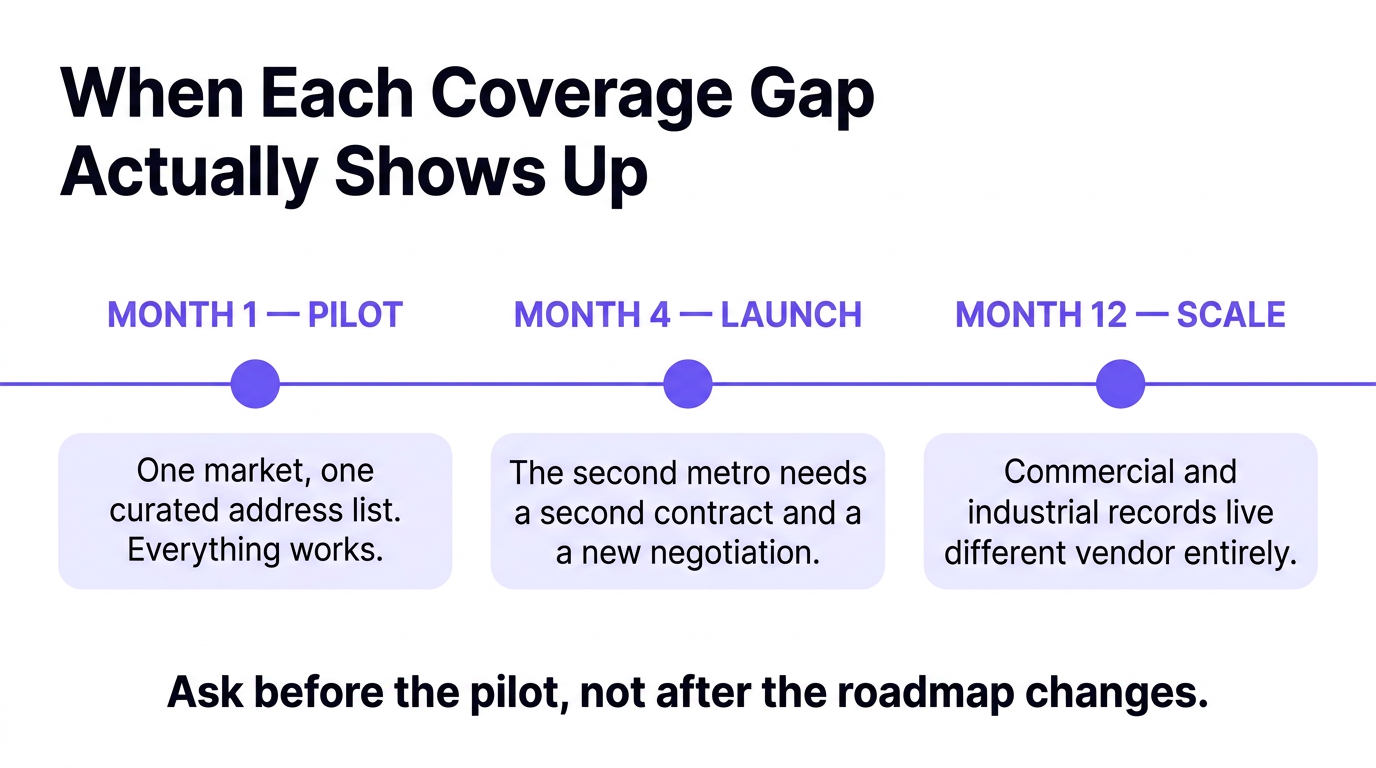
Coverage is the axis that punishes you last and hardest. It looks adequate during a pilot because pilots run in one market, on a curated address list, against the provider's strongest data. Production is where the gaps appear.
Any serious real estate API comparison has to separate two coverage questions that buyers routinely conflate. The first is geographic. The second is structural.
Regional Licensing Turns Into Contract Sprawl
Many providers license property data by region or by metro. You buy a package, integrate, launch, and everything works. Then product asks for three more markets and each one turns out to be a separate package, a separate negotiation, and often a separate contract with its own term and minimum.
The organizational cost outweighs the engineering cost. Your roadmap now runs through procurement, expansion timelines get set by contract cycles rather than sprint capacity, and volume rarely aggregates into a discount because each agreement is priced on its own.
Full national access removes that failure mode entirely. One integration reaches every market in the country, so adding a metro is a query parameter rather than a purchase order. When you evaluate a property data API, ask directly whether national coverage is included or assembled from regional packages. The answer changes your cost curve and your release calendar. National in a sales deck and national in a response payload are frequently different claims.

Property Type Is the Coverage Gap Nobody Plans For
The structural question is which property types a provider actually carries. Plenty of real estate APIs are residential-first, with commercial and industrial records thin, tiered as paid add-ons, or absent entirely.
This matters more than it seems at launch, because product direction shifts. A residential valuation tool gets asked for mixed-use. An investor dashboard gets asked for warehouses. If your provider cannot serve those records, you are integrating a second vendor and reconciling two schemas. Providers that carry residential, commercial, and industrial records under one API let you follow the roadmap without re-architecting the data layer.
How Do Real Estate API Pricing Models Compare?
Comparing headline prices across providers is close to meaningless because the billing units differ. Compare the unit instead, since it determines whether your costs scale with the value you receive or with the traffic you generate. Two billing units dominate, and they behave very differently past the pilot.
Per-request pricing charges for the call. Send a query that matches nothing, get an empty array back, and you have still spent a credit. Exploratory and filtered workloads are exactly the ones that produce empty results, so the model penalizes the queries that make property data useful in the first place. Whether a plan is billed as a monthly allowance or metered as you go matters far less than the unit underneath it, a distinction worth understanding before you compare real estate API pricing models in detail.
Per-record pricing charges for data delivered. A query that returns nothing costs nothing. A query that returns forty records costs forty records. Your bill tracks the data you actually put to work, which makes forecasting tractable and makes broad exploratory queries safe to run rather than something your team learns to avoid.

What Does Data Quality Mean for a Property Data API?
Data quality is the axis buyers evaluate least rigorously, usually because it is the hardest to assess from a marketing page. It is also the axis that consumes the most engineering time after integration. Quality in a property data API breaks down into two practical questions: is the schema consistent across markets, and how current is the record?
Schema Consistency Beats Raw Volume
Listing data in the United States is structurally fragmented. RESO reports 489 functioning MLS systems in the country, each historically carrying its own field names and conventions, which is why the RESO Web API exists as a common transport standard and why RESO stopped certifying the legacy RETS method back in 2018.
That fragmentation is what a good provider absorbs on your behalf. Normalized fields with consistent names and value conventions across every market mean adding a market costs you a query change. Raw regional variation means writing and maintaining a normalization layer forever. This is the core evaluation question for any MLS database API integration, and it separates providers far more decisively than record counts do.
Freshness Is a Cadence Question, Not a Marketing Word
Every provider says its data is current. Push for specifics: how often are records refreshed, which fields update on that cadence, and what mechanism lets you pull only what changed since your last sync. Scheduled delta queries filtered on a last-updated timestamp are the practical pattern here, and they keep your ingest proportional to actual change rather than to database size.
Ask what happens when a record is corrected rather than added. Correction handling is where freshness claims tend to fall apart, and it rarely comes up unless you raise it.
7 Questions to Ask Before You Choose the Best Real Estate API
The best real estate APIs answer all seven of these without hedging. Run every shortlisted provider through the same set and score the responses side by side, because a vague answer is itself a data point.
- Is national coverage native or stitched together? Ask what reaching a new metro actually requires. If the answer runs through procurement, that is your real expansion timeline.
- What exactly is the billing unit? Get a written answer on whether a query returning zero results is billed.
- Which property types are carried natively? Confirm commercial and industrial records sit in the same integration rather than a separate tier or vendor.
- Are there rate limits? Requests-per-second caps mean your team builds and maintains throttling and retry logic. That engineering time is part of the price and never appears on the invoice.
- Can you read the documentation right now? Public docs let you scope integration work before talking to anyone. Docs gated behind a sales call signal what the whole relationship will feel like.
- Can you explore the data before writing code? A visual web portal for building and previewing queries in a browser turns a week of speculative integration work into an afternoon of verification.
- What do your own addresses return? Run a real sample through a trial. Field completeness against your actual inputs beats every claim on every comparison page, including this one.
The documentation question deserves more weight than most buyers give it. Thin documentation is a broad industry problem rather than a real estate quirk: in Postman's 2025 State of the API Report, 55% of respondents cited documentation gaps, the most common collaboration challenge in the survey. When a vendor keeps its docs behind a sales conversation, you inherit that same problem from the outside before you have signed anything, which is what makes public documentation a real point of separation here.
Frequently Asked Questions
These are the questions that come up most often once teams move from browsing to evaluating.
Is There One Best Real Estate API for Every Use Case?
No. Public records, listings, valuations, and rental analytics are different data layers, and providers specialize. Define which layers your product needs, then find the provider whose coverage and schema serve those layers well. Teams needing several layers often consolidate onto one provider that carries them rather than stitching together three.
How Much Should a Property Data API Cost?
Published rates only tell you something if two providers bill the same unit, which they rarely do. Ask each provider to price your actual monthly record volume instead of quoting you a rate card, then compare those totals against each other. Providers that publish pricing openly make that exercise far faster than the ones routing every question through a sales call.
Can You Store and Redistribute Data From a Real Estate API?
Rights vary by provider and by data type, and listing data carries the most restrictions. Confirm storage, caching, and display permissions in writing before you design your architecture around them. Retrofitting after discovering a restriction is expensive.
What Are the Best Real Estate APIs for an Early-Stage Product?
Early-stage teams should weight pricing model and documentation quality most heavily, since both determine how fast a small team can move against an uncertain roadmap. Coverage breadth matters less on day one and a great deal by month twelve, so avoid providers that would force a migration once you expand.
Choosing the Best Real Estate API Comes Down to Fit
The provider that wins your evaluation should be the one that holds up under the conditions you are heading toward, not the one that performs best in a pilot you designed to be easy. Coverage that spans the whole country, a billing unit tied to delivered data, and a schema that stays consistent as you add markets are what keep a data layer from becoming a rebuild eighteen months out.
So test with your own addresses before you commit. The providers worth your time make that easy.
Datafiniti offers national property data across residential, commercial, and industrial records through a single integration, with per-record credit pricing, no rate limits, and public documentation you can evaluate today. Request a demo to get started and run your own addresses through it.
Read the latest articles

Read more

Business Data API: Company Data at Enterprise Scale

How to Build a Product Database With a Product Data API

Property Data API Coverage: What U.S. Datasets Include

Product Data API for Ecommerce Price Monitoring and Repricing

Real-Time Product Data API for Product-Led Growth Teams

Property Ownership Data API for Skip Tracing and Lead Gen

How APIs Make Building a Product Database Easy
Learn how to build a product database with APIs for cleaner imports, updates, search, and scalable product data.

What Is Property Transaction Data and How Does an API Help Get It?
Learn how property transaction data works and how APIs provide structured access for analysis and workflows.

How to Use Real Estate Transaction Data
Learn how to use real estate transaction data for analysis, valuation, underwriting, and market decisions.

How to Leverage Competitor Pricing Data with an API
Use competitor pricing data to build API-driven monitoring, analysis, and smarter pricing decisions.

Price Monitoring API: The Key to E-Commerce Pricing Strategy
Use a price monitoring API to track market changes, improve pricing decisions, and protect ecommerce margins.

How do Product Data APIs Work for E-Commerce Companies?
Learn how a product data API works, from collection and queries to ecommerce integration and use cases.

Bulk Real Estate Data Licensing: Access Datasets at Scale

How to Integrate MLS Listings Using an MLS Data API

GTIN Lookup API: Search Products by Barcode & UPC at Scale
Best Real Estate API 2026: Coverage, Pricing, Data Quality

Best Product Data API 2026: A State-of-the-Market Guide

Product Data API Integration Patterns for Ecommerce Platforms

Build a PropTech MVP With a Property Ownership Data API

3 Benefits of Web Scraping for Real Estate
Boost your research by using web scraping for real estate to gain market insights, automate lead lists, and minimize property risk.

How Real Estate Agents Can Leverage Proptech Data
Leverage proptech data to source leads, speed up valuations, and manage risk with accurate, real-time property insights.

What Is a UPC Lookup API?
Learn about the UPC lookup API, how it works, and its benefits for businesses. Get product data easily.

What Is a GTIN Lookup API?
Learn about the GTIN lookup API and how it can help your business grow. Get product data insights.

How Does a Property Data API Work?
Learn how a property data API works, its features, and how you can use it for real estate and business insights.

What The Best Real Estate APIs Should Have
Discover what makes the best real estate APIs stand out. Learn about essential features for your property data needs.
The Benefits of a Real Estate MLS API
Learn about the benefits of a real estate MLS API for streamlining data access and driving business growth.

Why Every Real Estate Pro Needs an MLS Database API
Learn why a MLS database API is vital for real estate pros. Get data, insights, and competitive edge.
How to Access MLS Listing Data
Learn how to access MLS listing data using an MLS data API. Discover Datafiniti's solutions and integration tips.
.png)
How to Enrich Your Product Catalog With a Real-Time API
.jpeg)
Product Data API Buyer's Guide for Ecommerce Teams

Do I Need a Real Estate Listing API?
Explore the benefits and technicalities of a real estate listing API. Learn how to choose the right provider and integrate data for business growth.

Unlocking the MLS Database with APIs
Unlock the MLS database with APIs. Learn how to access property data, gain real estate insights, and integrate MLS data for your business needs.

Why Real Estate Tech Startups Need Property APIs with Ownership Details
Discover how property APIs with ownership details empower real estate tech startups. Learn about data integration, risk mitigation, and driving business value.
The Value of a Product Catalog Sync for Product Managers
Unlock the value of product catalog sync for product managers. Streamline data, improve decisions, and reduce costs with real-time insights.

What is a Product Data Webhook?
Learn about product data webhooks, their components, and how they enable real-time updates for business intelligence and workflow automation.

Why Is a Product Data API Integration Essential for Analysts & Product Managers?
Unlock insights with product data API integration. Essential for analysts & product managers to streamline data access & enhance product strategy.

What Is a Product Data API and Its Benefits
Learn about product data APIs, their benefits, and how they drive business growth. Explore integration and advanced use cases.

What Do eCommerce Data Vendors Do?
Learn what ecommerce data vendors do, their services, and how to choose the right one for your business growth.

How to Compare Product Data Providers: What to Look For
Compare product data providers. Learn what to look for in data quality, structure, and integration features.

How to Get Your Product Data in Real-Time Using APIs
Learn how to leverage real-time product data APIs for e-commerce, competitive analysis, and AI. Get instant access to clean, structured product data.

Best Product Data API: Features to Look for
Find the best product data API with real-time updates, comprehensive coverage, and a user-friendly portal. Explore features to look for.

Unlocking Property Data with an API
Access property data with a powerful property database API. Explore listings, market analysis, investment opportunities, and more. Get started today!

Unlocking CRE with APIs
Unlock commercial real estate insights with a powerful API. Access property data, streamline workflows, and enhance investment strategies.

How to Get a Real-Time Product Feed Using an API
Learn how to get a real-time product feed using an API. Access, leverage, and ensure accuracy of product data for your business needs.

Spying on Competitor Prices: What You Need to Know
Learn how to gather and analyze competitor pricing data to inform your business strategy. Understand key components and ethical considerations.

Product Data Enrichment: What Are You Missing?
Enhance your product data with comprehensive enrichment. Discover insights, drive growth, and choose the right approach for your business.
.png)
IDX vs MLS API: A Developer's Guide to Real Estate Listing Data
.png)
Real Estate API Pricing Models Explained: Subscription vs. Usage-Based

Real Estate API vs Web Scraping: Which Wins in 2026?
.png)
Product Data APIs Explained: Powering Product Search and Catalog Automation

Best Sources for Bulk Real Estate Transaction Data

How to Get the Most out of a Product Catalog API
Learn how to leverage a product catalog API for business growth. Discover data quality, access methods, and strategy for your product catalog API.

Taming Your Ecommerce Product Data Feed
Optimize your ecommerce product data feed for growth. Learn strategies, leverage technology, and ensure data quality for better customer experience and AI initiatives.

Streamlining Your Product Search with an API
Explore the benefits and integration of a product search API. Streamline your product discovery and leverage data for business growth.
.png)
Real Estate Transaction Databases: What You Need to Know
.png)
Best MLS API for Real Estate Software: What Developers Need

How Real Estate Platforms Access MLS Database APIs
.png)
Commercial Real Estate API vs. Residential Property API
.png)
How to Choose a Real Estate Database API for Your MVP
MLS API vs. IDX: What's the Diff?
MLS API vs IDX: Explore the differences in real estate data access, retrieval, and integration. Understand which solution fits your needs.

Scraping vs. APIs: Getting Real Estate Data
Compare web scraping vs real estate API for data acquisition. Learn the pros, cons, and best use cases for each method.

Cracking the Code: Housing Sales Insights
Unlock housing sales analytics insights with Datafiniti. Explore property data, market trends, and advanced techniques for strategic decisions.

Property Valuation API: Your Go-To Real Estate Tool
Leverage the property valuation API for real estate insights. Access comprehensive property data for diverse applications with Datafiniti.

Product Data APIs Explained
Learn about product data APIs explained. Discover how to access, integrate, and utilize product data for e-commerce, analytics, and more.

Unlocking Your Ecommerce Data with APIs
Unlock ecommerce data with APIs for business insights, product catalog enrichment, and competitive analysis. Explore data via portal or API.

Your Guide to Housing Sales APIs
Explore housing sales API data for insights. Access property data, integrate into applications, and gain business intelligence. Get started today!

Real Estate Ownership Data: How to Access, Analyze and Use at Scale
Access, analyze, and use real estate ownership data at scale. Learn how to find, process, and leverage this crucial information for business insights.

Unlocking Opportunities: Navigating Bulk Real Estate Transaction Data
Unlock opportunities with bulk real estate transaction data. Learn how to access, analyze, and leverage property data for investing, marketing, and more.
What Is a Property Sales Database?
Explore what a property sales database is, its core components, how to access data, and key use cases for real estate analysis and more.

Benefits of Obtaining Housing Transaction Data
Unlock insights with housing transaction data. Analyze markets, investments, sales, and risk. Get comprehensive property data for informed decisions.

Understanding Real Estate Transaction Databases

IDX vs MLS API: What Every Real Estate Professional Should Know
Understand IDX vs MLS API differences. Learn about data access, integration, and how Datafiniti's solutions empower real estate professionals.

What Is an MLS Database API?
Explore the MLS database API: understand its components, benefits, and how to access real estate data for various applications. Learn about its core functionality and technical aspects.

How a Property Database API Can Help Real Estate Pros
Learn how a property database API can help real estate pros analyze trends, monitor listings, and optimize strategies. Get data insights.

What Is a Residential Property API?
Explore what a residential property API is, its features, benefits, and real-world applications for real estate professionals and investors.

What Is a Commercial Real Estate API?
Explore commercial real estate API functionality, data integration, and use cases. Learn how to leverage property, business, and people data for insights.

Understanding MVP Data Integration
Learn about MVP data integration, its components, benefits, and strategies for accessing and utilizing data resources effectively.

How to Choose the Best Property Data API
Learn how to choose the best property data API. Explore features, providers, pricing, and integration for real estate insights.

Real Estate Database API: What to Look for
Explore real estate database API options. Learn about data quality, features, and how to choose the right provider for your needs.
.png)
Real Estate Transaction Database: An API Access Guide

How Do Product Data APIs Work?
Understand how a product data API works, its key features, integration methods, and applications for e-commerce and business intelligence.

How Do Data Aggregation Platforms Work?
Explore how data aggregation platforms work, their capabilities, and applications. Learn to choose and implement the right platform for your business intelligence needs.

Why Do Companies Need Property Data Aggregation?
Discover why property data aggregation is crucial for businesses. Streamline access, empower functions, enhance risk management, and drive strategic decisions with authoritative insights.

MLS API: The Complete Guide to Accessing MLS Listing Data

Product Search API vs. Product Data API: What's the Difference?

What Are the Best MLS Data API Features to Look For?
Discover the best MLS data API features, including real-time updates, bulk downloads, and flexible filtering for property data.

What Is a Product Data API?
Explore the functionality and benefits of a product data API. Learn how to integrate, leverage, and choose the right provider for your business insights.
What Is the Difference Between Product Search API and Product Data API?
Understand the difference between Product Search API and Product Data API. Learn how to leverage product data for business intelligence and analytics.

Guide to Accessing Real Estate Transaction Database Via API
Access real estate transaction data via API. Explore property insights, sales, underwriting, and advanced applications with our authoritative guide.

Is a Real Estate MLS API Beneficial?
Explore the benefits of a real estate MLS API for enhanced data access, streamlined workflows, and market responsiveness. Learn about key features and use cases.

What is an MLS Database API?
Explore the MLS database API for comprehensive property data access. Learn about its core functionality, key features, and integration into real estate technology.

What Is a Property Data API?
Explore the capabilities of a property data API. Understand its core functionality, key features for developers, and how to access property information at scale for business insights.
.png)
Real Estate API Pricing: What You Need to Know Before You Build
.jpeg)
How to Choose a Property Market API for Investment Platforms
Choosing the right property market API is critical for investment platforms. Learn how to evaluate data depth, coverage, freshness, and integration quality before you commit.
Data you can trust, delivered in a format your systems can use, at the scale your product requires.