

What Is a Real Estate Transaction Database? A Complete Guide
Key Takeaways
A real estate transaction database is only worth licensing if you can verify what's in it, keep it current, and predict what it will cost at production volume.
- Every record traces back to a county filing, so a "largest database" claim means little until you know whether it counts documents, parcels, counties, or years.
- A deed shows that a property changed hands, but a complete history needs deeds, loans, and assessments linked to the same parcel.
- Cash sales and missing sale prices leave predictable gaps, and a good provider flags those gaps instead of filling them silently.
- The billing unit matters more than the rate card, because per-request pricing charges you for lookups that return nothing.
Choose the provider whose records, freshness, and billing you can verify yourself before the contract is signed.
A real estate transaction database is a structured collection of recorded property transfers, including deeds, sale prices, mortgages, and ownership changes, compiled from public records and standardized so software can search and analyze them. Each record ties a specific parcel to a specific event: who sold, who bought, when, for how much, and how the purchase was financed.
The volume never stops. Existing-home sales ran at an annual rate of 3.98 million in August 2026, and that figure counts only resales. New construction, commercial closings, land deals, and refinances all add their own filings on top.
Valuation models, underwriting systems, and prospecting tools all draw on these records. This guide covers what a real estate transaction database contains, what "largest" really means, how to access the data in bulk or by API, how licensing and pricing work, and what you can build with it.
What Is a Real Estate Transaction Database?
A real estate transaction database records what happened to a property, while a listing database records what's for sale. Listings describe a home someone hopes to sell. Transaction records describe the sale after it closed and was recorded with the county.
That distinction helps separate three things that search results often lump together.
Transaction Database vs. MLS vs. Transaction Management Software
An MLS is a private listing system run by and for brokers. It's the strongest source for active inventory, list prices, and days on market, but access is licensed market by market, and its closed sales mostly cover homes that were listed through it. Our MLS API: The Complete Guide covers that side of the market in depth.
Transaction management software is something else entirely. It's the workflow tool an agent uses to track paperwork on a deal in progress, and it holds no market-wide sales history. Many results for "real estate database" point to these CRM-style products anyway.
A property sales database sits closest to a transaction database, and many providers merge the two. They pair each sale with the property's characteristics and tax assessment so the price can be read in context. That merged view is what most analytics and product teams actually need.
What Is the Largest Real Estate Database?
There is no single official largest real estate database. Every national data set is an aggregation of local records, and the U.S. has 3,069 county governments (3,143 counties and county equivalents in total), whose offices keep land records, real estate transactions, and tax assessments in their own formats.
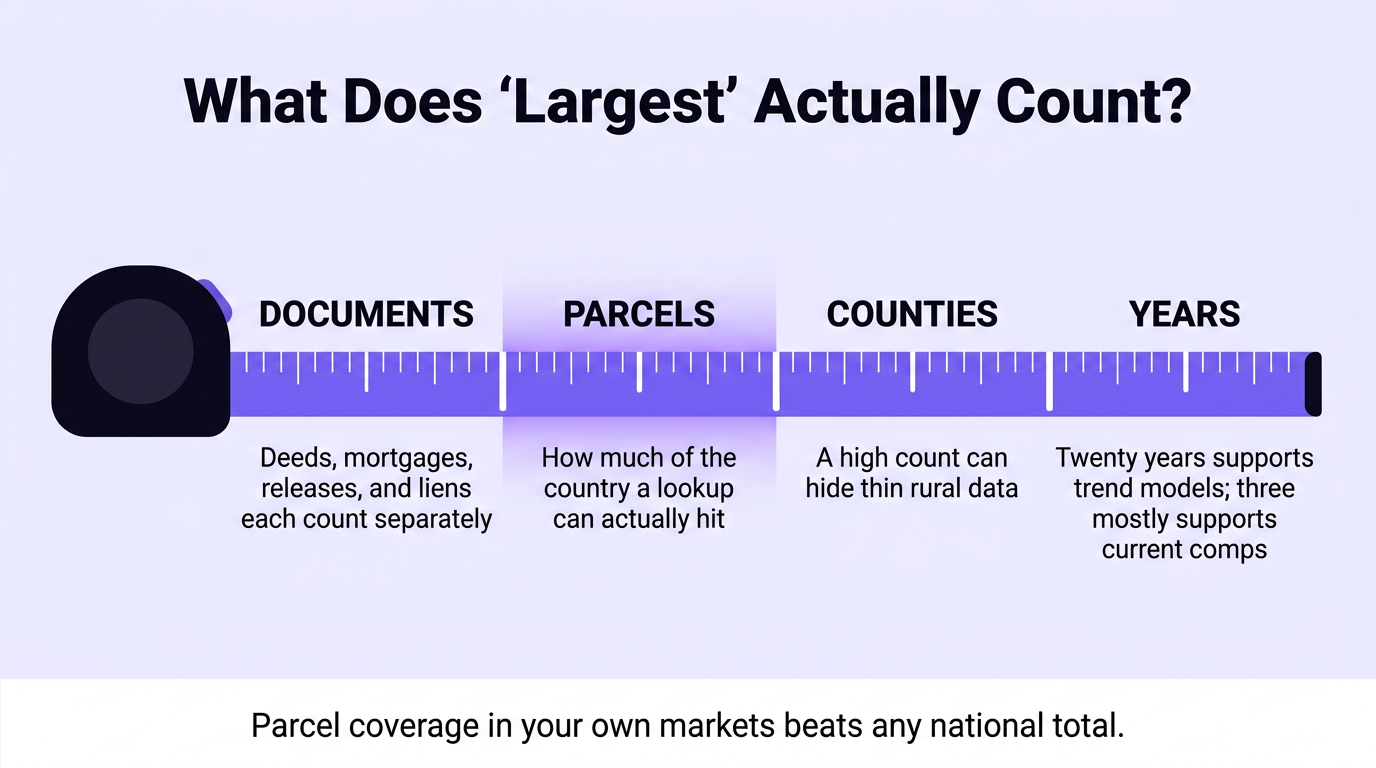
"Largest" is a claim providers make by choosing the yardstick that flatters them. When you see one, ask what it's counting:
- Documents. Deeds, mortgages, releases, and liens each count separately, so a document total can run several times higher than the number of properties behind it.
- Parcels or properties. This is the number that tells you how much of the country a lookup can actually hit.
- Counties covered. A high county count can hide thin data in rural markets or short history in newer ones.
- Years of history. Twenty years of deeds supports trend and repeat-sales models, while three years mostly supports current comps.
For a lookup-driven product, parcel coverage in your own markets beats any national total. Pull fifty addresses you know, including a rural sale and a new build, and count how many come back complete.
What Data Does a Real Estate Transaction Database Contain?
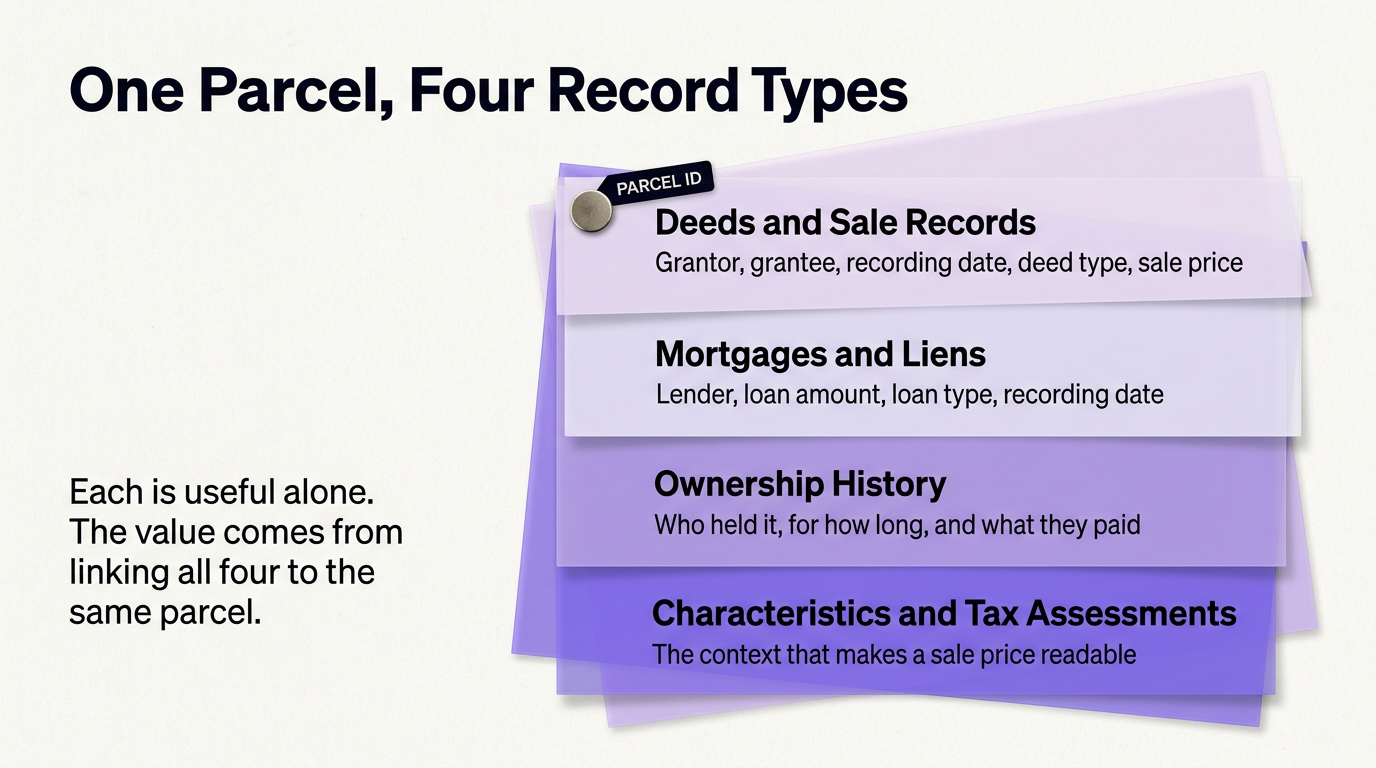
Four groups of records do most of the work. Each is useful alone, but the value comes from linking all four to the same parcel.
Deeds and Sale Records
A deed records the transfer: the grantor (seller), the grantee (buyer), the recording date, the document number, the deed type, and the sale price where the state requires it. Deed type matters more than most teams expect. A warranty deed usually signals an arm's-length sale, while a quitclaim between relatives or a transfer into an LLC often carries a nominal price that will distort a comp set if you don't filter it out.
Sale price isn't universal, either. In non-disclosure states, recorded documents typically don't carry the price, so providers fill the gap from listing data or leave the field empty. Ask how each state is handled before you build a model on it.
Mortgages, Liens, and Cash Sales
Mortgage records add the lender, loan amount, loan type, and recording date, which is how you estimate equity and spot refinancing. Liens, default notices, and foreclosure filings add the distress signals risk teams look for.
A missing loan isn't always missing data. In August 2026, 27% of transactions were cash sales, and those closings produce a deed with no mortgage behind it. Good housing transaction data lets you tell "no loan recorded" apart from "loan data not collected."
Ownership History, Characteristics, and Assessments
String a parcel's deeds together and you get an ownership chain: how long each owner held the property, what they paid, and how often it turned over. That chain is what surfaces flips, rapid resales, and unusual transfers.
Characteristics and tax assessments give each price its context. For example, a $400,000 sale says little alone, but a $400,000 sale of 1,100 square feet in a neighborhood assessed at half that says a lot. The parcel identifier holds it all together, so confirm it's consistent across record types.
How Do You Access Real Estate Transaction Data: Bulk or API?
Use bulk files when you need an entire market at once, and an API when your product needs one property at a time. Many teams use both, loading history in bulk and then keeping it fresh through the API.
Bulk Real Estate Data for Backfills and Models
Bulk delivery means large files, usually CSV or JSON, covering a state, a metro, or the whole country, delivered as one-time pulls or scheduled exports. It's the right fit for training valuation models, building a data warehouse, or running market research that needs every sale in a geography.
The trade-off is weight: you're storing and refreshing millions of rows yourself. A bulk real estate data license also tends to carry tighter terms on how you can use and share the files.
A Real Estate Database API for Lookups Inside Your Product
A real estate database API returns records on demand. You can look up an address, search a radius, or filter to sales recorded between two dates. That suits underwriting screens, lead enrichment, and any feature where a user asks about one property at a time.
Look for property data with transaction history returned alongside listings and characteristics in one response, so you aren't stitching three sources together. Throughput also shapes your architecture. An API with no rate limiting lets you run a large nightly enrichment job without building throttling and retry logic around it.
Keeping Data Current With Delta Queries
Neither access method stays current on its own. The standard pattern is a scheduled delta query: on a set cadence, request only the records updated since your last sync using a date-updated filter, then advance your stored timestamp. Run a slower full reconciliation now and then to catch anything missed.
Cadence is a product decision. A fraud screen may want daily pulls, while a quarterly market report is fine with monthly ones.
How Do Licensing and Pricing Work for Transaction Data?
When you license transaction records, you're buying usage rights rather than owning the data, so the contract defines what you can do as much as what you receive. Read four terms closely: permitted use (internal analytics or display in a customer-facing product), redistribution, refresh commitments, and what happens to stored data when the license ends.
Coverage terms deserve the same attention. Providers that sell by state or metro make you renegotiate every time you expand, and volume discounts rarely carry across separate agreements. National access under one contract removes that friction entirely.
Why Per-Record Pricing Beats Per-Request Pricing
Per-request billing charges for every call you make, whether it returns a record or not. Per-record billing charges only for the records you actually receive. At small volumes, the difference looks academic. At production scale, it becomes a real line item.
Here's a hypothetical. You enrich 10,000 leads by address, and 1,500 of those addresses don't match a property because of typos, unit numbers, or brand-new construction. Per-request pricing bills you for 10,000 calls. Per-record pricing bills you for 8,500 records.
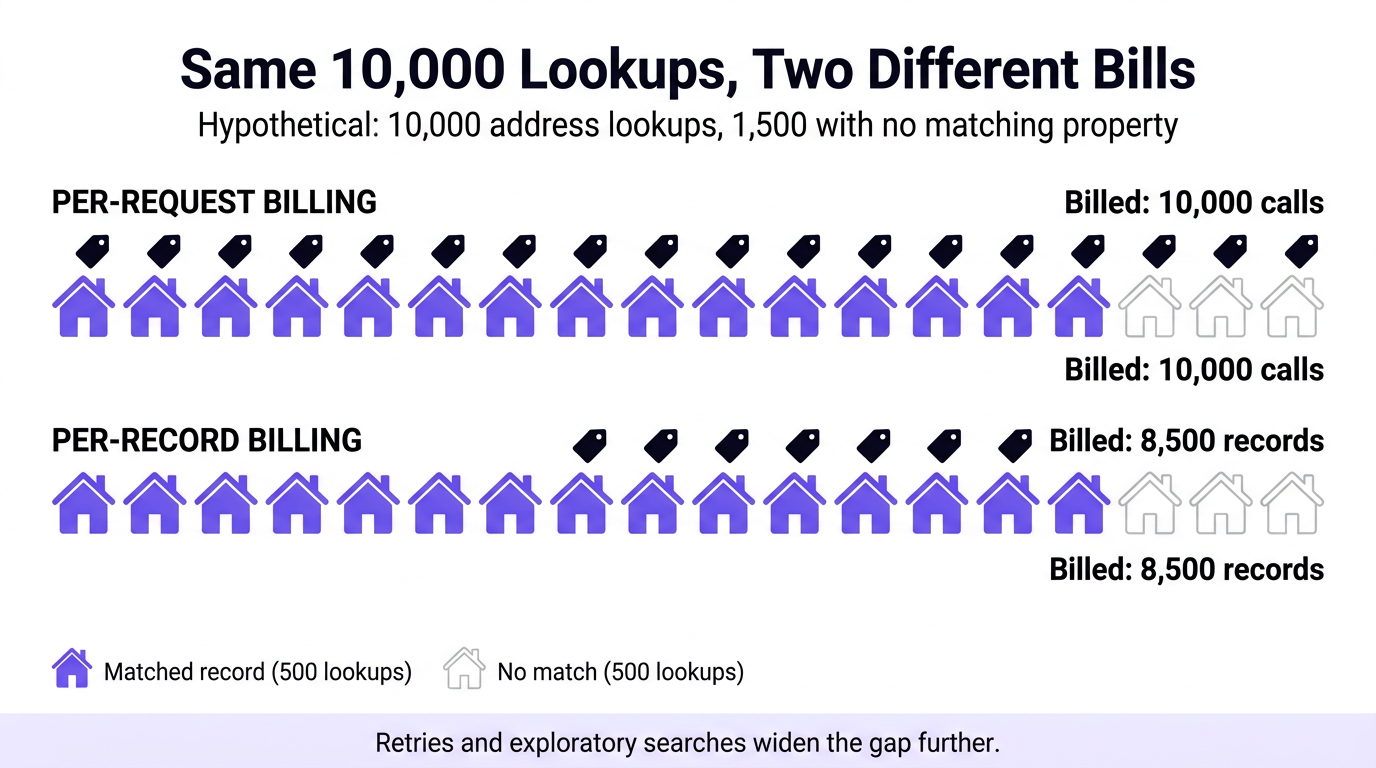
Retries and exploratory searches widen the gap further. The per-request model shifts the cost of imperfect input data onto you, while the per-record model keeps budgeting simple: forecast the records you need, and you've forecast the bill.
What Can You Build With Housing Transaction Data?
Most uses of housing transaction data fall into four groups, and all of them depend on the same sale, loan, and ownership fields.
- Automated valuation models. AVMs need clean, recent sales as comparables, and the bar rose for lenders when federal AVM quality control standards took effect on October 1, 2025, requiring random sample testing and protections against data manipulation.
- Comps and valuation support. Investors and appraisers filter a property sales database by distance, date, size, and deed type to build a defensible comp set.
- Underwriting and fraud screening. Lenders and insurers confirm that an applicant owns the property they claim and flag parcels that changed hands several times in a short window.
- Lead generation. Long-tenure owners, recent buyers, and absentee owners are all queryable segments, and our guide to the Property Ownership Data API shows how to turn them into outreach lists.
7 Questions to Ask Before You License a Real Estate Transaction Database
A demo shows a provider's best markets. These questions show you the rest.
- Can I read the documentation before I talk to sales? Public docs show field definitions, query syntax, and error handling up front. When they're gated behind a call, expect the rest of the evaluation to be gated too.
- Can I explore the data before writing code? A portal where you can search, filter, and inspect full records lets analysts judge field depth in an afternoon, before engineering time is spent.
- How are errors corrected? Ask how you report a bad record, who reviews it, and how quickly the fix appears in the API and in bulk files.
- Are commercial, industrial, and land sales in the same schema? Residential-only data forces you to add a second vendor the day your product expands.
- How is freshness measured? Ask for the typical lag between a county recording and the record appearing, plus the refresh cycle for off-market properties.
- What are the throughput limits on the real estate database API? Get the ceiling as a number, and find out exactly what happens when you exceed it.
- How are duplicate and conflicting records resolved? Data blended from several sources can disagree on price or date, so ask which source wins and whether you can see it.
Frequently Asked Questions
These are the questions people most often type into search bars and AI assistants on this topic.
What Is a Real Estate Database?
A real estate database is any organized collection of property information, such as listings, sales, ownership, characteristics, or tax records. The term covers everything from an agent's contact CRM to a national property sales database. For analytics and product work, it usually means structured records you can search by address, parcel, or geography.
Is Real Estate Transaction Data Public Record?
Yes, in the sense that deeds and mortgages are recorded with the county and open to inspection. What isn't free is the work of collecting records from thousands of offices, standardizing their fields, and matching each one to the right parcel. That work is what you're paying a provider for.
Can I Get Real Estate Transaction Data for Free?
For a single property, usually yes, through the county recorder or assessor website. For a whole market, free options run out fast, because county portals rarely offer bulk exports and research data sets often restrict commercial use. A provider trial is the practical way to test bulk real estate data at scale without paying up front.
How Much Does Real Estate Transaction Data Cost?
Cost depends on four things: record volume, geographic scope, field depth, and license terms. Small monthly plans suit testing and light enrichment, while national bulk licenses for product display or redistribution sit at the top of the range. To compare quotes fairly, ask each provider what one delivered record costs at your expected volume, with the fields you actually need.
Choosing a Real Estate Transaction Database You Can Verify
The records themselves are public. What you're really choosing is how they've been collected, linked, refreshed, and billed, and each of those is testable before you commit. Start with coverage in your markets, then model your bill at production volume.
Datafiniti's property data platform combines sales, ownership, tax, and listing records for residential, commercial, industrial, and land parcels nationwide, including 6.2 million commercial, industrial, and retail records and 17.9 million land parcels. You're billed only for records you actually receive, with public documentation, a portal for exploring records before you write code, and a free two-week trial of 1,000 records. Request a demo to run your own addresses and see the coverage for yourself.
Read the latest articles

Read more

Best Product Catalog API for Online Retailers: Aggregating Multi-Retailer Catalogs

Build vs Buy: Business Data Enrichment for Growing Teams

Company Data API Pricing: Bulk & Enterprise-Scale Access
Best Business Data APIs for Sales Teams & Prospecting

Business Data API: Company Data at Enterprise Scale

How to Build a Product Database With a Product Data API

Property Data API Coverage: What U.S. Datasets Include

Product Data API for Ecommerce Price Monitoring and Repricing

Real-Time Product Data API for Product-Led Growth Teams

Property Ownership Data API for Skip Tracing and Lead Gen

How APIs Make Building a Product Database Easy
Learn how to build a product database with APIs for cleaner imports, updates, search, and scalable product data.

How to Leverage Competitor Pricing Data with an API
Use competitor pricing data to build API-driven monitoring, analysis, and smarter pricing decisions.

Price Monitoring API: The Key to E-Commerce Pricing Strategy
Use a price monitoring API to track market changes, improve pricing decisions, and protect ecommerce margins.

How do Product Data APIs Work for E-Commerce Companies?
Learn how a product data API works, from collection and queries to ecommerce integration and use cases.

GTIN Lookup API: Search Products by Barcode & UPC at Scale

Best Real Estate API 2026: Coverage, Pricing, Data Quality

Best Product Data API 2026: A State-of-the-Market Guide

Product Data API Integration Patterns for Ecommerce Platforms

Build a PropTech MVP With a Property Ownership Data API
How Real Estate Agents Can Leverage Proptech Data
Leverage proptech data to source leads, speed up valuations, and manage risk with accurate, real-time property insights.

What Is a UPC Lookup API?
Learn about the UPC lookup API, how it works, and its benefits for businesses. Get product data easily.

What Is a GTIN Lookup API?
Learn about the GTIN lookup API and how it can help your business grow. Get product data insights.

How Does a Property Data API Work?
Learn how a property data API works, its features, and how you can use it for real estate and business insights.

What The Best Real Estate APIs Should Have
Discover what makes the best real estate APIs stand out. Learn about essential features for your property data needs.

MLS Listings API: How to Access MLS Listing Data
.png)
How to Enrich Your Product Catalog With a Real-Time API
.jpeg)
Product Data API Buyer's Guide for Ecommerce Teams

Why Real Estate Tech Startups Need Property APIs with Ownership Details
Discover how property APIs with ownership details empower real estate tech startups. Learn about data integration, risk mitigation, and driving business value.
The Value of a Product Catalog Sync for Product Managers
Unlock the value of product catalog sync for product managers. Streamline data, improve decisions, and reduce costs with real-time insights.

What is a Product Data Webhook?
Learn about product data webhooks, their components, and how they enable real-time updates for business intelligence and workflow automation.

Why Is a Product Data API Integration Essential for Analysts & Product Managers?
Unlock insights with product data API integration. Essential for analysts & product managers to streamline data access & enhance product strategy.

What Is a Product Data API and Its Benefits
Learn about product data APIs, their benefits, and how they drive business growth. Explore integration and advanced use cases.

What Do eCommerce Data Vendors Do?
Learn what ecommerce data vendors do, their services, and how to choose the right one for your business growth.

How to Compare Product Data Providers: What to Look For
Compare product data providers. Learn what to look for in data quality, structure, and integration features.

How to Get Your Product Data in Real-Time Using APIs
Learn how to leverage real-time product data APIs for e-commerce, competitive analysis, and AI. Get instant access to clean, structured product data.

Best Product Data API: Features to Look for
Find the best product data API with real-time updates, comprehensive coverage, and a user-friendly portal. Explore features to look for.

Unlocking Property Data with an API
Access property data with a powerful property database API. Explore listings, market analysis, investment opportunities, and more. Get started today!

Unlocking CRE with APIs
Unlock commercial real estate insights with a powerful API. Access property data, streamline workflows, and enhance investment strategies.

How to Get a Real-Time Product Feed Using an API
Learn how to get a real-time product feed using an API. Access, leverage, and ensure accuracy of product data for your business needs.

Spying on Competitor Prices: What You Need to Know
Learn how to gather and analyze competitor pricing data to inform your business strategy. Understand key components and ethical considerations.

Product Data Enrichment: What Are You Missing?
Enhance your product data with comprehensive enrichment. Discover insights, drive growth, and choose the right approach for your business.
.png)
Real Estate API Pricing Models Explained: Subscription vs. Usage-Based

Real Estate API vs Web Scraping: The Buy-vs-Build Decision
.png)
Product Data APIs Explained: Powering Product Search and Catalog Automation

How to Get the Most out of a Product Catalog API
Learn how to leverage a product catalog API for business growth. Discover data quality, access methods, and strategy for your product catalog API.

Taming Your Ecommerce Product Data Feed
Optimize your ecommerce product data feed for growth. Learn strategies, leverage technology, and ensure data quality for better customer experience and AI initiatives.

Streamlining Your Product Search with an API
Explore the benefits and integration of a product search API. Streamline your product discovery and leverage data for business growth.
What Is a Real Estate Transaction Database? A Complete Guide
.png)
Commercial Real Estate API vs. Residential Property API
.png)
How to Choose a Real Estate Database API for Your MVP

Property Valuation API: Your Go-To Real Estate Tool
Leverage the property valuation API for real estate insights. Access comprehensive property data for diverse applications with Datafiniti.

Product Data APIs Explained
Learn about product data APIs explained. Discover how to access, integrate, and utilize product data for e-commerce, analytics, and more.

Unlocking Your Ecommerce Data with APIs
Unlock ecommerce data with APIs for business insights, product catalog enrichment, and competitive analysis. Explore data via portal or API.

Real Estate Ownership Data: How to Access, Analyze and Use at Scale
Access, analyze, and use real estate ownership data at scale. Learn how to find, process, and leverage this crucial information for business insights.

IDX vs MLS API: What Every Real Estate Professional Should Know

How a Property Database API Can Help Real Estate Pros
Learn how a property database API can help real estate pros analyze trends, monitor listings, and optimize strategies. Get data insights.

What Is a Residential Property API?
Explore what a residential property API is, its features, benefits, and real-world applications for real estate professionals and investors.

What Is a Commercial Real Estate API?
Explore commercial real estate API functionality, data integration, and use cases. Learn how to leverage property, business, and people data for insights.

Understanding MVP Data Integration
Learn about MVP data integration, its components, benefits, and strategies for accessing and utilizing data resources effectively.

How to Choose the Best Property Data API
Learn how to choose the best property data API. Explore features, providers, pricing, and integration for real estate insights.

How Do Product Data APIs Work?
Understand how a product data API works, its key features, integration methods, and applications for e-commerce and business intelligence.

How Do Data Aggregation Platforms Work?
Explore how data aggregation platforms work, their capabilities, and applications. Learn to choose and implement the right platform for your business intelligence needs.

Why Do Companies Need Property Data Aggregation?
Discover why property data aggregation is crucial for businesses. Streamline access, empower functions, enhance risk management, and drive strategic decisions with authoritative insights.

MLS Database API: How to Choose a Provider and Get Access

Product Search API vs. Product Data API: What's the Difference?

What Is a Product Data API?
Explore the functionality and benefits of a product data API. Learn how to integrate, leverage, and choose the right provider for your business insights.
What Is the Difference Between Product Search API and Product Data API?
Understand the difference between Product Search API and Product Data API. Learn how to leverage product data for business intelligence and analytics.

What Is a Property Data API?
Explore the capabilities of a property data API. Understand its core functionality, key features for developers, and how to access property information at scale for business insights.
.png)
Real Estate API Pricing: What You Need to Know Before You Build
.jpeg)
How to Choose a Property Market API for Investment Platforms
Choosing the right property market API is critical for investment platforms. Learn how to evaluate data depth, coverage, freshness, and integration quality before you commit.
Data you can trust, delivered in a format your systems can use, at the scale your product requires.