
Product Catalog APIs & Purchase Routing: Normalizing Multi-Retailer Data
Key Takeaways
Purchase routing only works when every retailer's version of a product resolves to one canonical record with current offers attached.
- Retailer feeds describe the same item in different ways, so normalization has to happen before any routing logic runs.
- Identifier matching resolves most duplicates cheaply, while attribute scoring and a review queue catch the rest.
- Splitting products from offers keeps sync lightweight, since price and stock move far faster than specs.
- Scheduled delta queries keep offers fresh, while vendor throttling makes them stale.
If your router keeps sending shoppers to dead listings, the problem usually starts in your data model.
APIs for product catalog and purchase routing handle two jobs. They assemble a clean, deduplicated view of what's for sale across many retailers, and they decide where a shopper or internal system should buy each item. Both jobs rest on the same foundation: structured product data at scale that treats one physical product as one record, no matter how many stores list it.
That foundation matters more every quarter. The Census Bureau's quarterly report shows U.S. retail e-commerce sales reached $340.2 billion in the second quarter of 2026, or 17.1% of all retail sales. More online volume means more listings and more versions of the same product with slightly different titles, prices, and stock levels.
This guide covers how to normalize product data from multiple retailers, how product data deduplication and product entity resolution fit together, how to keep a product feed API in sync, and how to vet vendors.
What Do APIs for Product Catalog and Purchase Routing Do?
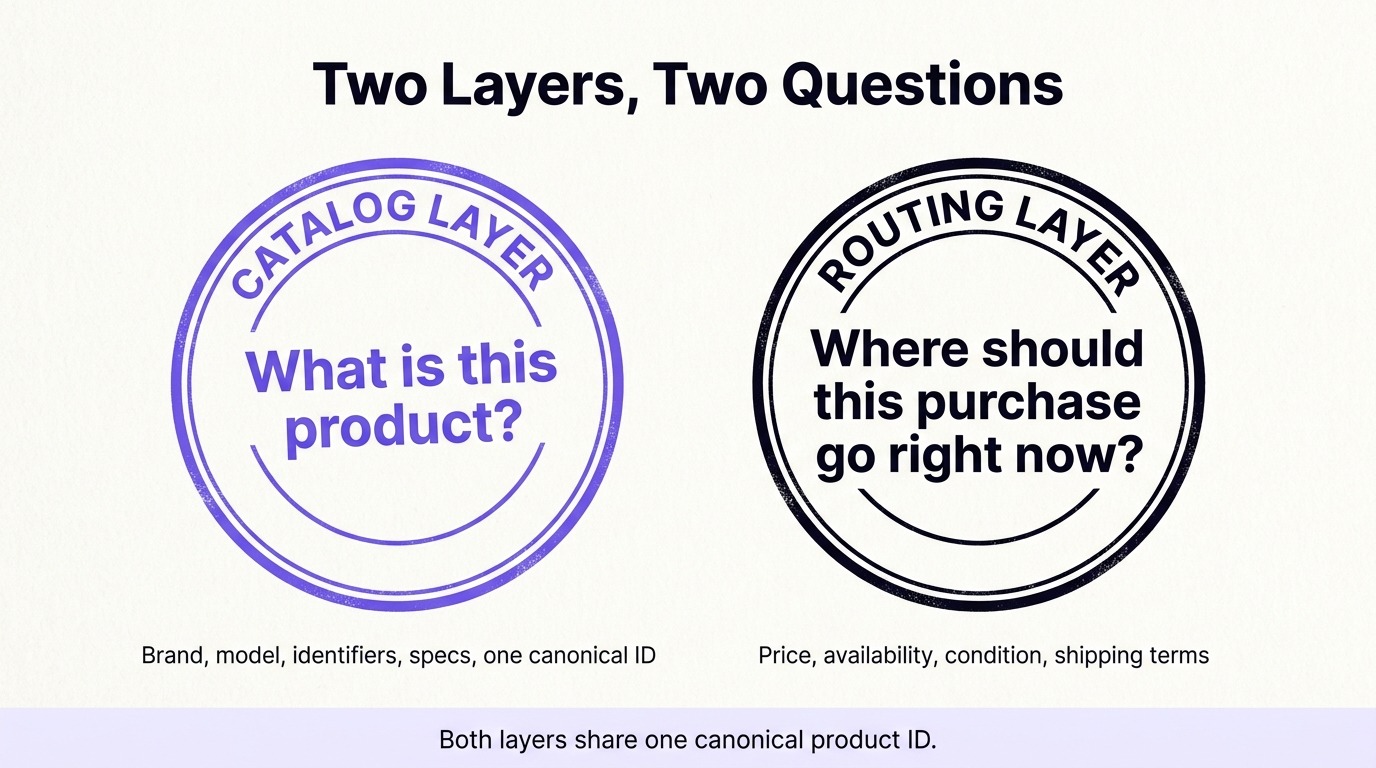
They turn scattered retailer listings into one canonical record per product, then pick the best retailer offer for each purchase. The catalog layer answers "what is this product?" and the routing layer answers "where should this purchase go right now?"
The Catalog Layer Defines the Product
The catalog layer stores the facts that rarely change: brand, model, identifiers, specifications, category, and images. A good catalog layer gives every product one canonical ID that search, recommendations, and analytics all share.
Without that shared ID, each system invents its own truth. Search shows three copies of one blender, analytics counts three SKUs, and your router can't compare prices because it doesn't know they're the same item.
The Routing Layer Picks the Offer
The routing layer chooses which retailer's offer a purchase goes to, based on rules like lowest landed price, preferred merchants, stock status, or shipping speed. An offer is the retailer-specific mix of price, availability, condition, and shipping terms attached to a product.
Availability is the most impactful part of routing. A June 2026 DOSS survey of 1,000 U.S. adults found that when shoppers hit an online stockout, 45% buy from a different retailer. If your router already knows a second retailer has the item in stock, that sale stays inside your experience.
Why Is It So Hard to Normalize Product Data Across Retailers?
Every retailer names, measures, and categorizes the same product in its own way, and those differences multiply with each source you add. Fixing one feed is easy; keeping dozens consistent as retailers change formats is the real work.
Where Retailer Feeds Disagree
Retailer feeds disagree in five places:
- Titles. One retailer leads with the brand, another with the product type, and a third packs in promotional keywords.
- Units and sizes. "12 oz," "12-ounce," and "340 g" can describe the same bottle, and pack counts show up in a dozen formats.
- Categories. Each store runs its own taxonomy, so one item might sit under Kitchen, Small Appliances, or Home Essentials.
- Variants. Some retailers list every color as its own product, while others nest colors under one parent.
- Price fields. Sale, list, and member prices arrive in different fields or crammed into one.
Each of these differences breaks matching in a different way, which is why normalization has to run before deduplication, not alongside it.
What a Normalized Schema Gives You
A normalized schema maps every source into one set of field names, units, and data types, which makes records comparable. Brand is always a brand field, prices are always numeric with a currency code, and identifiers live in predictable places.
You can build the mapping layer yourself, one retailer at a time. Or you can start from a product data API that already normalizes records into a single schema. Choosing a source that can normalize product data upstream moves your engineering time from parsing feeds to writing routing rules.
How Do Product Data Deduplication and Product Entity Resolution Work?
Product data deduplication removes repeated records within one source, while product entity resolution links records across sources that describe the same real-world item. Most pipelines run both in three passes: identifier matching, attribute scoring, and then human review for borderline pairs.
Start With Identifier Matching
Identifier matching is the cheapest, most reliable first pass. When two listings share a GTIN, UPC, or EAN, they almost always describe the same product, down to size and pack count. At volume, a GTIN Lookup API lets you resolve barcodes to product records before any fuzzy logic runs.
Normalize identifiers before you compare them. There are four GTIN formats in total, 8, 12, 13, and 14 digits long, and padding every code with leading zeros to 14 digits lets a UPC-A and its EAN-13 equivalent match as the same number. Then, validate the final check digit, and confirm brand and size before you merge, since placeholder and reused codes still turn up in retailer feeds.
Use Attribute Scoring for Everything Else
When identifiers are missing or conflicting, score candidate pairs on normalized attributes. The usual approach cleans brand names, extracts model numbers from titles, standardizes units, and rates how closely those fields agree. Brand plus manufacturer part number is often nearly as reliable as a barcode.
Set two thresholds instead of one. As a starting point, you might auto-merge pairs scoring above 0.9, keep pairs below 0.7 separate, and send everything between to a review queue. Tune both cutoffs against your own data.
Measure Match Quality Before You Route
Measure match quality by auditing samples because a bad merge sends a shopper to the wrong product. Pull a random sample of merged pairs each week and have someone check whether each pair really is the same item. The share that holds up is your merge precision.
Watch the review queue too, since steady growth usually means a retailer changed its feed format.
Keep Offers Separate From Products
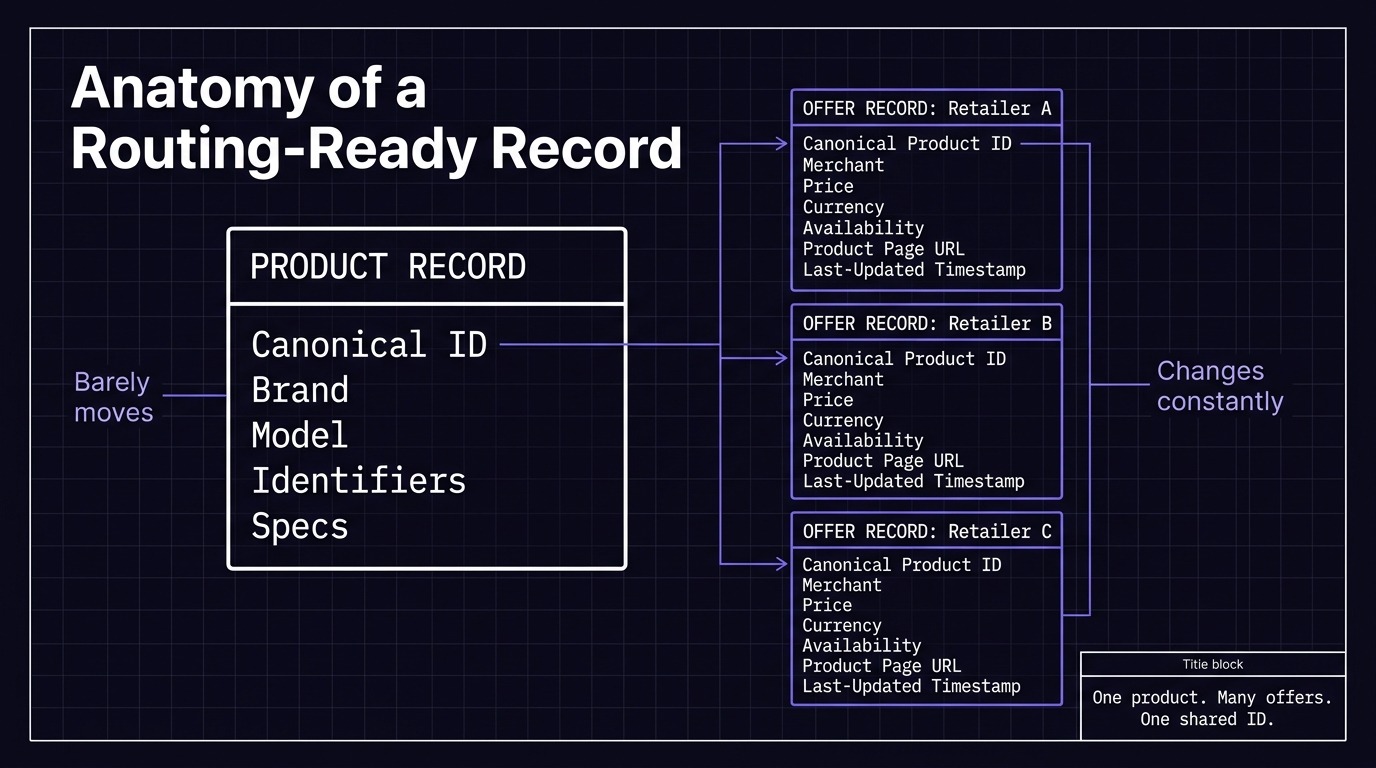
Split the product entity from its offers; it's the most useful modeling decision in the whole stack. The product record holds brand, model, identifiers, specs, and one canonical ID. Each offer record holds the canonical product ID, merchant, price, currency, availability, product page URL, and a last-updated timestamp.
Our guide to Aggregating Multi-Retailer Catalogs covers this structure in more depth. It also makes sync cheaper because offers change constantly while product attributes barely move.
How Do You Keep a Product Feed API in Sync for Routing?
Run scheduled delta queries that pull only records changed since your last sync, filtered on dateUpdated, and make sure the API's throughput lets each run finish on time.
Pull Changes With Scheduled Delta Queries
A scheduled delta query is the dependable way to keep a product feed API current. On a set cadence, your job requests records whose dateUpdated value falls after your last successful sync, then upserts those changes into your offer table. If the last run finished at 2:00 a.m., the next one asks for everything updated since then, minus a short overlap window of 10 or 15 minutes to catch late-arriving records.
Set the cadence by category. A reasonable starting point is several runs a day for fast-moving electronics, daily for grocery, and weekly for furniture or industrial parts. Your routing rules should also read each offer's timestamp and deprioritize anything outside your freshness window.
Why Rate Limits Make Routing Data Stale
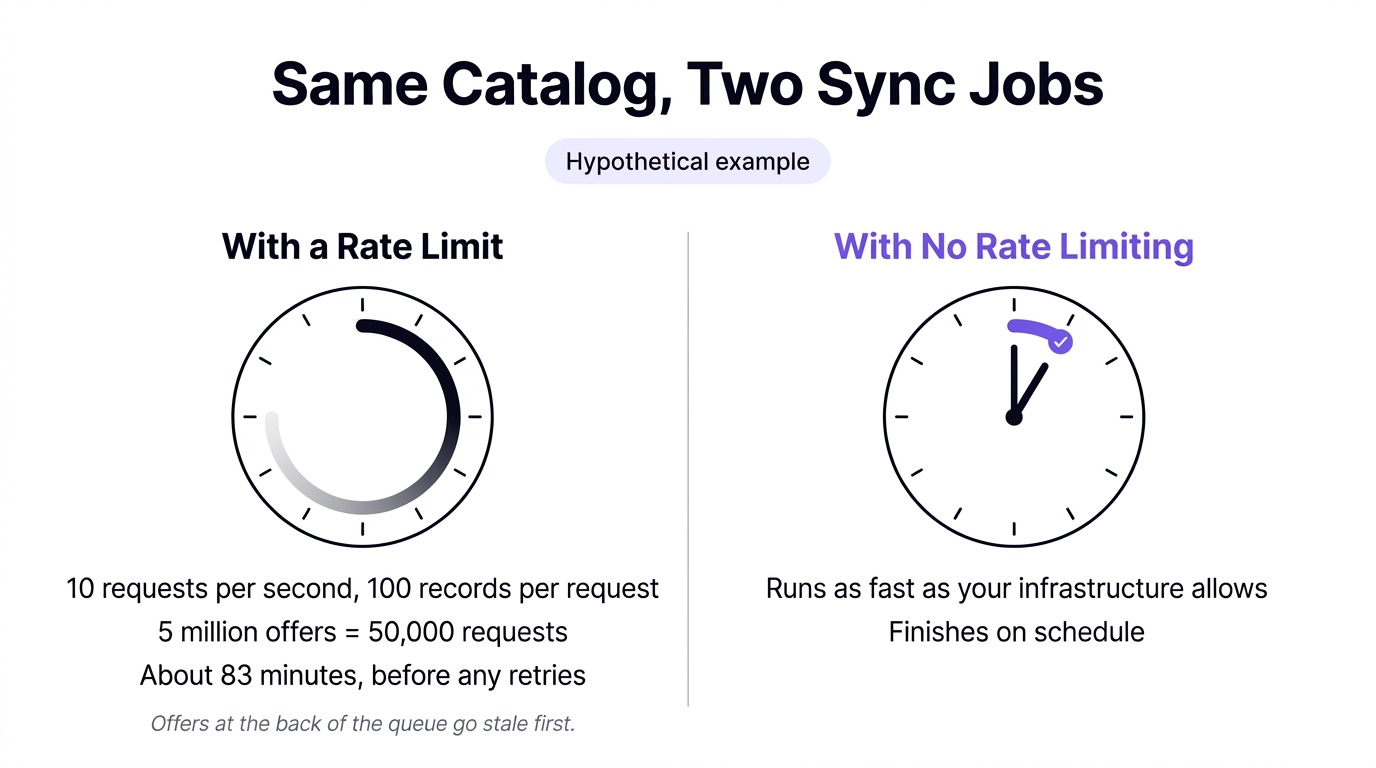
Rate limits make routing data stale because they stop a sync job from finishing inside its window. Take a hypothetical cap of 10 requests per second and 100 records per request: refreshing 5 million offers takes 50,000 requests and about 83 minutes, before any retries. Under caps like that, your team builds throttling logic, retry queues, and backoff handling just to stay under the limit, which is engineering time spent managing a vendor's constraint.
Throttling also degrades routing. When a sync job crawls through its queue, the offers at the back become the stalest data in your system, and your router can't reliably tell which ones they are. Stale availability is exactly how shoppers land on out-of-stock pages.
An API with no rate limiting removes that failure mode. Your delta job runs as fast as your own infrastructure allows and finishes on schedule. For APIs for product catalog and purchase routing, that throughput headroom keeps freshness from eroding as your catalog grows.
Use Bulk Files for the First Load
Load your starting catalog from bulk files, then switch to delta queries for everything after. Backfilling millions of records through paged API calls is slow and wasteful. Bulk files and scheduled exports in the API's schema let you seed product and offer tables in a single pass.
How Should You Evaluate APIs for Product Catalog and Purchase Routing?
Evaluate them on seven things: canonical records, date filtering, throughput, documentation, pre-code data access, billing, and contract coverage. These questions separate APIs for product catalog and purchase routing that hold up at scale from ones that only demo well.
- Does it return one canonical record per product? Ask how cross-retailer duplicates are handled and whether offers link to a shared product ID.
- Can you filter by last-updated date? A dateUpdated filter is the foundation of reliable sync.
- Are there throughput caps? Requests-per-second limits decide whether your sync finishes on time.
- Is the documentation public? Open docs let engineers scope the integration before a sales call, while many vendors hide basic query structure until you've talked to someone.
- Can you explore the data before writing code? A visual web portal lets you check coverage for your categories and build queries first.
- How is billing measured? Per-record billing charges only for records you actually receive, while per-request pricing bills you for empty and failed queries too.
- Is full coverage available under one contract? One agreement for every retailer and category avoids stitching together separate packages as you expand.
Frequently Asked Questions
What's the Difference Between a Product Feed API and a Product Catalog API?
A product feed API usually delivers offer-level data, like price and availability, on a recurring basis. A product catalog API focuses on attributes, identifiers, and categories. Purchase routing needs both, joined through a canonical product ID.
How Should I Estimate the Cost of a Product Catalog API?
Estimate the cost from the number of records you'll pull each month, then check how the vendor bills them. Add your one-time backfill to your ongoing delta volume; for example, 50,000 changed offers a day works out to about 1.5 million records a month. Under per-record billing, that number is your cost driver, while per-request pricing adds charges for empty pages and failed calls.
How Should I Handle Product Variants During Matching?
Match at the variant level, since size and color change what the shopper actually receives. Group variants under a parent for display, but route each purchase to the exact variant offer. Merging a 12-pack with a 24-pack is one of the most common and expensive matching errors.
Should Matching Run Before or After Data Reaches My Warehouse?
Run it after raw data lands, in a dedicated transformation step. Keeping the original retailer records lets you re-run matching when your rules improve.
Clean Product Data Makes Purchase Routing Work
Purchase routing succeeds or fails on data quality: normalized records, resolved entities, separate offers, and syncs that finish on time. Get those pieces right, and the routing rules become the easy part.
When you compare APIs for product catalog and purchase routing, weigh schema consistency, sync design, and throughput above long feature lists. Datafiniti delivers normalized, deduplicated product records with unthrottled API access, backed by bulk delivery for large loads. Request a Datafiniti demo to see how it fits your routing stack.
Read the latest articles
Read more

Best Property Data API Platforms for U.S. Real Estate: A Buyer's Comparison

Best Product Catalog API for Online Retailers: Aggregating Multi-Retailer Catalogs

Build vs Buy: Business Data Enrichment for Growing Teams

Company Data API Pricing: Bulk & Enterprise-Scale Access

Best Business Data APIs for Sales Teams & Prospecting

Business Data API: Company Data at Enterprise Scale

How to Build a Product Database With a Product Data API

Property Data API Coverage: What U.S. Datasets Include

Product Data API for Ecommerce Price Monitoring and Repricing

Real-Time Product Data API for Product-Led Growth Teams

Property Ownership Data API for Skip Tracing and Lead Gen

How APIs Make Building a Product Database Easy
Learn how to build a product database with APIs for cleaner imports, updates, search, and scalable product data.

How to Leverage Competitor Pricing Data with an API
Use competitor pricing data to build API-driven monitoring, analysis, and smarter pricing decisions.

Price Monitoring API: The Key to E-Commerce Pricing Strategy
Use a price monitoring API to track market changes, improve pricing decisions, and protect ecommerce margins.

How do Product Data APIs Work for E-Commerce Companies?
Learn how a product data API works, from collection and queries to ecommerce integration and use cases.

GTIN Lookup API: Search Products by Barcode & UPC at Scale

Best Real Estate API 2026: Coverage, Pricing, Data Quality

Best Product Data API 2026: A State-of-the-Market Guide

Product Data API Integration Patterns for Ecommerce Platforms

Build a PropTech MVP With a Property Ownership Data API

How Real Estate Agents Can Leverage Proptech Data
Leverage proptech data to source leads, speed up valuations, and manage risk with accurate, real-time property insights.

What Is a UPC Lookup API?
Learn about the UPC lookup API, how it works, and its benefits for businesses. Get product data easily.

What Is a GTIN Lookup API?
Learn about the GTIN lookup API and how it can help your business grow. Get product data insights.

How Does a Property Data API Work?
Learn how a property data API works, its features, and how you can use it for real estate and business insights.

What The Best Real Estate APIs Should Have
Discover what makes the best real estate APIs stand out. Learn about essential features for your property data needs.

MLS Listings API: How to Access MLS Listing Data

How to Enrich Your Product Catalog With a Real-Time API

Product Data API Buyer's Guide for Ecommerce Teams

Why Real Estate Tech Startups Need Property APIs with Ownership Details
Discover how property APIs with ownership details empower real estate tech startups. Learn about data integration, risk mitigation, and driving business value.
The Value of a Product Catalog Sync for Product Managers
Unlock the value of product catalog sync for product managers. Streamline data, improve decisions, and reduce costs with real-time insights.

What is a Product Data Webhook?
Learn about product data webhooks, their components, and how they enable real-time updates for business intelligence and workflow automation.

Why Is a Product Data API Integration Essential for Analysts & Product Managers?
Unlock insights with product data API integration. Essential for analysts & product managers to streamline data access & enhance product strategy.

What Is a Product Data API and Its Benefits
Learn about product data APIs, their benefits, and how they drive business growth. Explore integration and advanced use cases.

What Do eCommerce Data Vendors Do?
Learn what ecommerce data vendors do, their services, and how to choose the right one for your business growth.

How to Compare Product Data Providers: What to Look For
Compare product data providers. Learn what to look for in data quality, structure, and integration features.

How to Get Your Product Data in Real-Time Using APIs
Learn how to leverage real-time product data APIs for e-commerce, competitive analysis, and AI. Get instant access to clean, structured product data.

Best Product Data API: Features to Look for
Find the best product data API with real-time updates, comprehensive coverage, and a user-friendly portal. Explore features to look for.

Unlocking Property Data with an API
Access property data with a powerful property database API. Explore listings, market analysis, investment opportunities, and more. Get started today!

Unlocking CRE with APIs
Unlock commercial real estate insights with a powerful API. Access property data, streamline workflows, and enhance investment strategies.

How to Get a Real-Time Product Feed Using an API
Learn how to get a real-time product feed using an API. Access, leverage, and ensure accuracy of product data for your business needs.

Spying on Competitor Prices: What You Need to Know
Learn how to gather and analyze competitor pricing data to inform your business strategy. Understand key components and ethical considerations.

Product Data Enrichment: What Are You Missing?
Enhance your product data with comprehensive enrichment. Discover insights, drive growth, and choose the right approach for your business.

Real Estate API Pricing Models Explained: Subscription vs. Usage-Based

Real Estate API vs Web Scraping: The Buy-vs-Build Decision

Product Data APIs Explained: Powering Product Search and Catalog Automation

How to Get the Most out of a Product Catalog API
Learn how to leverage a product catalog API for business growth. Discover data quality, access methods, and strategy for your product catalog API.

Taming Your Ecommerce Product Data Feed
Optimize your ecommerce product data feed for growth. Learn strategies, leverage technology, and ensure data quality for better customer experience and AI initiatives.

Streamlining Your Product Search with an API
Explore the benefits and integration of a product search API. Streamline your product discovery and leverage data for business growth.

What Is a Real Estate Transaction Database? A Complete Guide

Commercial Real Estate API vs. Residential Property API

How to Choose a Real Estate Database API for Your MVP

Property Valuation API: Your Go-To Real Estate Tool
Leverage the property valuation API for real estate insights. Access comprehensive property data for diverse applications with Datafiniti.

Product Data APIs Explained
Learn about product data APIs explained. Discover how to access, integrate, and utilize product data for e-commerce, analytics, and more.

Unlocking Your Ecommerce Data with APIs
Unlock ecommerce data with APIs for business insights, product catalog enrichment, and competitive analysis. Explore data via portal or API.

Real Estate Ownership Data: How to Access, Analyze and Use at Scale
Access, analyze, and use real estate ownership data at scale. Learn how to find, process, and leverage this crucial information for business insights.

IDX vs MLS API: What Every Real Estate Professional Should Know

How a Property Database API Can Help Real Estate Pros
Learn how a property database API can help real estate pros analyze trends, monitor listings, and optimize strategies. Get data insights.

What Is a Residential Property API?
Explore what a residential property API is, its features, benefits, and real-world applications for real estate professionals and investors.

What Is a Commercial Real Estate API?
Explore commercial real estate API functionality, data integration, and use cases. Learn how to leverage property, business, and people data for insights.

Understanding MVP Data Integration
Learn about MVP data integration, its components, benefits, and strategies for accessing and utilizing data resources effectively.

How to Choose the Best Property Data API
Learn how to choose the best property data API. Explore features, providers, pricing, and integration for real estate insights.

How Do Product Data APIs Work?
Understand how a product data API works, its key features, integration methods, and applications for e-commerce and business intelligence.

How Do Data Aggregation Platforms Work?
Explore how data aggregation platforms work, their capabilities, and applications. Learn to choose and implement the right platform for your business intelligence needs.

Why Do Companies Need Property Data Aggregation?
Discover why property data aggregation is crucial for businesses. Streamline access, empower functions, enhance risk management, and drive strategic decisions with authoritative insights.

MLS Database API: How to Choose a Provider and Get Access

Product Search API vs. Product Data API: What's the Difference?

What Is a Product Data API?
Explore the functionality and benefits of a product data API. Learn how to integrate, leverage, and choose the right provider for your business insights.
What Is the Difference Between Product Search API and Product Data API?
Understand the difference between Product Search API and Product Data API. Learn how to leverage product data for business intelligence and analytics.

What Is a Property Data API?
Explore the capabilities of a property data API. Understand its core functionality, key features for developers, and how to access property information at scale for business insights.

Real Estate API Pricing: What You Need to Know Before You Build

How to Choose a Property Market API for Investment Platforms
Choosing the right property market API is critical for investment platforms. Learn how to evaluate data depth, coverage, freshness, and integration quality before you commit.
Data you can trust, delivered in a format your systems can use, at the scale your product requires.