

How to Integrate MLS Listings Using an MLS Data API
Key Takeaways
Integrating MLS listings into a real estate app comes down to four things: authenticating against the API, querying the right endpoints, syncing updates on a schedule, and following the display rules that govern how listings appear.
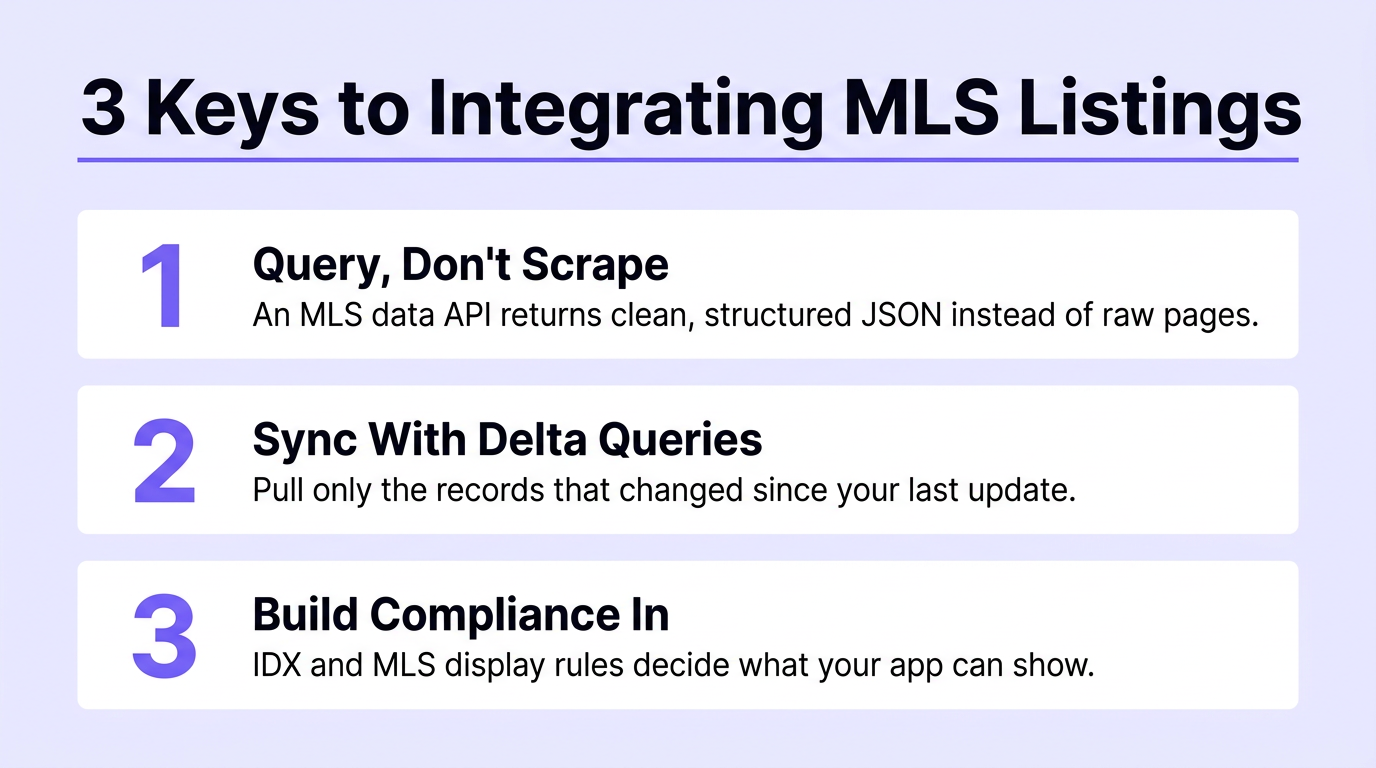
- An MLS data API delivers structured listing records over REST, so your app reads clean JSON instead of parsing raw feeds or scraping pages.
- Authentication and endpoints are the starting point; a single filtered query returns listings you can map straight into your app's data model.
- Keeping listings current relies on scheduled delta queries that pull only records changed since your last sync, not manual re-downloads.
- IDX and MLS display rules decide what you can show and how, so compliance belongs in your integration plan from day one.
The right listing API turns a months-long data project into a predictable integration you can ship.
Home buyers start on their phones. In the latest national survey of home buyers, nearly all searched online, and finding the right home was still the hardest part of the process. If your app cannot show accurate, current listings, users leave for one that can.
That accuracy comes from the Multiple Listing Service. Getting those listings into your product is the developer problem this guide solves, and an MLS data API is the cleanest way to pull structured real estate data into an app without building and babysitting your own collection pipeline.
Choosing a real estate app API really comes down to four capabilities: reliable data, simple authentication, dependable sync, and clean compliance. This guide walks each one, so you know how to integrate MLS listings without surprises halfway through the build.
What Is an MLS Data API and How Does Integration Work?
Before writing any integration code, it helps to see the whole path a listing takes from the MLS to a user's screen. That path shapes every technical decision that follows.
An MLS data API is a web service that delivers Multiple Listing Service property records, such as price, status, photos, and location, to your application as structured data over standard HTTP requests.
How Listing Data Reaches Your App
A listing originates in a local MLS, where agents enter and update property records. A provider collects that data, normalizes the fields into a consistent schema, and exposes it through an API your app can call.
Your app sends a request, receives JSON, and renders the results, with no manual downloads or spreadsheet imports in the loop. For a broader look at how these systems fit together, our MLS API guide maps the full landscape of access methods and providers.
Why the RESO Standard Matters
Most modern listing feeds follow the RESO Web API, a REST-based standard the industry adopted to replace the older RETS transport, as RESO documents. Because RESO defines a common data dictionary, a query written against one standardized feed looks much like a query against another.
That consistency is what makes a standardized feed predictable to build against. Field names and data types line up across markets, so the mapping work you do once keeps paying off as you add cities.
How Do You Authenticate and Make Your First Request?
With the data path clear, the next step is getting your app talking to the API. Two pieces matter here: credentials and the shape of your first query.
Getting Credentials
Access to raw MLS feeds is granted through local MLS organizations, which set data-use terms before issuing access. A data provider handles those relationships for you and issues an API token instead.
You send that token with each request, usually in an authorization header, and the API ties your usage to your account. Good providers publish this in open, public documentation, so you can see the exact auth flow and query structure up front rather than booking a sales call just to learn how the API works.
Making Your First Request
A first request is usually a GET call to a listings endpoint with a few query parameters: a city or postal code, a price range, and a status filter such as active. The API returns a JSON array of listing records, each with standardized fields you can map directly into your app's data model.
From there, retrieving a single property by its ID or paginating through a large result set follows the same pattern. A clean MLS API integration keeps auth, querying, and display in separate, testable layers, so a change in one does not ripple through the others.

How Do You Sync MLS Listings and Keep Data Current?
Listings change constantly: prices drop, homes go under contract, and new inventory hits the market. A one-time pull goes stale within hours, so sync is where most integrations live or die.
Use Scheduled Delta Queries
The reliable pattern is a scheduled delta query. On a fixed cadence, your app asks the API for only the records that changed since your last sync, filtered with a dateUpdated parameter.
You store the timestamp of each run, pass it into the next request, and process a small batch of changes instead of re-downloading the entire market. This keeps your database fresh, your bandwidth low, and your sync logic simple.
Sync at Volume Without Throttling
High-frequency sync across many markets runs into a wall on APIs that cap requests per second. When that happens, you end up writing throttling logic and retry handlers just to stay under the limit, which is engineering effort spent on the provider's constraints instead of your product.
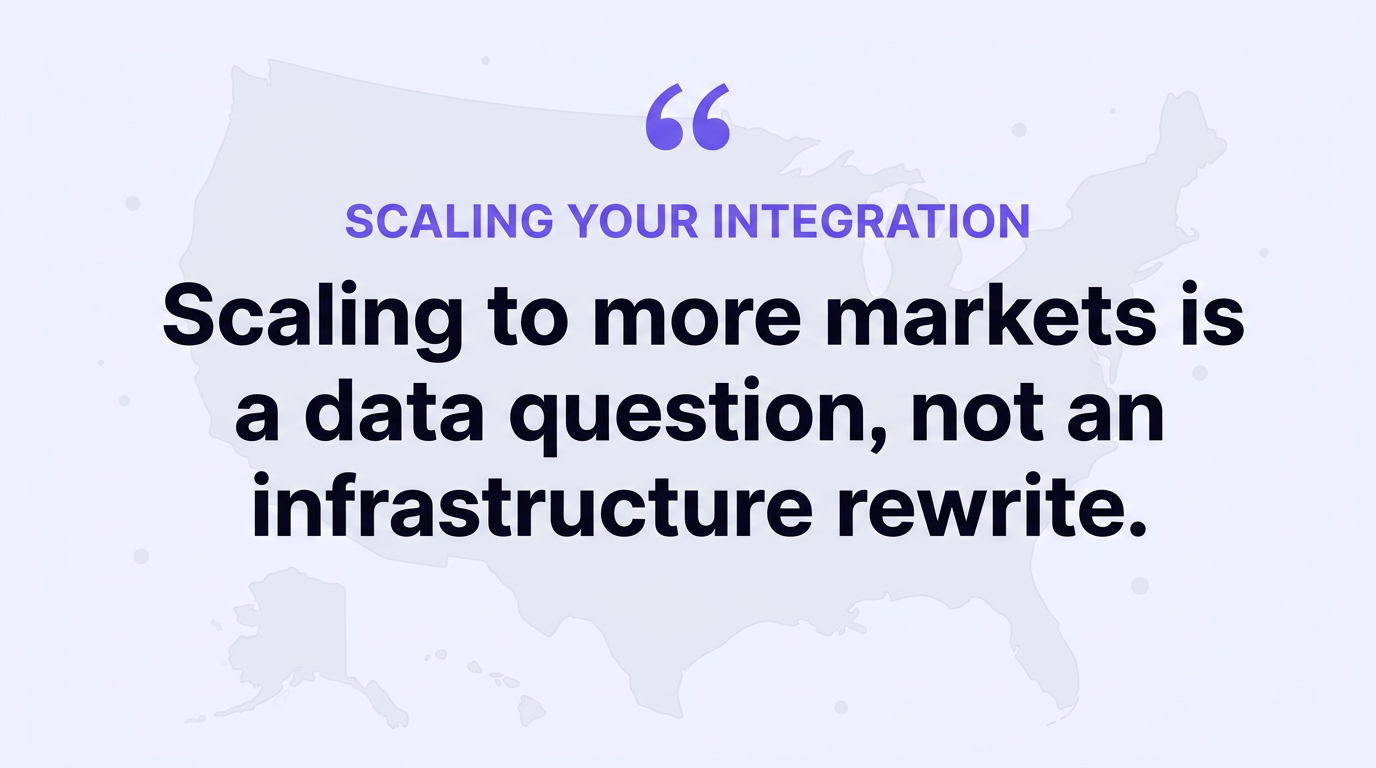
An MLS data API without rate limiting removes that tax entirely. A nightly full refresh or a tight polling loop runs the same way, so scaling to more markets is a data question, not an infrastructure rewrite.
Explore MLS Listing Data Before You Write Integration Code
One step often gets skipped in integration guides, and it is the one that saves the most time: looking at the data before you commit code to it.
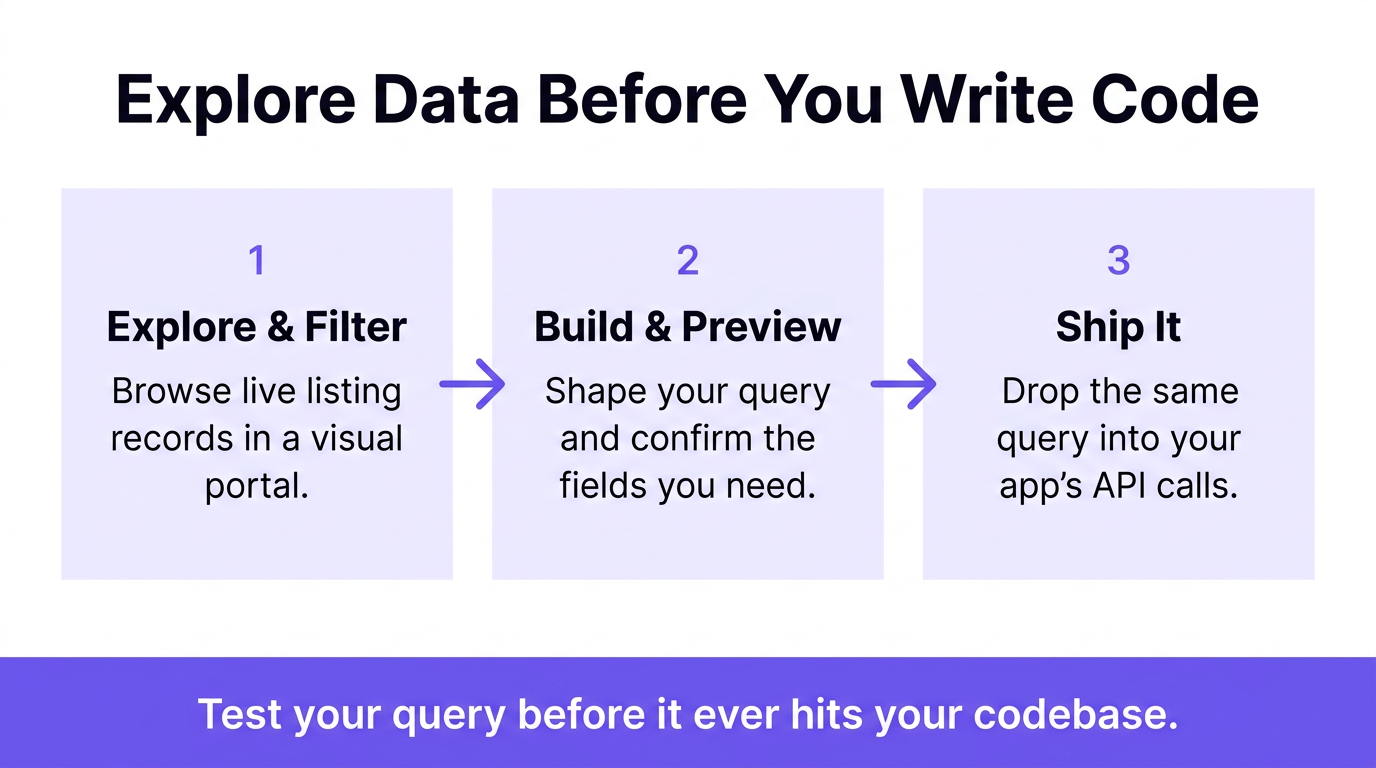
A visual web portal lets you browse and filter live listing records in a browser, inspect the exact fields a query returns, and build a working query before writing any integration code. You point, filter, and preview, then carry that query structure into the calls your app makes to the API.
For a developer, that changes the order of work. Instead of guessing at field names and debugging an empty response, you confirm up front that the data exists and matches your model. You can see how residential, commercial, and land records differ, check coverage in your markets, and confirm the fields your interface needs are populated. By the time you write the request in your app, you have already tested it.
What IDX and Display Rules Mean for Your Integration
Pulling listings is a technical problem. Showing them is a rules problem, and the rules come from the MLS and from IDX policies, not from your codebase.
IDX, or Internet Data Exchange, governs how listing data can be displayed on public-facing sites and apps. Each MLS sets its own requirements: which fields you may show, how attribution appears, when sold or pending listings can be shown, and how quickly you must reflect status changes. Our developer's guide to IDX and MLS access breaks down where those lines fall.
Building these rules into your integration from the start avoids rework later, since a feed can be suspended if display requirements are violated. Treating compliance as part of your MLS API integration, rather than a step bolted on at launch, keeps your app in good standing with the MLS.
Five Things to Get Right When You Integrate MLS Listings
Before you ship, confirm these five points. They separate an integration that scales from one that breaks the first time a market grows or a feed changes.
- Field mapping. Map the provider's standardized fields to your data model once, and normalization stops being a recurring chore. Consistent schemas across markets make this a single mapping job, not one per feed.
- Freshness cadence. Decide how often you sync. A scheduled delta query on a dateUpdated filter keeps listings current without re-pulling everything, and the right cadence depends on how fast your markets move.
- Coverage. Confirm the provider reaches every market you plan to serve. Full national access means one integration covers new cities without new regional contracts, so a single property data source scales with you.
- Property types. Residential is table stakes, but commercial, land, and multi-family records matter as your product grows. An API that carries all property types under one integration means you are not re-integrating when the roadmap expands.
- Cost model. Understand how you are billed. Per-record pricing, where you pay for the listings you actually receive rather than every request you send, keeps costs predictable as query volume climbs.
Nail these five and the rest of the build is mostly interface work.
Frequently Asked Questions
These are the questions developers ask most often before they start building an MLS integration.
Can You Recommend APIs for Integrating MLS Listings Into a Real Estate App?
The best fit is an MLS data API that gives you standardized listing records over REST, clear public documentation, and coverage in your markets. Look for JSON responses, a dateUpdated filter for sync, and no rate limits so high-volume polling does not require extra engineering. Those traits matter more than any single brand name when you integrate MLS listings.
What Is the Difference Between IDX and an MLS Feed?
IDX is a set of rules and a display framework for showing listings on public sites, while the feed is the technical channel that delivers the underlying data. You can power an IDX-compliant experience from an API, but the API handles data access and IDX governs presentation.
What Data Comes Back in an MLS Listing Record?
A standardized listing record typically includes the property address, price, listing status, description, photos, and structured attributes like bedrooms, bathrooms, and square footage. Because feeds follow a common data dictionary, those fields stay consistent from one market to the next, so your app can rely on the same structure everywhere it operates.
Do You Need a License to Display MLS Data?
Yes. MLS data is licensed through local MLS organizations, and each sets terms for how listings can be accessed and displayed. A provider that manages those relationships simplifies your MLS API integration, so you focus on building rather than negotiating feed agreements.
What Should You Look For in a Real Estate App API?
Prioritize coverage, freshness, and a billing model that scales. A strong real estate app API offers national coverage, all property types under one integration, a portal to explore data before you build, and pricing that tracks the data you actually receive.
Building a Real Estate App on an MLS Data API
Integrating MLS listings well is mostly about the choices you make before the first request: where your data comes from, how fresh it stays, and how cleanly it maps to your app. Get those right and the integration stops being a roadmap risk and becomes a predictable piece of your build, one you can scale to new markets without starting over.
Datafiniti gives real estate teams an MLS data API built for exactly this: standardized listing records, no rate limiting, national coverage across every property type, and a visual portal to explore the data before you write a line of code. Request a demo to see how your listings would look flowing through it.
Read the latest articles

Read more

Build vs Buy: Business Data Enrichment for Growing Teams

Best Business Data APIs for Sales Teams & Prospecting

Business Data API: Company Data at Enterprise Scale

How to Build a Product Database With a Product Data API

Property Data API Coverage: What U.S. Datasets Include

Product Data API for Ecommerce Price Monitoring and Repricing

Real-Time Product Data API for Product-Led Growth Teams

Property Ownership Data API for Skip Tracing and Lead Gen

How APIs Make Building a Product Database Easy
Learn how to build a product database with APIs for cleaner imports, updates, search, and scalable product data.

What Is Property Transaction Data and How Does an API Help Get It?
Learn how property transaction data works and how APIs provide structured access for analysis and workflows.

How to Use Real Estate Transaction Data
Learn how to use real estate transaction data for analysis, valuation, underwriting, and market decisions.

How to Leverage Competitor Pricing Data with an API
Use competitor pricing data to build API-driven monitoring, analysis, and smarter pricing decisions.

Price Monitoring API: The Key to E-Commerce Pricing Strategy
Use a price monitoring API to track market changes, improve pricing decisions, and protect ecommerce margins.

How do Product Data APIs Work for E-Commerce Companies?
Learn how a product data API works, from collection and queries to ecommerce integration and use cases.

Bulk Real Estate Data Licensing: Access Datasets at Scale
How to Integrate MLS Listings Using an MLS Data API

GTIN Lookup API: Search Products by Barcode & UPC at Scale

Best Real Estate API 2026: Coverage, Pricing, Data Quality

Best Product Data API 2026: A State-of-the-Market Guide

Product Data API Integration Patterns for Ecommerce Platforms

Build a PropTech MVP With a Property Ownership Data API

3 Benefits of Web Scraping for Real Estate
Boost your research by using web scraping for real estate to gain market insights, automate lead lists, and minimize property risk.

How Real Estate Agents Can Leverage Proptech Data
Leverage proptech data to source leads, speed up valuations, and manage risk with accurate, real-time property insights.

What Is a UPC Lookup API?
Learn about the UPC lookup API, how it works, and its benefits for businesses. Get product data easily.

What Is a GTIN Lookup API?
Learn about the GTIN lookup API and how it can help your business grow. Get product data insights.

How Does a Property Data API Work?
Learn how a property data API works, its features, and how you can use it for real estate and business insights.

What The Best Real Estate APIs Should Have
Discover what makes the best real estate APIs stand out. Learn about essential features for your property data needs.

The Benefits of a Real Estate MLS API
Learn about the benefits of a real estate MLS API for streamlining data access and driving business growth.

Why Every Real Estate Pro Needs an MLS Database API
Learn why a MLS database API is vital for real estate pros. Get data, insights, and competitive edge.
How to Access MLS Listing Data
Learn how to access MLS listing data using an MLS data API. Discover Datafiniti's solutions and integration tips.
.png)
How to Enrich Your Product Catalog With a Real-Time API
.jpeg)
Product Data API Buyer's Guide for Ecommerce Teams

Do I Need a Real Estate Listing API?
Explore the benefits and technicalities of a real estate listing API. Learn how to choose the right provider and integrate data for business growth.

Unlocking the MLS Database with APIs
Unlock the MLS database with APIs. Learn how to access property data, gain real estate insights, and integrate MLS data for your business needs.

Why Real Estate Tech Startups Need Property APIs with Ownership Details
Discover how property APIs with ownership details empower real estate tech startups. Learn about data integration, risk mitigation, and driving business value.
The Value of a Product Catalog Sync for Product Managers
Unlock the value of product catalog sync for product managers. Streamline data, improve decisions, and reduce costs with real-time insights.

What is a Product Data Webhook?
Learn about product data webhooks, their components, and how they enable real-time updates for business intelligence and workflow automation.

Why Is a Product Data API Integration Essential for Analysts & Product Managers?
Unlock insights with product data API integration. Essential for analysts & product managers to streamline data access & enhance product strategy.

What Is a Product Data API and Its Benefits
Learn about product data APIs, their benefits, and how they drive business growth. Explore integration and advanced use cases.

What Do eCommerce Data Vendors Do?
Learn what ecommerce data vendors do, their services, and how to choose the right one for your business growth.

How to Compare Product Data Providers: What to Look For
Compare product data providers. Learn what to look for in data quality, structure, and integration features.

How to Get Your Product Data in Real-Time Using APIs
Learn how to leverage real-time product data APIs for e-commerce, competitive analysis, and AI. Get instant access to clean, structured product data.

Best Product Data API: Features to Look for
Find the best product data API with real-time updates, comprehensive coverage, and a user-friendly portal. Explore features to look for.

Unlocking Property Data with an API
Access property data with a powerful property database API. Explore listings, market analysis, investment opportunities, and more. Get started today!

Unlocking CRE with APIs
Unlock commercial real estate insights with a powerful API. Access property data, streamline workflows, and enhance investment strategies.

How to Get a Real-Time Product Feed Using an API
Learn how to get a real-time product feed using an API. Access, leverage, and ensure accuracy of product data for your business needs.

Spying on Competitor Prices: What You Need to Know
Learn how to gather and analyze competitor pricing data to inform your business strategy. Understand key components and ethical considerations.

Product Data Enrichment: What Are You Missing?
Enhance your product data with comprehensive enrichment. Discover insights, drive growth, and choose the right approach for your business.
.png)
IDX vs MLS API: A Developer's Guide to Real Estate Listing Data
.png)
Real Estate API Pricing Models Explained: Subscription vs. Usage-Based

Real Estate API vs Web Scraping: Which Wins in 2026?
.png)
Product Data APIs Explained: Powering Product Search and Catalog Automation

Best Sources for Bulk Real Estate Transaction Data

How to Get the Most out of a Product Catalog API
Learn how to leverage a product catalog API for business growth. Discover data quality, access methods, and strategy for your product catalog API.

Taming Your Ecommerce Product Data Feed
Optimize your ecommerce product data feed for growth. Learn strategies, leverage technology, and ensure data quality for better customer experience and AI initiatives.

Streamlining Your Product Search with an API
Explore the benefits and integration of a product search API. Streamline your product discovery and leverage data for business growth.
.png)
Real Estate Transaction Databases: What You Need to Know
.png)
Best MLS API for Real Estate Software: What Developers Need

How Real Estate Platforms Access MLS Database APIs
.png)
Commercial Real Estate API vs. Residential Property API
.png)
How to Choose a Real Estate Database API for Your MVP
MLS API vs. IDX: What's the Diff?
MLS API vs IDX: Explore the differences in real estate data access, retrieval, and integration. Understand which solution fits your needs.

Scraping vs. APIs: Getting Real Estate Data
Compare web scraping vs real estate API for data acquisition. Learn the pros, cons, and best use cases for each method.

Cracking the Code: Housing Sales Insights
Unlock housing sales analytics insights with Datafiniti. Explore property data, market trends, and advanced techniques for strategic decisions.

Property Valuation API: Your Go-To Real Estate Tool
Leverage the property valuation API for real estate insights. Access comprehensive property data for diverse applications with Datafiniti.

Product Data APIs Explained
Learn about product data APIs explained. Discover how to access, integrate, and utilize product data for e-commerce, analytics, and more.

Unlocking Your Ecommerce Data with APIs
Unlock ecommerce data with APIs for business insights, product catalog enrichment, and competitive analysis. Explore data via portal or API.

Your Guide to Housing Sales APIs
Explore housing sales API data for insights. Access property data, integrate into applications, and gain business intelligence. Get started today!

Real Estate Ownership Data: How to Access, Analyze and Use at Scale
Access, analyze, and use real estate ownership data at scale. Learn how to find, process, and leverage this crucial information for business insights.

Unlocking Opportunities: Navigating Bulk Real Estate Transaction Data
Unlock opportunities with bulk real estate transaction data. Learn how to access, analyze, and leverage property data for investing, marketing, and more.
What Is a Property Sales Database?
Explore what a property sales database is, its core components, how to access data, and key use cases for real estate analysis and more.

Benefits of Obtaining Housing Transaction Data
Unlock insights with housing transaction data. Analyze markets, investments, sales, and risk. Get comprehensive property data for informed decisions.

Understanding Real Estate Transaction Databases

IDX vs MLS API: What Every Real Estate Professional Should Know
Understand IDX vs MLS API differences. Learn about data access, integration, and how Datafiniti's solutions empower real estate professionals.

What Is an MLS Database API?
Explore the MLS database API: understand its components, benefits, and how to access real estate data for various applications. Learn about its core functionality and technical aspects.

How a Property Database API Can Help Real Estate Pros
Learn how a property database API can help real estate pros analyze trends, monitor listings, and optimize strategies. Get data insights.

What Is a Residential Property API?
Explore what a residential property API is, its features, benefits, and real-world applications for real estate professionals and investors.

What Is a Commercial Real Estate API?
Explore commercial real estate API functionality, data integration, and use cases. Learn how to leverage property, business, and people data for insights.

Understanding MVP Data Integration
Learn about MVP data integration, its components, benefits, and strategies for accessing and utilizing data resources effectively.

How to Choose the Best Property Data API
Learn how to choose the best property data API. Explore features, providers, pricing, and integration for real estate insights.

Real Estate Database API: What to Look for
Explore real estate database API options. Learn about data quality, features, and how to choose the right provider for your needs.
.png)
Real Estate Transaction Database: An API Access Guide

How Do Product Data APIs Work?
Understand how a product data API works, its key features, integration methods, and applications for e-commerce and business intelligence.

How Do Data Aggregation Platforms Work?
Explore how data aggregation platforms work, their capabilities, and applications. Learn to choose and implement the right platform for your business intelligence needs.

Why Do Companies Need Property Data Aggregation?
Discover why property data aggregation is crucial for businesses. Streamline access, empower functions, enhance risk management, and drive strategic decisions with authoritative insights.

MLS API: The Complete Guide to Accessing MLS Listing Data

Product Search API vs. Product Data API: What's the Difference?

What Are the Best MLS Data API Features to Look For?
Discover the best MLS data API features, including real-time updates, bulk downloads, and flexible filtering for property data.

What Is a Product Data API?
Explore the functionality and benefits of a product data API. Learn how to integrate, leverage, and choose the right provider for your business insights.
What Is the Difference Between Product Search API and Product Data API?
Understand the difference between Product Search API and Product Data API. Learn how to leverage product data for business intelligence and analytics.

Guide to Accessing Real Estate Transaction Database Via API
Access real estate transaction data via API. Explore property insights, sales, underwriting, and advanced applications with our authoritative guide.

Is a Real Estate MLS API Beneficial?
Explore the benefits of a real estate MLS API for enhanced data access, streamlined workflows, and market responsiveness. Learn about key features and use cases.

What is an MLS Database API?
Explore the MLS database API for comprehensive property data access. Learn about its core functionality, key features, and integration into real estate technology.

What Is a Property Data API?
Explore the capabilities of a property data API. Understand its core functionality, key features for developers, and how to access property information at scale for business insights.
.png)
Real Estate API Pricing: What You Need to Know Before You Build
.jpeg)
How to Choose a Property Market API for Investment Platforms
Choosing the right property market API is critical for investment platforms. Learn how to evaluate data depth, coverage, freshness, and integration quality before you commit.
Data you can trust, delivered in a format your systems can use, at the scale your product requires.